

Daily Vocabulary from International Newspapers and Publications
Expand Your Vocabulary with Wordpandit’s Global Vocabulary Hub
At Wordpandit, we are committed to helping you develop a truly global vocabulary by drawing from some of the most respected international publications. This section is designed to keep you ahead of the curve by introducing you to words that define global conversations and trends.
The Power of Global Sources
To help you think and communicate on a global scale, we curate vocabulary from renowned international sources, such as:
- The New York Times
- The Washington Post
- BBC
- The Guardian
- The Economist
- Scientific American
- Psychology Today
- And many more...
Stay Global, Stay Competitive
Our daily updates from international publications ensure you are consistently exposed to new words that reflect global news and developments, making sure your vocabulary is not only current but also globally relevant.
Enhance Your Global Perspective
Whether you’re preparing for international exams, aiming to excel in global business communication, or want to enhance your language skills for personal growth, Wordpandit offers the resources you need to thrive in a global context.
Effective Learning, Global Reach
Our learning methodology combines global examples, memory aids, and interactive activities, allowing you to internalize new words effectively and apply them in real-world scenarios.
Begin Your Global Vocabulary Journey Now!

Why Choose Wordpandit?
Practical Learning: Focus on words you'll actually encounter in real-world reading, enhancing your comprehension and communication skills.
Diverse Content: From current affairs to scientific breakthroughs, our varied sources expose you to vocabulary across multiple domains.
Effortless Integration: Make Wordpandit a part of your daily routine. Just a few minutes each day can significantly boost your lexicon over time.
Your Path to Vocabulary Mastery
- Visit our Daily Vocabulary section regularly
- Explore new words and their usage in context
- Practice incorporating these words into your own writing and speech
- Track your progress as your vocabulary expands
Start Your Journey Today
Embark on your vocabulary enhancement journey with Wordpandit. By consistently engaging with our daily posts, you'll build a robust vocabulary that serves you well in academic, professional, and personal contexts.
Remember, a word a day keeps linguistic limitations at bay. Make Wordpandit your daily companion in the quest for vocabulary excellence!
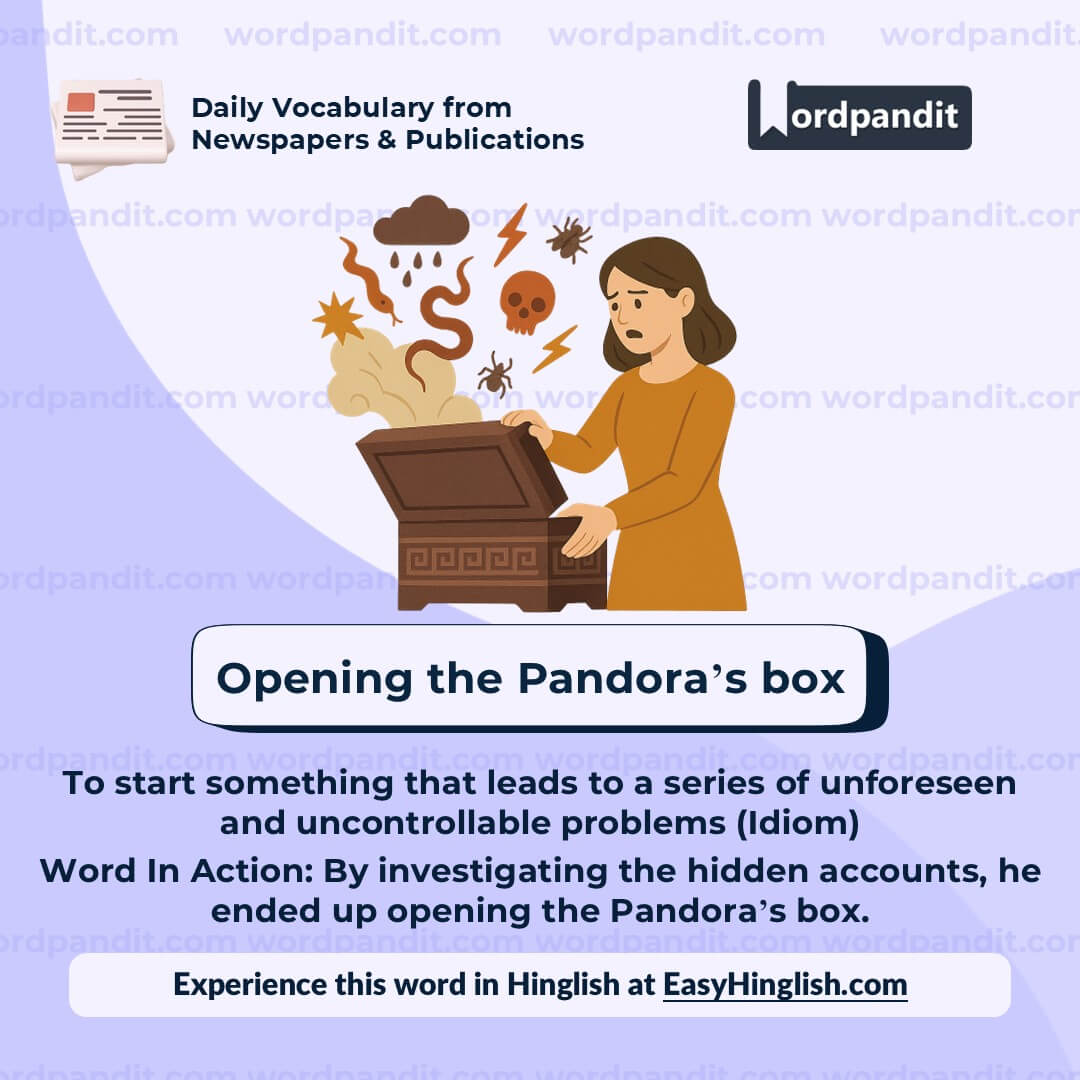
WORD-1: Opening the Pandora’s Box
Context:
"Opening the Pandora’s box of abortion reform is something no one should do without the confidence that they are able to manage the resulting chaos. Moves to decriminalise abortion, in response to the continued prosecution of women for having one, could unintentionally enable the restriction of access under a future regressive government." - The Guardian
Explanatory Paragraph:
“Opening the Pandora’s box” is an idiomatic expression that refers to starting or triggering a process or action that will likely lead to many unforeseen problems or complications. The phrase originates from Greek mythology, where Pandora opened a forbidden box and unknowingly released all the evils into the world, leaving only hope behind. In the context of the article, the phrase suggests that reforming abortion laws—while perhaps well-intentioned—could unleash political and legal turmoil if not handled with caution and foresight.
Meaning: To start something that leads to a series of unforeseen and uncontrollable problems (Idiom)
Pronunciation: oh-puh-ning the pan-dor-uhz boks
Difficulty Level: ⭐⭐⭐⭐ Advanced
Etymology: Derived from the Greek myth of Pandora, the first woman created by the gods, who opened a box (actually a jar) out of curiosity, releasing all the world’s evils.
Prashant Sir's Notes:
This phrase is metaphorical and commonly used in journalism, politics, and debates to describe decisions that have risky and far-reaching consequences. It's excellent for analytical essays where you need to evaluate both risks and benefits of actions.
Synonyms & Antonyms:
Synonyms: unleash chaos, invite trouble, trigger unintended consequences, light the fuse
Antonyms: resolve peacefully, contain, stabilize, restore order
Usage Examples:
- Invading the region without a clear plan was like opening the Pandora’s box of political instability.
- By digging into the old case files, the journalist opened a Pandora’s box of corruption and cover-ups.
- The new legislation unintentionally opened a Pandora’s box of legal loopholes and conflicts.
- She feared that asking too many questions would open a Pandora’s box she wasn't ready to face.
Cultural Reference:
In Greek mythology, Pandora was gifted a box by the gods and told never to open it. Her curiosity led her to release all the world's misfortunes—except hope, which remained inside. The phrase is now symbolic of actions that appear small but lead to serious consequences.
Think About It:
Have you ever experienced a situation where asking one question or making one decision led to a series of unexpected problems? Was it worth it?
Quick Activity:
Think of a current event or policy that could be seen as “opening a Pandora’s box.” Write one sentence explaining why it fits the idiom.
Memory Tip:
Picture a mysterious, glowing box—once opened, problems come flying out like spirits. That’s the essence of Pandora’s box: curiosity that leads to chaos.
Real-World Application:
This phrase is particularly useful in critical writing, debates, and journalism when assessing policy changes, scientific experiments, or social reforms that could have broad and unintended effects.
WORD-2: Decriminalise
Context:
"Opening the Pandora’s box of abortion reform is something no one should do without the confidence that they are able to manage the resulting chaos. Moves to decriminalise abortion, in response to the continued prosecution of women for having one, could unintentionally enable the restriction of access under a future regressive government." - The Guardian
Explanatory Paragraph:
“Decriminalise” means to officially remove criminal penalties for a particular act, making it no longer punishable under criminal law. It doesn’t necessarily mean making the act fully legal or approved—it may still be regulated—but it no longer carries the risk of arrest or prosecution. In this context, it refers to efforts to protect women from being prosecuted for seeking abortions by removing abortion from the criminal code. The word often appears in discussions about drug policy, reproductive rights, and social reform.
Meaning: To remove criminal penalties associated with a particular act (Verb)
Pronunciation: dee-krim-uh-nuh-lize
Difficulty Level: ⭐⭐⭐ Intermediate
Etymology: From Latin “de” (away) + “criminal” (relating to crime), meaning “to take away the criminal status.” British spelling uses “-ise”; American spelling uses “-ize.”
Prashant Sir's Notes:
This is a key word in legal and policy-related debates. Use it precisely—decriminalising an act doesn’t mean promoting or encouraging it. It’s a formal shift from punishment to regulation, often driven by public health, human rights, or justice arguments.
Synonyms & Antonyms:
Synonyms: legalise (in some contexts), permit, deregulate, liberalise
Antonyms: criminalise, outlaw, ban, prohibit
Usage Examples:
- Many campaigners are calling to decriminalise abortion to protect women's rights and health.
- Portugal was among the first countries to decriminalise drug use for personal possession.
- There’s a growing debate on whether to decriminalise certain minor traffic violations.
- The proposal to decriminalise euthanasia sparked intense political and ethical debates.
Cultural Reference:
The global movement to decriminalise marijuana has gained momentum in countries like Canada, parts of the US, and Uruguay—framing it as a public health rather than criminal issue.
Think About It:
What are the risks and benefits of decriminalising an act that was once considered a crime? Who gains, and who might lose, from such a shift?
Quick Activity:
List two social issues that have been or are being debated for decriminalisation. Write a sentence explaining the reasoning behind each.
Memory Tip:
Think of “decriminalise” as “delete from the list of crimes”—you’re not saying it’s good, just that it shouldn’t be punished as a criminal act.
Real-World Application:
“Decriminalise” is a vital term in law, politics, and ethics. It plays a key role in understanding reforms related to health, civil rights, and justice—where changing a law can alter lives dramatically.

WORD-3: Agonising
Context:
"You’ve been deceived by the campaign for assisted dying. It has told you who the proposed law is for: people on their metaphorical deathbeds, no hope in sight, desperate to spare themselves and their loved ones the experience of an agonising death. And no wonder – these cases obviously merit sympathy and concern. These are the people campaigners want to talk about; this is the narrative that pushes people into unquestioning support for their cause." - The Guardian
Explanatory Paragraph:
"Agonising" describes something that causes intense physical or emotional pain. It can refer to severe suffering, either literal — such as a painful illness — or metaphorical — such as an emotionally devastating experience. In the context of the sentence, "agonising death" underscores the unbearable and prolonged suffering people wish to avoid through assisted dying legislation.
Meaning: Causing great physical or mental pain; extremely painful or distressing (Adjective)
Pronunciation: AG-uh-ny-zing
Difficulty Level: ⭐⭐ Moderate
Etymology: From Greek *agonizesthai*, meaning "to struggle" — related to *agon*, meaning "contest" or "painful effort."
Prashant Sir's Notes:
"Agonising" is a word loaded with emotion. Use it to describe pain or experiences that are drawn out and deeply distressing — whether physical (like illness) or emotional (like waiting for news or dealing with grief).
Synonyms & Antonyms:
Synonyms: excruciating, unbearable, torturous, intense, harrowing
Antonyms: painless, soothing, comfortable, mild
Usage Examples:
- The wait for the test results was agonising.
- She suffered an agonising injury during the match.
- Making that decision was an agonising process for him.
- They watched with agonising helplessness as the fire spread.
Cultural Reference:
In many war memoirs and novels, such as *All Quiet on the Western Front*, authors describe the agonising suffering of soldiers to highlight the brutal realities of combat. - War Literature Canon
Think About It:
What kinds of decisions or experiences in life can be described as "agonising"—and what makes them so painful?
Quick Activity:
Describe an "agonising" moment you’ve read about in a novel or witnessed in real life. Use the word in a sentence that conveys strong emotion.
Memory Tip:
Remember that "agonising" sounds like "agony" — it’s the adjective form used to describe things that *cause* agony.
Real-World Application:
“Agonising” is often used in medical, emotional, and philosophical discussions — especially in debates around end-of-life care, trauma, and deeply emotional decision-making.
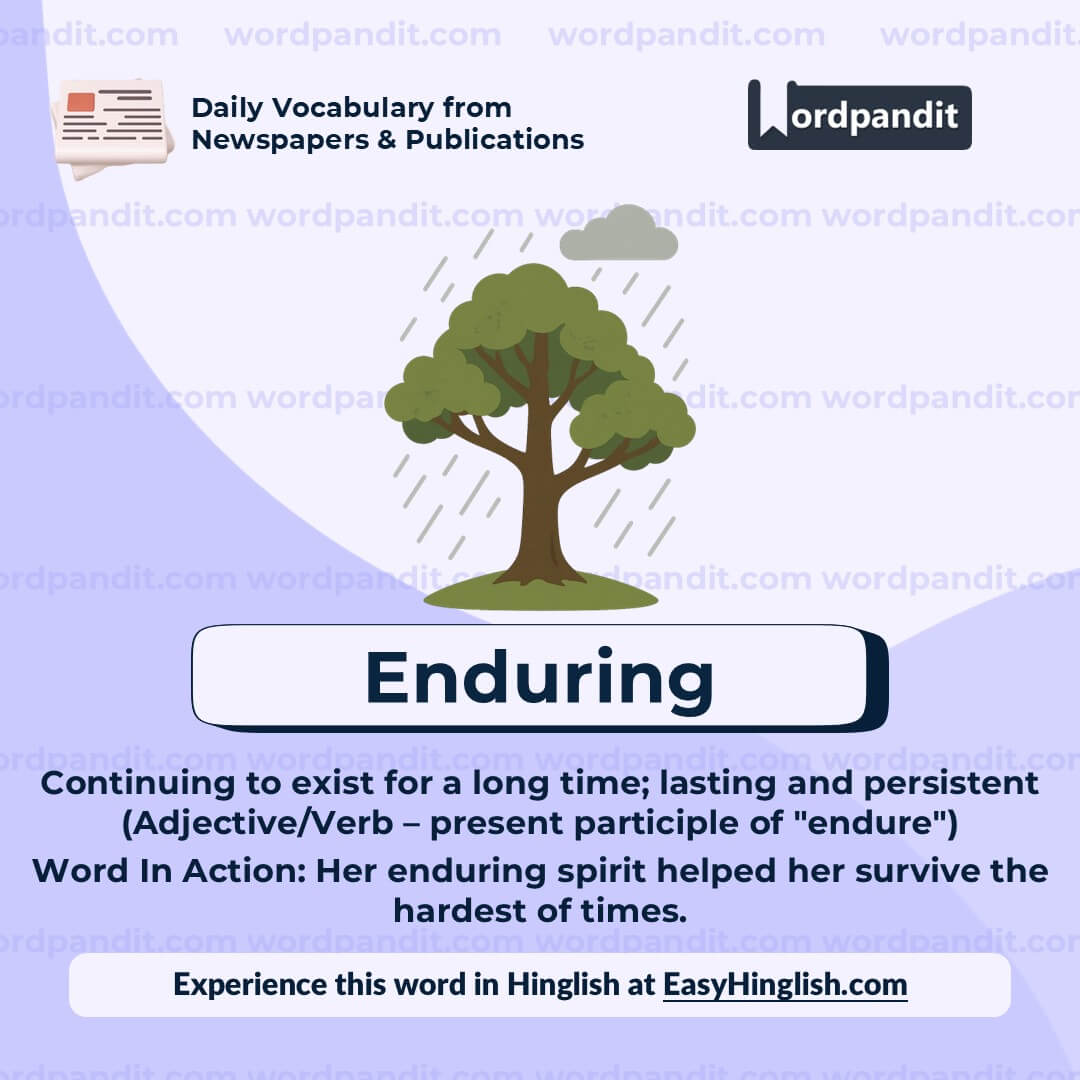
WORD-4: Enduring
Context:
"There’s something oddly engaging about listening to a stranger’s murder while unloading the dishwasher or walking the dog. That’s not a judgment—it’s an observation. The popularity of true crime media, especially among women, has become one of the most enduring entertainment trends of the past decade." - Psychology Today
Explanatory Paragraph:
“Enduring” refers to something that lasts over a long period of time, often in the face of challenges, change, or trends. It conveys the idea of durability, persistence, or timeless relevance. In this context, the phrase “enduring entertainment trend” suggests that the true crime genre has maintained its appeal and popularity over many years, showing no signs of fading despite changing tastes or cultural shifts.
Meaning: Continuing to exist for a long time; lasting and persistent (Adjective/Verb – present participle of "endure")
Pronunciation: en-dyoor-ing
Difficulty Level: ⭐⭐ Basic to Intermediate
Etymology: From Latin “indurare” meaning “to harden,” evolving through Old French and Middle English into “endure,” meaning “to last.”
Prashant Sir's Notes:
“Enduring” is often used to describe things with long-lasting emotional, cultural, or historical impact—like relationships, values, or phenomena. It’s excellent for essays, articles, and analytical writing, especially when commenting on what gives something timeless value.
Synonyms & Antonyms:
Synonyms: lasting, persistent, timeless, abiding, long-standing
Antonyms: fleeting, temporary, short-lived, passing, momentary
Usage Examples:
- Shakespeare’s works remain an enduring part of the literary canon.
- The couple’s enduring love inspired everyone at the celebration.
- The brand’s success is due to its enduring relevance in modern fashion.
- Despite criticism, the theory has had an enduring influence on psychology.
Cultural Reference:
The phrase “enduring appeal” is often used in marketing and media to describe iconic figures or trends that persist across generations—like Audrey Hepburn, classic rock, or traditional storytelling formats.
Think About It:
What qualities make something “enduring”? Can popularity alone guarantee longevity, or does it require deeper meaning or emotional resonance?
Quick Activity:
Think of one enduring idea, value, or trend in your culture or family. Write 1-2 sentences about why you think it has lasted.
Memory Tip:
“Enduring” comes from “endure”—if something endures, it survives. So, enduring things are survivors of time and change.
Real-World Application:
Use “enduring” in academic writing, journalism, or professional reports when evaluating legacy, historical significance, or long-term effects—whether in culture, politics, science, or personal relationships.
WORD-5: Dramatizations
Context:
"Podcasts like Crime Junkie, Morbid, and My Favorite Murder, documentaries like Making a Murderer, and dramatizations like American Murder: Gabby Petito and Monster are more than just entertainment—they're part of how we understand the world." - Psychology Today
Explanatory Paragraph:
“Dramatizations” are portrayals of real events or fictional stories that are presented in a dramatic format, often for television, film, or theater. They may be based on true stories but are enhanced with scripted dialogue, actors, and emotional storytelling to engage viewers. In the given context, dramatizations are true crime re-creations that not only entertain but shape public perception and understanding of real events by presenting them in emotionally charged, narrative-driven formats.
Meaning: Adaptations of real or imagined events into dramatic performances for film, television, or theater (Noun – plural of "dramatization")
Pronunciation: dram-uh-tuh-zay-shuns
Difficulty Level: ⭐⭐⭐ Intermediate
Etymology: From Greek “drama” meaning “action, play,” + English suffix “-ization,” indicating the process of turning something into a drama or play.
Prashant Sir's Notes:
This word is useful when discussing media, film studies, or storytelling. It signals that a story is being interpreted or re-told with dramatic elements—often raising questions about accuracy, bias, or emotional impact.
Synonyms & Antonyms:
Synonyms: re-enactments, portrayals, performances, interpretations
Antonyms: documentation, reportage, factual account, raw footage
Usage Examples:
- The dramatizations in the series were based on interviews and police reports.
- While entertaining, dramatizations can sometimes distort the facts.
- True crime dramatizations often blur the line between fact and fiction.
- The documentary was praised for avoiding unnecessary dramatizations and sticking to the evidence.
Cultural Reference:
Netflix’s When They See Us is a dramatization of the Central Park Five case that received critical acclaim for raising awareness about systemic injustice, demonstrating how dramatizations can powerfully influence public opinion.
Think About It:
How do dramatizations of real-life tragedies influence the way society views justice, victims, and the truth?
Quick Activity:
List a dramatization you’ve seen based on true events. Then, write one sentence about how it shaped your understanding of the real story.
Memory Tip:
Remember: “dramatizations” add *drama*—they turn stories into performances, often with actors, music, and emotional scenes.
Real-World Application:
“Dramatizations” are key in journalism, education, and entertainment. They’re powerful for engaging audiences, but they must be used responsibly when dealing with real events to avoid misinformation.


