

Daily Vocabulary from International Newspapers and Publications
Expand Your Vocabulary with Wordpandit’s Global Vocabulary Hub
At Wordpandit, we are committed to helping you develop a truly global vocabulary by drawing from some of the most respected international publications. This section is designed to keep you ahead of the curve by introducing you to words that define global conversations and trends.
The Power of Global Sources
To help you think and communicate on a global scale, we curate vocabulary from renowned international sources, such as:
- The New York Times
- The Washington Post
- BBC
- The Guardian
- The Economist
- Scientific American
- Psychology Today
- And many more...
Stay Global, Stay Competitive
Our daily updates from international publications ensure you are consistently exposed to new words that reflect global news and developments, making sure your vocabulary is not only current but also globally relevant.
Enhance Your Global Perspective
Whether you’re preparing for international exams, aiming to excel in global business communication, or want to enhance your language skills for personal growth, Wordpandit offers the resources you need to thrive in a global context.
Effective Learning, Global Reach
Our learning methodology combines global examples, memory aids, and interactive activities, allowing you to internalize new words effectively and apply them in real-world scenarios.
Begin Your Global Vocabulary Journey Now!

Why Choose Wordpandit?
Practical Learning: Focus on words you'll actually encounter in real-world reading, enhancing your comprehension and communication skills.
Diverse Content: From current affairs to scientific breakthroughs, our varied sources expose you to vocabulary across multiple domains.
Effortless Integration: Make Wordpandit a part of your daily routine. Just a few minutes each day can significantly boost your lexicon over time.
Your Path to Vocabulary Mastery
- Visit our Daily Vocabulary section regularly
- Explore new words and their usage in context
- Practice incorporating these words into your own writing and speech
- Track your progress as your vocabulary expands
Start Your Journey Today
Embark on your vocabulary enhancement journey with Wordpandit. By consistently engaging with our daily posts, you'll build a robust vocabulary that serves you well in academic, professional, and personal contexts.
Remember, a word a day keeps linguistic limitations at bay. Make Wordpandit your daily companion in the quest for vocabulary excellence!
WORD-1: Scandalised
Context:
"The media often takes a scandalised tone about pharmacological innovation: whether it’s the NHS trying to palm you off with second best, or big pharma selling snake oil, someone is always out to get you. “This seems OK; let’s see how it goes” is a peculiarly difficult editorial line to take." - The Guardian
Explanatory Paragraph:
"Scandalised" describes a strong reaction of shock, moral outrage, or indignation—especially in response to something perceived as improper or unethical. In this context, the media is portrayed as reacting with excessive dismay or outrage to developments in the pharmaceutical industry. Rather than maintaining a neutral or balanced tone, they are said to adopt a sensationalized stance that assumes wrongdoing or deception, fueling public distrust.
Meaning: Shocked or morally outraged, especially in reaction to perceived wrongdoing or impropriety (Verb – past participle)
Pronunciation: skan-duh-lized
Difficulty Level: ⭐⭐ Moderate
Etymology: From Old French *scandale*, based on Latin *scandalum*, from Greek *skandalon* meaning “snare” or “offense”. The verb form emerged in the 17th century.
Prashant Sir's Notes:
"Scandalised" is a word that captures emotional intensity. It often points to a cultural or moral clash, and is frequently used in opinion pieces, media commentary, or personal reactions to controversial actions or statements.
Synonyms & Antonyms:
Synonyms: outraged, appalled, shocked, offended, dismayed
Antonyms: indifferent, accepting, tolerant, unfazed
Usage Examples:
- The conservative community was scandalised by the artist’s provocative performance.
- She was scandalised to hear that her trusted friend had been involved in fraud.
- Many readers were scandalised by the magazine’s bold cover image.
- The politician’s remarks scandalised the audience and sparked public outrage.
Cultural Reference:
Oscar Wilde’s plays often scandalised Victorian society by mocking its rigid moral codes and social hypocrisies.
Think About It:
Does being "scandalised" always reflect genuine moral concern, or can it sometimes mask fear of change or difference?
Quick Activity:
Think of a recent news story that scandalised the public. Write one sentence summarizing why people reacted so strongly to it.
Memory Tip:
“Scandalised” sounds like someone caught in a *scandal*—their shocked reaction is like a red flag of moral panic.
Real-World Application:
"Scandalised" is often used in journalism and commentary to describe the intense emotional responses of individuals, groups, or societies when confronting controversial or ethically dubious situations.
WORD-2: Pharmacological
Context:
"The media often takes a scandalised tone about pharmacological innovation: whether it’s the NHS trying to palm you off with second best, or big pharma selling snake oil, someone is always out to get you. “This seems OK; let’s see how it goes” is a peculiarly difficult editorial line to take." - The Guardian
Explanatory Paragraph:
"Pharmacological" refers to anything related to the science of drugs and their effects on the body. This includes the development, testing, and clinical use of medications. In the context of this article, the term is used to describe innovations or advancements in drug research and treatment, which are often met with public skepticism or media scrutiny due to concerns over efficacy, safety, and trust in the pharmaceutical industry.
Meaning: Relating to the study or use of drugs and their effects on the human body (Adjective)
Pronunciation: fahr-muh-kuh-loj-ih-kuhl
Difficulty Level: ⭐⭐⭐ Intermediate
Etymology: From Greek *pharmakon* meaning "drug or medicine" + *-logia* meaning "study of". Entered English through modern Latin in the 19th century.
Prashant Sir's Notes:
This is a technical word rooted in medical science. It often appears in academic, scientific, or journalistic texts discussing treatments, trials, and drug effects. Mastering this word helps understand serious debates about medicine and healthcare.
Synonyms & Antonyms:
Synonyms: medicinal, drug-related, therapeutic, clinical
Antonyms: non-medical, holistic (in some contexts), alternative (in some contexts)
Usage Examples:
- Pharmacological research has led to major breakthroughs in cancer treatment.
- The patient responded well to the pharmacological intervention prescribed by the doctor.
- Pharmacological effects can vary greatly depending on individual body chemistry.
- The team studied the pharmacological properties of a rare tropical plant.
Cultural Reference:
During the COVID-19 pandemic, global attention focused on pharmacological solutions like vaccines and antiviral drugs as key tools in ending the crisis. - World Health Organization Reports
Think About It:
How much should the general public understand about pharmacological science before forming opinions about new treatments?
Quick Activity:
Match the following terms with their correct fields: pharmacological, neurological, psychological, ecological. Then write one sentence using “pharmacological.”
Memory Tip:
Think of “pharma” as medicine and “-logical” as study—so pharmacological means the scientific study or use of medicine.
Real-World Application:
“Pharmacological” is a key term in healthcare, used when discussing clinical trials, prescription drugs, side effects, and medical treatments. It’s essential vocabulary for students, professionals, and informed patients alike.

WORD-3: Palm You Off
Context:
"The media often takes a scandalised tone about pharmacological innovation: whether it’s the NHS trying to palm you off with second best, or big pharma selling snake oil, someone is always out to get you. “This seems OK; let’s see how it goes” is a peculiarly difficult editorial line to take." - The Guardian
Explanatory Paragraph:
“Palm you off” is an informal British idiom meaning to deceive someone by giving them something of lesser quality or value, often while pretending it's adequate or desirable. It carries a connotation of dishonesty or neglect. In this context, it implies that the NHS might be accused of offering subpar medications or treatments to patients while framing them as acceptable solutions. The phrase suggests mistrust and dissatisfaction with perceived cost-cutting or corner-cutting measures in public health.
Meaning: To trick or persuade someone into accepting something inferior or unwanted (Idiom/Phrasal Verb)
Pronunciation: pahm yoo off
Difficulty Level: ⭐⭐ Moderate
Etymology: Originates from sleight-of-hand tricks where something undesirable is discreetly 'palmed off' onto another person. The phrase has been used since the 19th century in British English.
Prashant Sir's Notes:
This is a colorful idiom, especially in British usage, and it's useful in both casual and editorial writing. Be cautious—it often implies criticism or deception, so tone matters when using it.
Synonyms & Antonyms:
Synonyms: fob off, pass off, dump on, deceive, mislead
Antonyms: offer genuinely, present truthfully, provide sincerely
Usage Examples:
- The company tried to palm off old stock as brand new products.
- Don’t let them palm you off with excuses—demand a proper explanation.
- She palmed him off with a weak apology and walked away.
- Tourists are often palmed off with low-quality souvenirs at high prices.
Cultural Reference:
The phrase is frequently used in British journalism and satire to critique public services or consumer experiences, often implying frustration with bureaucracy or deceitful practices.
Think About It:
Have you ever accepted something substandard just because it was presented convincingly? What made you realize it?
Quick Activity:
Write a short dialogue where one character is trying to palm something off onto another. Make sure the second character sees through it!
Memory Tip:
Imagine someone slyly using their *palm* to hand you something bad while pretending it's good—you're being “palmed off.”
Real-World Application:
This idiom is particularly useful in consumer awareness, media critique, and public policy discussions—highlighting situations where someone may feel misled or underserved.
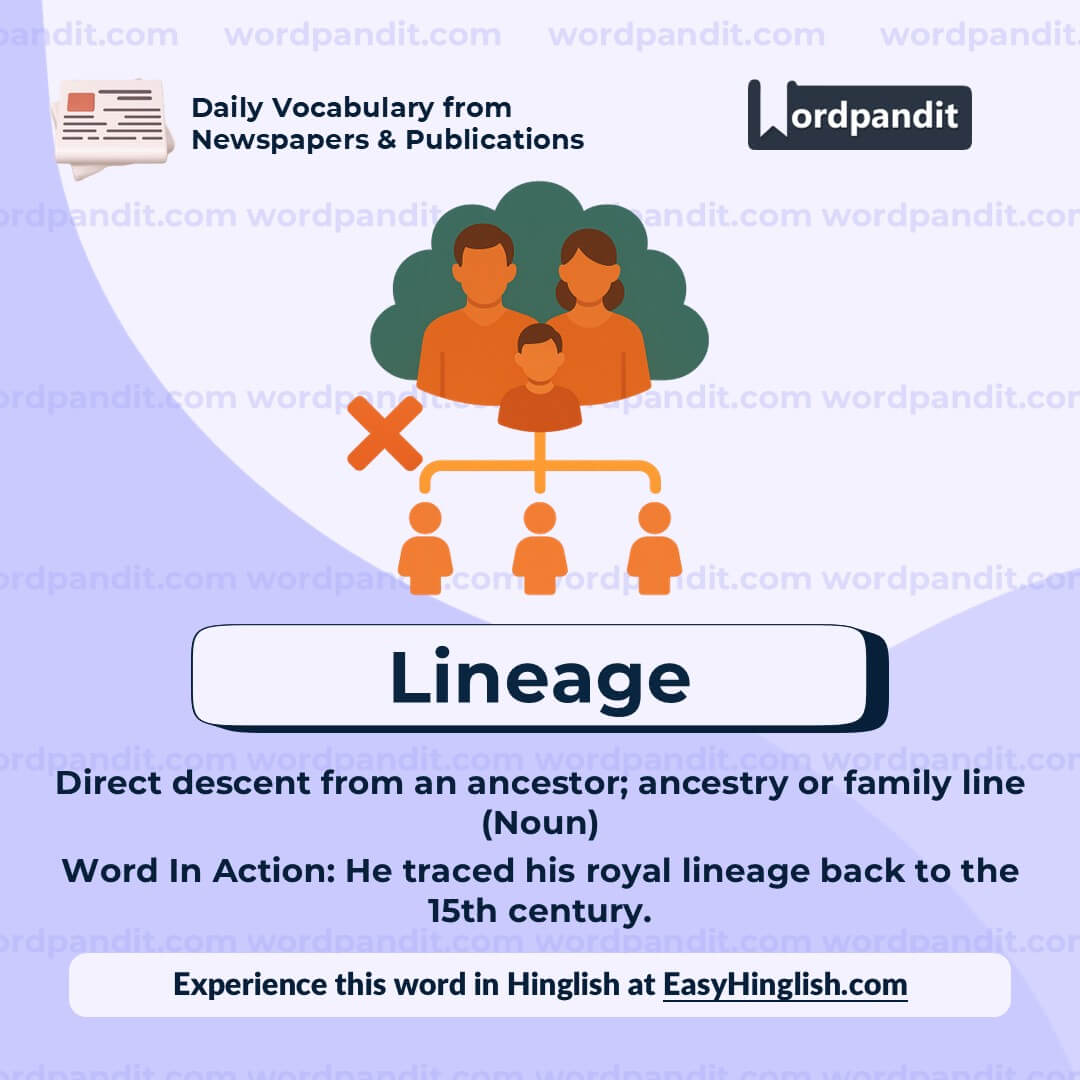
WORD-4: Lineage
Context:
"A population crisis is unfolding – in my family. My paternal grandparents were born in India and had 10 children. I did my part to keep our lineage going (my wife was also involved) yet over the course of three generations, my family’s ‘fertility rate’ plummeted from 10 to less than 1." - Aeon
Explanatory Paragraph:
"Lineage" refers to one's line of descent or ancestry, typically tracing family history through generations. It captures not just biological relationships but also cultural and social continuity passed down from one generation to the next. In the context of this excerpt, the author reflects on the sharp decline in family size and fertility over generations, raising concerns about the survival and continuation of their family’s bloodline or heritage.
Meaning: Direct descent from an ancestor; ancestry or family line (Noun)
Pronunciation: lin-ee-ij
Difficulty Level: ⭐⭐ Moderate
Etymology: From Middle English *linage*, from Old French *lignage*, from Latin *linea* meaning “line”.
Prashant Sir's Notes:
"Lineage" is a poetic and powerful word that emphasizes heritage and roots. It often appears in discussions about genealogy, legacy, nobility, and cultural identity. Knowing your lineage helps you understand where you come from and how history flows through your life.
Synonyms & Antonyms:
Synonyms: ancestry, bloodline, heritage, descent, genealogy
Antonyms: unrelated, adoption (in genealogical contrast), nonbiological connection
Usage Examples:
- He proudly traced his lineage back to a 15th-century warrior clan.
- Royal families often keep detailed records of their lineage.
- Her artistic talents seemed to run in her lineage for generations.
- The documentary explored the lineage of great scientists through history.
Cultural Reference:
In many cultures, especially in India, China, and Africa, lineage plays a vital role in determining one's social status, inheritance rights, and family responsibilities.
Think About It:
How important is it to preserve one's lineage in a modern, globalized world where identities often blend and evolve?
Quick Activity:
Interview an elder in your family about your family’s lineage. Write down three interesting facts or stories they share.
Memory Tip:
“Lineage” contains the word “line” — think of a family tree as a continuous line stretching through generations.
Real-World Application:
"Lineage" is commonly used in genetic research, history, anthropology, and even animal breeding to track traits and origins. It's also significant in personal identity and cultural heritage.
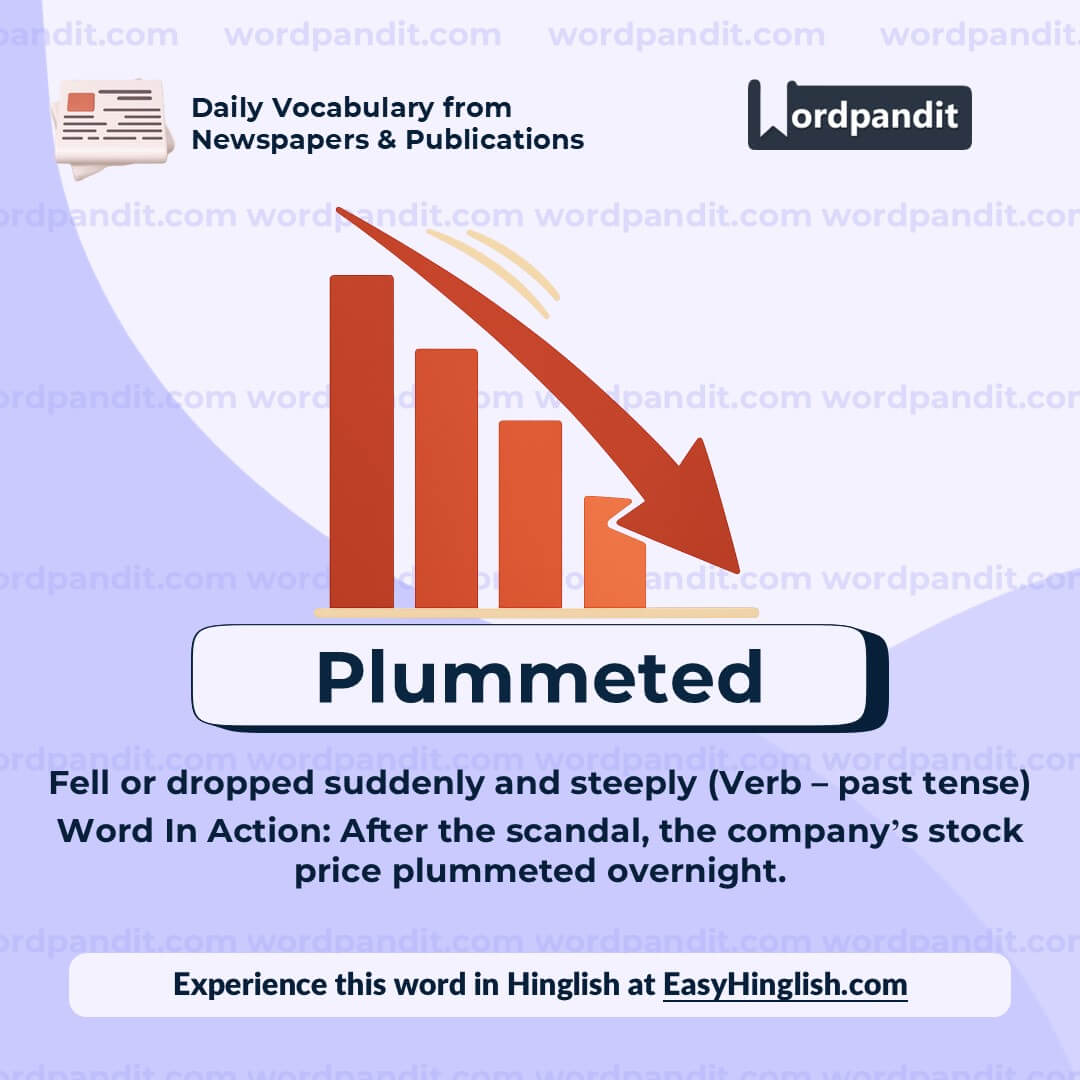
WORD-5: Plummeted
Context:
"A population crisis is unfolding – in my family. My paternal grandparents were born in India and had 10 children. I did my part to keep our lineage going (my wife was also involved) yet over the course of three generations, my family’s ‘fertility rate’ plummeted from 10 to less than 1." - Aeon
Explanatory Paragraph:
"Plummeted" is a vivid verb that describes a rapid and significant fall or decline. It often implies a steep and sudden drop, both literally (as in falling from a great height) and metaphorically (as in numbers or performance). In this context, it refers to the sharp decrease in fertility rate across generations, highlighting a demographic trend that feels abrupt and dramatic to the writer.
Meaning: Fell or dropped suddenly and steeply (Verb – past tense)
Pronunciation: plum-it-ted
Difficulty Level: ⭐⭐ Moderate
Etymology: From the noun *plummet*, originally meaning a lead weight used for measuring depth, from Old French *plommet*, diminutive of *plom* ("lead"). The verb evolved to mean “falling sharply,” like a weight.
Prashant Sir's Notes:
"Plummeted" is a strong, impactful word often used in journalistic writing to show rapid negative change. Whether it's the stock market, population, or temperature, the word adds urgency and weight to a downward trend.
Synonyms & Antonyms:
Synonyms: dropped, fell, declined, sank, collapsed
Antonyms: soared, rose, increased, surged, ascended
Usage Examples:
- Stock prices plummeted after the company’s quarterly loss was announced.
- Her confidence plummeted when she saw the negative reviews.
- Temperatures plummeted overnight, causing icy road conditions.
- The birth rate has plummeted in many developed countries over the past two decades.
Cultural Reference:
During the 2008 financial crisis, global markets plummeted, wiping out trillions in wealth—an event still studied today in economics and finance. – BBC News Archive
Think About It:
Why do we tend to notice and react more strongly to things that plummet rather than things that gradually decline?
Quick Activity:
Think of a situation where something plummeted (e.g., scores, mood, attendance). Write a two-sentence story using "plummeted" to describe what happened.
Memory Tip:
Picture a *plummet*—a heavy weight dropping fast into water. That visual helps you connect “plummeted” with sudden, steep falls.
Real-World Application:
"Plummeted" is widely used in economics, environmental reports, media headlines, and health data to describe rapid declines in measurable factors, adding intensity and urgency to statistical trends.


