

Daily Vocabulary from International Newspapers and Publications
Expand Your Vocabulary with Wordpandit’s Global Vocabulary Hub
At Wordpandit, we are committed to helping you develop a truly global vocabulary by drawing from some of the most respected international publications. This section is designed to keep you ahead of the curve by introducing you to words that define global conversations and trends.
The Power of Global Sources
To help you think and communicate on a global scale, we curate vocabulary from renowned international sources, such as:
- The New York Times
- The Washington Post
- BBC
- The Guardian
- The Economist
- Scientific American
- Psychology Today
- And many more...
Stay Global, Stay Competitive
Our daily updates from international publications ensure you are consistently exposed to new words that reflect global news and developments, making sure your vocabulary is not only current but also globally relevant.
Enhance Your Global Perspective
Whether you’re preparing for international exams, aiming to excel in global business communication, or want to enhance your language skills for personal growth, Wordpandit offers the resources you need to thrive in a global context.
Effective Learning, Global Reach
Our learning methodology combines global examples, memory aids, and interactive activities, allowing you to internalize new words effectively and apply them in real-world scenarios.
Begin Your Global Vocabulary Journey Now!

Why Choose Wordpandit?
Practical Learning: Focus on words you'll actually encounter in real-world reading, enhancing your comprehension and communication skills.
Diverse Content: From current affairs to scientific breakthroughs, our varied sources expose you to vocabulary across multiple domains.
Effortless Integration: Make Wordpandit a part of your daily routine. Just a few minutes each day can significantly boost your lexicon over time.
Your Path to Vocabulary Mastery
- Visit our Daily Vocabulary section regularly
- Explore new words and their usage in context
- Practice incorporating these words into your own writing and speech
- Track your progress as your vocabulary expands
Start Your Journey Today
Embark on your vocabulary enhancement journey with Wordpandit. By consistently engaging with our daily posts, you'll build a robust vocabulary that serves you well in academic, professional, and personal contexts.
Remember, a word a day keeps linguistic limitations at bay. Make Wordpandit your daily companion in the quest for vocabulary excellence!
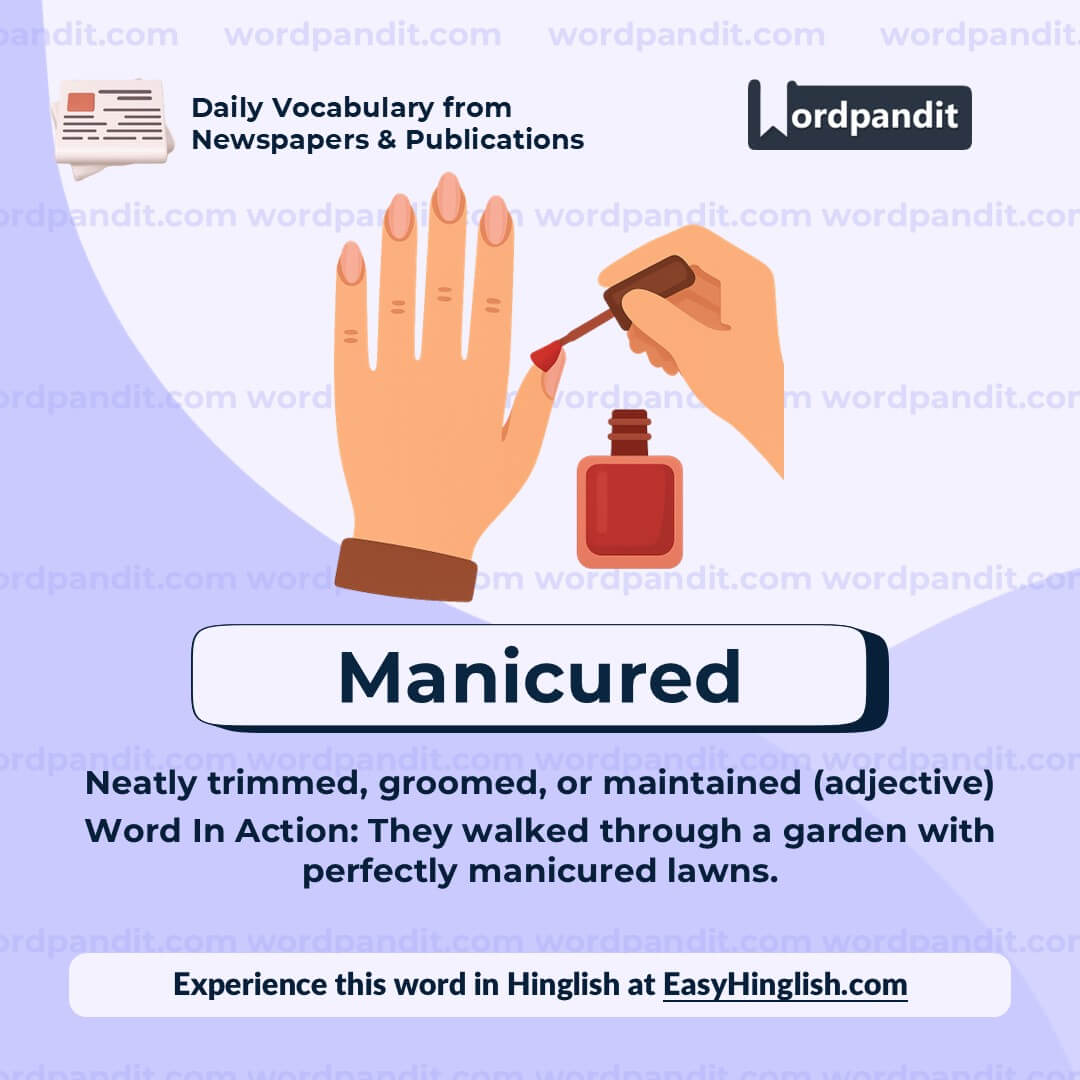
WORD-1: Manicured
Context:
"Ivanka Trump has had her manicured fingers in many pies. She’s designed jewellery and shoes. She’s written a book called Women Who Work, marketed at women who work, full of inspirational quotes and touching anecdotes about how she, a woman, has sometimes worked so hard that she has had to sacrifice massages." - The Guardian
Explanatory Paragraph:
The word "manicured" is often used to describe something that is well-groomed or carefully maintained, especially in terms of appearance. In this context, it is used metaphorically to emphasize the polished and pristine image of Ivanka Trump. The phrase "manicured fingers" suggests attention to detail, refinement, and a lifestyle that values outward perfection, while also potentially hinting at superficiality or a focus on aesthetics.
Meaning: Neatly trimmed, groomed, or maintained (adjective)
Pronunciation: MAN-ih-kyurd
Difficulty Level: ⭐⭐ Basic
Etymology: Derived from the Latin “manus” (hand) and “cura” (care), the term originally referred to hand grooming and later broadened to general neat maintenance.
Prashant Sir's Notes:
This word frequently appears in lifestyle and fashion contexts but also has metaphorical applications. Look for it in discussions of appearance, grooming, and sometimes irony in literature or satire.
Synonyms & Antonyms:
Synonyms: groomed, neat, polished, tidy, well-maintained
Antonyms: unkempt, messy, disheveled, scruffy
Usage Examples:
- The garden was beautifully manicured, with every hedge trimmed to perfection.
- She always appeared with manicured nails, no matter how busy her schedule was.
- His answers were so manicured that they seemed rehearsed rather than sincere.
- The resort boasts manicured lawns and a crystal-clear pool overlooking the ocean.
Cultural Reference:
"The manicured lawns of suburban America symbolize the culture's obsession with control and conformity." - Cultural Studies Review
Think About It:
Does the use of the word “manicured” in a metaphorical sense reflect societal values about appearances and perfectionism?
Quick Activity:
Write three adjectives that describe a place or object you think could be "manicured." Then, write a sentence using the word metaphorically.
Memory Tip:
Think of a manicure for your nails—tidy, precise, and polished. Anything "manicured" shares that sleek, cared-for look.
Real-World Application:
“Manicured” is often used by real estate agents, luxury product marketers, and fashion writers to highlight elegance, care, and a sense of perfection—making it a useful term in lifestyle journalism and branding.
WORD-2: Anecdotes
Context:
"Ivanka Trump has had her manicured fingers in many pies. She’s designed jewellery and shoes. She’s written a book called *Women Who Work*, marketed at women who work, full of inspirational quotes and touching anecdotes about how she, a woman, has sometimes worked so hard that she has had to sacrifice massages." - The Guardian
Explanatory Paragraph:
"Anecdotes" are short, often amusing or interesting stories about a real incident or person. In this context, Ivanka Trump’s book is described as containing touching anecdotes — brief personal stories intended to evoke emotion, create relatability, or provide insight into her experiences. These stories are typically used to support a message or lesson in a more human, accessible way.
Meaning: Short and often personal stories or accounts of specific incidents (noun, plural)
Pronunciation: AN-ik-doats
Difficulty Level: ⭐⭐ Beginner
Etymology: From the Greek word "anekdota" meaning "things unpublished," it originally referred to unpublished or secret stories.
Prashant Sir's Notes:
We often use anecdotes in conversation or writing to add a personal touch or explain a point with a real-life example. They help connect ideas to human experiences, making communication more engaging and memorable.
Synonyms & Antonyms:
Synonyms: story, tale, narrative, incident, recollection
Antonyms: data, statistics, report, analysis
Usage Examples:
- He opened his speech with a funny anecdote from his childhood.
- The teacher shared several anecdotes to explain the scientific concept in a relatable way.
- Her book is filled with personal anecdotes that give insight into her journey.
- During the interview, he relied more on anecdotes than on actual performance metrics.
Cultural Reference:
"Anecdotes are the heart of storytelling," says author Brené Brown, emphasizing how personal stories can forge emotional connections. - TED Talk on Vulnerability
Think About It:
Do anecdotes help us understand people better, or can they sometimes be misleading when used instead of facts?
Quick Activity:
Write a short anecdote about a funny or memorable event in your school life. Keep it under 5 sentences.
Memory Tip:
Think of "anecdote" as “a little note” — a short note or story that adds color to your main message.
Real-World Application:
In public speaking, education, therapy, and even marketing, anecdotes are widely used to humanize content, illustrate key points, and create stronger emotional impact.
WORD-3: Sacrifice
Context:
"Ivanka Trump has had her manicured fingers in many pies. She’s designed jewellery and shoes. She’s written a book called *Women Who Work*, marketed at women who work, full of inspirational quotes and touching anecdotes about how she, a woman, has sometimes worked so hard that she has had to sacrifice massages." - The Guardian
Explanatory Paragraph:
"Sacrifice" refers to giving up something valued for the sake of something else considered more important or worthy. In this satirical context, Ivanka Trump's "sacrifice" of massages is used to illustrate her supposed dedication to work. It subtly critiques how privilege can redefine what is considered a true sacrifice, contrasting everyday struggles with relatively luxurious compromises.
Meaning: To give up something valuable or important for the sake of another purpose or person (verb/noun)
Pronunciation: SAK-ruh-fice
Difficulty Level: ⭐⭐⭐ Intermediate
Etymology: From Latin *sacrificium*, meaning “an offering to a deity,” derived from *sacer* (sacred) + *facere* (to make).
Prashant Sir's Notes:
"Sacrifice" can carry deep emotional weight. It often denotes noble or selfless acts, but context matters. Sometimes, what is framed as a sacrifice might seem trivial to others. Always assess the context to understand its true value and tone.
Synonyms & Antonyms:
Synonyms: give up, forgo, surrender, relinquish, renounce
Antonyms: gain, keep, retain, preserve
Usage Examples:
- Parents often sacrifice their own dreams to support their children's futures.
- She sacrificed her weekend plans to help finish the team project.
- During the war, soldiers made unimaginable sacrifices for their country.
- He sacrificed comfort for ambition, working long nights to build his startup.
Cultural Reference:
"The ultimate measure of a man is not where he stands in moments of comfort... but where he stands at times of challenge and controversy." - Martin Luther King Jr., often cited when discussing sacrifice and moral courage.
Think About It:
What have you sacrificed recently, and was it worth it? How do we measure the value of a sacrifice?
Quick Activity:
Make a list of 3 things someone might sacrifice for their career. Then, write one sentence explaining why each sacrifice might be necessary.
Memory Tip:
Think of “sacrifice” as “sacred price” — something you give up because the cause is more important or 'sacred' to you.
Real-World Application:
"Sacrifice" is a powerful concept used in leadership, parenting, military service, and even sports — often to highlight dedication, responsibility, and the cost of success or values.

WORD-4: Intricacies
Context:
"It's time we had a serious conversation about where we're headed with artificial intelligence. I've spent my career exploring the intricacies of the human mind and behavior, particularly how human language and cognition emerged from usage-based cooperation, and why this has led to both incredible human achievements and human misery. From that perspective, looking at the rapid advancements in AI, I've come to the personal belief that we are now in the process of creating a new conscious species." - Psychology Today
Explanatory Paragraph:
"Intricacies" refers to the complex, detailed, and often delicate parts of a system or subject. In the context of the human mind and behavior, the word highlights the subtle, layered nature of cognition, language, and psychological functioning. These are not simple, surface-level phenomena; they involve deep interconnections that are difficult to untangle and understand — much like a sophisticated machine with many interlocking gears.
Meaning: The complicated or complex details or elements of something (noun, plural)
Pronunciation: IN-trih-kuh-seez
Difficulty Level: ⭐⭐⭐ Intermediate
Etymology: From Latin *intricare*, meaning "to entangle," which also gives rise to the word "intricate".
Prashant Sir's Notes:
Use “intricacies” when referring to topics that are not straightforward — things that require deep thought or careful attention to detail. It’s especially useful in academic, technical, or philosophical writing to convey intellectual depth.
Synonyms & Antonyms:
Synonyms: complexities, details, subtleties, nuances, complications
Antonyms: simplicities, basics, essentials, fundamentals
Usage Examples:
- The novel delves into the intricacies of love, betrayal, and redemption.
- He studied the intricacies of international law for years before becoming a diplomat.
- Understanding the intricacies of machine learning requires both mathematical and programming skills.
- The watchmaker marveled at the intricacies of the tiny gears and springs inside the timepiece.
Cultural Reference:
"The intricacies of the legal system often leave ordinary people confused and intimidated." - A recurring theme in legal dramas like *Suits* and *The Good Wife*
Think About It:
Do we lose appreciation for the intricacies of nature and the human mind when we reduce everything to data or algorithms?
Quick Activity:
Choose a topic you know well (e.g., chess, dance, photography) and write 3 sentences describing its intricacies.
Memory Tip:
Think of “intricacies” like “intricate laces” — finely woven details that require careful attention to understand or unravel.
Real-World Application:
"Intricacies" is commonly used in professional and academic discussions — from engineering and medicine to art and literature — to acknowledge the depth and complexity involved in mastering a subject.
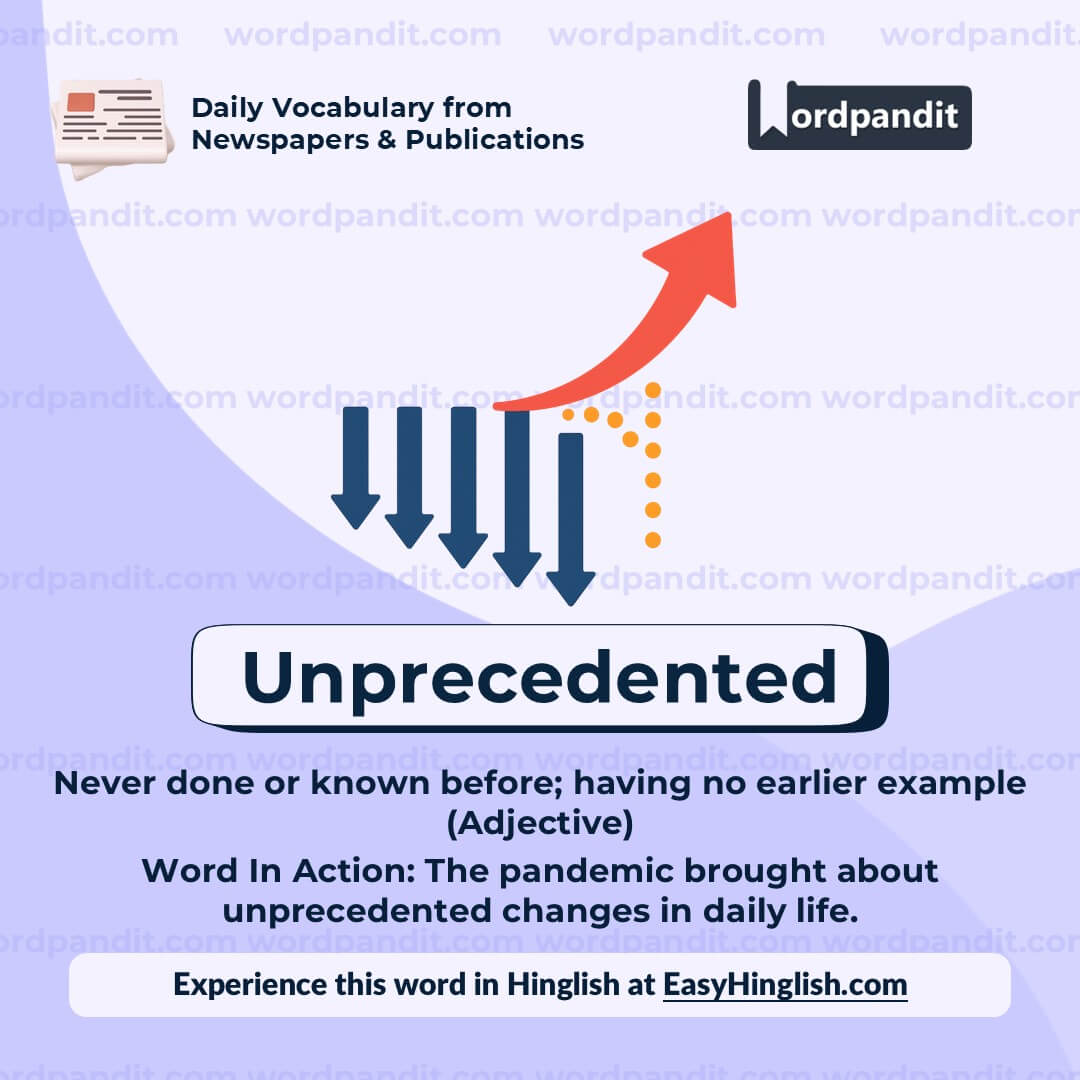
WORD-5: Unprecedented
Context:
"How is it that we live in an era of apparently unprecedented choice and yet almost every film and TV series, as well as a good many plays and novels, have exactly the same plot?" - Aeon
Explanatory Paragraph:
"Unprecedented" refers to something that has never happened or been seen before. It is used to describe events, experiences, or situations that are entirely new or unmatched in history. In this context, the author highlights how, despite an era offering an extraordinary and unmatched amount of choice in media, there is still a frustrating sameness in creative storytelling — which seems ironic given the novelty of the situation.
Meaning: Never done or known before; having no earlier example (Adjective)
Pronunciation: un-PRESS-ih-den-tid
Difficulty Level: ⭐⭐⭐ Intermediate
Etymology: From Latin *praecedentem* (precedent), meaning "to go before," combined with the prefix *un-* meaning "not." It literally means "not preceded."
Prashant Sir's Notes:
"Unprecedented" is often used in media and formal contexts to emphasize just how extraordinary a situation is. It’s useful for describing historical events, technological breakthroughs, or shifts in society that stand out as unique or groundbreaking.
Synonyms & Antonyms:
Synonyms: unparalleled, unmatched, extraordinary, singular, unheard-of
Antonyms: familiar, ordinary, common, traditional, precedented
Usage Examples:
- The pandemic caused an unprecedented disruption to global travel.
- She achieved unprecedented success at such a young age.
- The storm brought unprecedented levels of rainfall to the region.
- We are living through an era of unprecedented technological advancement.
Cultural Reference:
The term "unprecedented" was one of the most frequently used words in global media during the COVID-19 pandemic, reflecting the unique and uncharted nature of the crisis. - Oxford English Dictionary Trends
Think About It:
Can a situation still feel ordinary even if it’s unprecedented? Why do we sometimes fail to recognize the uniqueness of the time we live in?
Quick Activity:
List one event or experience from your life or from current affairs that you believe is truly "unprecedented." Use the word in a complete sentence.
Memory Tip:
Break it into “un + precedent + ed” — something that has *no precedent*, or has *never happened before*.
Real-World Application:
"Unprecedented" is especially valuable in academic writing, journalism, and business communication when highlighting breakthroughs, anomalies, or unique conditions.


