

Daily Vocabulary from International Newspapers and Publications
Expand Your Vocabulary with Wordpandit’s Global Vocabulary Hub
At Wordpandit, we are committed to helping you develop a truly global vocabulary by drawing from some of the most respected international publications. This section is designed to keep you ahead of the curve by introducing you to words that define global conversations and trends.
The Power of Global Sources
To help you think and communicate on a global scale, we curate vocabulary from renowned international sources, such as:
- The New York Times
- The Washington Post
- BBC
- The Guardian
- The Economist
- Scientific American
- Psychology Today
- And many more...
Stay Global, Stay Competitive
Our daily updates from international publications ensure you are consistently exposed to new words that reflect global news and developments, making sure your vocabulary is not only current but also globally relevant.
Enhance Your Global Perspective
Whether you’re preparing for international exams, aiming to excel in global business communication, or want to enhance your language skills for personal growth, Wordpandit offers the resources you need to thrive in a global context.
Effective Learning, Global Reach
Our learning methodology combines global examples, memory aids, and interactive activities, allowing you to internalize new words effectively and apply them in real-world scenarios.
Begin Your Global Vocabulary Journey Now!

Why Choose Wordpandit?
Practical Learning: Focus on words you'll actually encounter in real-world reading, enhancing your comprehension and communication skills.
Diverse Content: From current affairs to scientific breakthroughs, our varied sources expose you to vocabulary across multiple domains.
Effortless Integration: Make Wordpandit a part of your daily routine. Just a few minutes each day can significantly boost your lexicon over time.
Your Path to Vocabulary Mastery
- Visit our Daily Vocabulary section regularly
- Explore new words and their usage in context
- Practice incorporating these words into your own writing and speech
- Track your progress as your vocabulary expands
Start Your Journey Today
Embark on your vocabulary enhancement journey with Wordpandit. By consistently engaging with our daily posts, you'll build a robust vocabulary that serves you well in academic, professional, and personal contexts.
Remember, a word a day keeps linguistic limitations at bay. Make Wordpandit your daily companion in the quest for vocabulary excellence!
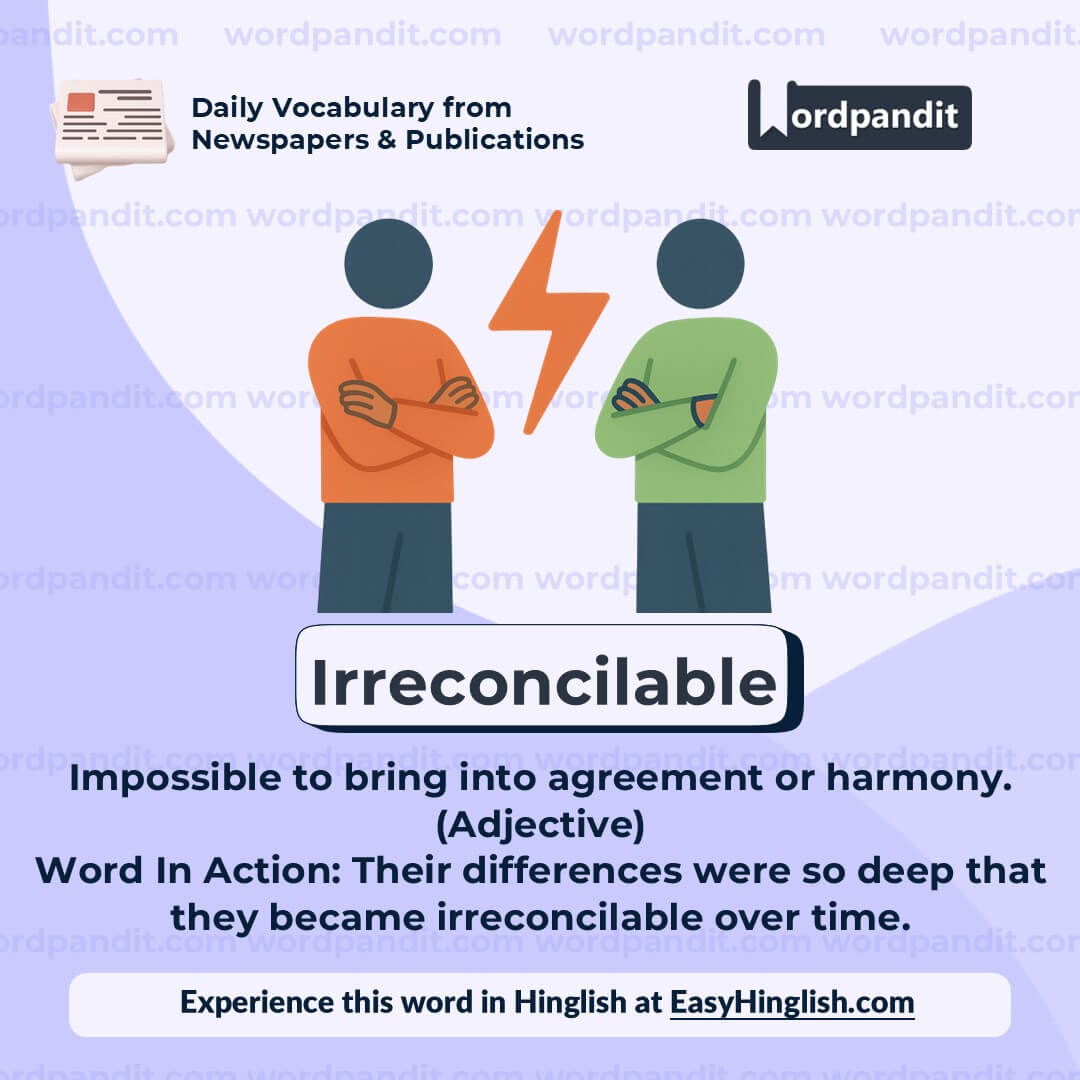
WORD-1: Irreconcilable
Context:
"When I called my parents the day after Mr. Yoon's failed attempt, that irreconcilable national divide was evident even in my otherwise harmonious family: I condemned the blatantly undemocratic power grab, which revived grim memories of past military rule; my father praised it as necessary to rein in the opposition, which he views as pro-North Korea." - The New York Times
Explanatory Paragraph:
Irreconcilable meaning in English is 'impossible to resolve, settle, or bring into harmony.' This word is used when describing conflicts, differences, or viewpoints that are so fundamentally opposed that no compromise or agreement can be reached between them. How to use irreconcilable correctly: it commonly appears in formal writing, newspaper editorials, political commentary, and competitive exam passages like CAT and GRE to describe deep divisions—whether in relationships, ideologies, families, or nations—that cannot be bridged through negotiation or understanding.
Meaning: Impossible to resolve or make compatible; fundamentally incompatible (Adjective)
Pronunciation: ih-REK-uhn-SYE-luh-buhl
Difficulty Level: ⭐⭐⭐ Intermediate to Advanced
Etymology: Irreconcilable comes from the prefix 'ir-' (meaning 'not') combined with 'reconcilable,' which derives from Latin 'reconciliare' meaning 'to bring together again.' The word entered English in the 16th century to describe differences so profound that they cannot be brought back into harmony, no matter how much effort is applied. Over time, it became particularly common in describing ideological, political, and personal conflicts that resist all attempts at resolution.
Prashant Sir's Notes:
Many students confuse irreconcilable with 'incompatible'—while both describe things that don't work together, the difference between irreconcilable and incompatible is crucial: irreconcilable specifically emphasizes that the conflict cannot be resolved even with effort, while incompatible simply means things don't fit together. For CAT and GRE aspirants, irreconcilable frequently appears in Reading Comprehension passages about political divisions, philosophical debates, or relationship breakdowns. In Indian newspapers like The Hindu and Indian Express, you'll often see 'irreconcilable differences' used in political analysis—especially during coalition government disputes or when describing BJP-Congress ideological clashes. The usage pattern is typically: 'irreconcilable differences/views/positions' followed by a description of what makes them impossible to resolve.
Synonyms & Antonyms:
Synonyms: incompatible, conflicting, contradictory, opposing, clashing, incongruous, discordant, mutually exclusive, antagonistic, diametrically opposed
Antonyms: compatible, harmonious, reconcilable, agreeable, resolvable, consonant
Usage Examples:
- The irreconcilable differences between the coalition partners over farm loan waivers finally led to the government's collapse in Karnataka.
- Priya and Arjun's marriage ended after years of irreconcilable views on where to settle—she wanted Mumbai, he insisted on Bangalore.
- The Supreme Court noted the irreconcilable conflict between individual privacy rights and national security concerns in the Aadhaar case.
- Despite multiple mediation attempts, the business partners had irreconcilable visions for the startup's future and decided to part ways amicably.
Cultural Reference:
"In Kabhi Alvida Naa Kehna, Shah Rukh Khan and Rani Mukerji's characters discover irreconcilable differences in their respective marriages, leading them toward each other—a Bollywood exploration of when love cannot bridge fundamental incompatibilities." - Film analysis
Think About It:
Are political differences in India becoming increasingly irreconcilable, or do we simply lack the patience and dialogue needed to bridge our divides?
Quick Activity:
Identify three areas in Indian public life where you see irreconcilable differences—politics, religion, or regional disputes. Write one sentence explaining why you think each conflict seems impossible to resolve.
Memory Tip:
Think of 'Irreconcilable' as 'IR (not) + RECONCILE + ABLE'—imagine India vs Pakistan cricket rivalry where fans are so passionate that their differences are NOT able to be RECONCILED, no matter how many peace talks happen. The 'ir' prefix tells you immediately: this cannot be fixed.
Real-World Application:
Irreconcilable is commonly used in legal documents (especially divorce petitions citing 'irreconcilable differences'), political commentary analyzing coalition breakdowns, business reports explaining partnership dissolutions, and editorial pieces discussing ideological divides. In competitive exam essays for UPSC or CAT, using 'irreconcilable' demonstrates sophisticated vocabulary when discussing conflicts—whether analyzing India-China border disputes, caste-based social divisions, or environmental vs. development priorities. Journalists use it to signal that compromise is impossible, making readers understand the severity of the division being described.
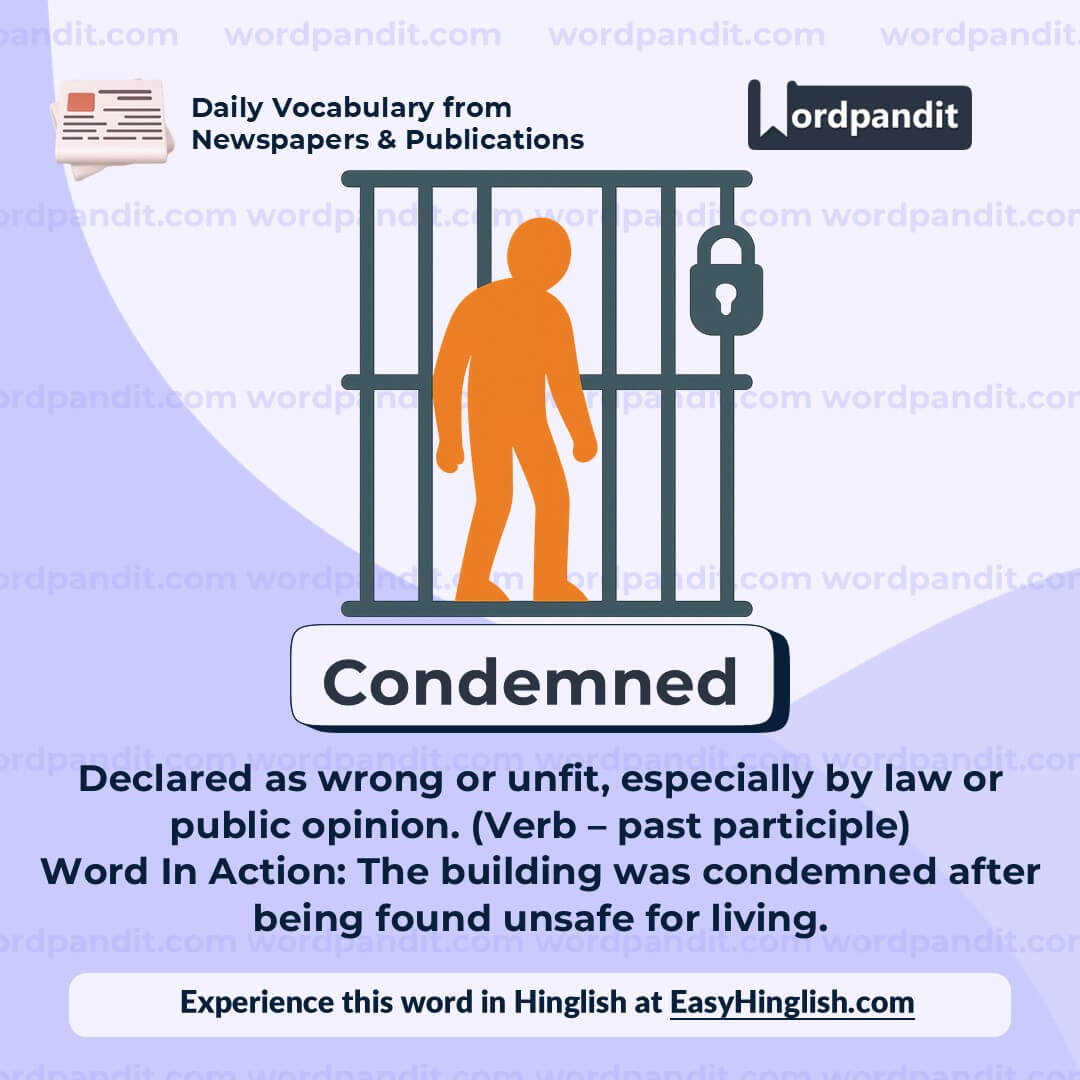
WORD-2: Condemned
Context:
"When I called my parents the day after Mr. Yoon's failed attempt, that irreconcilable national divide was evident even in my otherwise harmonious family: I condemned the blatantly undemocratic power grab, which revived grim memories of past military rule; my father praised it as necessary to rein in the opposition, which he views as pro-North Korea." - The New York Times
Explanatory Paragraph:
Condemned meaning in English is 'to express strong disapproval of something or to declare something as wrong or evil.' This word is used when someone publicly criticizes actions, policies, or behaviors they consider morally or ethically unacceptable. Condemned is commonly used in news reports, political speeches, international diplomacy, and competitive exam passages for CAT, GRE, and UPSC to describe formal denunciations of wrongdoing, violence, injustice, or controversial decisions. The word carries a tone of moral judgment and serious disapproval.
Meaning: To express complete disapproval of something; to criticize severely; to declare as wrong (Verb - past tense)
Pronunciation: kuhn-DEMD
Difficulty Level: ⭐⭐ Basic to Intermediate
Etymology: Condemned comes from Latin 'condemnare,' which combines 'com-' (intensive prefix) and 'damnare' meaning 'to inflict loss upon or to doom.' The word entered English through Old French 'condemner' in the 14th century. Originally used in legal contexts to pronounce guilt or sentence, it evolved to mean expressing strong moral disapproval. The word retains its heavy, final quality—when you condemn something, you're passing a severe judgment that leaves no room for approval.
Prashant Sir's Notes:
Students often ask: what is the difference between condemned and criticized? While both show disapproval, condemned is far stronger—it implies moral judgment and complete rejection, whereas criticized can be constructive or mild. How to use condemned correctly in sentences: it typically appears with serious issues like violence, injustice, or human rights violations. For UPSC and CAT aspirants, condemned frequently appears in passages about international relations, where countries condemn terrorist attacks, or in editorials where activists condemn government policies. In Indian English newspapers, you'll see patterns like 'opposition condemned the government's decision' or 'activists condemned the police action'—the word signals not just disagreement but moral outrage. Remember: you condemn actions, not just dislike them.
Synonyms & Antonyms:
Synonyms: denounced, censured, criticized severely, disapproved, decried, repudiated, castigated, vilified, damned, excoriated
Antonyms: praised, approved, commended, endorsed, applauded, lauded, supported
Usage Examples:
- Opposition parties condemned the government's sudden demonetization move in 2016, calling it poorly planned and devastating for small businesses.
- The United Nations condemned the terrorist attack in Mumbai, expressing solidarity with India and demanding accountability from those who harbored the perpetrators.
- Human rights organizations condemned the violence against Rohingya refugees, urging international intervention to protect vulnerable communities.
- Virat Kohli publicly condemned the online trolling of Mohammed Shami after India's cricket loss, calling for respect and unity among fans.
Cultural Reference:
"In the film Article 15, Ayushmann Khurrana's character condemns the caste-based discrimination and violence he witnesses as a police officer, making a powerful statement against social injustice that resonated with audiences across India." - Film commentary
Think About It:
When political leaders condemn actions publicly but fail to take concrete steps, does the condemnation lose its meaning and become merely performative?
Quick Activity:
Find two news headlines from today's Indian newspapers where someone or some organization has condemned an action. Notice what specific language patterns appear alongside the word 'condemned.'
Memory Tip:
Think of 'Condemned' as 'CON (against) + DEMNED (damned)'—imagine a cricket match where the entire stadium is AGAINST the umpire's decision and they're all DAMNING it loudly. When you condemn something, you're totally against it with strong moral disapproval, like the crowd unanimously rejecting a bad call.
Real-World Application:
Condemned is extensively used in journalism, particularly in reporting international relations, political statements, and social issues. News agencies use it when countries issue formal statements against terrorism, violence, or policy decisions. In diplomatic communication, governments condemn actions that violate international law or human rights. For UPSC aspirants writing essays on governance, ethics, or international relations, using 'condemned' appropriately demonstrates understanding of strong disapproval. In corporate contexts, companies condemn unethical practices or discrimination. The word signals not mere disagreement but a moral stance, making it powerful in persuasive writing and formal criticism.
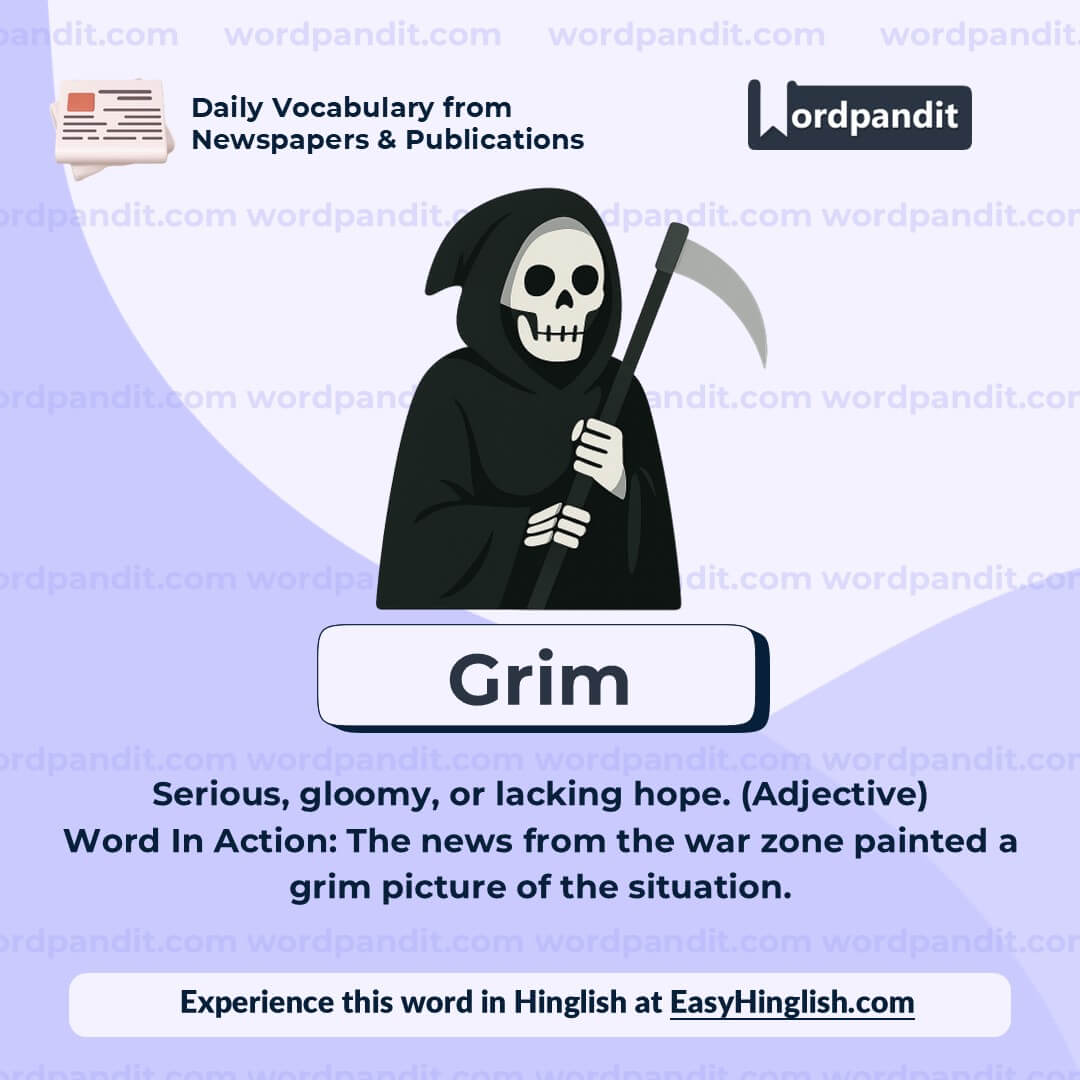
WORD-3: Grim
Context:
"When I called my parents the day after Mr. Yoon's failed attempt, that irreconcilable national divide was evident even in my otherwise harmonious family: I condemned the blatantly undemocratic power grab, which revived grim memories of past military rule; my father praised it as necessary to rein in the opposition, which he views as pro-North Korea." - The New York Times
Explanatory Paragraph:
Grim meaning in English is 'harsh, forbidding, or depressing; involving something unpleasant or worrying.' This word is used when describing situations, expressions, outlooks, or memories that are dark, serious, or filled with hardship and suffering. How to use grim effectively: it commonly appears in news reports about economic downturns, war, disasters, or difficult historical periods, and frequently shows up in CAT, GRE, and UPSC reading comprehension passages to convey bleakness or severity. The word captures both literal darkness and metaphorical hopelessness in a single powerful adjective.
Meaning: Harsh, forbidding, or depressing; looking or sounding very serious or worrying (Adjective)
Pronunciation: GRIM
Difficulty Level: ⭐⭐ Basic to Intermediate
Etymology: Grim comes from Old English 'grimm' meaning 'fierce, cruel, or savage,' which is related to similar words in Old Norse and German languages. The word has ancient Germanic roots connecting it to masks worn in battle and death imagery. Over centuries, grim evolved from describing fierce warriors or cruel actions to encompass any situation that is harsh, depressing, or foreboding. The word's short, sharp sound perfectly matches its meaning—just one syllable that hits with the weight of harsh reality.
Prashant Sir's Notes:
Many students confuse grim with 'gloomy'—while both describe negativity, the difference between grim and gloomy is important: grim emphasizes harshness and severity, often with life-or-death seriousness, while gloomy simply means sad or dark. For CAT and GRE reading comprehension, grim frequently appears in passages about economic crises, wars, or historical tragedies—when you see 'grim reality' or 'grim prospects,' the author is signaling truly serious problems, not just temporary sadness. In Indian newspapers like The Hindu, you'll encounter phrases like 'grim employment scenario' or 'grim monsoon forecast'—these aren't just negative predictions but warnings of severe consequences. The word often pairs with 'reality,' 'situation,' 'outlook,' 'reminder,' or 'memories' to emphasize the seriousness of what's being described.
Synonyms & Antonyms:
Synonyms: harsh, bleak, forbidding, somber, stern, severe, depressing, dreary, dismal, dire, ominous, unpleasant
Antonyms: cheerful, pleasant, bright, hopeful, optimistic, encouraging, joyful
Usage Examples:
- The economic survey painted a grim picture of India's rural employment crisis, with millions of farmers struggling to make ends meet.
- Partition survivors carry grim memories of 1947—stories of violence and displacement that still haunt families generations later.
- The doctor delivered the grim news with compassion, explaining that Rajesh's father had only months left despite aggressive treatment.
- Mumbai's air quality report made for grim reading during Diwali week, with pollution levels reaching hazardous categories across the city.
Cultural Reference:
"In the film Rang De Basanti, the grim reality of government corruption and injustice transforms carefree college students into revolutionaries—the contrast between their youthful energy and the grim circumstances they face drives the entire narrative." - Film analysis
Think About It:
Why do leaders often avoid acknowledging grim realities about unemployment, poverty, or climate change, even when data clearly shows the severity of these problems?
Quick Activity:
List three situations in Indian society or politics that could be described as 'grim.' Write one sentence for each explaining what makes the situation harsh or severe rather than just unfortunate.
Memory Tip:
Think of 'Grim' as 'GRIM REAPER'—the figure of death itself, draped in black, representing the harshest reality of all. Just like Virat Kohli's grim expression after India lost the World Cup final—not just sad but intensely serious and harsh. The word is as short and sharp as the reality it describes: no softness, just hard truth.
Real-World Application:
Grim is extensively used in journalism, particularly in economic reports, disaster coverage, and analysis of serious social issues. Business newspapers use phrases like 'grim quarterly results' or 'grim jobs data' to signal genuinely troubling trends beyond normal fluctuations. In UPSC essay writing, using grim appropriately when discussing poverty, unemployment, or environmental degradation demonstrates precise vocabulary—it tells examiners you understand the severity of issues. Medical professionals use grim when delivering serious diagnoses. Editorial writers employ it to cut through optimistic spin and present harsh realities. The word serves as a reality check in formal communication, signaling that sugarcoating would be inappropriate.
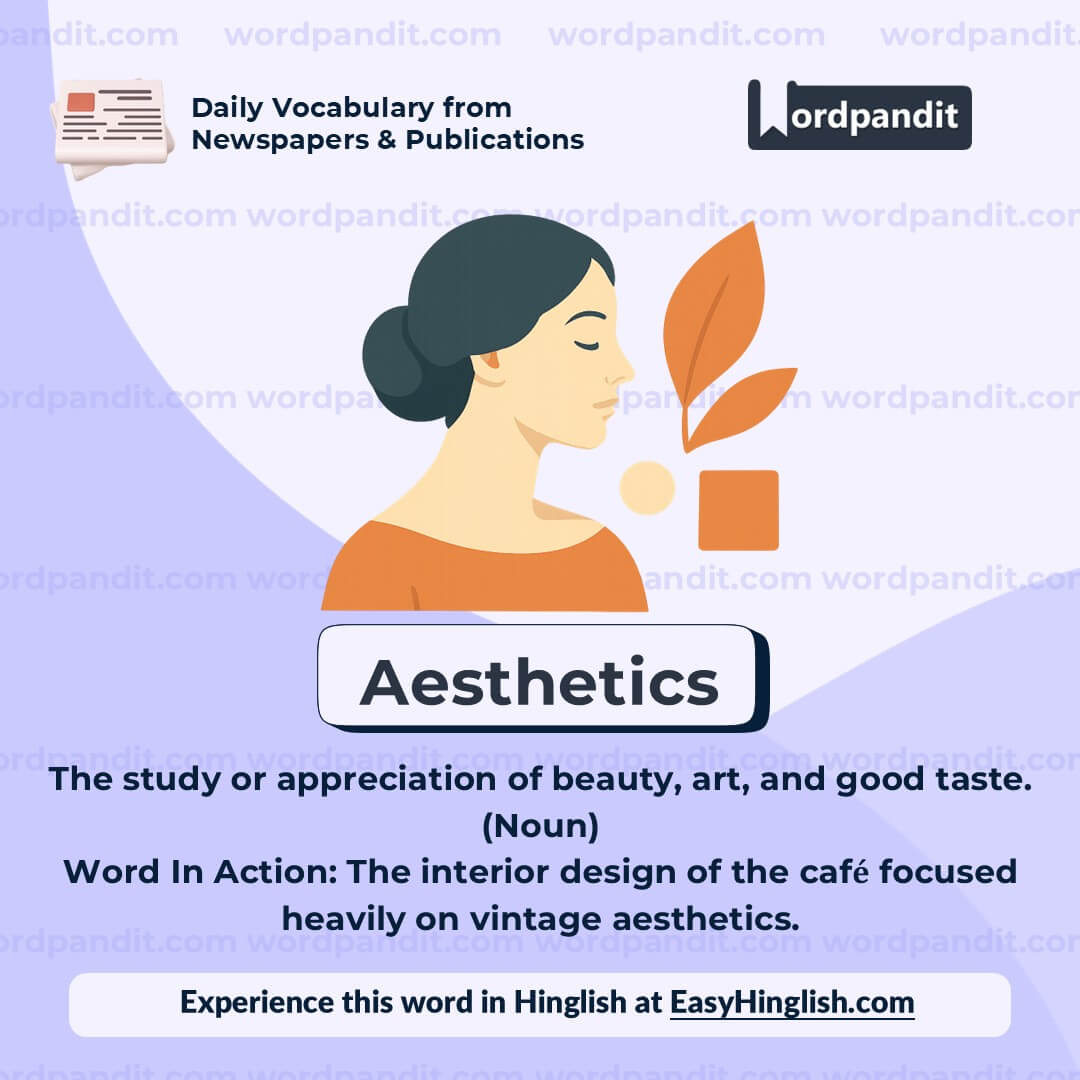
WORD-4: Aesthetics
Context:
"In the arts, aesthetics is strangely devalued. In reaction to the conventions of European academic art, Modernism (late 19th c to mid-20th) rebelled against any idea that art should be "beautiful." When I discovered in art school that beauty was beside the point, I was delighted to make ugly things!" - Psychology Today
Explanatory Paragraph:
Aesthetics meaning in English is 'the branch of philosophy dealing with beauty and artistic taste; the visual appearance or style of something.' This word is used when discussing what makes something pleasing to look at, the principles of beauty in art and design, or the overall visual appeal of objects and spaces. Aesthetics appears frequently in art criticism, design discussions, philosophy texts, and competitive exam passages for CAT, GRE, and UPSC, especially in questions about culture, architecture, and artistic movements. Understanding how to use aesthetics correctly helps in analyzing both classical beauty and modern design principles.
Meaning: The study or philosophy of beauty; the visual appearance or style of something (Noun); can also be used as an adjective: aesthetic
Pronunciation: es-THET-iks (or ees-THET-iks)
Difficulty Level: ⭐⭐⭐ Intermediate
Etymology: Aesthetics comes from Greek 'aisthetikos' meaning 'relating to perception by the senses,' derived from 'aistheta' meaning 'perceptible things.' The term was coined by German philosopher Alexander Baumgarten in 1735 to describe the science of sensory perception and beauty. It entered English in the late 18th century during discussions of art and philosophy. The word initially focused on philosophical questions about beauty, but evolved to encompass all aspects of visual appeal, style, and artistic judgment, making it essential vocabulary in art, design, architecture, and even social media culture today.
Prashant Sir's Notes:
Students often confuse 'aesthetics' with 'cosmetics'—while both relate to appearance, the difference between aesthetics and cosmetics is fundamental: aesthetics is about the philosophy and principles of beauty across all visual experiences, while cosmetics are specifically makeup products. For CAT and GRE aspirants, aesthetics frequently appears in reading comprehension passages about art movements, architectural theory, or cultural criticism. In Indian English usage, you'll hear people say 'the aesthetics of this cafe' or 'Instagram aesthetics'—referring to the overall visual vibe or style. How to use aesthetics in sentences: as a singular noun when discussing the field ('Aesthetics is important in design') or plural when discussing visual qualities ('The aesthetics of Mughal architecture are stunning'). In UPSC essays on culture or heritage, demonstrating understanding of aesthetics shows sophisticated thinking about why we value certain art forms or architectural styles.
Synonyms & Antonyms:
Synonyms: visual appeal, artistic taste, beauty, style, design principles, artistic philosophy, visual harmony, artistry, elegance (in some contexts)
Antonyms: ugliness, unattractiveness, functionality (when contrasted), practicality (when opposed to beauty), plainness
Usage Examples:
- The new Terminal 3 at Delhi Airport balances traditional Indian aesthetics with modern architectural functionality, incorporating lotus-inspired designs throughout the space.
- Minimalist aesthetics have taken over Indian urban homes, with young professionals preferring clean lines over the ornate furniture their parents favored.
- Sabyasachi's bridal collections blend vintage Bollywood aesthetics with traditional Bengali weaving techniques, creating a distinctive visual style that defines luxury weddings.
- The café's Instagram-worthy aesthetics—pastel walls, hanging plants, and marble tables—attract more customers than its overpriced coffee actually deserves.
Cultural Reference:
"Wes Anderson films like The Grand Budapest Hotel are celebrated for their distinctive aesthetics—symmetrical compositions, pastel color palettes, and meticulous production design that create instantly recognizable visual worlds." - Film criticism
Think About It:
Has social media's obsession with 'aesthetics'—perfectly curated Instagram feeds and Pinterest boards—made us value appearance over substance, or simply democratized discussions about beauty and design?
Quick Activity:
Choose any two places you visit regularly—a café, your college campus, or a metro station. Write two sentences comparing their aesthetics: what visual elements define each space's style and appeal?
Memory Tip:
Break 'Aesthetics' into 'A-SEAT-TICS'—imagine taking A SEAT in a beautifully designed space and getting TICS (twitches) of excitement from how gorgeous everything looks! Or remember: Shah Rukh Khan's home Mannat has stunning aesthetics—every photo shows carefully curated beauty and style. The word captures both the philosophy of beauty and the visual vibe of a space.
Real-World Application:
Aesthetics is crucial vocabulary in multiple professional fields. Interior designers discuss 'residential aesthetics' when presenting concepts to clients. Fashion journalists analyze the 'aesthetics of couture collections' during fashion weeks. Architects write about 'sustainable aesthetics' that balance environmental concerns with visual appeal. In digital marketing, teams strategize about 'brand aesthetics' for social media presence. For UPSC aspirants writing essays on Indian culture, discussing the aesthetics of temple architecture, classical dance forms, or traditional crafts demonstrates sophisticated cultural understanding. The term bridges philosophy, art, design, and everyday conversations about why things look the way they do and why visual appeal matters in our lives.
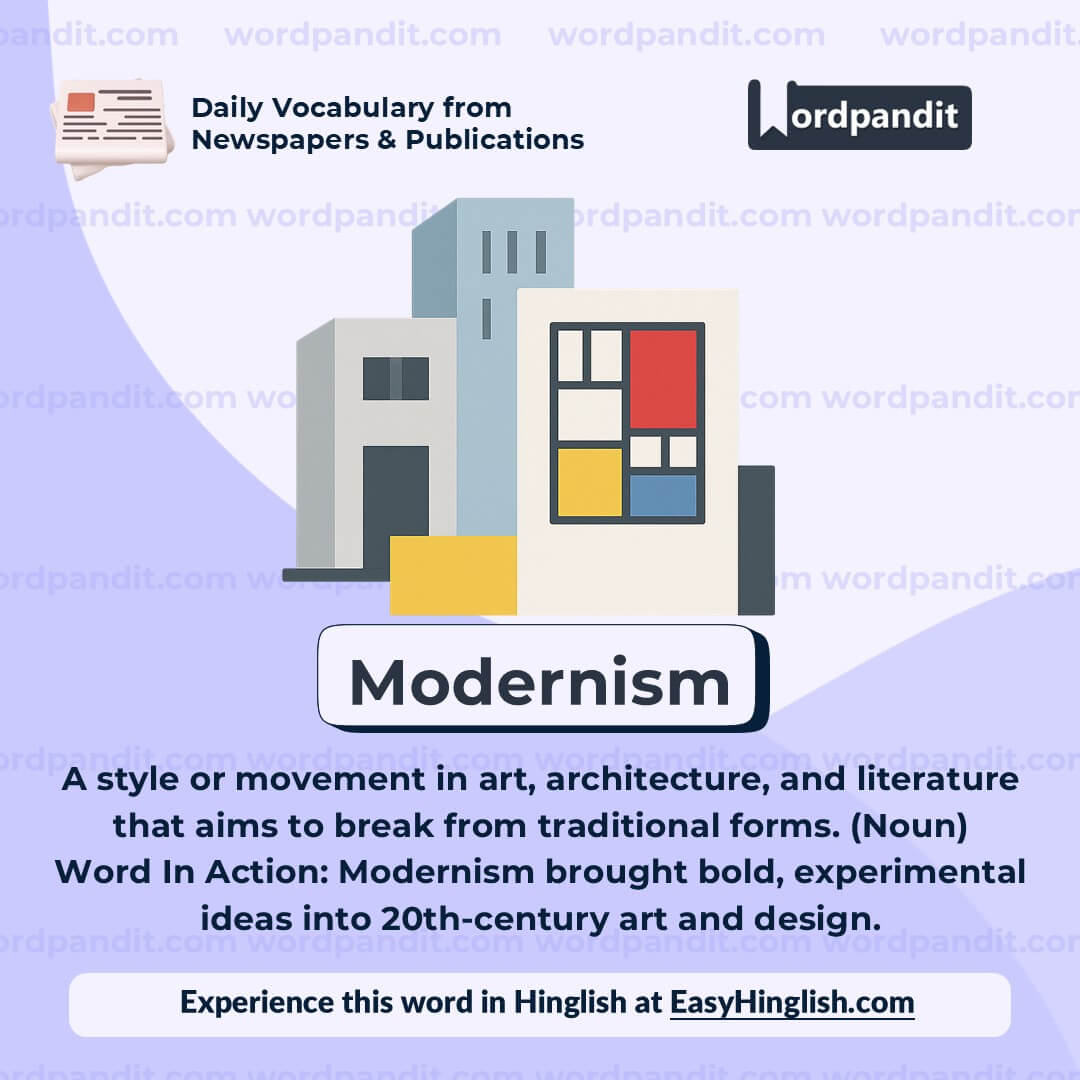
WORD-5: Modernism
Context:
"In the arts, aesthetics is strangely devalued. In reaction to the conventions of European academic art, Modernism (late 19th c to mid-20th) rebelled against any idea that art should be "beautiful." When I discovered in art school that beauty was beside the point, I was delighted to make ugly things!" - Psychology Today
Explanatory Paragraph:
Modernism meaning in English is 'a cultural, artistic, and intellectual movement that broke from traditional forms and embraced experimentation, innovation, and radical change.' This word is used when discussing the revolutionary artistic and literary movements of the late 19th and early 20th centuries that rejected conventional styles in favor of new forms of expression. How to use modernism correctly: it appears in art history, literature courses, architectural discussions, and competitive exam passages for CAT, GRE, and UPSC when analyzing cultural shifts, artistic rebellions, or the evolution of creative expression from traditional to contemporary forms.
Meaning: A movement in arts, architecture, and literature that consciously broke with classical and traditional forms (Noun); also refers to modern thinking or methods
Pronunciation: MOD-ur-niz-uhm
Difficulty Level: ⭐⭐⭐ Intermediate to Advanced
Etymology: Modernism derives from 'modern,' which comes from Late Latin 'modernus' meaning 'of the present time,' formed from 'modo' meaning 'just now.' The '-ism' suffix was added in the late 19th century to describe the conscious movement toward new artistic forms. The term gained prominence as artists like Picasso, writers like Virginia Woolf, and architects like Le Corbusier deliberately broke traditional rules. What began as a rebellion against Victorian conventions became one of the most influential cultural movements in history, fundamentally changing how we think about art, literature, architecture, and even society itself.
Prashant Sir's Notes:
Many students confuse modernism with 'modernity'—the difference between modernism and modernity is crucial: modernism is a specific artistic and cultural movement (roughly 1880-1950), while modernity refers to the general condition of being modern or the modern era itself. For CAT and UPSC aspirants, modernism frequently appears in passages about cultural history, literature movements, or architectural evolution. In Indian context, you'll encounter discussions of how Indian writers like Raja Rao or Mulk Raj Anand adapted modernism to Indian themes, or how Le Corbusier's modernist architecture shaped Chandigarh's design. The word signals a deliberate break from tradition—not just being contemporary, but actively rejecting old rules. When you see 'modernism rebelled' or 'modernist rejection,' the author is describing conscious revolution, not gradual evolution. Understanding modernism helps decode reading comprehension passages about cultural movements and artistic philosophy.
Synonyms & Antonyms:
Synonyms: avant-garde, innovation, experimentalism, contemporary movement, progressive art, revolutionary aesthetics (context-dependent)
Antonyms: traditionalism, classicism, conservatism, conventional art, academicism, orthodoxy
Usage Examples:
- Le Corbusier's modernism transformed Chandigarh into India's first planned city, with geometric buildings and open spaces replacing traditional urban design.
- Indian writers like Kamala Das embraced literary modernism in the 1960s, breaking from formal poetry structures to explore raw personal experiences and female sexuality.
- The National Gallery of Modern Art in Delhi showcases how Indian artists like M.F. Husain blended Western modernism with indigenous themes and techniques.
- Architectural modernism dominates Gurgaon's skyline—glass towers and minimal ornamentation contrasting sharply with Old Delhi's ornate historical structures just kilometers away.
Cultural Reference:
"Satyajit Ray's Apu Trilogy represents Indian cinematic modernism—breaking from melodramatic Bollywood conventions to explore social realism, psychological depth, and innovative storytelling techniques that influenced world cinema." - Film history
Think About It:
Did modernism's rebellion against traditional beauty and form liberate artists to explore deeper truths, or did it sometimes prioritize shock value and novelty over genuine artistic merit?
Quick Activity:
Compare two buildings in your city—one traditional and one modern. Write three sentences identifying specific features that show how modernism rejected traditional architectural principles in favor of new forms.
Memory Tip:
Think of 'Modernism' as 'MODERN + ISM (ideology)'—imagine Picasso painting a woman with eyes on one side of her face and nose on the other, deliberately making it MODERN and shocking by following the ISM (ideology) of breaking all traditional rules. Or remember Chandigarh: Le Corbusier's modernism created straight lines and concrete blocks instead of the curves and decorations of traditional Indian architecture—modern ideology completely changed the rules of design.
Real-World Application:
Modernism is essential vocabulary in humanities education, art criticism, architectural theory, and cultural analysis. Literature professors discuss 'literary modernism' when teaching Joyce, Woolf, or Eliot. Architects reference 'architectural modernism' when explaining functionalist design principles. In UPSC essays on culture or development, understanding modernism helps analyze the tension between preserving tradition and embracing progress—whether discussing urban planning, educational reform, or cultural policy. Art critics use the term to contextualize contemporary art within historical movements. Even in everyday conversation, saying 'that's very modernist' signals recognition of stark simplicity, experimental form, or deliberate rejection of ornament. The word helps us understand the 20th century's revolutionary transformation of creative expression.


