

Daily Vocabulary from International Newspapers and Publications
Expand Your Vocabulary with Wordpandit’s Global Vocabulary Hub
At Wordpandit, we are committed to helping you develop a truly global vocabulary by drawing from some of the most respected international publications. This section is designed to keep you ahead of the curve by introducing you to words that define global conversations and trends.
The Power of Global Sources
To help you think and communicate on a global scale, we curate vocabulary from renowned international sources, such as:
- The New York Times
- The Washington Post
- BBC
- The Guardian
- The Economist
- Scientific American
- Psychology Today
- And many more...
Stay Global, Stay Competitive
Our daily updates from international publications ensure you are consistently exposed to new words that reflect global news and developments, making sure your vocabulary is not only current but also globally relevant.
Enhance Your Global Perspective
Whether you’re preparing for international exams, aiming to excel in global business communication, or want to enhance your language skills for personal growth, Wordpandit offers the resources you need to thrive in a global context.
Effective Learning, Global Reach
Our learning methodology combines global examples, memory aids, and interactive activities, allowing you to internalize new words effectively and apply them in real-world scenarios.
Begin Your Global Vocabulary Journey Now!

Why Choose Wordpandit?
Practical Learning: Focus on words you'll actually encounter in real-world reading, enhancing your comprehension and communication skills.
Diverse Content: From current affairs to scientific breakthroughs, our varied sources expose you to vocabulary across multiple domains.
Effortless Integration: Make Wordpandit a part of your daily routine. Just a few minutes each day can significantly boost your lexicon over time.
Your Path to Vocabulary Mastery
- Visit our Daily Vocabulary section regularly
- Explore new words and their usage in context
- Practice incorporating these words into your own writing and speech
- Track your progress as your vocabulary expands
Start Your Journey Today
Embark on your vocabulary enhancement journey with Wordpandit. By consistently engaging with our daily posts, you'll build a robust vocabulary that serves you well in academic, professional, and personal contexts.
Remember, a word a day keeps linguistic limitations at bay. Make Wordpandit your daily companion in the quest for vocabulary excellence!
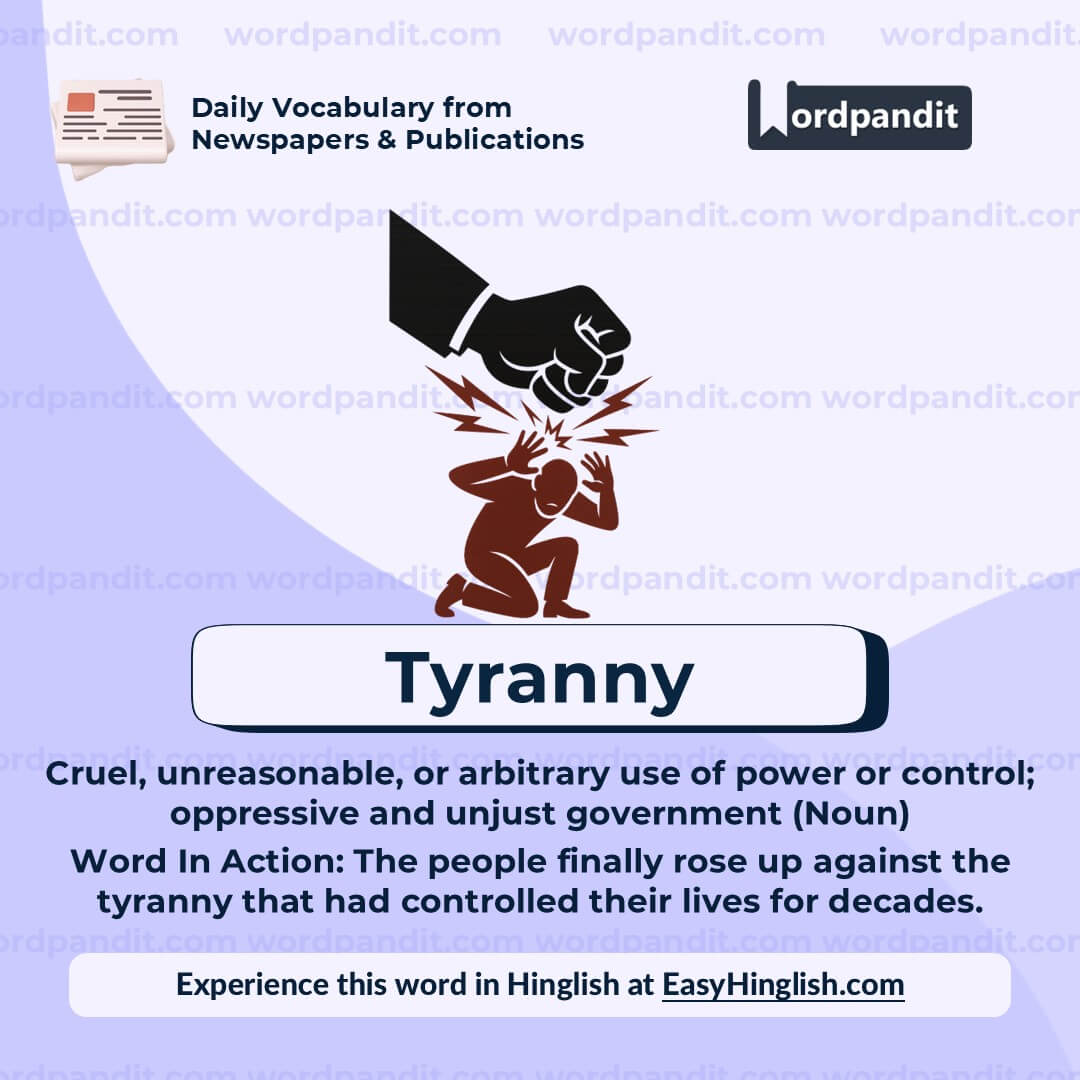
WORD-1: Tyranny
Context:
"...destined to unleash the cruellest tyranny upon the people that uphold them." - The Republic Analysis Article
Explanatory Paragraph:
Tyranny meaning in English is cruel and oppressive government or rule where power is exercised without justice or compassion. This word is used when describing authoritarian regimes, dictatorial leadership, or any situation where someone exercises absolute power in a harsh and unjust manner. How to use tyranny effectively: it commonly appears in political discourse, history textbooks, competitive exam passages about governance, and news analysis discussing authoritarian systems. Tyranny is particularly relevant for UPSC, CAT Reading Comprehension, and GRE passages dealing with political philosophy and historical analysis.
Meaning: Cruel, unreasonable, or arbitrary use of power or control; oppressive and unjust government (Noun)
Pronunciation: TIR-uh-nee
Difficulty Level: ⭐⭐⭐ Intermediate
Etymology: Tyranny comes from Greek 'tyrannos' meaning 'absolute ruler,' originally referring to someone who seized power illegally rather than inheriting it. Through Latin 'tyrannia' and Old French 'tyrannie,' the word evolved to specifically mean oppressive and cruel rule. By medieval times, tyranny had acquired its modern negative connotation of unjust, harsh governance that disregards the welfare of citizens.
Prashant Sir's Notes:
Many students confuse tyranny with autocracy or dictatorship—the difference between tyranny and dictatorship is that tyranny specifically emphasizes the cruel and oppressive nature of rule, while dictatorship is simply concentrated power. For UPSC and CAT aspirants, tyranny frequently appears in passages about political philosophy, especially when discussing Plato's Republic or examining how democracies can deteriorate. In Indian English newspapers, you'll often see "tyranny of the majority" when discussing how democratic systems can sometimes oppress minority groups. How to use tyranny correctly in essays: pair it with words like "unleash," "suffer under," or "escape from" to show the oppressive nature. Remember, tyranny isn't just about power—it's about the cruel misuse of that power against people's welfare.
Synonyms & Antonyms:
Synonyms: oppression, despotism, dictatorship, authoritarianism, totalitarianism, autocracy, absolutism, repression, subjugation, domination
Antonyms: democracy, freedom, liberty, justice, fairness, equality
Usage Examples:
- The Emergency period of 1975-77 is often cited as an example of state tyranny when fundamental rights were suspended across India.
- Priya escaped the tyranny of her controlling manager by requesting a transfer to the Mumbai office where workplace culture was more democratic.
- The passage argued that unchecked technological surveillance represents a new form of digital tyranny that threatens individual privacy and autonomy.
- Rohan finally stood up against the tyranny of peer pressure and decided to pursue engineering instead of medicine despite family expectations.
Cultural Reference:
"Every form of government tends to perish by excess of its basic principle. Tyranny collapses from excess of force." - Commonly referenced principle in Indian political science discourse on governance and power
Think About It:
Can tyranny exist not just in governments but also in families, workplaces, or social groups? When does strong leadership cross the line into tyranny?
Quick Activity:
Write two sentences describing a historical or contemporary situation where people fought against tyranny. Use Indian independence movement or any recent news example you've read.
Memory Tip:
Think of 'Tyranny' as 'TRY-RAIN-Y'—imagine a cruel ruler who tries to rain down harsh punishments on people. Just like heavy rain can be oppressive and relentless, tyranny is oppressive rule that gives people no relief.
Real-World Application:
Tyranny is commonly used in political analysis, editorial columns, and history textbooks to describe oppressive regimes and authoritarian systems. In competitive exam essays on governance, democracy, and political philosophy, using tyranny demonstrates sophisticated understanding of power dynamics. News articles discussing human rights violations, authoritarian crackdowns, or excessive government control frequently employ this term to convey the severity and injustice of oppressive rule. For CAT and GRE Reading Comprehension, recognizing tyranny helps identify the author's critical stance toward power structures.
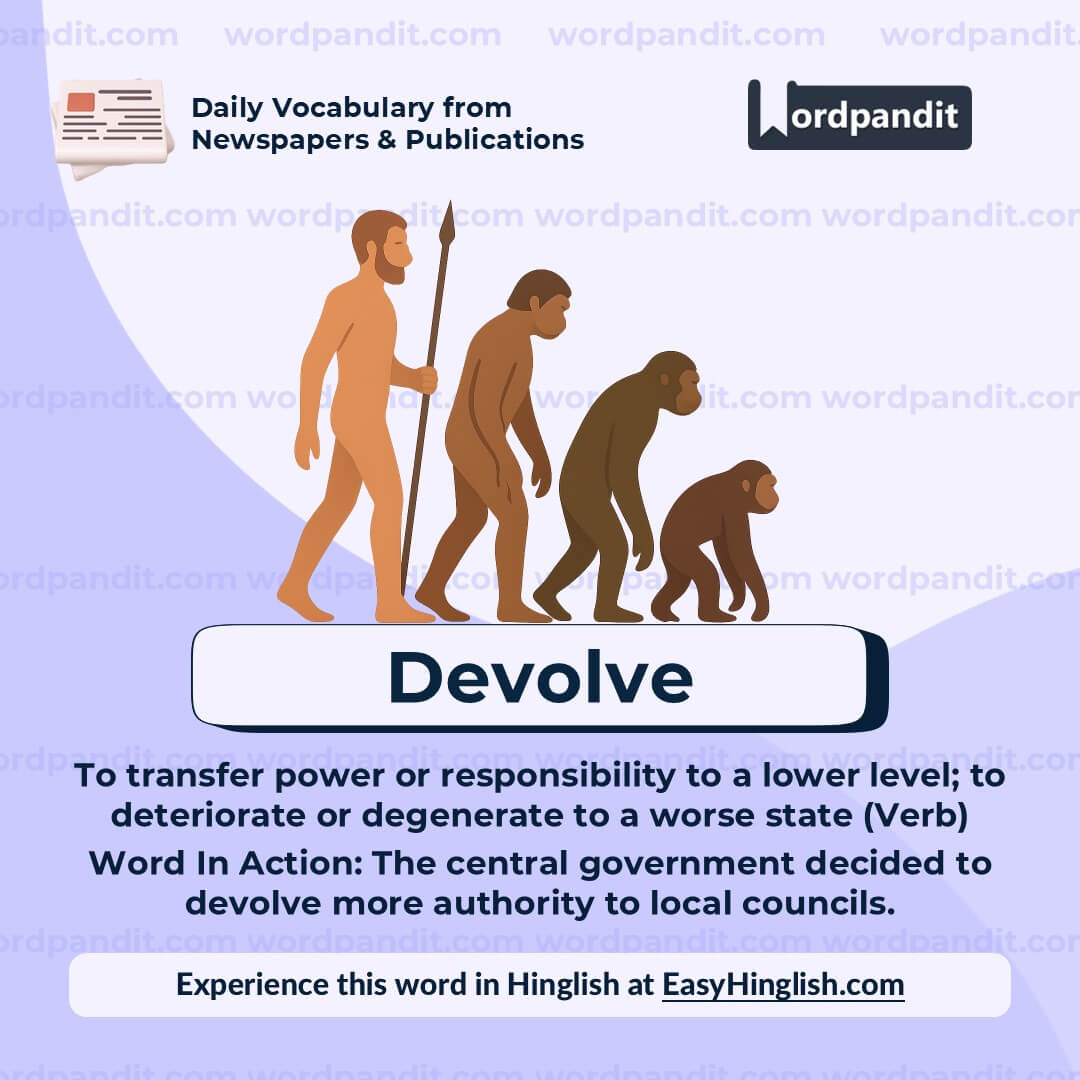
WORD-2: Devolve
Context:
"...each form is predetermined to devolve into the next..." - The Republic Analysis Article
Explanatory Paragraph:
Devolve meaning in English is to deteriorate or degenerate from a higher to a lower state, or to transfer power or responsibility from a central authority to local units. This word is used when describing processes of decline, degradation, or the delegation of powers and duties. How to use devolve correctly: it appears frequently in political science discussions about federalism, in formal writing about organizational structures, and in CAT and GRE passages discussing evolutionary or cyclical theories. Devolve is particularly important for UPSC aspirants studying Indian governance, where devolution of powers to states and local bodies is a fundamental constitutional concept.
Meaning: To transfer power or responsibility to a lower level; to deteriorate or degenerate to a worse state (Verb)
Pronunciation: dih-VOLV
Difficulty Level: ⭐⭐⭐ Intermediate to Advanced
Etymology: Devolve comes from Latin 'devolvere,' combining 'de-' (down) and 'volvere' (to roll), literally meaning 'to roll down.' The word entered English in the 15th century initially meaning to pass down from one person to another, particularly regarding property or duties. Over time, it developed two distinct meanings: the transfer of power or responsibility downward in a hierarchy, and the deterioration or decline into a lower state, both reflecting the original sense of downward movement.
Prashant Sir's Notes:
Students often ask: what is the difference between devolve and evolve? While evolve means to develop or progress upward, devolve means to deteriorate or transfer downward—they're almost opposite processes. For UPSC aspirants, devolve is crucial when discussing the 73rd and 74th Constitutional Amendments that devolved powers to Panchayati Raj institutions and urban local bodies. In CAT Reading Comprehension, devolve usage in sentences about political philosophy often signals cyclical theories where good systems gradually devolve into worse forms. Indian newspapers frequently use "powers devolve to states" when discussing federalism and center-state relations. Remember: devolve can mean both deterioration (negative) and decentralization (neutral or positive)—context determines which meaning applies.
Synonyms & Antonyms:
Synonyms: deteriorate, degenerate, decline, regress, decay, transfer, delegate, decentralize (for power transfer), worsen, sink
Antonyms: evolve, develop, progress, improve, advance, centralize (for power context), enhance,升升
Usage Examples:
- According to the 73rd Amendment, certain administrative and financial powers devolve from state governments to village panchayats for grassroots democracy.
- What started as a professional disagreement between Amit and Neha quickly devolved into personal attacks and office gossip.
- The CAT passage discussed how Plato believed democracy would inevitably devolve into tyranny as people prioritized freedom over order.
- After the manager left, responsibility for the Chennai project devolved to Kavita, who had been the deputy team leader.
Cultural Reference:
"The beauty of Indian federalism lies in how powers devolve from the Union to states, and further to local bodies, creating a three-tier democratic structure." - Common reference in Indian civics education and UPSC preparation materials
Think About It:
When does giving more power to local authorities strengthen democracy, and when might it devolve into chaos or inefficiency? Is devolution always beneficial?
Quick Activity:
Write two sentences: one using devolve to describe power transfer (like in Indian federalism), and another using devolve to describe a situation deteriorating from good to bad.
Memory Tip:
Remember 'Devolve' as 'DE-volve' where 'DE' means 'down.' Think of it as the opposite of 'E-volve' (evolve upward). Imagine a ball rolling DOWN a hill—that's devolving. Or picture power flowing DOWN from Delhi to state capitals to village panchayats—that's devolution of authority.
Real-World Application:
Devolve is essential vocabulary in political science, public administration, and organizational management contexts. For UPSC aspirants, understanding devolution of powers is critical for essays on federalism, local governance, and constitutional amendments. In corporate communications and business reports, devolve is used to describe delegation of responsibilities and decentralization of decision-making. CAT and GRE passages frequently employ devolve when discussing political theories, cyclical patterns in history, or organizational structures. News articles about center-state relations, local body elections, and administrative reforms in India regularly use this term to explain power distribution in the federal system.
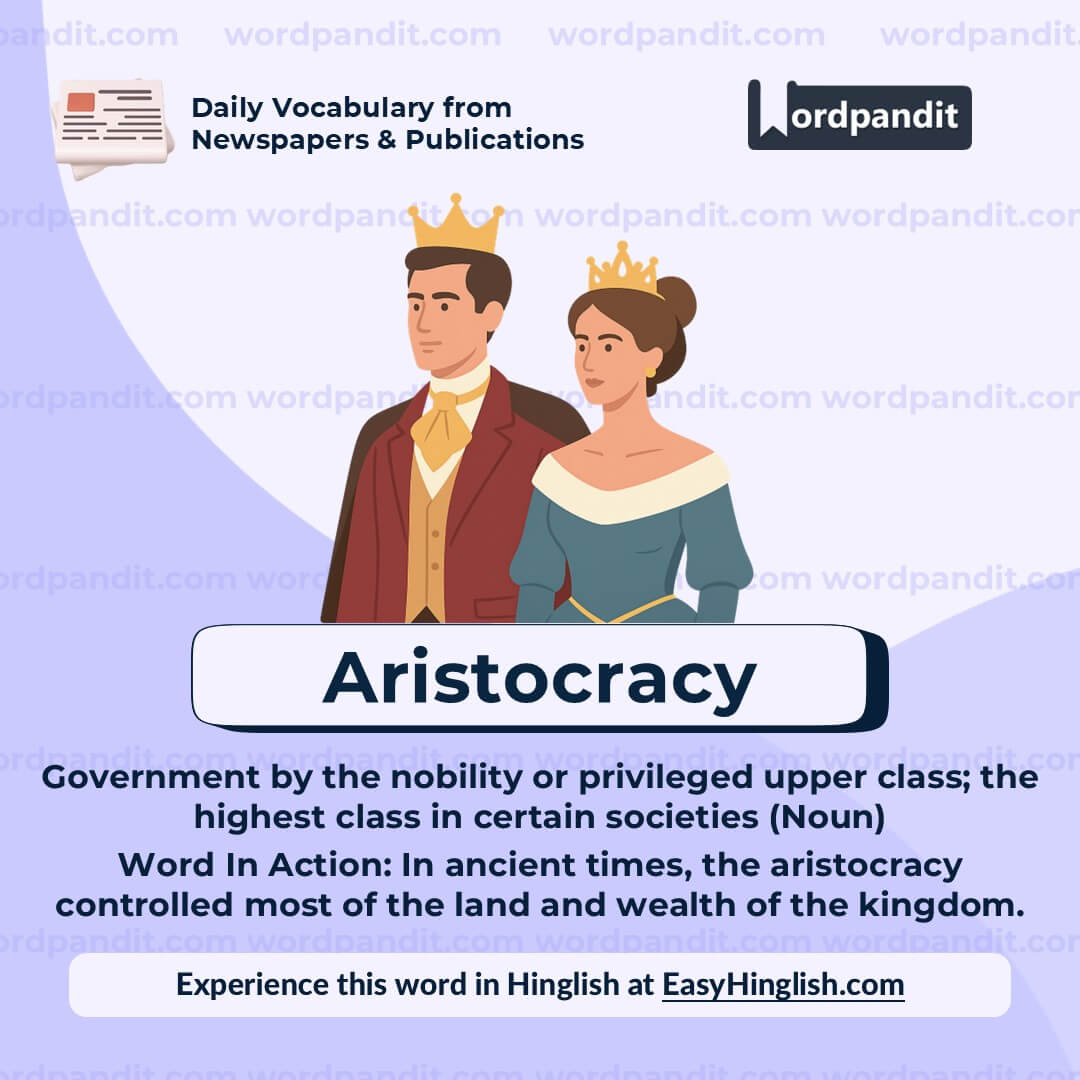
WORD-3: Aristocracy
Context:
"Plato sorts political systems into five types: aristocracy, timocracy, oligarchy, democracy, and tyranny." - The Republic Analysis Article
Explanatory Paragraph:
Aristocracy meaning in English is a form of government in which power is held by the nobility or a privileged upper class, or it can refer to the highest class in society itself. This word is used when discussing political systems where ruling authority rests with a select group considered superior by birth, wealth, or intellect. How to use aristocracy in writing: it commonly appears in history textbooks discussing European monarchies, political science analyses of governance systems, and competitive exam passages about social hierarchies and class structures. Aristocracy is essential vocabulary for UPSC history and polity sections, as well as GRE and CAT reading comprehension passages dealing with political philosophy and social stratification.
Meaning: Government by the nobility or privileged upper class; the highest class in certain societies (Noun)
Pronunciation: air-ih-STOK-ruh-see
Difficulty Level: ⭐⭐⭐ Intermediate
Etymology: Aristocracy comes from Greek 'aristokratia,' combining 'aristos' (best, most excellent) and 'kratos' (power, rule), literally meaning 'rule by the best.' In ancient Greece, it originally referred to government by the most virtuous and capable citizens. The word entered English through Old French in the 16th century. Over time, aristocracy shifted from Plato's ideal of rule by the wisest to describe hereditary nobility and privileged social classes, though it still retains both meanings—an ideal form of merit-based governance and the actual system of inherited privilege.
Prashant Sir's Notes:
Many students confuse aristocracy with oligarchy and monarchy—the difference between aristocracy and oligarchy is that aristocracy theoretically means rule by the 'best' or most qualified (though in practice often hereditary nobles), while oligarchy simply means rule by a few wealthy or powerful individuals without the connotation of nobility or virtue. The difference between aristocracy and monarchy is that monarchy is rule by one person (a king or queen), while aristocracy is rule by a privileged class. For CAT and GRE passages, aristocracy usage often appears in discussions of Plato's Republic, where it represents the ideal government by philosopher-kings. In Indian context, while we didn't have European-style aristocracy, the princely states under British rule and the traditional zamindar system shared some aristocratic characteristics. When you see aristocracy in UPSC history passages, think of the British House of Lords or the French nobility before the revolution.
Synonyms & Antonyms:
Synonyms: nobility, elite, upper class, gentry, patricians, blue bloods, ruling class, privileged class, peerage, landed gentry
Antonyms: democracy, common people, masses, proletariat, working class, commoners, plebeians
Usage Examples:
- Before independence, India's princely states were governed by an aristocracy of maharajas and nawabs who enjoyed hereditary privileges and vast wealth.
- The British aristocracy maintained their power through land ownership, titles passed down through generations, and exclusive education at institutions like Eton and Oxford.
- Plato argued that aristocracy, where philosopher-kings rule based on wisdom and virtue, was the ideal form of government before it inevitably devolved into timocracy.
- Despite coming from an aristocratic family in Kolkata, Rahul rejected his privileged background to work with rural communities in Bihar.
Cultural Reference:
"The zamindari system in pre-independence India functioned as a form of landed aristocracy, where hereditary landowners wielded significant social and political power over peasants." - Commonly discussed in Indian history and socio-economic studies
Think About It:
Does India have a modern aristocracy based on wealth, education, or family connections? Can true merit-based aristocracy exist, or does concentrated power always become hereditary privilege?
Quick Activity:
List three characteristics that defined historical aristocracies (like land ownership or titles) and compare them with three ways elite status is maintained in modern India (like education or professional networks).
Memory Tip:
Break 'Aristocracy' into 'ARISTO-CRACY': think of 'Aristo' as 'the best' (from Greek aristos) and 'cracy' as 'rule' (like in democracy). So aristocracy = rule by the best. Or remember: "A RICH STOCKRACY" - imagine the rich stock of noble families racing to maintain their privileged position in society.
Real-World Application:
Aristocracy is fundamental vocabulary in history textbooks, political science literature, and sociology discussions about class structures. For UPSC preparation, understanding aristocracy is essential when studying European history, the French and Russian revolutions, British colonialism in India, and the princely states system. In CAT and GRE reading comprehension passages, aristocracy frequently appears in excerpts from political philosophy, particularly Plato's Republic and discussions of governance systems. News articles analyzing social inequality, inherited privilege, and class mobility often reference aristocratic systems as historical comparisons. The term also appears in cultural criticism examining elite institutions, exclusive social circles, and the persistence of hereditary advantages in modern democracies.
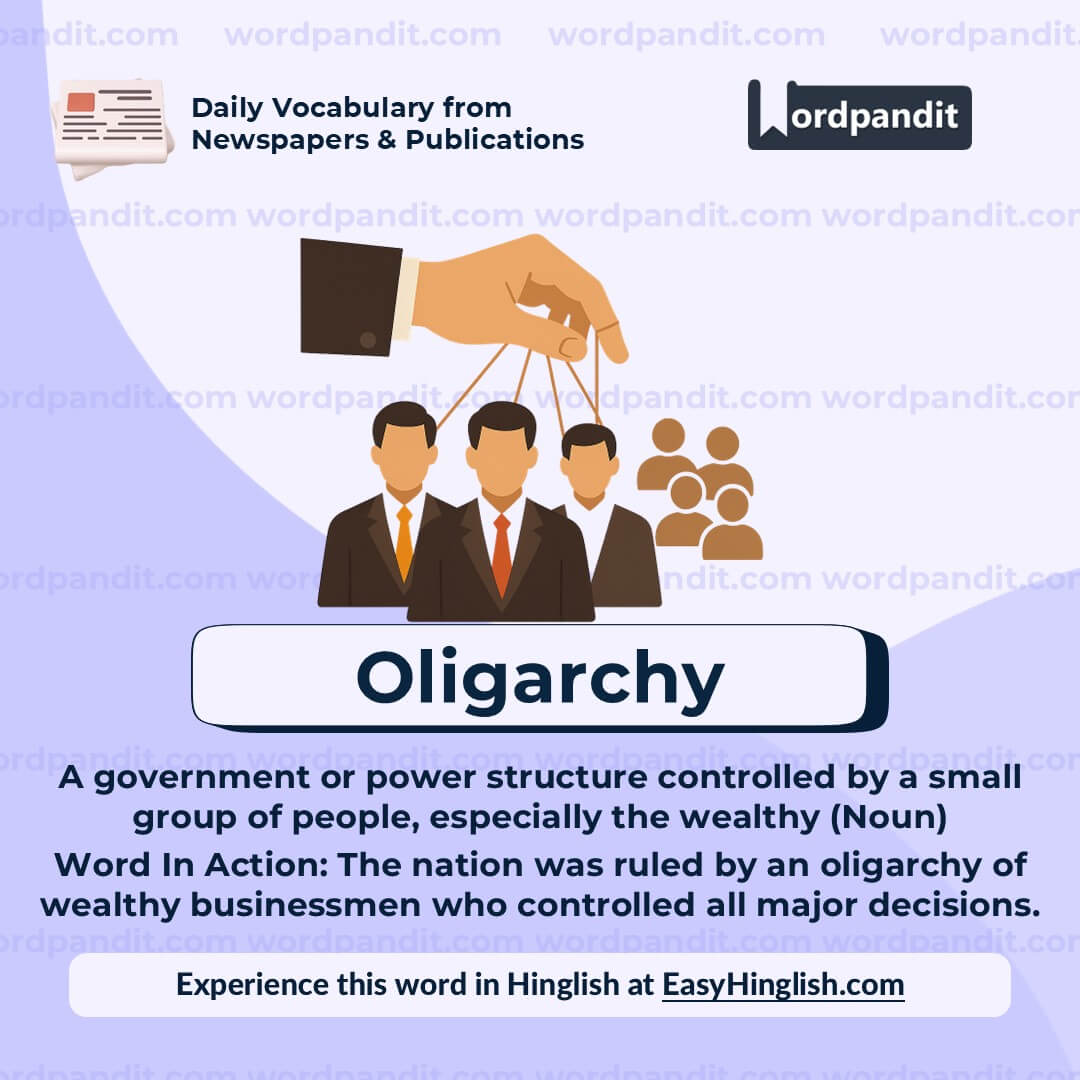
WORD-4: Oligarchy
Context:
"Oligarchy is rule by the wealthy." - The Republic Analysis Article
Explanatory Paragraph:
Oligarchy meaning in English is a form of government in which power is concentrated in the hands of a small, privileged group, typically the wealthy or powerful elite. This word is used when describing political systems where a few individuals or families control decision-making, resources, and governance, often prioritizing their own interests over the general population. How to use oligarchy effectively: it appears frequently in political science texts analyzing power structures, economics discussions about wealth concentration, and competitive exam passages critiquing governance systems. Oligarchy is crucial vocabulary for UPSC polity and international relations, as well as CAT and GRE reading comprehension dealing with political corruption, economic inequality, and comparative government systems.
Meaning: A government or power structure controlled by a small group of people, especially the wealthy (Noun)
Pronunciation: OL-ih-gar-kee
Difficulty Level: ⭐⭐⭐ Intermediate
Etymology: Oligarchy comes from Greek 'oligarkhia,' combining 'oligos' (few) and 'arkhein' (to rule), literally meaning 'rule by the few.' The term was used by ancient Greek philosophers like Plato and Aristotle to describe governments controlled by a small wealthy class rather than the broader citizenry. The word entered English in the late 16th century through Latin 'oligarchia.' Historically, oligarchy has consistently carried negative connotations, implying that concentrated power serves the interests of the few at the expense of the many, distinguishing it from aristocracy which theoretically emphasized rule by the 'best' or most virtuous.
Prashant Sir's Notes:
Students often ask: what is the difference between oligarchy and aristocracy? While both involve rule by a small group, aristocracy theoretically means rule by the 'noble' or 'best' based on birth or virtue, whereas oligarchy specifically emphasizes rule by the wealthy few, regardless of nobility. The difference between oligarchy and plutocracy is subtle—plutocracy explicitly means rule by the rich, while oligarchy means rule by a few who typically happen to be wealthy. For UPSC and CAT aspirants, oligarchy frequently appears in passages discussing modern Russia's oligarchs, corporate influence in politics, or how democracies can transform into oligarchies when wealth becomes too concentrated. In Indian English newspapers, you'll see phrases like "corporate oligarchy" when discussing how a few business houses dominate certain industries. Remember: oligarchy usage in exam passages often signals the author's critique of power concentration and economic inequality.
Synonyms & Antonyms:
Synonyms: plutocracy, rule by the few, elite rule, power elite, ruling class, moneyed interests, cronyism (when involving corruption), kleptocracy (when involving theft)
Antonyms: democracy, egalitarianism, populism, people's rule, majority rule, representative government
Usage Examples:
- Critics argue that post-Soviet Russia transformed from communism into an oligarchy where a handful of billionaires control vast economic and political power.
- The startup ecosystem in Bangalore sometimes resembles an oligarchy, with a few venture capital firms and angel investors determining which companies receive funding and succeed.
- The passage argued that extreme wealth inequality could cause democracies to devolve into oligarchies where money, rather than votes, determines policy outcomes.
- Priya's research paper examined how media oligarchy in India, with a few conglomerates owning multiple news channels, affects journalistic independence and public discourse.
Cultural Reference:
"When wealth is concentrated in too few hands, democracy risks becoming an oligarchy in disguise." - A principle frequently cited in Indian political discourse on economic reforms and inclusive growth
Think About It:
Can a country be a democracy politically but an oligarchy economically? Does India face risks of oligarchic control in certain sectors like telecommunications, aviation, or media?
Quick Activity:
Write two sentences describing how an oligarchy differs from a democracy, using examples from current events or history that you've studied or read about recently.
Memory Tip:
Remember 'Oligarchy' as 'OLI-GARCHY': think of 'OLI' sounding like "only" and 'GARCHY' like "guard key" - imagine ONLY a few guards hold the KEY to power and wealth. Or break it as "O-LI-GAR" = Only a Limited Group Are Rulers. This helps you remember it means rule by just a few powerful people.
Real-world Application:
Oligarchy is essential vocabulary in political science, economics, and international relations discussions. For UPSC preparation, understanding oligarchy is crucial when analyzing global political systems, studying post-Soviet states, or discussing wealth concentration and its political implications. In CAT and GRE reading comprehension, oligarchy appears in passages critiquing power structures, discussing democratic backsliding, or analyzing how economic inequality affects governance. Indian newspapers and opinion pieces frequently use oligarchy when discussing corporate monopolies, crony capitalism, or the influence of business houses on policy-making. The term is also common in business journalism analyzing market concentration, in media studies examining ownership patterns, and in political commentary about the relationship between wealth and political power in modern democracies.
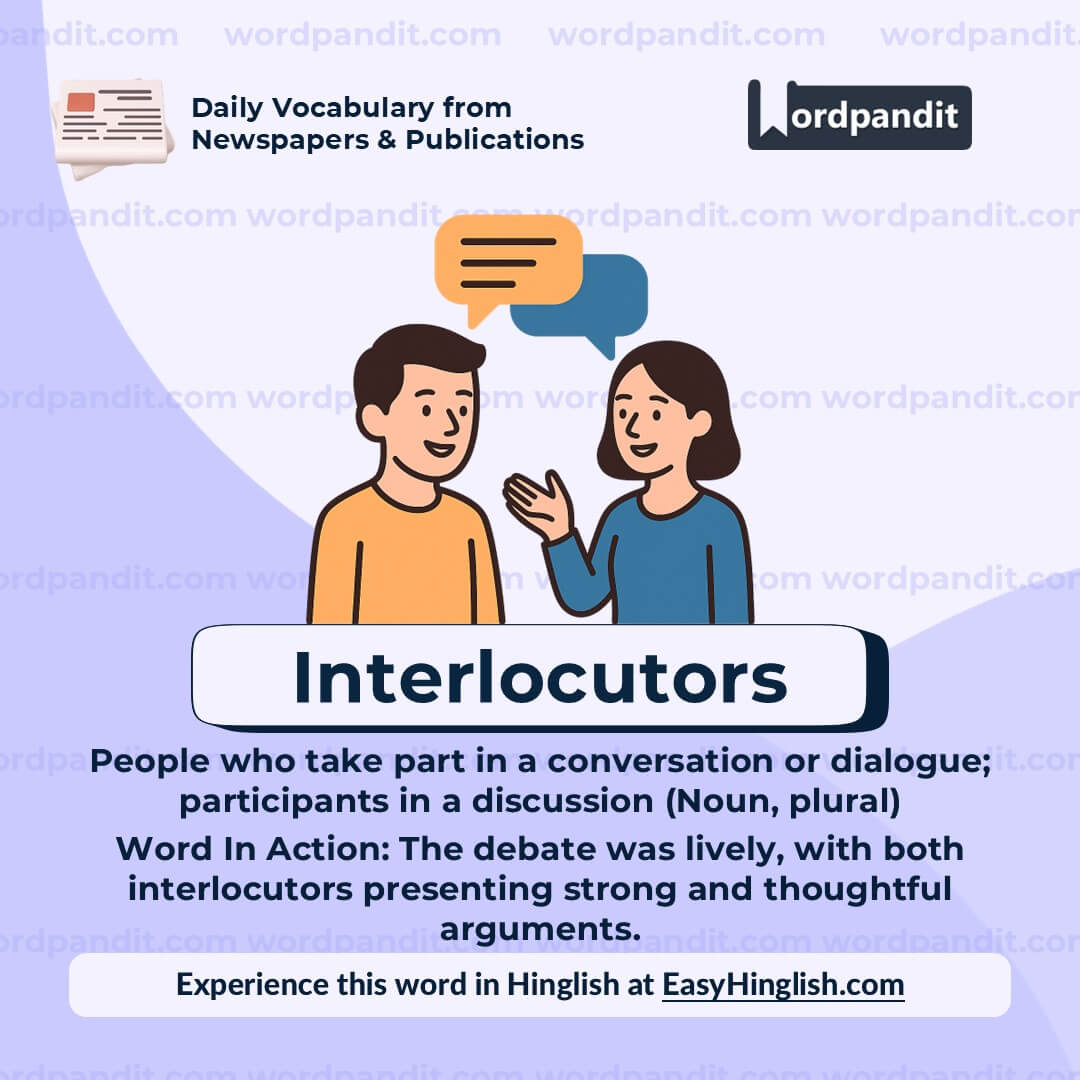
WORD-5: Interlocutors
Context:
"Plato explores this through the character of Socrates and various interlocutors who pose questions to him." - The Republic Analysis Article
Explanatory Paragraph:
Interlocutors meaning in English is people who take part in a dialogue or conversation, especially in a formal discussion or debate. This word is used when describing participants in philosophical dialogues, diplomatic negotiations, or any structured exchange of ideas between two or more parties. How to use interlocutors correctly: it commonly appears in academic writing about philosophical texts, diplomatic reports describing negotiating parties, and competitive exam passages discussing dialogue-based literature. Interlocutors is particularly relevant for UPSC aspirants studying international relations and diplomacy, as well as for GRE and CAT reading comprehension passages dealing with Socratic dialogues, debates, or formal discussions where multiple perspectives are exchanged.
Meaning: People who take part in a conversation or dialogue; participants in a discussion (Noun, plural)
Pronunciation: in-ter-LOK-yuh-terz
Difficulty Level: ⭐⭐⭐⭐ Advanced
Etymology: Interlocutor comes from Latin 'interloqui,' combining 'inter' (between) and 'loqui' (to speak), literally meaning 'to speak between or among.' The word entered English in the 16th century, initially used in legal and theological contexts to describe someone who participated in formal dialogues or investigations. The term became particularly associated with philosophical dialogues, especially Platonic dialogues where Socrates conversed with various interlocutors to explore philosophical questions. In diplomatic language, interlocutor evolved to mean an official representative engaged in negotiations, maintaining its formal connotation of structured, purposeful conversation rather than casual chat.
Prashant Sir's Notes:
Many students confuse interlocutors with simple "speakers" or "participants"—the difference between interlocutors and regular conversation partners is that interlocutors implies a formal, structured dialogue with purpose, often involving questioning and intellectual exchange. For UPSC international relations, you'll frequently see "interlocutors" when discussing India-Pakistan talks, Kashmir dialogue, or any diplomatic negotiations where official representatives exchange views. In CAT and GRE passages about philosophy, interlocutors usage appears constantly in discussions of Plato's Republic, where Socrates debates with various interlocutors like Glaucon, Thrasymachus, and Adeimantus. How to use interlocutors in essays: pair it with verbs like "engage," "challenge," or "respond to" to show active dialogue. Remember: in Indian diplomatic language, when newspapers say "both interlocutors agreed to continue talks," they're referring to official negotiating parties, not just any two people chatting over chai.
Synonyms & Antonyms:
Synonyms: conversationalist, dialogue partner, discussant, collocutor, debater, negotiator (in diplomatic contexts), participant, respondent, questioner
Antonyms: listener, observer, audience member, bystander, spectator, silent party
Usage Examples:
- During the Shimla Agreement negotiations of 1972, Indian and Pakistani interlocutors met to discuss bilateral relations and the future of Kashmir.
- In Plato's Republic, Socrates engages multiple interlocutors who challenge his ideas about justice, forcing him to refine and defend his philosophical positions.
- The corporate mediation session brought together interlocutors from both companies to resolve the merger dispute through structured dialogue rather than litigation.
- Professor Sharma encouraged her students to be active interlocutors in classroom discussions, questioning assumptions and building on each other's arguments rather than passively listening.
Cultural Reference:
"The beauty of the Socratic method lies in how Socrates treats his interlocutors not as opponents to defeat, but as partners in the search for truth." - Commonly referenced principle in Indian philosophy and education discussions about dialectical reasoning
Think About It:
In today's social media age of quick reactions and one-way broadcasting, have we lost the art of being thoughtful interlocutors who genuinely engage with opposing viewpoints?
Quick Activity:
Write two sentences: one using interlocutors in a diplomatic or political context (like India's foreign relations), and another using it in an academic or philosophical context (like a classroom debate or Socratic dialogue).
Memory Tip:
Break 'Interlocutors' into 'INTER-LOCU-TORS': think of 'INTER' (between), 'LOCU' (sounds like "talk you"), and 'TORS' (people who do something). So interlocutors = people who talk BETWEEN themselves. Or imagine Socrates sitting INTER (between) his LOCU-TORS (talk partners) in ancient Athens, engaging them in philosophical dialogue.
Real-World Application:
Interlocutors is essential vocabulary in diplomatic communications, academic philosophy, and formal discussion settings. For UPSC international relations and polity preparation, understanding interlocutors is crucial when reading about bilateral negotiations, peace talks, or official dialogues between governments. In CAT and GRE reading comprehension, interlocutors appears frequently in passages about Platonic dialogues, Socratic method, or any philosophical text structured as conversation. Indian newspapers use interlocutors extensively when reporting on Kashmir dialogue, India-China border talks, or any formal negotiations where official representatives engage in structured discussions. The term also appears in academic papers analyzing dialogue-based literature, legal contexts describing parties in discussions, and business communications about negotiating parties in commercial disputes or merger talks.


