

Daily Vocabulary from International Newspapers and Publications
Expand Your Vocabulary with Wordpandit’s Global Vocabulary Hub
At Wordpandit, we are committed to helping you develop a truly global vocabulary by drawing from some of the most respected international publications. This section is designed to keep you ahead of the curve by introducing you to words that define global conversations and trends.
The Power of Global Sources
To help you think and communicate on a global scale, we curate vocabulary from renowned international sources, such as:
- The New York Times
- The Washington Post
- BBC
- The Guardian
- The Economist
- Scientific American
- Psychology Today
- And many more...
Stay Global, Stay Competitive
Our daily updates from international publications ensure you are consistently exposed to new words that reflect global news and developments, making sure your vocabulary is not only current but also globally relevant.
Enhance Your Global Perspective
Whether you’re preparing for international exams, aiming to excel in global business communication, or want to enhance your language skills for personal growth, Wordpandit offers the resources you need to thrive in a global context.
Effective Learning, Global Reach
Our learning methodology combines global examples, memory aids, and interactive activities, allowing you to internalize new words effectively and apply them in real-world scenarios.
Begin Your Global Vocabulary Journey Now!

Why Choose Wordpandit?
Practical Learning: Focus on words you'll actually encounter in real-world reading, enhancing your comprehension and communication skills.
Diverse Content: From current affairs to scientific breakthroughs, our varied sources expose you to vocabulary across multiple domains.
Effortless Integration: Make Wordpandit a part of your daily routine. Just a few minutes each day can significantly boost your lexicon over time.
Your Path to Vocabulary Mastery
- Visit our Daily Vocabulary section regularly
- Explore new words and their usage in context
- Practice incorporating these words into your own writing and speech
- Track your progress as your vocabulary expands
Start Your Journey Today
Embark on your vocabulary enhancement journey with Wordpandit. By consistently engaging with our daily posts, you'll build a robust vocabulary that serves you well in academic, professional, and personal contexts.
Remember, a word a day keeps linguistic limitations at bay. Make Wordpandit your daily companion in the quest for vocabulary excellence!
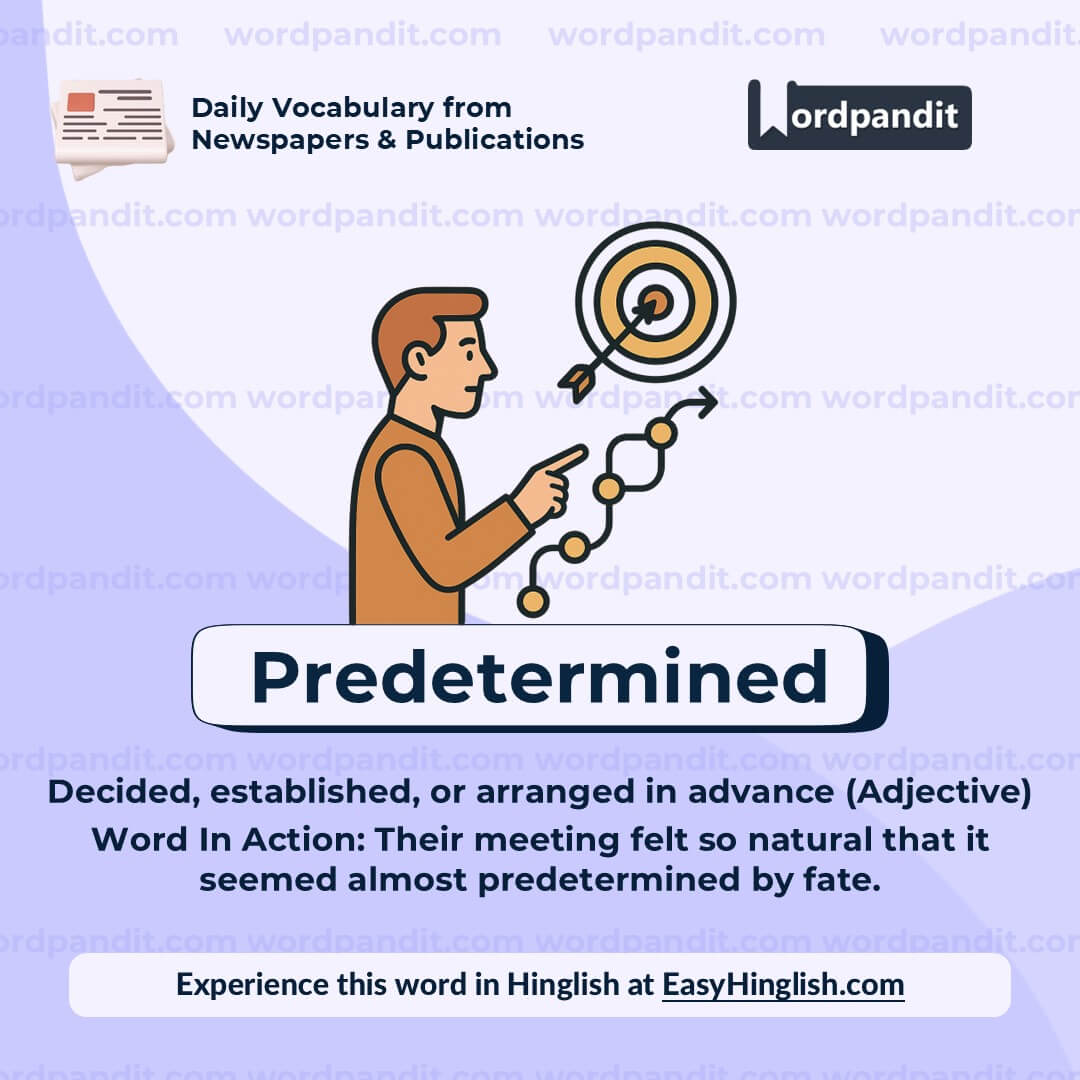
WORD-1: Predetermined
Context:
"...each form is predetermined to devolve into the next..." - The Republic Analysis Article
Explanatory Paragraph:
Predetermined meaning in English is 'decided, established, or arranged in advance before something happens.' This word is used when outcomes, sequences, or conditions have been fixed beforehand rather than being spontaneous or decided in the moment. Predetermined is commonly used in formal writing, scientific discussions, philosophical texts, and competitive exam passages like CAT and GRE to describe events, results, or patterns that follow a pre-established plan or natural order.
Meaning: Decided, established, or arranged in advance (Adjective)
Pronunciation: pree-dih-TUR-mind
Difficulty Level: ⭐⭐ Basic to Intermediate
Etymology: Predetermined combines the prefix 'pre-' meaning 'before' with 'determined' from Latin 'determinare' meaning 'to set boundaries or limits.' The word emerged in English around the 17th century, particularly in philosophical and theological discussions about fate and free will, eventually expanding to describe any outcome or condition fixed in advance.
Prashant Sir's Notes:
Students often ask: what is the difference between predetermined and predestined? While both suggest something decided in advance, 'predetermined' is neutral and often used for scientific, logical, or planned sequences, whereas 'predestined' carries spiritual or fate-related connotations. For CAT and GRE aspirants, predetermined frequently appears in reading comprehension passages about scientific processes, evolutionary patterns, or structured systems. How to use predetermined correctly: it typically modifies nouns like 'outcome,' 'path,' 'sequence,' or 'conclusion.' In Indian newspapers, you'll often see predetermined used in political analysis—"the election result seemed predetermined"—or in discussions about bureaucratic processes where decisions are made before public consultation.
Synonyms & Antonyms:
Synonyms: prearranged, preordained, fixed, preset, foreordained, predestined, established in advance, decided beforehand, preestablished, planned ahead
Antonyms: spontaneous, random, unpredictable, impromptu, unplanned, undecided
Usage Examples:
- The match outcome felt predetermined after Mumbai Indians lost their top three batsmen in the first five overs of the chase.
- Priya suspected the interview results were predetermined since the company had already informally offered the position to an internal candidate.
- The bureaucratic process followed a predetermined sequence of approvals that added months to even simple applications for business licenses.
- In many joint families, career paths often seem predetermined by parental expectations rather than individual interests and talents.
Cultural Reference:
"The philosophy of karma suggests that consequences are predetermined by our actions, though we retain the freedom to choose those actions." - Common interpretation in Indian spiritual discourse
Think About It:
Do you believe major life outcomes are predetermined by circumstances, or do individual choices truly shape our destiny? Where does free will begin in a world of predetermined social, economic, and familial conditions?
Quick Activity:
Identify three situations in your daily life where outcomes seem predetermined—perhaps exam seat numbers, queue positions, or meeting agendas. Write one sentence describing each using 'predetermined' correctly.
Memory Tip:
Think of 'Predetermined' as 'PRE-DETERMINED'—imagine a cricket match where the DETERMINATION (result) was made BEFORE (pre) the game even started. Picture a fixed match where everyone knows the winner beforehand—that's predetermined!
Real-World Application:
Predetermined is commonly used in scientific writing to describe fixed sequences or outcomes in experiments, evolutionary biology, and systems analysis. In business contexts, it appears in project management discussions about predetermined milestones and in legal documents describing predetermined penalties or conditions. For competitive exam essays and RC passages, understanding 'predetermined' helps you identify arguments about causality, inevitability, and the tension between structure and agency in social, biological, or mechanical systems.
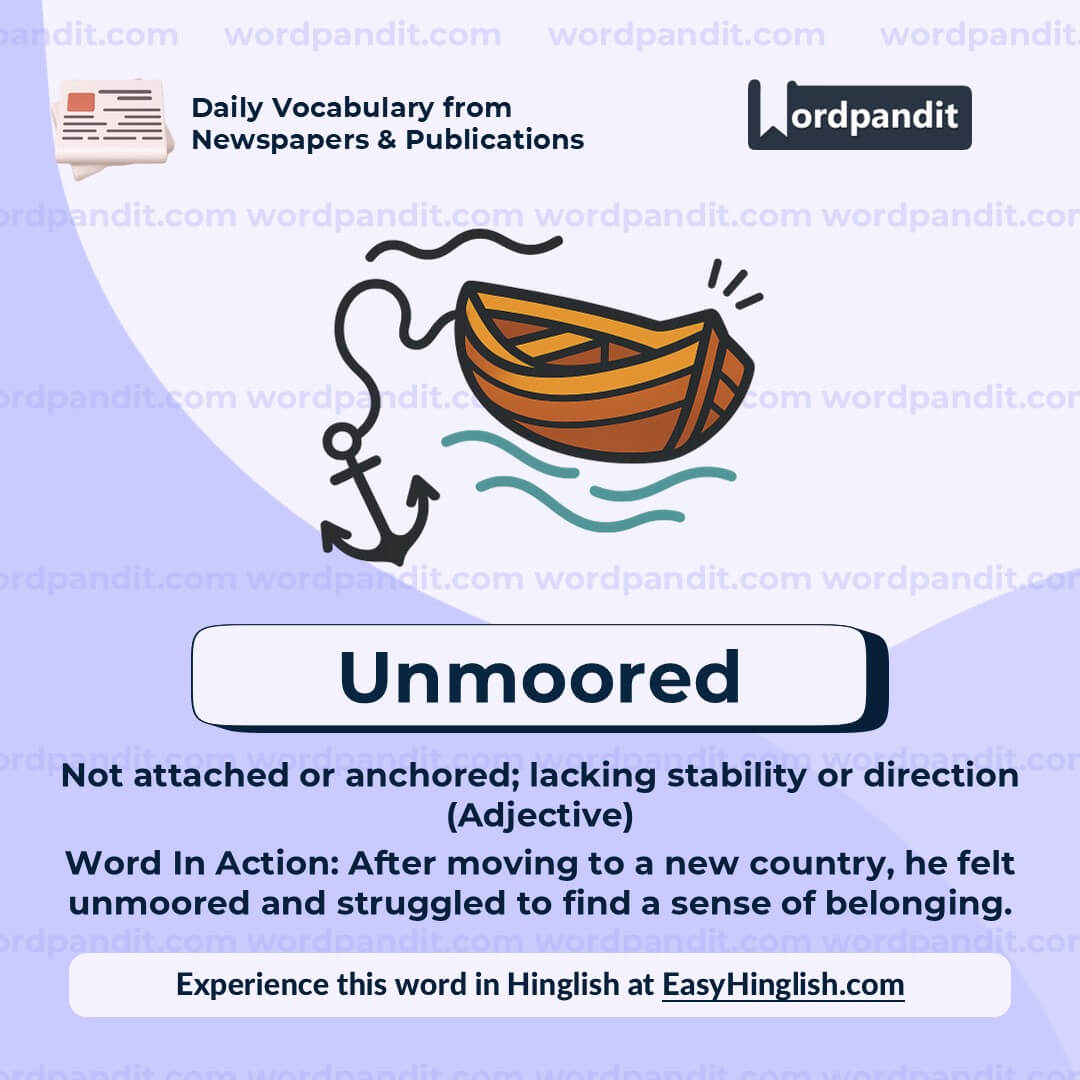
WORD-2: Unmoored
Context:
"The democratic man himself is generous... but unmoored." - The Republic Analysis Article
Explanatory Paragraph:
Unmoored meaning in English is 'not attached or anchored; lacking stability, direction, or firm principles.' This word is used when describing something or someone that has lost their anchor or foundational connection, drifting without guidance or fixed purpose. Unmoored is commonly used in literary writing, psychological discussions, philosophical texts, and competitive exam passages like CAT, GRE, and UPSC to describe emotional states, social conditions, or individuals who lack stable grounding in values, relationships, or beliefs.
Meaning: Not attached or anchored; lacking stability or direction (Adjective)
Pronunciation: un-MOORD
Difficulty Level: ⭐⭐⭐ Intermediate
Etymology: Unmoored comes from the nautical term 'moored,' derived from Middle English 'moren' and Middle Dutch 'maren,' meaning 'to tie or fasten a boat.' The prefix 'un-' negates this, creating the image of a boat that has broken free from its anchor and drifts without control. By the 19th century, the word expanded metaphorically to describe psychological and philosophical states of disconnection and instability.
Prashant Sir's Notes:
Many students confuse unmoored with unmotivated or directionless, but unmoored specifically suggests something once anchored that has come loose—there's a sense of lost stability rather than never having direction. The difference between unmoored and adrift is subtle: while both suggest lacking direction, unmoored usage emphasizes the breaking away from previous stability, whereas adrift is more neutral. For UPSC and CAT aspirants, unmoored frequently appears in passages about modern society, identity crises, or philosophical discussions about values. In Indian English newspapers, you'll often see "feeling unmoored" in editorials about rapid social change, migration experiences, or the psychological impact of leaving traditional family structures for urban independence.
Synonyms & Antonyms:
Synonyms: adrift, untethered, unanchored, rootless, unstable, directionless, ungrounded, disconnected, floating, detached
Antonyms: anchored, grounded, stable, rooted, secure, fixed, settled
Usage Examples:
- After losing his job at the Bangalore startup, Arjun felt completely unmoored, questioning his career choices and life direction.
- The pandemic left many students feeling unmoored as familiar routines of school, coaching classes, and friendships suddenly disappeared.
- Meera's decision to break away from her family's traditional business left her financially independent but emotionally unmoored from generations of legacy.
- The novel's protagonist wanders through Delhi's streets, unmoored from his village roots yet unable to find belonging in the city.
Cultural Reference:
"In the film 'Zindagi Na Milegi Dobara,' the three friends are initially unmoored from their true selves, anchored only to societal expectations until their Spanish journey reconnects them to authentic living." - Common film analysis interpretation
Think About It:
In today's rapidly changing India, where young professionals frequently relocate for opportunities, is feeling unmoored from family and tradition the inevitable price of ambition and growth, or can we find ways to stay anchored while pursuing modern aspirations?
Quick Activity:
Think of three situations where people might feel unmoored—perhaps after graduation, during job transitions, or after moving cities. Write a sentence describing one of these using 'unmoored' to capture that sense of lost stability.
Memory Tip:
Think of 'Unmoored' as 'UN-MOORED'—imagine a boat whose MOORING rope has come UNDONE, now floating freely without direction. Picture a houseboat in Kerala's backwaters that has broken free from its anchor and drifts aimlessly—that's being unmoored!
Real-World Application:
Unmoored is commonly used in literary criticism, psychology articles, and philosophical essays to describe emotional or existential states of disconnection. In journalistic writing, it appears in feature stories about migration, identity crises, and social transformation. For competitive exam essays and reading comprehension passages, understanding 'unmoored' helps you analyze characters' psychological states, societal commentary about rapid change, and arguments about the tension between tradition and modernity, making it particularly valuable for UPSC essay papers and CAT RC passages exploring human conditions.
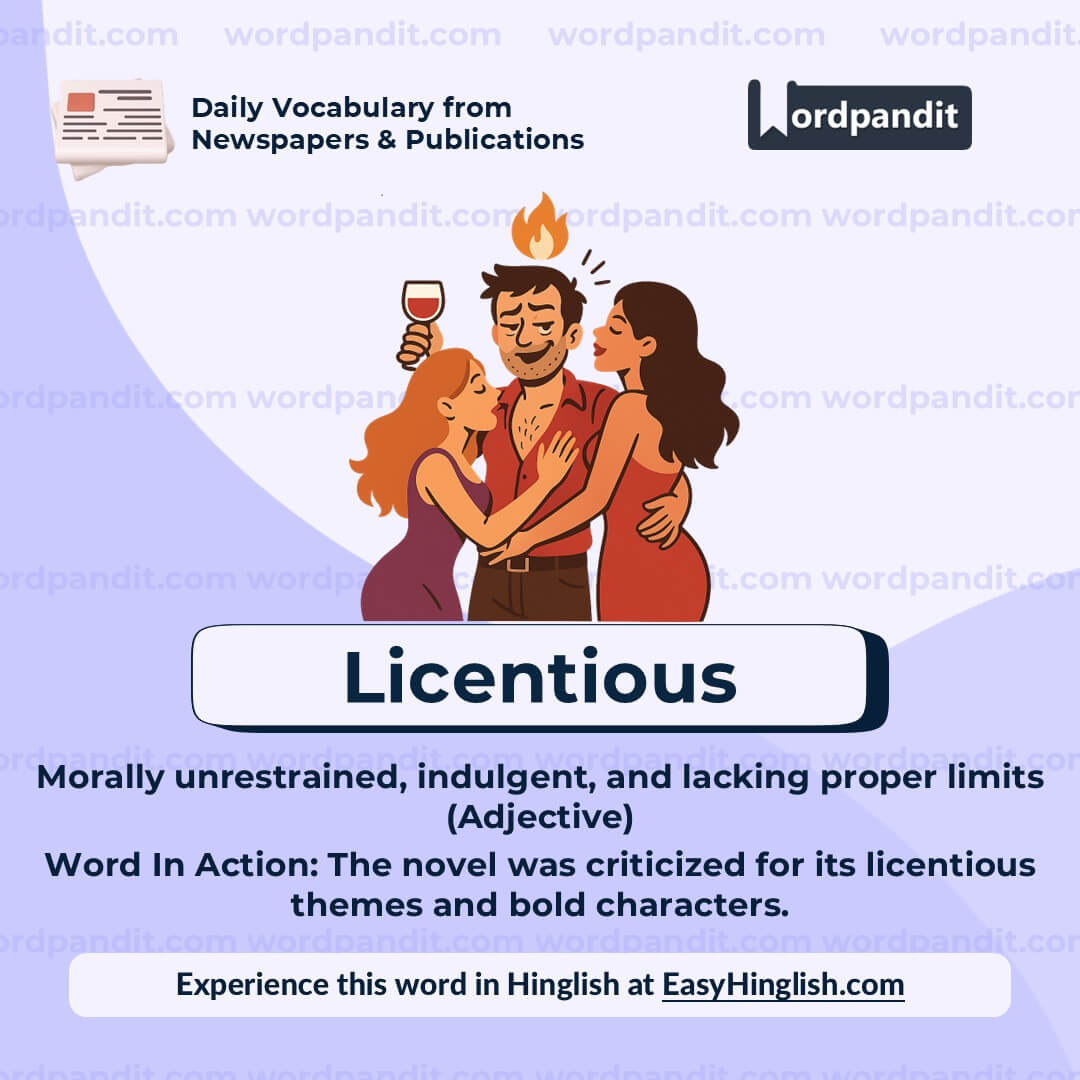
WORD-3: Licentious
Context:
"...the youth who become licentious by a law forbidding them to spend and waste..." - The Republic Analysis Article
Explanatory Paragraph:
Licentious meaning in English is 'morally unrestrained, lacking legal or ethical restraints, especially in sexual conduct or indulgent behavior.' This word is used when describing people or behaviors that disregard accepted moral standards and pursue excessive pleasure or freedom without self-control. Licentious is commonly used in literary criticism, historical texts, philosophical discussions, and competitive exam passages like CAT, GRE, and UPSC to describe characters, societies, or behaviors characterized by moral excess and lack of discipline.
Meaning: Morally unrestrained, indulgent, and lacking proper limits (Adjective)
Pronunciation: ly-SEN-shus
Difficulty Level: ⭐⭐⭐⭐ Advanced
Etymology: Licentious comes from Latin 'licentia' meaning 'freedom' or 'license,' derived from 'licere' meaning 'to be permitted.' While 'license' initially meant legitimate freedom, 'licentious' evolved in the 16th century to specifically describe excessive freedom that crosses into moral disorder. The word carries the idea that too much freedom without restraint leads to corruption and indulgence, transforming permission into moral abandonment.
Prashant Sir's Notes:
Many students confuse licentious with promiscuous, but there's an important distinction: promiscuous specifically refers to sexual behavior, while licentious usage encompasses broader moral indulgence including excess in pleasure, disregard for rules, and general lack of self-control. The difference between licentious and libertine is subtle—libertine often implies philosophical rejection of morality, while licentious simply describes unrestrained behavior. For CAT and GRE aspirants, licentious frequently appears in reading comprehension passages about historical periods, social criticism, or character analysis in literature. In Indian English newspapers, you'll occasionally see licentious used in opinion pieces criticizing political or corporate excess, though writers often prefer softer terms like "indulgent" or "unrestrained" for contemporary contexts.
Synonyms & Antonyms:
Synonyms: dissolute, debauched, immoral, unrestrained, promiscuous, libertine, wanton, dissipated, profligate, lascivious
Antonyms: moral, virtuous, restrained, disciplined, chaste, proper, principled
Usage Examples:
- The historical novel depicted the licentious lifestyle of certain Mughal courtiers who indulged in excessive luxury while the empire faced external threats.
- Critics argued that the film glorified licentious behavior rather than presenting it as a cautionary tale about moral decline.
- The reformer's speeches condemned what he called the licentious attitudes of the urban elite who ignored traditional values in pursuit of material pleasure.
- Sharma's grandmother often complained that modern society had become too licentious, with young people showing no respect for boundaries or propriety.
Cultural Reference:
"The character of Prem in 'Devdas' is portrayed not merely as romantic but as licentious in his self-destructive pursuit of pleasure through alcohol, ultimately representing the consequences of unrestrained passion." - Film analysis perspective
Think About It:
Where should society draw the line between personal freedom and moral responsibility? Is what one generation calls licentious behavior simply the next generation's definition of individual liberty and choice?
Quick Activity:
Write two sentences comparing different historical or fictional characters—one who exercised restraint and one who lived licentiously. Explore how their choices led to different outcomes.
Memory Tip:
Think of 'Licentious' as 'LICENSE-ious'—imagine someone who takes their LICENSE (freedom) TOO far, crossing all moral boundaries. Picture a driving license holder who thinks the license means no rules apply—driving recklessly everywhere. That excessive, rule-breaking freedom is licentious behavior!
Real-World Application:
Licentious is commonly used in literary analysis when discussing character flaws, in historical writing describing decadent periods or corrupt societies, and in social commentary critiquing moral decline. For competitive exam essays, particularly UPSC ethics papers and CAT reading comprehension, understanding 'licentious' helps you analyze arguments about freedom versus responsibility, individual rights versus social order, and the consequences of unchecked indulgence. The word frequently appears in passages discussing ancient civilizations, Renaissance courts, or modern debates about cultural values and personal liberty.
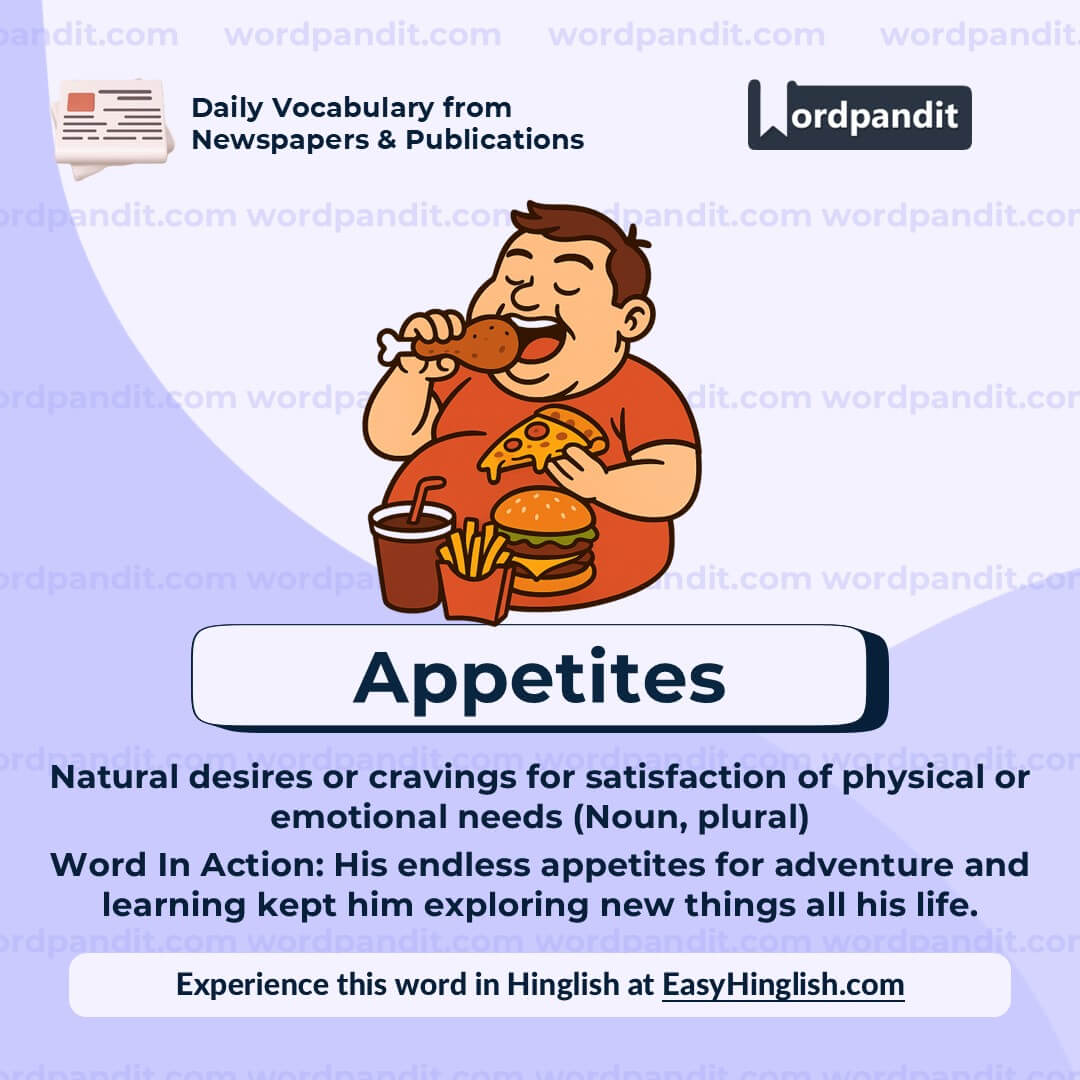
WORD-4: Appetites
Context:
"Democracy unchains the appetite of the oligarchic man..." - The Republic Analysis Article
Explanatory Paragraph:
Appetites meaning in English is 'natural desires or cravings, particularly for food, pleasure, or satisfaction of physical and emotional needs.' This word is used when describing human drives and urges that motivate behavior, ranging from basic biological needs to deeper psychological desires for power, wealth, or pleasure. Appetites is commonly used in philosophical texts, psychological discussions, nutritional contexts, and competitive exam passages like CAT, GRE, and UPSC to explore human motivation, self-control, and the tension between desire and reason.
Meaning: Natural desires or cravings for satisfaction of physical or emotional needs (Noun, plural)
Pronunciation: AP-uh-tyts
Difficulty Level: ⭐⭐ Basic to Intermediate
Etymology: Appetites comes from Latin 'appetitus' meaning 'desire' or 'longing,' derived from 'appetere' meaning 'to seek after' or 'strive for.' The root combines 'ad-' (toward) and 'petere' (to seek). Originally used primarily for hunger and physical cravings in the 14th century, the word gradually expanded to encompass all forms of desire—from basic needs for food to complex yearnings for power, knowledge, or pleasure, making it central to philosophical discussions about human nature.
Prashant Sir's Notes:
Students often ask: what is the difference between appetites and desires? While both refer to wanting something, appetites specifically suggests natural, often physical cravings that arise from bodily or instinctual needs, whereas desires can be purely mental or abstract. How to use appetites correctly: in philosophical contexts like the given example, it's often plural and refers to the full range of human cravings—not just hunger. For UPSC essay and CAT RC passages, appetites frequently appears in discussions about self-control, governance, human nature, and morality. In Indian English newspapers, you'll see phrases like "political appetites," "consumer appetites," or "appetites for growth"—the word extends metaphorically to any strong craving or ambition beyond just food.
Synonyms & Antonyms:
Synonyms: desires, cravings, hungers, yearnings, urges, longings, wants, inclinations, thirsts, lusts
Antonyms: aversion, distaste, disinterest, apathy, satiation, satisfaction, repulsion
Usage Examples:
- The festival season awakened everyone's appetites for sweets, with mithai shops in Delhi witnessing long queues from morning till night.
- Corporate leaders must balance their appetites for growth with ethical responsibilities toward employees and society at large.
- Ravi's appetites extended beyond mere food—he craved knowledge, travel experiences, and meaningful conversations with diverse people.
- The economic reforms of the 1990s unleashed Indian consumers' appetites for international brands and luxury goods previously unavailable in the market.
Cultural Reference:
"In the Bhagavad Gita, Krishna advises Arjuna on controlling one's appetites and desires, teaching that mastery over cravings leads to inner peace and spiritual clarity." - Common interpretation of Gita's teachings on self-control
Think About It:
In a consumer-driven society with unlimited choices and constant advertising, how can individuals distinguish between genuine appetites that need satisfaction and manufactured desires created by marketing and social pressure?
Quick Activity:
List three different types of appetites humans experience—physical, emotional, and intellectual. Write one sentence for each, showing how these different appetites drive behavior in different ways.
Memory Tip:
Think of 'Appetites' as 'APPE-TITES'—imagine your stomach and mind both being TIED to different APPS (applications) of desire. Just as food apps make you hungry, different life situations activate different appetites—hunger app, ambition app, pleasure app. All these cravings are your appetites!
Real-World Application:
Appetites is commonly used in nutritional and health writing when discussing eating habits and physical cravings, in business journalism to describe market demand and consumer behavior, and in philosophical or political writing to explore human motivation and governance. For competitive exam essays, particularly UPSC ethics and CAT reading comprehension, understanding 'appetites' helps you analyze arguments about self-control, the role of desire in human behavior, consumer culture, and the philosophical tension between satisfying needs and maintaining discipline. The word frequently appears in passages discussing psychology, economics, political philosophy, and social commentary.
WORD-5: Posited
Context:
"These regimes can be observed in isolation, but they are also posited as a linear progression..." - The Republic Analysis Article
Explanatory Paragraph:
Posited meaning in English is 'put forward or assumed as a fact or basis for reasoning; proposed as a theory or explanation.' This word is used when someone presents an idea, theory, or assumption as the foundation for further argument or discussion, without necessarily proving it first. Posited is commonly used in academic writing, philosophical texts, scientific papers, and competitive exam passages like CAT, GRE, and UPSC to indicate that a concept or framework has been proposed as a starting point for analysis or debate.
Meaning: Put forward as a basis for argument; assumed or proposed as true (Verb, past tense)
Pronunciation: PAH-zih-ted
Difficulty Level: ⭐⭐⭐ Intermediate
Etymology: Posited comes from Latin 'positus,' the past participle of 'ponere' meaning 'to place' or 'to put.' The word entered English through medieval philosophical Latin 'positum,' referring to something laid down or established as a premise. In academic discourse, it evolved to mean proposing something as an axiom or starting assumption, emphasizing the act of intellectually "placing" an idea on the table for consideration rather than proving it empirically.
Prashant Sir's Notes:
Many students confuse posited with proven or stated, but there's a crucial distinction: posited specifically means proposing something as a theoretical foundation without necessarily having evidence yet. The difference between posited and hypothesized is that hypothesized suggests a testable proposition in scientific method, while posited usage is broader and appears in philosophy, social sciences, and theoretical frameworks. For CAT and GRE aspirants, posited frequently appears in reading comprehension passages about theories, models, and conceptual frameworks—it signals that what follows is a proposed explanation rather than established fact. In Indian academic writing and newspaper editorials, you'll see phrases like "the theory posits that" or "economists have posited"—it's the sophisticated way to say "someone has suggested this idea as a starting point."
Synonyms & Antonyms:
Synonyms: proposed, postulated, assumed, hypothesized, theorized, suggested, advanced, put forward, asserted, presumed
Antonyms: disproved, refuted, rejected, questioned, challenged, denied
Usage Examples:
- The economist posited that India's demographic dividend would drive growth for the next two decades, though critics questioned several underlying assumptions.
- Ancient Indian philosophers posited the concept of karma as a fundamental law governing moral consequences across lifetimes.
- The research paper posited a direct correlation between social media usage and anxiety levels among Bangalore's working professionals.
- Historians have posited various theories about the decline of the Indus Valley Civilization, ranging from climate change to foreign invasions.
Cultural Reference:
"Einstein posited that time is relative rather than absolute, fundamentally changing how we understand the universe—a theory that seemed impossible until experimental evidence confirmed it." - Common reference in science education
Think About It:
How many beliefs we hold about success, happiness, or the "right way to live" are simply ideas posited by society or family tradition rather than truths we've personally examined and tested?
Quick Activity:
Think of a common assumption in Indian society about career, marriage, or success. Write one sentence using 'posited' to present this assumption as a theory that could be questioned or examined.
Memory Tip:
Think of 'Posited' as 'POSITION-ed'—imagine someone POSITIONING a chess piece on the board as their opening move. They're PLACING an idea on the table as a starting point, not claiming victory yet. Just as a chess opening POSITS a strategy, academic arguments POSIT theories as foundations for discussion!
Real-World Application:
Posited is commonly used in academic writing across all disciplines when introducing theories, models, or frameworks, in research papers when presenting hypotheses or assumptions, and in analytical essays when discussing proposed explanations. For competitive exam essays and reading comprehension, particularly UPSC mains and CAT RC passages, understanding 'posited' helps you identify when authors are presenting theoretical frameworks versus established facts. It signals critical thinking opportunities—whenever something is posited, you should evaluate the evidence and logic supporting that proposition rather than accepting it as proven truth.


