

Daily Vocabulary from International Newspapers and Publications
Expand Your Vocabulary with Wordpandit’s Global Vocabulary Hub
At Wordpandit, we are committed to helping you develop a truly global vocabulary by drawing from some of the most respected international publications. This section is designed to keep you ahead of the curve by introducing you to words that define global conversations and trends.
The Power of Global Sources
To help you think and communicate on a global scale, we curate vocabulary from renowned international sources, such as:
- The New York Times
- The Washington Post
- BBC
- The Guardian
- The Economist
- Scientific American
- Psychology Today
- And many more...
Stay Global, Stay Competitive
Our daily updates from international publications ensure you are consistently exposed to new words that reflect global news and developments, making sure your vocabulary is not only current but also globally relevant.
Enhance Your Global Perspective
Whether you’re preparing for international exams, aiming to excel in global business communication, or want to enhance your language skills for personal growth, Wordpandit offers the resources you need to thrive in a global context.
Effective Learning, Global Reach
Our learning methodology combines global examples, memory aids, and interactive activities, allowing you to internalize new words effectively and apply them in real-world scenarios.
Begin Your Global Vocabulary Journey Now!

Why Choose Wordpandit?
Practical Learning: Focus on words you'll actually encounter in real-world reading, enhancing your comprehension and communication skills.
Diverse Content: From current affairs to scientific breakthroughs, our varied sources expose you to vocabulary across multiple domains.
Effortless Integration: Make Wordpandit a part of your daily routine. Just a few minutes each day can significantly boost your lexicon over time.
Your Path to Vocabulary Mastery
- Visit our Daily Vocabulary section regularly
- Explore new words and their usage in context
- Practice incorporating these words into your own writing and speech
- Track your progress as your vocabulary expands
Start Your Journey Today
Embark on your vocabulary enhancement journey with Wordpandit. By consistently engaging with our daily posts, you'll build a robust vocabulary that serves you well in academic, professional, and personal contexts.
Remember, a word a day keeps linguistic limitations at bay. Make Wordpandit your daily companion in the quest for vocabulary excellence!
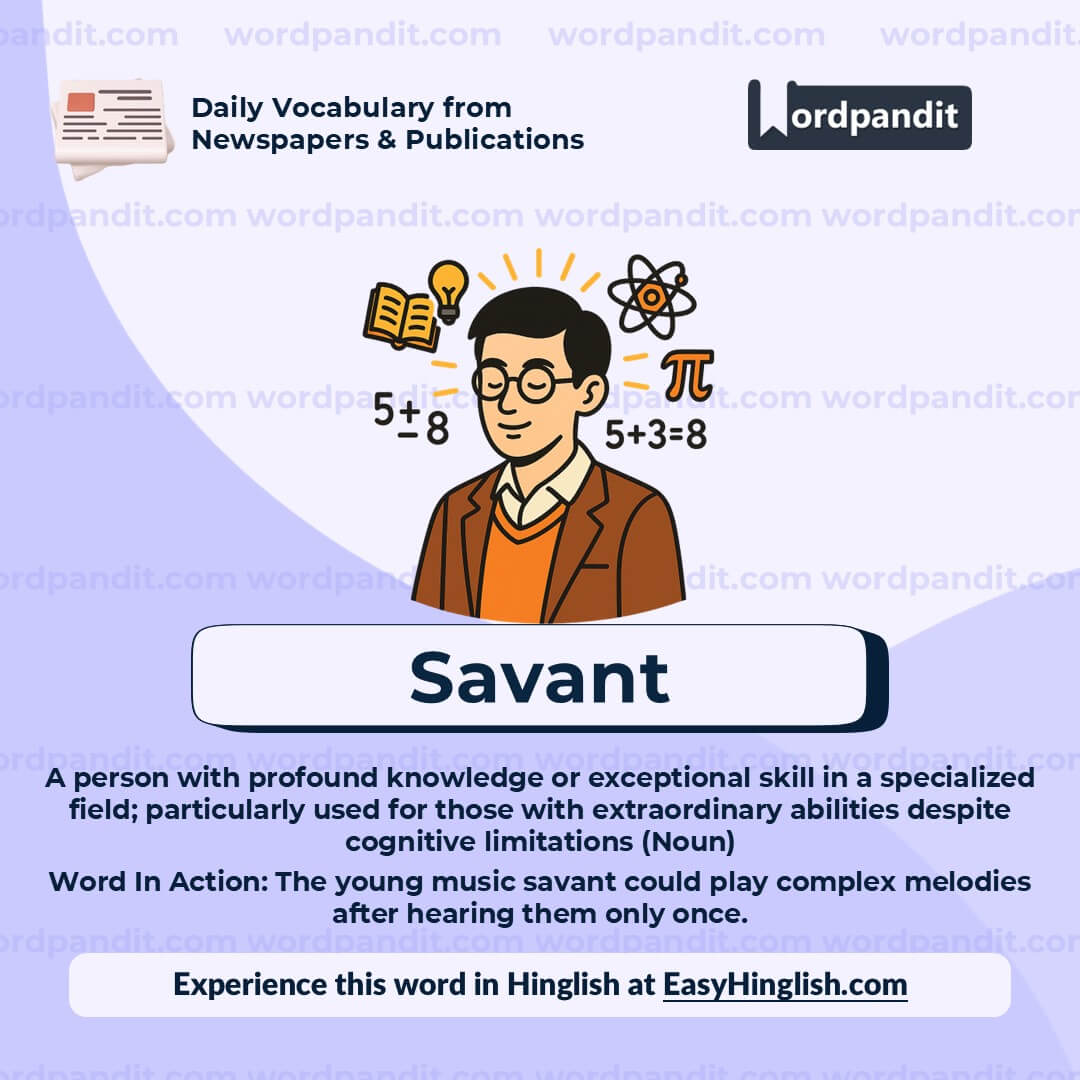
WORD-1: Savant
Context:
"The answer took the form of a medical label: the boy was what 19th-century medicine termed an 'idiot savant'." - Aeon
Explanatory Paragraph:
Savant meaning in English is 'a person with exceptional skill or knowledge in a specific area, often despite significant mental disabilities.' This word is used when describing individuals who possess extraordinary abilities in particular domains like mathematics, music, or memory, while facing challenges in other cognitive areas. How to use savant correctly depends on context—it appears frequently in psychology articles, medical literature, and competitive exam passages discussing human cognition and exceptional abilities.
Meaning: A person with profound knowledge or exceptional skill in a specialized field; particularly used for those with extraordinary abilities despite cognitive limitations (Noun)
Pronunciation: suh-VAHNT or SAV-uhnt
Difficulty Level: ⭐⭐⭐ Intermediate
Etymology: Savant comes from French 'savant' meaning 'knowing or learned,' derived from Latin 'sapere' meaning 'to be wise.' The term evolved in medical contexts during the 19th century when it was paired with 'idiot' to describe individuals with remarkable abilities coexisting with developmental disabilities. Modern usage has dropped the offensive pairing, using 'savant' or 'savant syndrome' alone to respectfully describe this fascinating cognitive phenomenon.
Prashant Sir's Notes:
Many students confuse 'savant' with 'genius'—the difference between savant and genius is that a savant typically has exceptional ability in one narrow area despite overall cognitive challenges, while a genius shows high intelligence across multiple domains. For CAT and GRE aspirants, savant frequently appears in Reading Comprehension passages about neuroscience, psychology, and human potential. In Indian English newspapers, you'll often see phrases like "a musical savant" or "savant-like abilities" when describing prodigies or individuals with extraordinary specialized talents. The savant usage in sentences often emphasizes the contrast between remarkable skill and other limitations, making it crucial for understanding nuanced descriptions of human capability.
Synonyms & Antonyms:
Synonyms: expert, specialist, scholar, master, virtuoso, prodigy, genius (in specific context), authority, maven, wizard (informal)
Antonyms: novice, amateur, layperson, beginner, ignoramus, generalist
Usage Examples:
- Aarav was a mathematical savant who could calculate complex equations mentally within seconds, though he struggled with basic social interactions.
- The documentary featured a musical savant from Mumbai who could replicate any melody perfectly after hearing it just once.
- Despite limited formal education, the village carpenter was a savant in woodworking, creating intricate designs that amazed architects from Delhi.
- Priya's brother has savant syndrome and can remember every cricket match statistic from the past twenty years with perfect accuracy.
Cultural Reference:
"Like the savants who can paint masterpieces or play complex music without formal training, true genius often operates beyond conventional learning." - Common reference in discussions about Ramanujan, India's mathematical genius
Think About It:
What does the existence of savants tell us about the untapped potential of the human brain, and why do extraordinary abilities sometimes emerge alongside significant challenges?
Quick Activity:
Research one famous savant (like Stephen Wiltshire or Kim Peek) and write three sentences describing their extraordinary abilities and how they challenge our understanding of intelligence.
Memory Tip:
Think of 'Savant' as 'SAVE-ANT'—imagine an ant that can SAVE all information perfectly in one specific area, like remembering every route in an entire city, even though it's just a tiny ant with limitations in other areas.
Real-World Application:
Savant is commonly used in psychology journals, medical literature, and feature articles about extraordinary human abilities. In academic writing and competitive exam passages, the term appears when discussing neuroscience, cognitive diversity, and the spectrum of human intelligence. Journalists use 'savant' to describe individuals with remarkable specialized talents, particularly in fields like music, mathematics, art, and memory, making it essential vocabulary for understanding discussions about human potential and neurological conditions.
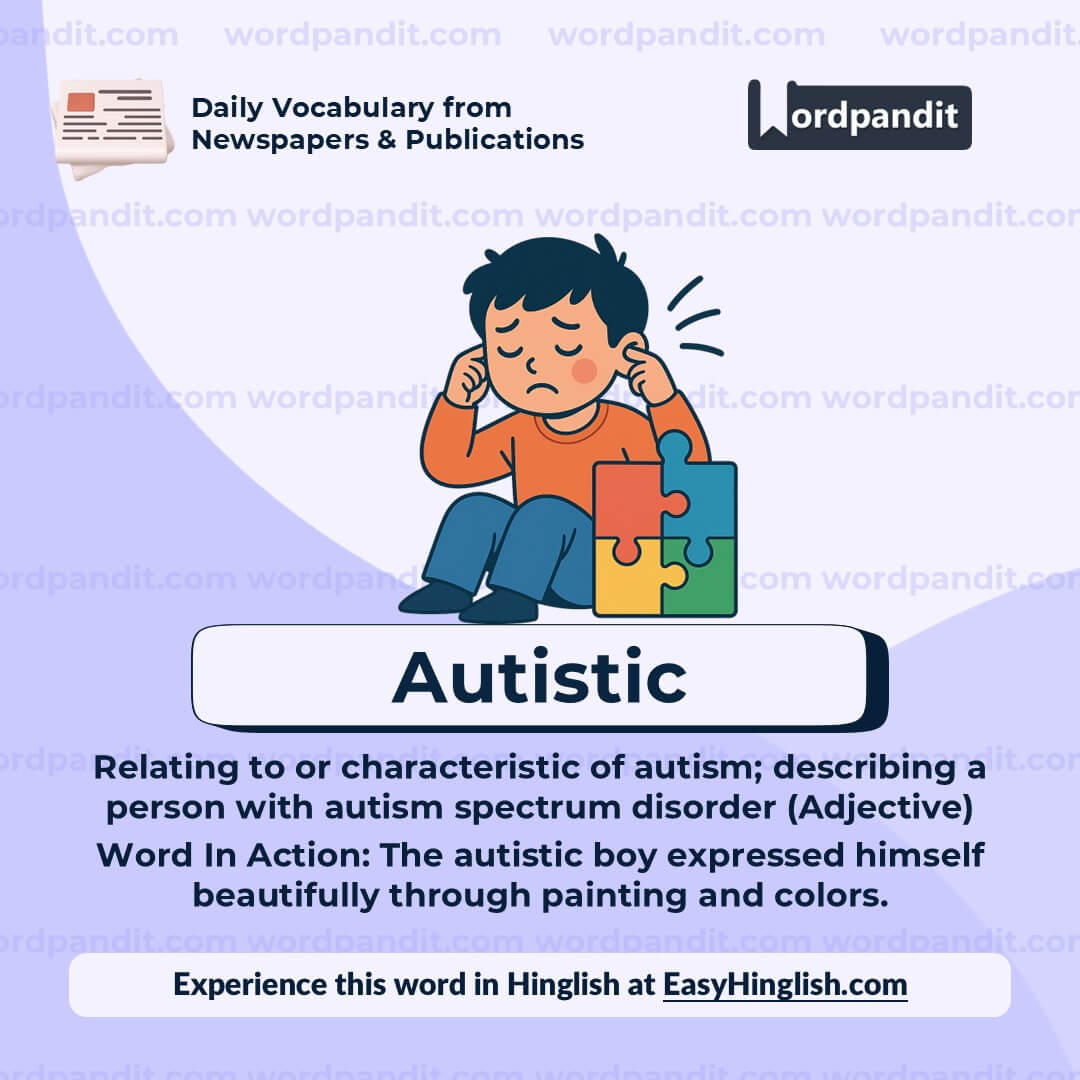
WORD-2: Autistic
Context:
"Treffert (1933-2020), one of the leading experts in the field – defines the savant phenomenon as 'a rare condition in which persons with various developmental disorders, including autistic disorder, have an amazing ability and talent'." - Aeon
Explanatory Paragraph:
Autistic meaning in English is 'relating to or affected by autism, a developmental condition characterized by differences in social communication, behavior patterns, and sensory processing.' This word is used when describing individuals with autism spectrum disorder or characteristics associated with this neurological condition. How to use autistic in sentences requires sensitivity and person-first or identity-first language preferences, and the term appears frequently in medical literature, educational contexts, psychology articles, and discussions about neurodiversity in competitive exam passages.
Meaning: Relating to or characteristic of autism; describing a person with autism spectrum disorder (Adjective)
Pronunciation: aw-TIS-tik
Difficulty Level: ⭐⭐ Basic to Intermediate
Etymology: Autistic comes from Greek 'autos' meaning 'self,' combined with the suffix '-istic.' The term was coined in 1912 by Swiss psychiatrist Eugen Bleuler, who used 'autism' to describe the self-absorbed behavior he observed in some schizophrenia patients. In 1943, Leo Kanner applied the term specifically to children with developmental differences in social interaction and communication, establishing autism as a distinct condition. The word reflects the early (now outdated) perception of autistic individuals as being withdrawn into their own world, though modern understanding recognizes autism as a complex neurological variation with diverse presentations.
Prashant Sir's Notes:
Students often ask: what is the difference between autistic and autism? 'Autism' is the noun naming the condition itself, while 'autistic' is the adjective describing someone with autism or characteristics of autism. For UPSC and CAT aspirants, autistic frequently appears in passages about neurodiversity, education policy, and social inclusion. In Indian English usage, you'll see both 'autistic person' (identity-first language preferred by many in the autism community) and 'person with autism' (person-first language). When discussing this topic in essays or comprehension answers, it's important to use respectful, neutral language that recognizes autism as a neurological difference rather than a deficit. In competitive exam RC passages, autistic often appears in contexts discussing diverse cognitive styles and special education.
Synonyms & Antonyms:
Synonyms: on the spectrum (informal), neurodivergent (broader term), having autism spectrum disorder (clinical), neuroatypical (general term)
Antonyms: neurotypical, allistic (technical term for non-autistic), typically developing
Usage Examples:
- The school in Bangalore opened a special program to support autistic children in developing social and communication skills alongside their academic studies.
- Rohan, an autistic software engineer, excels at pattern recognition and debugging code, bringing unique strengths to his development team at the tech company.
- Many autistic individuals have sensory sensitivities that make crowded places like Mumbai local trains particularly overwhelming and challenging to navigate.
- The documentary explored how autistic adults in India face employment discrimination despite having valuable skills and perspectives to contribute to workplaces.
Cultural Reference:
"Understanding autism isn't about fixing someone—it's about accepting different ways of experiencing the world." - Common perspective in neurodiversity advocacy, echoing themes from popular media like the movie "My Name is Khan"
Think About It:
Why does Indian society need better awareness about autism, and how can workplaces and educational institutions create more inclusive environments for autistic individuals?
Quick Activity:
Write two sentences describing how schools or workplaces in India can better support autistic students or employees, focusing on practical accommodations and inclusive practices.
Memory Tip:
Remember 'Autistic' by thinking 'AUTO-STICK'—like how some people's brains are on 'AUTO' mode that 'STICKS' to certain patterns, routines, and ways of processing information that differ from typical development.
Real-World Application:
Autistic is commonly used in medical reports, educational assessments, psychology research, and policy documents related to special education and disability rights. In journalism and feature writing, the term appears in articles about neurodiversity, inclusion, and mental health awareness. For competitive exam essays and answers, understanding 'autistic' is essential when discussing education policy, social inclusion, healthcare accessibility, and workplace diversity. The term is increasingly important in Indian discourse as awareness grows about developmental differences and the need for inclusive practices in schools, colleges, and professional environments.
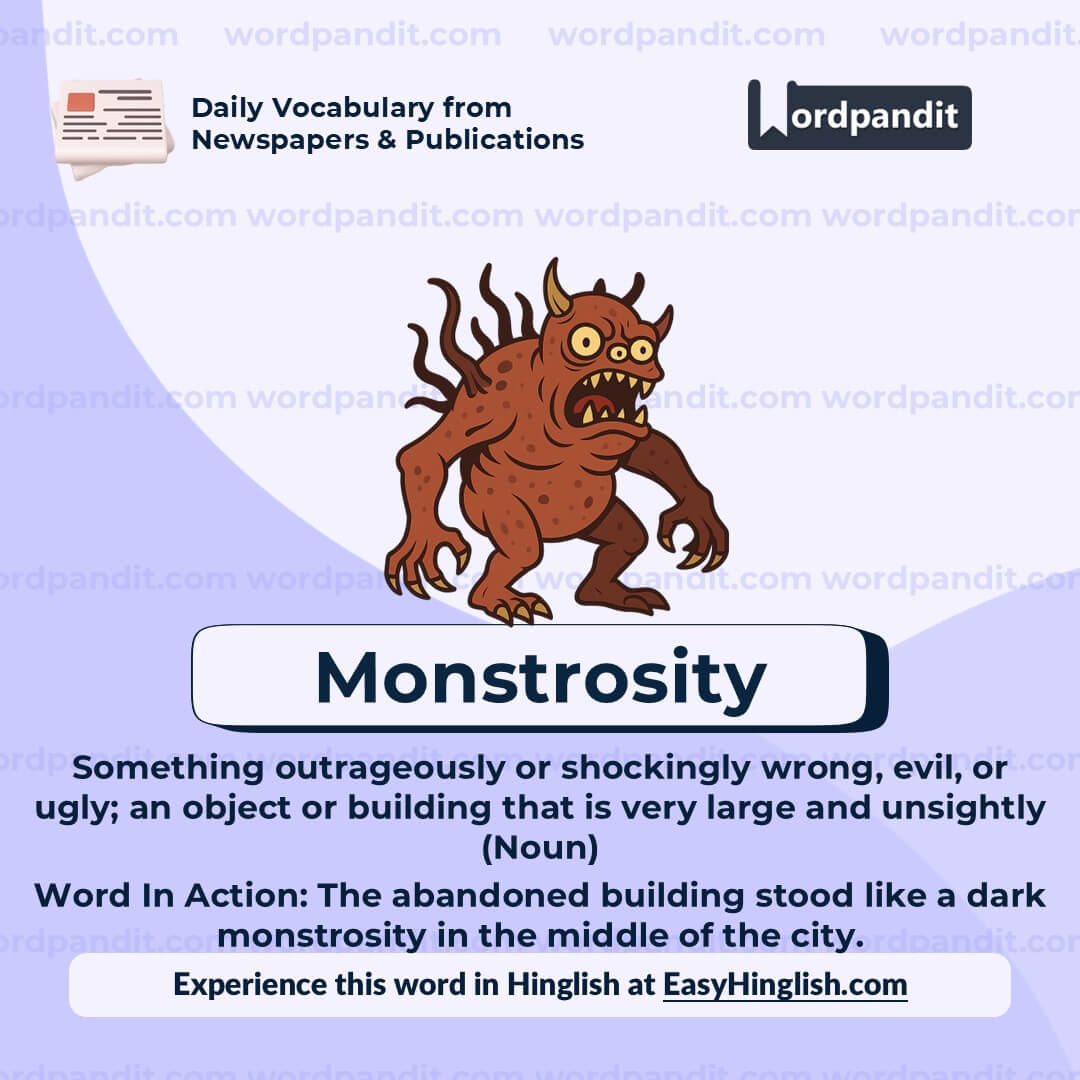
WORD-3: Monstrosity
Context:
"In the scheme of how intelligence was understood then, the savant was at best otherworldly and at worst a monstrosity." - Aeon
Explanatory Paragraph:
Monstrosity meaning in English is 'something that is shockingly ugly, wrong, or unnatural; an outrageous or horrifying thing or person.' This word is used when describing something perceived as grotesque, morally offensive, or so abnormal that it provokes shock or disgust. Monstrosity appears commonly in literary criticism, social commentary, historical discussions, and competitive exam passages where authors express strong disapproval or describe something as fundamentally wrong or distorted beyond acceptable limits.
Meaning: Something outrageously or shockingly wrong, evil, or ugly; an object or building that is very large and unsightly (Noun)
Pronunciation: mon-STROS-ih-tee
Difficulty Level: ⭐⭐⭐ Intermediate
Etymology: Monstrosity comes from Latin 'monstrum' meaning 'divine omen, portent, or monster,' which itself derives from 'monere' meaning 'to warn.' In ancient times, unusual births or phenomena were seen as warnings from gods. The word passed through Old French 'monstruosité' into English in the 16th century. Originally used for beings or things that defied natural order, 'monstrosity' evolved to describe anything shockingly abnormal, whether physically grotesque, morally repugnant, or aesthetically offensive. The connection to 'monster' reveals how societies have historically labeled anything different or unusual as frightening or wrong.
Prashant Sir's Notes:
Many students confuse 'monstrosity' with 'atrocity'—the difference between monstrosity and atrocity is that monstrosity emphasizes something's shocking abnormality or ugliness (physical or moral), while atrocity specifically refers to extremely cruel or wicked acts. For CAT and GRE aspirants, monstrosity frequently appears in passages discussing historical injustices, architectural criticism, or moral philosophy. How to use monstrosity correctly: it carries very strong negative judgment, so use it only when describing something truly outrageous or offensive. In Indian English newspapers, you'll see "architectural monstrosity" for ugly buildings, "legal monstrosity" for unjust laws, or "moral monstrosity" for deeply unethical situations. The word signals the author's strong condemnation, making it crucial for identifying tone in RC passages.
Synonyms & Antonyms:
Synonyms: abomination, atrocity, horror, eyesore, outrage, obscenity, grotesquerie, aberration, enormity (in modern usage), travesty
Antonyms: beauty, marvel, wonder, masterpiece, delight, treasure, perfection
Usage Examples:
- The new shopping mall built in the heritage district of Jaipur was criticized as an architectural monstrosity that destroyed the city's historic character.
- Activists called the dowry system a social monstrosity that continues to oppress women and perpetuate violence despite legal prohibitions.
- The colonial-era law requiring licenses for every small business was described as a bureaucratic monstrosity that stifled entrepreneurship in independent India.
- Neighbors complained that Sharma's house extension was a concrete monstrosity that blocked sunlight and ruined the aesthetic appeal of the entire neighborhood.
Cultural Reference:
"The Emergency period of 1975-77 is often described as a democratic monstrosity—a time when fundamental rights were suspended and dissent was crushed." - Common reference in Indian political discourse
Think About It:
What practices or systems in modern Indian society might future generations view as monstrosities, just as we now condemn historical injustices like untouchability or child marriage?
Quick Activity:
Write two sentences describing something you consider a monstrosity—it could be a building, a law, a social practice, or a policy—and explain why it deserves such strong criticism.
Memory Tip:
Think of 'Monstrosity' as 'MONSTER-CITY'—imagine a city full of monsters, something so shocking and wrong that it horrifies everyone who sees it, just like how this word describes things that are outrageously awful.
Real-World Application:
Monstrosity is commonly used in opinion pieces, architectural criticism, social commentary, and political discourse to express strong disapproval. In formal writing and competitive exam essays, the term effectively conveys moral outrage or aesthetic shock when discussing unjust systems, ugly constructions, or deeply flawed policies. Journalists use 'monstrosity' in editorials about corruption scandals, environmental destruction, or human rights violations. Understanding this word is essential for identifying strong authorial tone in CAT and GRE Reading Comprehension passages, where such emotionally charged vocabulary reveals the writer's perspective and judgment.
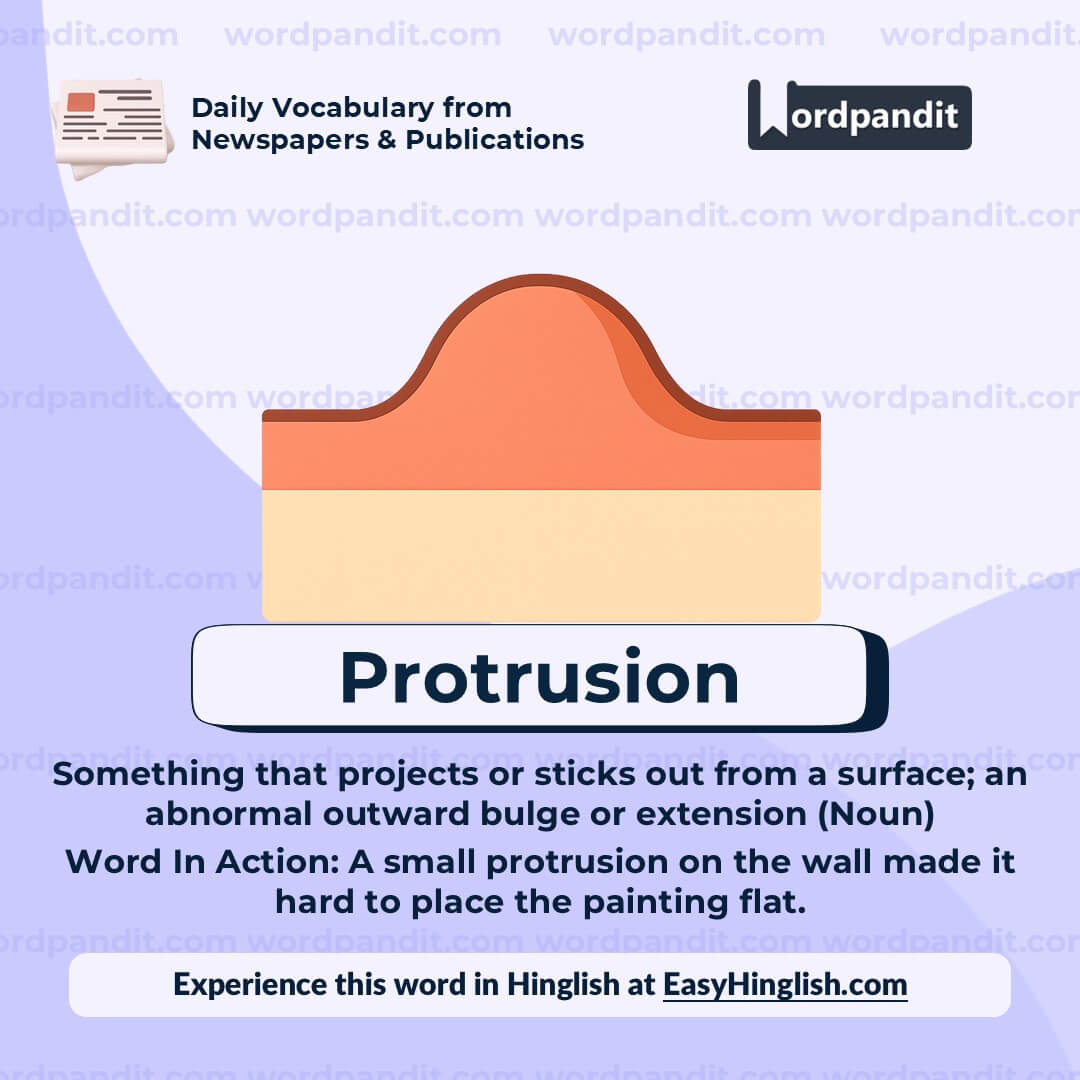
WORD-4: Protrusion
Context:
"It is from this [wealthier] class almost exclusively that we have musical, mathematical, architectural, and other varieties of the idiot savant; useless protrusion of a single faculty, accompanied by a wo[e]ful general impotence." - Aeon
Explanatory Paragraph:
Protrusion meaning in English is 'something that sticks out or extends beyond a surface; an abnormal projection or bulge.' This word is used when describing physical objects that jut out awkwardly, or metaphorically, when referring to something that stands out excessively or inappropriately from its context. How to use protrusion depends on whether you're describing literal physical extension (like a rock jutting from a wall) or figurative excess (like an intrusive element in a system). Protrusion appears in medical texts, architectural descriptions, geology, and competitive exam passages discussing physical structures or metaphorical imbalances.
Meaning: Something that projects or sticks out from a surface; an abnormal outward bulge or extension (Noun)
Pronunciation: proh-TROO-zhun
Difficulty Level: ⭐⭐⭐ Intermediate
Etymology: Protrusion comes from Latin 'protrudere,' formed from 'pro-' meaning 'forward' and 'trudere' meaning 'to thrust or push.' The word entered English in the 17th century, initially used in medical and anatomical contexts to describe abnormal physical projections. Over time, its usage expanded to architecture, geology, and eventually metaphorical applications where something extends beyond normal or appropriate boundaries. The root 'trudere' (to thrust) also gives us words like 'intrude' and 'extrude,' all sharing the concept of pushing or forcing something into or out of a space.
Prashant Sir's Notes:
Many students confuse 'protrusion' with 'intrusion'—the difference between protrusion and intrusion is that protrusion means something sticking out or projecting outward, while intrusion means something forcing its way in or entering unwelcome. For GRE and CAT aspirants, protrusion frequently appears in scientific passages about geology, anatomy, or biology, but also watch for metaphorical usage like in this context sentence where a "protrusion of a single faculty" means one ability awkwardly jutting out while others remain undeveloped. In Indian English newspapers, you'll see "bone protrusion" in medical reports or "rock protrusion" in descriptions of mountainous terrain. The protrusion usage in sentences often emphasizes something being out of place or disproportionate, which is crucial for understanding the author's negative tone.
Synonyms & Antonyms:
Synonyms: projection, bulge, outgrowth, extrusion, prominence, protuberance, extension, jut, overhang, swelling
Antonyms: indentation, depression, cavity, recess, hollow, concavity
Usage Examples:
- The doctor examined the unusual bone protrusion on Rajesh's wrist and recommended an X-ray to determine if it required medical intervention.
- Hikers were warned about the dangerous rock protrusions along the Himalayan trail that could cause injuries in foggy conditions.
- The architect's design included an awkward protrusion on the building's facade that ruined the otherwise elegant symmetry of the structure.
- In the competitive exam passage, the author used "protrusion" metaphorically to describe how one overdeveloped skill created an imbalance in the person's overall abilities.
Cultural Reference:
"Like the Taj Mahal's minarets that frame rather than dominate, good architecture avoids unnecessary protrusions that disturb visual harmony." - Common principle in discussions of Indian architectural aesthetics
Think About It:
Can developing one skill to an extreme level while neglecting others create an unhealthy "protrusion" in our personal or professional lives, leaving us unbalanced?
Quick Activity:
Look around your room or workspace and identify two physical protrusions—things that stick out awkwardly. Then write one sentence describing each and whether it serves a purpose or is merely an eyesore.
Memory Tip:
Break 'Protrusion' into 'PRO-TRUDE-SHUN'—think of something that TRUDES (thrusts) out in a PRO (forward) direction, like your friend's broken phone screen protruding awkwardly from the cracked case.
Real-World Application:
Protrusion is commonly used in medical reports to describe bone spurs, herniated discs, or abnormal growths that extend beyond normal tissue boundaries. In architectural and engineering contexts, the term appears in descriptions of structural elements, design flaws, or geographical features. For competitive exam passages, understanding both literal and metaphorical uses of 'protrusion' is essential—it can describe physical projections or figuratively represent disproportionate development of one aspect at the expense of balance. Science writers and journalists use this term when discussing geological formations, dental issues, construction problems, or any situation where something extends awkwardly beyond its expected boundaries.
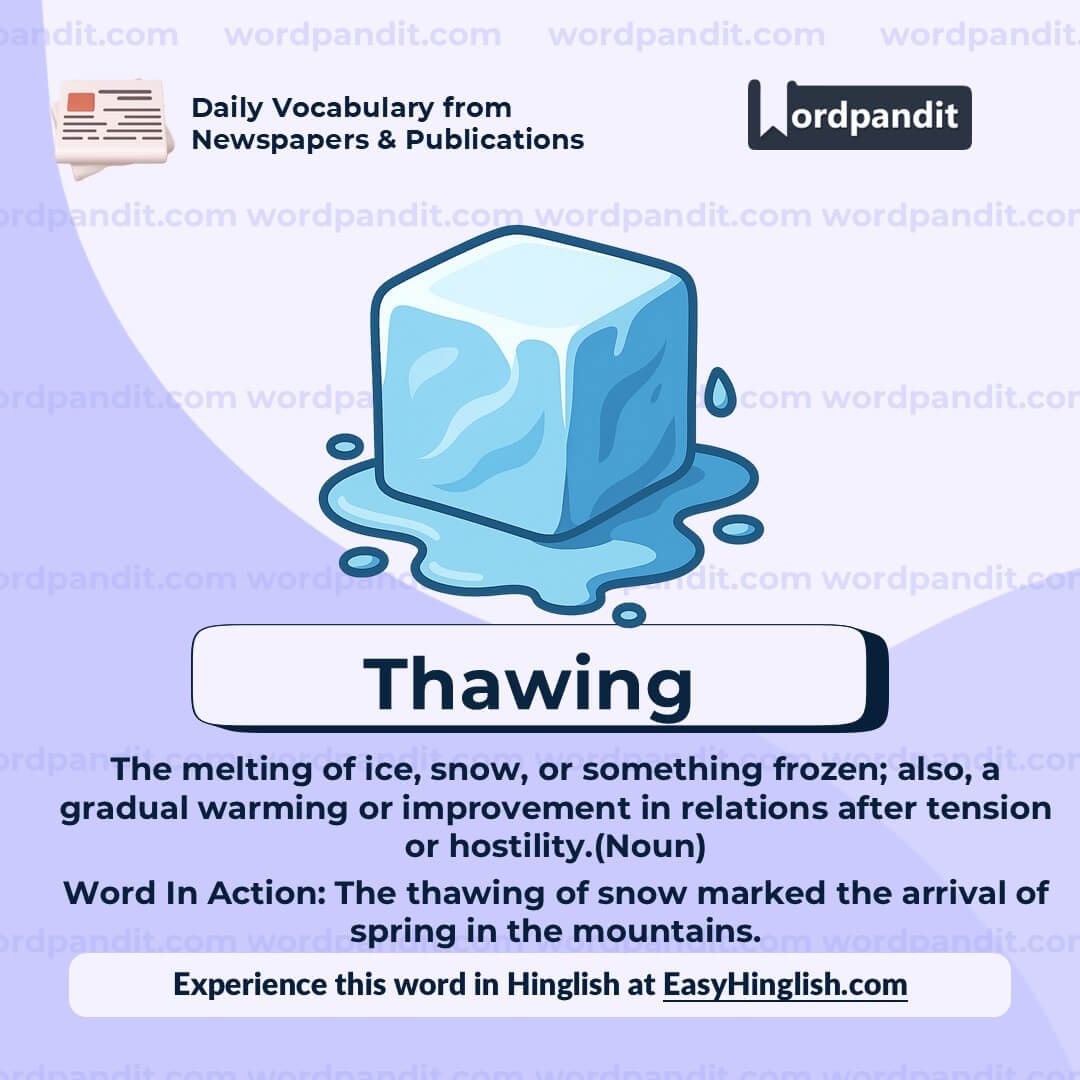
WORD-5: Thawing
Context:
"In particular, the piece focuses on Tseng's most well-known series, East Meets West (1979-89), in which, amid thawing relations between China and the US, he photographed himself wearing an outfit similar to Mao Zedong's famed 'Mao suit' at US landmarks including the White House, the Statue of Liberty and even Disneyland." - Aeon
Explanatory Paragraph:
Thawing meaning in English is 'the process of becoming less cold or frozen; metaphorically, the gradual warming or improvement of previously hostile or strained relationships.' This word is used when describing ice or snow melting, but more importantly in diplomatic and social contexts when tensions between people, groups, or nations begin to ease. How to use thawing correctly depends on context—literally for frozen substances becoming liquid, or figuratively for relationships becoming friendlier. Thawing appears frequently in international relations articles, political commentary, and competitive exam passages discussing diplomacy and conflict resolution.
Meaning: The process of ice, snow, or frozen substances melting; the gradual improvement of relations after a period of hostility or tension (Noun/Adjective when used as 'thawing relations')
Pronunciation: THAW-ing
Difficulty Level: ⭐⭐ Basic to Intermediate
Etymology: Thawing comes from Old English 'þawian' meaning 'to melt or become liquid from a frozen state,' related to Old Norse 'þeyja' and Dutch 'dooien.' The word has Germanic roots referring specifically to the melting of ice and snow. By the 16th century, English writers began using 'thaw' metaphorically to describe the warming of cold emotional states or hostile relationships. The gerund form 'thawing' emphasizes the gradual, ongoing process rather than a sudden change, making it perfect for describing the slow improvement of diplomatic relations, as frozen hostility gradually melts into cooperation.
Prashant Sir's Notes:
Students often ask: what is the difference between thawing and warming? While both suggest improvement, thawing specifically implies a previous frozen or icy state—relationships weren't just cool, they were completely frozen and hostile. For UPSC and CAT aspirants, thawing relations frequently appears in passages about international diplomacy, particularly Cold War history or India-Pakistan relations. In Indian English newspapers, you'll see phrases like "thawing ties between India and China after the border standoff" or "thawing relations following years of diplomatic freeze." The thawing usage in political contexts always emphasizes the gradual nature of improvement—ice doesn't melt instantly, and neither do hostile relationships. When you see this word in RC passages, it signals a cautiously optimistic tone about previously terrible relations finally improving, though not yet fully normalized.
Synonyms & Antonyms:
Synonyms: melting, warming, softening, easing, relaxing (of tensions), improving, normalizing (relations), détente (diplomatic term), reconciliation
Antonyms: freezing, cooling, chilling, deteriorating, souring (relations), hardening, worsening
Usage Examples:
- After decades of hostility, thawing relations between India and Bangladesh led to increased trade and cultural exchanges across the border.
- The corporate merger faced resistance initially, but thawing attitudes among employees from both companies eventually created a collaborative work environment.
- Political analysts observed thawing tensions between the two rival parties as they cooperated on the crucial education reform bill.
- Following the diplomatic breakthrough, signs of thawing appeared when both nations agreed to resume direct flights and visa-free travel for tourists.
Cultural Reference:
"The cricket diplomacy between India and Pakistan in 2004 symbolized thawing relations, as Vajpayee's bus journey to Lahore had attempted years earlier." - Common reference in South Asian political discourse
Think About It:
Why do frozen relationships between nations or communities take so long to thaw, even after the original causes of conflict have been resolved or forgotten?
Quick Activity:
Write two sentences about a personal or historical example of thawing relations—between friends, family members, communities, or countries—and identify what triggered the gradual improvement.
Memory Tip:
Think of 'Thawing' as 'THE-ICE-AWNING'—imagine an awning made of ice that's slowly melting and dripping, just like how frozen hostile relationships slowly warm up and improve, drip by drip, step by step.
Real-World Application:
Thawing is commonly used in diplomatic reporting, international relations analysis, and political commentary to describe improving relations between previously hostile entities. In business journalism, the term appears when discussing corporate rivalries becoming partnerships or labor disputes reaching resolution. For competitive exam essays on topics like international cooperation, conflict resolution, or diplomacy, 'thawing relations' is essential vocabulary. News anchors and editorial writers use this metaphor when covering peace processes, trade negotiations, or cultural exchanges following periods of tension. Understanding this term helps decode the cautiously optimistic tone often present in articles about gradual diplomatic progress.


