

Daily Vocabulary from International Newspapers and Publications
Expand Your Vocabulary with Wordpandit’s Global Vocabulary Hub
At Wordpandit, we are committed to helping you develop a truly global vocabulary by drawing from some of the most respected international publications. This section is designed to keep you ahead of the curve by introducing you to words that define global conversations and trends.
The Power of Global Sources
To help you think and communicate on a global scale, we curate vocabulary from renowned international sources, such as:
- The New York Times
- The Washington Post
- BBC
- The Guardian
- The Economist
- Scientific American
- Psychology Today
- And many more...
Stay Global, Stay Competitive
Our daily updates from international publications ensure you are consistently exposed to new words that reflect global news and developments, making sure your vocabulary is not only current but also globally relevant.
Enhance Your Global Perspective
Whether you’re preparing for international exams, aiming to excel in global business communication, or want to enhance your language skills for personal growth, Wordpandit offers the resources you need to thrive in a global context.
Effective Learning, Global Reach
Our learning methodology combines global examples, memory aids, and interactive activities, allowing you to internalize new words effectively and apply them in real-world scenarios.
Begin Your Global Vocabulary Journey Now!

Why Choose Wordpandit?
Practical Learning: Focus on words you'll actually encounter in real-world reading, enhancing your comprehension and communication skills.
Diverse Content: From current affairs to scientific breakthroughs, our varied sources expose you to vocabulary across multiple domains.
Effortless Integration: Make Wordpandit a part of your daily routine. Just a few minutes each day can significantly boost your lexicon over time.
Your Path to Vocabulary Mastery
- Visit our Daily Vocabulary section regularly
- Explore new words and their usage in context
- Practice incorporating these words into your own writing and speech
- Track your progress as your vocabulary expands
Start Your Journey Today
Embark on your vocabulary enhancement journey with Wordpandit. By consistently engaging with our daily posts, you'll build a robust vocabulary that serves you well in academic, professional, and personal contexts.
Remember, a word a day keeps linguistic limitations at bay. Make Wordpandit your daily companion in the quest for vocabulary excellence!
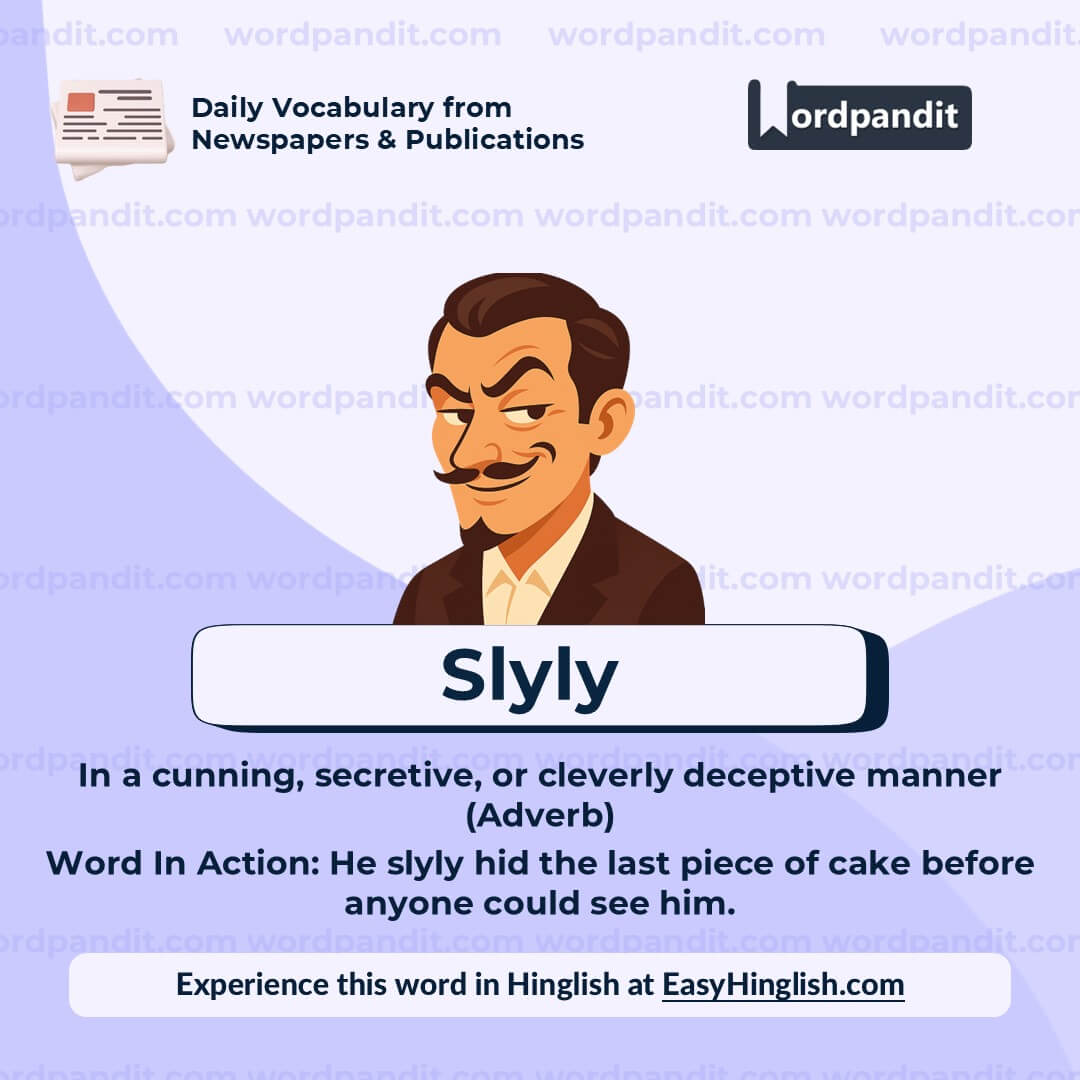
WORD-1: Slyly
Context:
"But then, he slyly used my sister's pregnancy as a distraction to skip the surgery altogether." - Aeon
Explanatory Paragraph:
Slyly meaning in English is 'in a cunning or secretive manner, often with clever deception.' This word is used when describing actions done with subtle trickery or sneaky intelligence, where someone achieves their goal without being obvious about their intentions. How to use slyly effectively: it commonly appears in storytelling, character descriptions in competitive exam passages, and formal writing to indicate cunning behavior or hidden motives behind seemingly innocent actions.
Meaning: In a cunning, secretive, or cleverly deceptive manner (Adverb)
Pronunciation: SLY-lee
Difficulty Level: ⭐⭐ Basic to Intermediate
Etymology: Slyly comes from the Old Norse word 'sloegr' meaning 'cunning or crafty,' which entered English through Scandinavian influences. The word evolved from describing physical stealth to encompass mental craftiness and deceptive cleverness, maintaining its association with secretive and clever behavior throughout centuries.
Prashant Sir's Notes:
Many students confuse 'slyly' with 'slowly'—the spelling difference is crucial! The difference between slyly and sneakily is subtle: slyly usage in sentences emphasizes cleverness and cunning intelligence, while 'sneakily' focuses more on secretive physical movement. For CAT and GRE aspirants, slyly frequently appears in RC passages describing character motivations or political maneuvering. In Indian English newspapers, you'll often see phrases like "slyly avoiding questions" or "slyly changing the topic" during political interviews—watch for this pattern when the writer wants to highlight cunning avoidance tactics.
Synonyms & Antonyms:
Synonyms: cunningly, craftily, sneakily, deviously, artfully, cleverly, furtively, stealthily, shrewdly, deceitfully
Antonyms: openly, honestly, directly, transparently, frankly, straightforwardly
Usage Examples:
- The opposition leader slyly shifted the debate topic whenever questions about corruption funding arose during the parliamentary session.
- Priya slyly mentioned her competitor's weaknesses during the presentation without directly criticizing them, impressing the selection committee.
- The vendor slyly added extra charges to the bill, hoping customers wouldn't notice the inflated service tax amount.
- Rohan slyly grinned when his mother asked who ate the last piece of cake, knowing his younger brother would be blamed.
Cultural Reference:
"Like Shakuni from Mahabharat, politicians often slyly manipulate situations to their advantage while appearing to support the common good." - Common reference in Indian political commentary
Think About It:
When does acting slyly cross the line from being clever to being unethical? Can sly behavior ever be justified in professional or personal life?
Quick Activity:
Think of a famous movie character (Bollywood or Hollywood) who acts slyly. Write two sentences describing how they use cunning behavior to achieve their goals.
Memory Tip:
Think of 'Slyly' as 'SLY-smile'—imagine someone with a sly smile on their face, like they're secretly planning something clever. Picture a fox (known for being sly) grinning while executing a cunning plan without anyone noticing.
Real-World Application:
In journalism and opinion writing, 'slyly' is commonly used to describe political maneuvers, corporate strategies, or character behavior where deception is subtle rather than obvious. Business reports use this word when analyzing competitive tactics where companies cleverly undermine rivals without direct confrontation. In academic essays and exam answers, using 'slyly' demonstrates sophisticated vocabulary when analyzing character motivations in literature or historical figures' strategies.
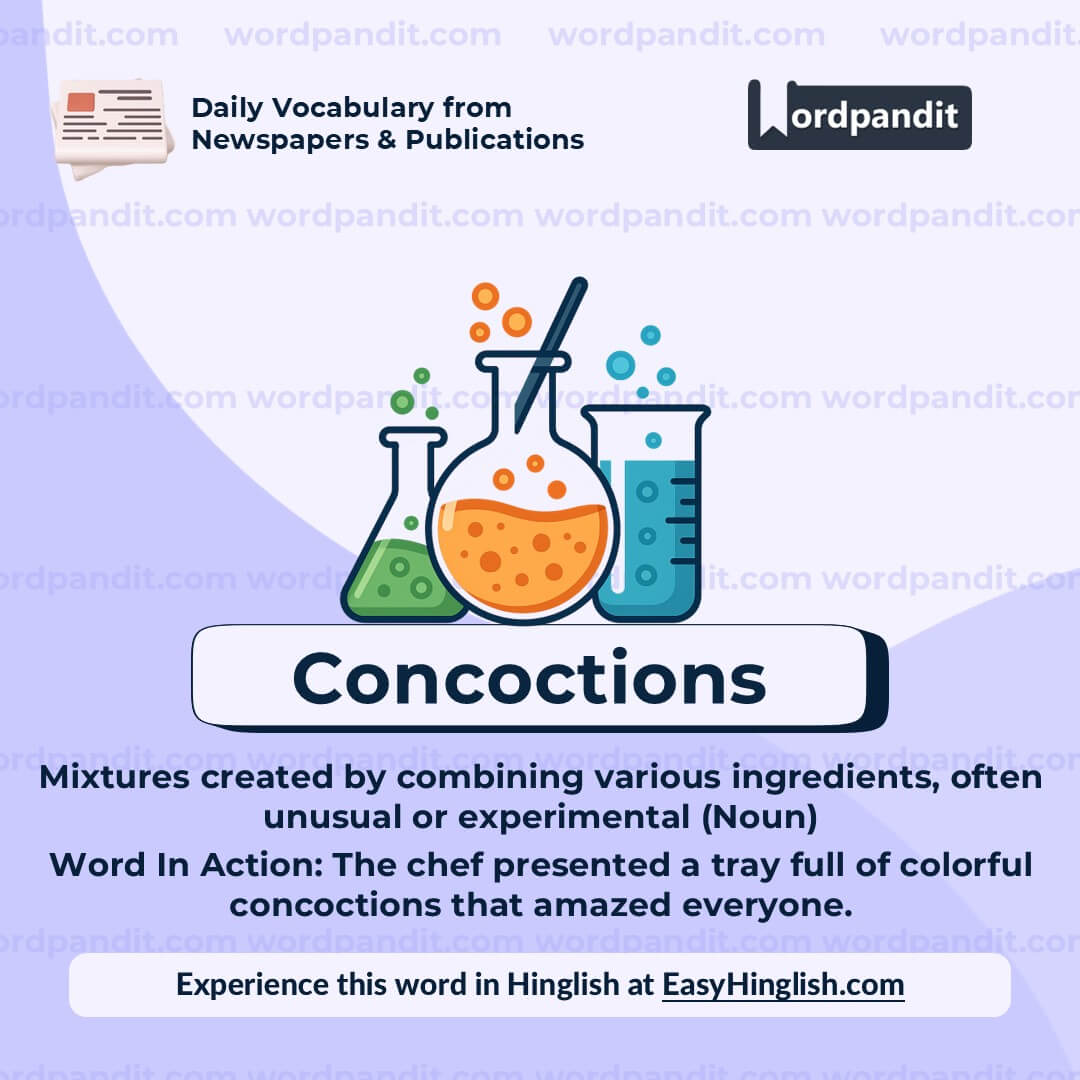
WORD-2: Concoctions
Context:
"I find it hard to believe my dad's herbal concoctions worked, but I have also since come to realise that the seemingly all-knowing internet I so readily trusted contains huge gaps – and in a world of AI, it's about to get worse." - Aeon
Explanatory Paragraph:
Concoctions meaning in English is 'mixtures of various ingredients, especially those prepared by combining unusual or experimental elements.' This word is used when describing something created by mixing different substances together, often in cooking, medicine, or chemistry. How to use concoctions correctly: the term appears frequently in contexts involving home remedies, creative recipes, or storytelling about unusual mixtures, and is common in competitive exam passages discussing traditional medicine, innovation, or scientific experiments.
Meaning: Mixtures created by combining various ingredients, often unusual or experimental (Noun)
Pronunciation: kun-KOK-shunz
Difficulty Level: ⭐⭐ Basic to Intermediate
Etymology: Concoctions comes from the Latin word 'concoquere' meaning 'to cook together' or 'to digest,' formed from 'con-' (together) and 'coquere' (to cook). The word entered English through French in the 16th century, initially referring to the process of preparing medicines by heating ingredients together. Over time, its meaning expanded to include any mixture of ingredients, whether literal or figurative.
Prashant Sir's Notes:
Students often ask: what is the difference between concoctions and mixtures? While both involve combining ingredients, concoctions usage specifically suggests creativity, experimentation, or something homemade and unusual. For UPSC and CAT aspirants, concoctions frequently appears in passages about traditional medicine, Ayurveda versus modern science, or innovation narratives. In Indian English newspapers, you'll commonly see "herbal concoctions," "grandmother's concoctions," or "chemical concoctions"—the adjective before it tells you whether it's positive (herbal, traditional) or negative (dangerous, chemical). Notice how the word carries a slightly informal or experimental tone compared to formal terms like "preparations" or "formulations."
Synonyms & Antonyms:
Synonyms: mixtures, preparations, brews, blends, compounds, potions, formulations, combinations, creations, medleys
Antonyms: pure substances, single ingredients, unmixed elements, natural compounds
Usage Examples:
- My grandmother's kitchen was filled with aromatic concoctions made from turmeric, ginger, and honey to treat seasonal colds and coughs.
- The startup founder presented several beverage concoctions to investors, hoping one would become the next popular health drink in India.
- Street vendors in Mumbai sell colorful concoctions of fruit juices, syrups, and spices that tourists find both fascinating and overwhelming.
- Anjali's beauty blog features DIY concoctions using kitchen ingredients like gram flour, yogurt, and rose water for glowing skin.
Cultural Reference:
"In every Indian household, mothers and grandmothers have their secret concoctions—kadha for immunity, hair oil for growth, face packs for weddings—passed down through generations like precious recipes." - Common observation in Indian lifestyle writing
Think About It:
Why do we often dismiss traditional concoctions as unscientific, yet readily trust modern pharmaceutical formulations that are essentially the same concept—mixing ingredients for health benefits?
Quick Activity:
List three concoctions you've encountered in your home—it could be health drinks, beauty treatments, or special recipes. Write one sentence describing what each mixture contains and its purpose.
Memory Tip:
Remember 'Concoctions' by breaking it into 'CON-COOK-shuns'—think of someone COOKing together (CON = together) various ingredients to create something new. Visualize your grandmother in the kitchen mixing various ingredients into her special health drink or remedy.
Real-World Application:
In feature articles and lifestyle writing, 'concoctions' is commonly used when discussing alternative medicine, home remedies, creative cooking, or DIY beauty treatments. Science journalism employs this word when describing experimental formulations or questioning the efficacy of unproven mixtures. In competitive exam essays, using 'concoctions' demonstrates nuanced vocabulary when discussing topics like traditional versus modern medicine, innovation, or the blending of different cultural practices. The word works particularly well when you want to suggest something creative yet unproven or experimental.
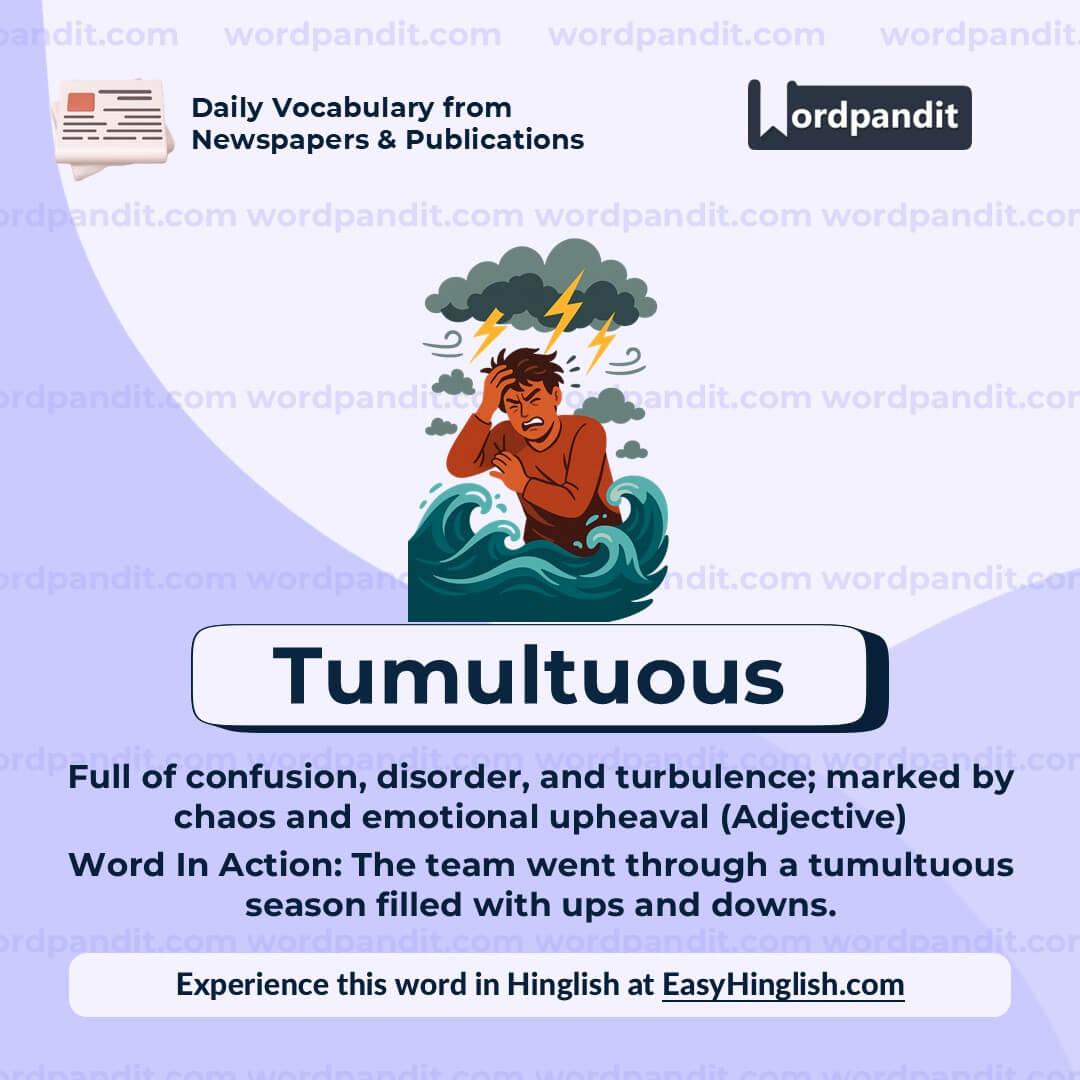
WORD-3: Tumultuous
Context:
"Growing up in a tumultuous household and feeling alienated from her peers, Raina never felt comfortable in her body." - Aeon
Explanatory Paragraph:
Tumultuous meaning in English is 'characterized by confusion, disorder, and emotional turbulence, often involving loud noise or violent disturbance.' This word is used when describing situations, relationships, or periods that are chaotic, unstable, and full of upheaval. Tumultuous is commonly used in formal writing, historical accounts, news reports, and competitive exam passages to describe anything from personal relationships and political periods to natural events and social movements that involve significant disorder and emotional intensity.
Meaning: Full of confusion, disorder, and turbulence; marked by chaos and emotional upheaval (Adjective)
Pronunciation: too-MUL-choo-us
Difficulty Level: ⭐⭐⭐ Intermediate
Etymology: Tumultuous comes from the Latin word 'tumultus' meaning 'commotion, uproar, or disturbance,' which itself derives from 'tumere' meaning 'to swell.' The word entered English in the 16th century, carrying the sense of something swelling up into disorder and chaos. Originally used to describe physical disturbances like riots and battles, it evolved to encompass emotional and psychological turbulence as well, reflecting both external chaos and internal turmoil.
Prashant Sir's Notes:
Many students confuse 'tumultuous' with 'tremendous'—they sound similar but mean completely different things! The difference between tumultuous and chaotic is nuanced: tumultuous usage in sentences emphasizes emotional intensity and often prolonged disorder, while 'chaotic' focuses more on lack of order without necessarily implying emotional distress. For CAT, GRE, and UPSC aspirants, tumultuous frequently appears in RC passages about historical periods, political transitions, or character backgrounds. In Indian English newspapers, you'll see "tumultuous political climate," "tumultuous relationship," or "tumultuous times"—this word is perfect for describing the Partition era, Emergency period, or any phase of intense social upheaval. Notice that it works for both external situations (tumultuous protests) and internal states (tumultuous emotions).
Synonyms & Antonyms:
Synonyms: chaotic, turbulent, stormy, tempestuous, disorderly, violent, wild, agitated, riotous, uproarious, volatile, unstable
Antonyms: peaceful, calm, orderly, tranquil, serene, stable, quiet, harmonious
Usage Examples:
- India's tumultuous journey to independence involved decades of protests, sacrifices, and political negotiations that reshaped the entire subcontinent.
- After a tumultuous board meeting filled with heated arguments, the company's CEO announced his sudden resignation to surprised shareholders.
- Meera's tumultuous childhood, marked by frequent relocations and family conflicts, made it difficult for her to form lasting friendships.
- The cricket match became tumultuous when controversial umpiring decisions led to angry exchanges between players and disruptions from the crowd.
Cultural Reference:
"Bollywood thrives on tumultuous love stories—from Devdas to Bajirao Mastani—where passion, obstacles, and emotional chaos create unforgettable cinema that resonates with audiences across generations." - Common observation in Indian film criticism
Think About It:
Do tumultuous experiences in childhood necessarily lead to problems in adulthood, or can they sometimes build resilience and strength that calmer childhoods might not develop?
Quick Activity:
Think of a tumultuous period in Indian history (Partition, Emergency, or recent political events). Write two sentences describing what made that period particularly chaotic and emotionally charged.
Memory Tip:
Break 'Tumultuous' into 'TU-MULT-uous'—imagine a MULT-iple (many) TUmult (chaos) happening simultaneously. Picture a crowded Mumbai local train during rush hour with everyone pushing, shouting, and jostling—that's the essence of tumultuous: multiple disturbances creating overwhelming chaos.
Real-World Application:
In journalism and historical writing, 'tumultuous' is essential for describing politically volatile periods, social movements, or economic crises that involve both chaos and emotional intensity. Business reports use this word when analyzing market volatility or corporate upheavals marked by instability. In academic essays and competitive exam answers, using 'tumultuous' demonstrates sophisticated vocabulary when discussing historical transitions, character development in literature, or analyzing periods of significant social change. The word is particularly effective in comparative essays contrasting peaceful periods with chaotic ones, or in character analysis showing how turbulent backgrounds shape personality.
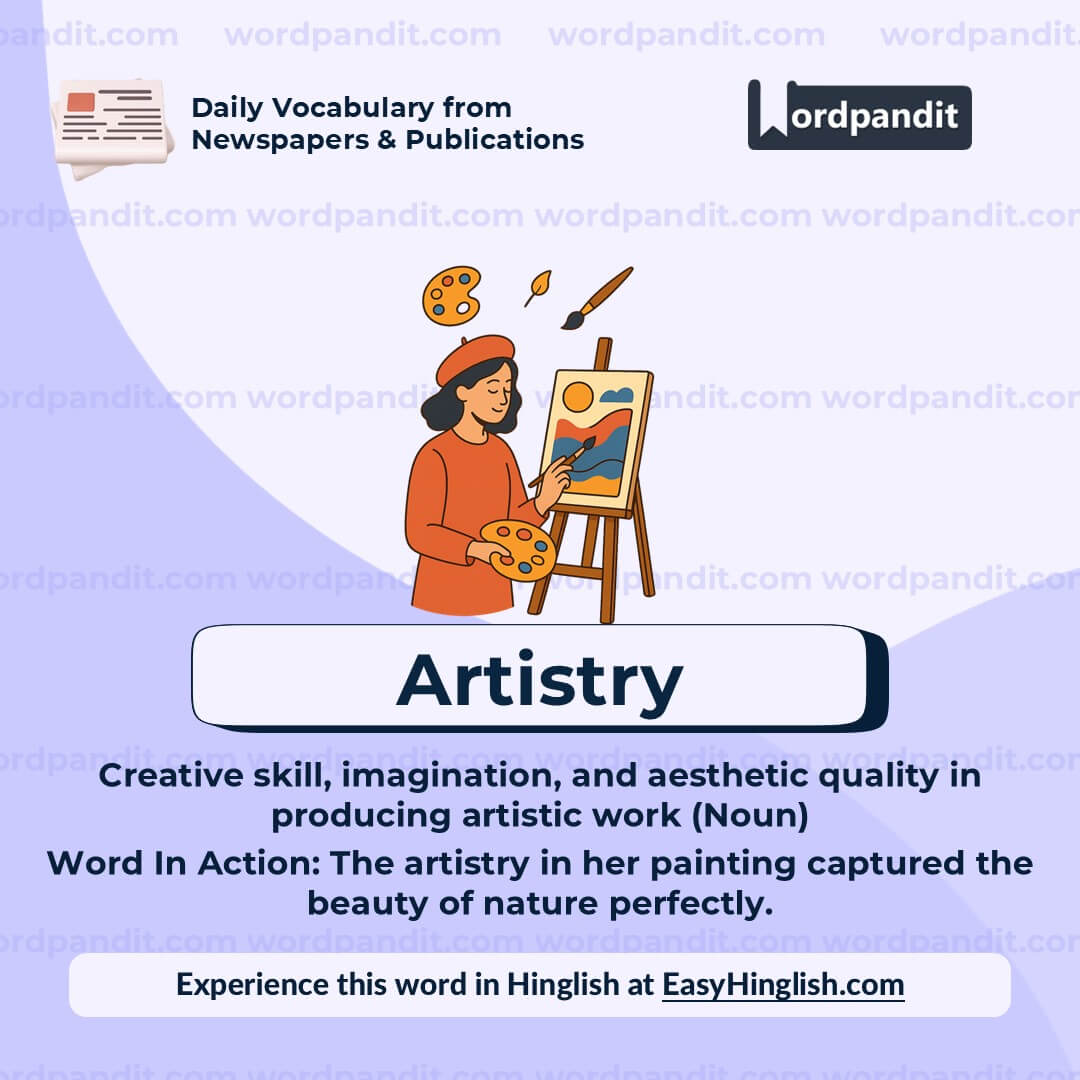
WORD-4: Artistry
Context:
"Combining live-action footage and rotoscope animation, the US director Joanna Rudnick conveys Raina's story with empathy and artistry." - Aeon
Explanatory Paragraph:
Artistry meaning in English is 'creative skill and imagination in producing works of art, or the quality of showing exceptional artistic ability.' This word is used when describing the technical skill, aesthetic judgment, and creative vision demonstrated in any artistic endeavor. How to use artistry effectively: it commonly appears in reviews, critiques, cultural commentary, and competitive exam passages to acknowledge the high level of craftsmanship and creative expression in fields ranging from cinema and music to cooking and design.
Meaning: Creative skill, imagination, and aesthetic quality in producing artistic work (Noun)
Pronunciation: AR-tis-tree
Difficulty Level: ⭐⭐ Basic to Intermediate
Etymology: Artistry comes from the word 'artist,' which traces back to Latin 'ars' meaning 'skill' or 'craft,' and ultimately to the Proto-Indo-European root meaning 'to fit together' or 'join.' The suffix '-ry' was added in the 19th century to denote the quality or practice of being an artist. The word evolved to encompass not just the technical skills of creating art, but also the imaginative and aesthetic qualities that distinguish exceptional creative work from merely competent execution.
Prashant Sir's Notes:
Students often ask: what is the difference between artistry and art? While 'art' refers to the work itself, artistry usage specifically emphasizes the skill, technique, and creative excellence behind the work. For GRE and CAT aspirants, artistry frequently appears in passages about film criticism, cultural analysis, or discussions about craftsmanship in any field. Many students confuse 'artistry' with 'artiste' (a performer)—artistry is about creative skill, not the person! In Indian English newspapers, you'll see phrases like "culinary artistry," "cinematic artistry," or "Kapoor's artistry in that scene"—the word elevates any skill to an art form. Notice that artistry can apply beyond traditional arts: "the artistry of a well-crafted legal argument" or "the artistry in Kohli's batting technique" both work perfectly.
Synonyms & Antonyms:
Synonyms: craftsmanship, skill, creativity, mastery, technique, finesse, expertise, virtuosity, workmanship, proficiency, aesthetic quality
Antonyms: clumsiness, ineptitude, amateurishness, incompetence, mediocrity, lack of skill
Usage Examples:
- Sanjay Leela Bhansali's films showcase extraordinary artistry through elaborate sets, intricate costumes, and breathtaking cinematography that transport audiences into different worlds.
- The chef demonstrated remarkable artistry by transforming simple dal and rice into a visually stunning presentation worthy of fine dining.
- Ravi Shankar's sitar performances were celebrated globally for their technical precision and emotional artistry that bridged Eastern and Western musical traditions.
- The architect's artistry was evident in how she seamlessly blended traditional Indian motifs with modern sustainable design principles.
Cultural Reference:
"From Satyajit Ray's cinematic artistry in the Apu Trilogy to M.F. Husain's bold paintings, Indian artists have demonstrated that artistry transcends medium—it's about vision, skill, and the courage to express truth through creativity." - Common theme in Indian art criticism
Think About It:
Can artistry exist in everyday professions like teaching, coding, or customer service, or is it reserved only for traditionally creative fields like painting and music?
Quick Activity:
Identify one person in your life (family member, teacher, or public figure) who demonstrates artistry in their work. Write two sentences explaining what makes their approach artistic rather than just skilled.
Memory Tip:
Think of 'Artistry' as 'ART-is-TREE'—imagine an artist's skill growing like a tree, with roots in technique, a trunk of practice, and branches of creativity reaching toward excellence. Or simply remember: ARTIST + RY (quality of) = the quality of being an exceptional artist.
Real-World Application:
In film and book reviews, 'artistry' is commonly used to praise the creative excellence and technical mastery behind a work, distinguishing exceptional craft from routine production. Professional profiles and recommendation letters employ this word to elevate someone's skills beyond mere competence to the realm of creative excellence. In competitive exam essays, using 'artistry' demonstrates sophisticated vocabulary when analyzing literary techniques, discussing cultural contributions, or evaluating creative works. The word is particularly effective when you want to acknowledge both technical skill and aesthetic vision simultaneously, making it valuable in any discussion of excellence across diverse fields.
WORD-5: Dismays
Context:
"This delicate yet deliberate act of protest dismays her mother and unsettles some older relatives, but, among the young women present, it opens up candid conversations about traditions, gender and culture." - Aeon
Explanatory Paragraph:
Dismays meaning in English is 'causes someone to feel concern, distress, or disappointment, often due to something unexpected or unwelcome.' This word is used when describing reactions of shock, disappointment, or alarm to situations that disturb someone's expectations or sense of propriety. How to use dismays correctly: it appears frequently in formal writing, news articles, and competitive exam passages to describe emotional responses to disappointing news, unexpected behavior, or troubling developments, conveying a sense of both surprise and unhappiness.
Meaning: Causes concern, distress, or disappointment; troubles or alarms someone (Verb, third person singular present)
Pronunciation: dis-MAYZ
Difficulty Level: ⭐⭐⭐ Intermediate
Etymology: Dismays comes from the Old French word 'esmaier' meaning 'to trouble, disturb, or frighten,' which itself derived from the Vulgar Latin 'exmagare' meaning 'to deprive of power.' The prefix 'dis-' intensified the meaning when the word entered Middle English in the 13th century. Originally carrying stronger connotations of fear and loss of courage, the word gradually softened to its modern sense of distress, disappointment, and concern, though it still retains a suggestion of being caught off guard by something troubling.
Prashant Sir's Notes:
Many students confuse 'dismays' with 'disappoints'—while both involve negative feelings, the difference between dismays and disappoints is important: dismays usage carries a stronger sense of shock, alarm, and being troubled, not just let down. For CAT and GRE aspirants, dismays frequently appears in RC passages about social change, generational conflicts, or reactions to unexpected events. In Indian English newspapers, you'll commonly see "to the dismay of," "much to his dismay," or "dismays traditionalists"—notice the word often describes reactions to progressive actions or unconventional choices. Watch for this pattern: dismays typically involves someone in authority or from an older generation reacting to something that challenges their values or expectations, making it perfect for describing intergenerational tensions.
Synonyms & Antonyms:
Synonyms: distresses, troubles, disturbs, alarms, unsettles, disconcerts, shocks, disappoints, disheartens, perturbs, appalls
Antonyms: reassures, encourages, comforts, pleases, delights, satisfies, heartens
Usage Examples:
- The rising unemployment rate dismays economists who had predicted steady growth based on previous quarterly data and government initiatives.
- Priya's decision to pursue stand-up comedy instead of engineering dismays her parents, who had envisioned a more traditional career path.
- The sudden resignation of three senior ministers dismays party workers across the country, raising questions about internal conflicts.
- It dismays environmental activists that despite numerous warnings, plastic usage continues to increase in urban Indian neighborhoods and markets.
Cultural Reference:
"In Bollywood's '3 Idiots,' Rancho's unconventional approach to education dismays the rigid Director Viru Sahastrabudhhe, perfectly capturing the generational clash between innovation and tradition that resonates across Indian society." - Common example in discussions of Indian cinema
Think About It:
Why do our choices often dismay older generations? Is it because they genuinely see danger ahead, or because change itself threatens their understanding of how the world should work?
Quick Activity:
Think of a recent news event or personal situation where someone's actions dismayed others. Write two sentences describing what happened and why it caused distress or alarm.
Memory Tip:
Break 'Dismays' into 'DIS-MAZE'—imagine someone lost in a maze (DIS-oriented in a MAZE), feeling troubled and alarmed because things aren't going as expected. Or think of the prefix 'dis-' (away from) + 'may' (possibility/hope)—taking away someone's hope or comfort, leaving them distressed.
Real-World Application:
In news reporting and opinion pieces, 'dismays' is commonly used to describe reactions to policy decisions, social trends, or unexpected developments that cause concern among specific groups. Political commentary employs this word when analyzing how actions by one group trouble or alarm another, particularly in generational or ideological conflicts. In competitive exam essays, using 'dismays' demonstrates sophisticated vocabulary when discussing social change, resistance to progress, or analyzing stakeholder reactions in case studies. The word is particularly effective in formal writing when you need to convey not just disappointment but also a sense of alarm or being troubled by unexpected developments.


