

Daily Vocabulary from International Newspapers and Publications
Expand Your Vocabulary with Wordpandit’s Global Vocabulary Hub
At Wordpandit, we are committed to helping you develop a truly global vocabulary by drawing from some of the most respected international publications. This section is designed to keep you ahead of the curve by introducing you to words that define global conversations and trends.
The Power of Global Sources
To help you think and communicate on a global scale, we curate vocabulary from renowned international sources, such as:
- The New York Times
- The Washington Post
- BBC
- The Guardian
- The Economist
- Scientific American
- Psychology Today
- And many more...
Stay Global, Stay Competitive
Our daily updates from international publications ensure you are consistently exposed to new words that reflect global news and developments, making sure your vocabulary is not only current but also globally relevant.
Enhance Your Global Perspective
Whether you’re preparing for international exams, aiming to excel in global business communication, or want to enhance your language skills for personal growth, Wordpandit offers the resources you need to thrive in a global context.
Effective Learning, Global Reach
Our learning methodology combines global examples, memory aids, and interactive activities, allowing you to internalize new words effectively and apply them in real-world scenarios.
Begin Your Global Vocabulary Journey Now!

Why Choose Wordpandit?
Practical Learning: Focus on words you'll actually encounter in real-world reading, enhancing your comprehension and communication skills.
Diverse Content: From current affairs to scientific breakthroughs, our varied sources expose you to vocabulary across multiple domains.
Effortless Integration: Make Wordpandit a part of your daily routine. Just a few minutes each day can significantly boost your lexicon over time.
Your Path to Vocabulary Mastery
- Visit our Daily Vocabulary section regularly
- Explore new words and their usage in context
- Practice incorporating these words into your own writing and speech
- Track your progress as your vocabulary expands
Start Your Journey Today
Embark on your vocabulary enhancement journey with Wordpandit. By consistently engaging with our daily posts, you'll build a robust vocabulary that serves you well in academic, professional, and personal contexts.
Remember, a word a day keeps linguistic limitations at bay. Make Wordpandit your daily companion in the quest for vocabulary excellence!
WORD-1: Ideologies
Context:
"...and ideologies propounded by parties, intellectuals and institutions..." - Aeon
Explanatory Paragraph:
Ideologies meaning in English is 'a system of ideas and ideals that forms the basis of economic or political theory and policy.' This word is used when discussing belief systems that guide political parties, social movements, or philosophical frameworks. How to use ideologies correctly depends on understanding that it represents comprehensive worldviews rather than simple opinions. Ideologies is commonly used in political science discussions, news analyses, UPSC essays, and CAT reading comprehension passages dealing with governance and social theory.
Meaning: A system of ideas and ideals, especially one which forms the basis of economic or political theory and policy (Noun)
Pronunciation: eye-dee-OL-uh-jeez (plural) or eye-dee-OL-uh-jee (singular)
Difficulty Level: ⭐⭐⭐ Intermediate
Etymology: Ideologies comes from French 'idéologie,' coined in 1796 by philosopher Destutt de Tracy from Greek 'idea' (form, pattern) and 'logia' (study of). Originally meant as the 'science of ideas,' the word evolved to represent complete belief systems that shape political and social thinking, especially after Karl Marx used it to describe worldviews that justify particular social orders.
Prashant Sir's Notes:
Many students confuse ideologies with simple opinions or beliefs—the difference between ideology and opinion is that an ideology is a comprehensive, organized system of thought, while an opinion is just a single viewpoint. For UPSC and CAT aspirants, ideologies frequently appears in passages about political movements, governance models, and social reform. Students often ask: what is the difference between ideologies and philosophies? While philosophy is abstract thinking about existence and knowledge, ideologies are specifically applied belief systems with political or economic implications. In Indian newspapers, you'll see phrases like "competing ideologies" when discussing BJP versus Congress approaches, or "Left ideologies" when covering political movements in Kerala and West Bengal.
Synonyms & Antonyms:
Synonyms: belief system, doctrine, philosophy, creed, worldview, principles, dogma, tenets, convictions, political theory
Antonyms: pragmatism, practicality, flexibility, open-mindedness, empiricism
Usage Examples:
- The clash between capitalist and socialist ideologies dominated Indian political discourse throughout the post-independence era until economic liberalization.
- Priya's research paper compared the educational ideologies propounded by Tagore and Gandhi in shaping India's learning institutions.
- Political parties often abandon their stated ideologies when electoral considerations demand coalition partnerships with ideologically opposite groups.
- Rohan realized that his company's management operated on conflicting ideologies—the CEO valued innovation while the board prioritized risk-aversion.
Cultural Reference:
"In the film 'Rang De Basanti,' the transformation of college students from carefree youth to revolutionaries illustrates how powerful ideologies can reshape individual identities and inspire collective action against injustice."
Think About It:
Do political parties in India truly follow their stated ideologies, or have ideologies become merely branding tools for gaining power while actual governance remains pragmatic?
Quick Activity:
Identify three major ideologies that have shaped Indian politics since independence and write one sentence describing each ideology's core principle.
Memory Tip:
Think of 'IDEA-OLOGIES' as 'IDEA + LOGIC + IES'—it's the LOGIC behind a set of IDEAS that multiple people (IES) follow together as a complete system of beliefs.
Real-World Application:
Ideologies is commonly used in editorial columns, UPSC Mains essay papers, political science research, and GRE reading passages to discuss systematic belief frameworks. In journalistic writing, phrases like "ideological divide," "ideological purity," or "competing ideologies" help readers understand deeper motivations behind political conflicts beyond mere personality clashes. For competitive exam aspirants, recognizing when a passage discusses ideologies versus simple policies helps in answering inference and tone-based questions accurately.
WORD-2: Canon
Context:
"...Arendt is now seen as a central figure in the modern philosophical canon..." - Aeon
Explanatory Paragraph:
Canon meaning in English is 'a collection of works or principles that are considered authentic, authoritative, and defining in a particular field.' This word is used when referring to the established, most respected body of work in literature, philosophy, music, or any discipline. How to use canon correctly involves recognizing it represents not just any collection, but the gold standard that scholars and experts consider essential. Canon is commonly used in academic discussions, literary criticism, GRE passages, and UPSC essays about culture and intellectual traditions.
Meaning: A collection of works, principles, or figures accepted as genuine, authoritative, and defining within a particular field (Noun)
Pronunciation: KAN-un
Difficulty Level: ⭐⭐⭐ Intermediate to Advanced
Etymology: Canon comes from Greek 'kanōn' meaning 'rule' or 'measuring rod,' through Latin 'canon.' Originally used by the Christian church to denote the official list of biblical books, the word evolved to represent any authoritative collection of works. By the Renaissance, it expanded to describe the accepted masterworks in literature, art, and philosophy that serve as benchmarks of excellence in their fields.
Prashant Sir's Notes:
Many students confuse canon with 'cannon' (the weapon)—they sound identical but are completely different. The difference between canon and classic is subtle but important: a classic is a single outstanding work, while the canon is the entire collection of such works that define a field. For CAT and GRE aspirants, canon frequently appears in passages about literature and arts, often discussing who gets included or excluded from the canon. Students often ask: what is the literary canon? It's the body of works considered essential reading—think Shakespeare, Milton, and Wordsworth in English literature, or Kalidas, Premchand, and Tagore in Indian literary canon. In Indian academic contexts, you'll see debates about expanding the canon to include Dalit literature, regional language classics, and women writers who were historically excluded.
Synonyms & Antonyms:
Synonyms: standard works, established body, accepted texts, authoritative collection, recognized classics, orthodox texts, official list, core curriculum
Antonyms: apocrypha, fringe works, unrecognized texts, marginal literature, rejected works, non-standard
Usage Examples:
- The Western literary canon has been criticized for excluding women writers and authors from colonized nations like India and Africa.
- Satyajit Ray's films are now firmly established in the international cinematic canon, studied in film schools worldwide.
- Professor Sharma argued that Bhakti poetry deserves greater representation in the Indian philosophical canon alongside Sanskrit texts.
- Vikram wondered why his literature syllabus focused exclusively on the Western canon when Indian English writers had produced equally significant works.
Cultural Reference:
"The debate over whether contemporary writers like Arundhati Roy and Amitav Ghosh have entered the literary canon mirrors historical discussions about which voices deserve to be preserved and celebrated as defining cultural achievements."
Think About It:
Who decides what enters the canon, and does the canon reflect genuine excellence or simply the preferences of those in power throughout history?
Quick Activity:
List five works or authors you believe should be part of the Indian literary canon and explain in one sentence why each deserves inclusion.
Memory Tip:
Think of 'CANON' as 'CAN-ON (the list)'—if you're ON this special CAN (container), you're among the chosen, authoritative works that everyone agrees are essential and defining.
Real-World Application:
Canon is commonly used in academic writing, literary criticism, university syllabi discussions, and cultural commentary to identify which works are considered foundational in any field. In essays for UPSC or GRE, using 'canon' demonstrates sophisticated understanding of how disciplines establish standards. Phrases like "challenging the canon," "expanding the canon," or "canonical texts" frequently appear in passages about education reform, cultural preservation, and debates over representation in arts and humanities.
WORD-3: Discern
Context:
"We are unable to discern the truth..." - Aeon
Explanatory Paragraph:
Discern meaning in English is 'to perceive, recognize, or distinguish something with difficulty by using careful observation or insight.' This word is used when something requires mental effort or keen judgment to identify or understand clearly. How to use discern effectively involves situations where the truth, pattern, or distinction isn't obvious and needs intellectual or sensory sharpness to detect. Discern is commonly used in formal writing, analytical essays for CAT and GRE, philosophical discussions, and passages about judgment and perception in competitive exams.
Meaning: To perceive, recognize, or distinguish something that is not immediately obvious (Verb)
Pronunciation: dih-SURN
Difficulty Level: ⭐⭐⭐ Intermediate
Etymology: Discern comes from Latin 'discernere' meaning 'to separate, distinguish between,' formed from 'dis-' (apart) and 'cernere' (to sift, separate). The word entered English through Old French 'discerner' in the 14th century. Its evolution reflects the idea of mentally sifting through information to separate truth from falsehood, or clarity from confusion, much like physically separating grain from chaff.
Prashant Sir's Notes:
Many students confuse discern with simply 'see' or 'notice'—the difference between discern and observe is that discerning requires judgment and insight, not just visual perception. For CAT and GRE aspirants, discern frequently appears in RC passages about critical thinking, analysis, and making difficult distinctions. Students often ask: what is the difference between discern and distinguish? While distinguish means to recognize differences between things, discern implies detecting something that's hidden or requires wisdom to perceive. In Indian English usage, you'll see phrases like "discern the truth behind political rhetoric" or "discern genuine intentions from false promises"—particularly common in editorial columns during election season when newspapers analyze party manifestos and campaign speeches.
Synonyms & Antonyms:
Synonyms: perceive, detect, recognize, distinguish, identify, make out, ascertain, determine, comprehend, grasp
Antonyms: overlook, miss, confuse, mistake, misunderstand, ignore
Usage Examples:
- Experienced investors like Rakesh can discern promising startups from those with inflated valuations by analyzing their business fundamentals carefully.
- In the dense fog covering the Himalayan road, Priya could barely discern the outline of vehicles just meters ahead.
- Voters struggled to discern genuine policy differences between the two candidates, as both made similar promises about employment and development.
- A discerning reader can easily discern the author's bias in how the news article frames the controversial government decision.
Cultural Reference:
"In the film '3 Idiots,' Rancho's ability to discern the difference between rote learning and true understanding challenges the education system's focus on grades over genuine knowledge and wisdom."
Think About It:
In an age of misinformation and deepfakes, how can we sharpen our ability to discern truth from manipulation in the content we consume daily on social media?
Quick Activity:
Write two sentences using 'discern'—one about distinguishing truth from lies in news, and another about recognizing quality in art or literature.
Memory Tip:
Break 'DISCERN' into 'DIS-CERN' and think of it as 'DIS-concerning' (this concerning)—when you need to DIS-cover what's concerning or hidden by looking carefully and using judgment to separate truth from confusion.
Real-World Application:
Discern is commonly used in analytical writing, critical essays, business reports, and academic discussions to indicate careful judgment and perception. In CAT reading comprehension, passages about decision-making, critical thinking, or complex analysis frequently use 'discern' to test whether students understand nuanced thinking processes. Phrases like "ability to discern," "difficult to discern," or "discern patterns" appear regularly in GRE passages, UPSC essay topics about governance and ethics, and professional writing where distinguishing between options requires wisdom and insight rather than just observation.
WORD-4: Avant-garde
Context:
"...membership in a self-conscious avant-garde..." - Aeon
Explanatory Paragraph:
Avant-garde meaning in English is 'new, experimental, or innovative ideas and methods in art, culture, or politics that are ahead of their time.' This term is used when describing artists, thinkers, or movements that challenge conventional norms and push boundaries. How to use avant-garde correctly involves recognizing it applies to pioneers who experiment with radical ideas that mainstream society hasn't yet accepted. Avant-garde is commonly used in art criticism, cultural commentary, GRE passages about innovation, and discussions about revolutionary movements in literature, cinema, and social thought.
Meaning: New, unusual, or experimental ideas and methods, especially in the arts; people or works that are innovative and ahead of their time (Noun/Adjective)
Pronunciation: ah-vahn-GARD or AV-ahn-gard
Difficulty Level: ⭐⭐⭐⭐ Advanced
Etymology: Avant-garde comes directly from French, meaning 'vanguard' or 'advance guard'—the military term for troops that move ahead of the main army. The phrase combines 'avant' (before) and 'garde' (guard). First used in English in the 1910s to describe innovative artists and movements, it evolved from its military origins to represent cultural pioneers who advance into unexplored creative territory, leading society toward new forms of expression before the mainstream follows.
Prashant Sir's Notes:
Many students confuse avant-garde with simply 'modern' or 'contemporary'—the difference between avant-garde and modern is that avant-garde is deliberately experimental and challenges norms, while modern just means current or recent. For GRE and CAT aspirants, avant-garde appears in passages about art movements, cultural innovation, and revolutionary thinking. Students often ask: what is the difference between avant-garde and mainstream? Avant-garde represents the cutting edge that most people don't yet understand or accept, while mainstream is what society already embraces. In Indian contexts, filmmakers like Ritwik Ghatak and Mani Kaul are considered avant-garde because their experimental cinema challenged Bollywood conventions. Similarly, the Progressive Writers' Movement in Hindi and Urdu literature was avant-garde in its time, addressing social issues through innovative narrative techniques.
Synonyms & Antonyms:
Synonyms: cutting-edge, innovative, experimental, pioneering, progressive, revolutionary, groundbreaking, unconventional, trailblazing, vanguard
Antonyms: conventional, traditional, mainstream, conservative, orthodox, established, commonplace, standard
Usage Examples:
- Amrita Sher-Gil's bold painting style was considered avant-garde in 1930s India, blending European modernism with Indian themes and sensibilities.
- The theatre group's avant-garde performance confused many audience members who expected traditional storytelling rather than abstract symbolism and experimental staging.
- Mumbai's avant-garde fashion designers are creating sustainable clothing using unconventional materials like banana fiber and recycled plastic, challenging the industry's wasteful practices.
- Aditi hesitated to invest in the startup's avant-garde technology, wondering if consumers were ready for such a radical departure from existing products.
Cultural Reference:
"Anurag Kashyap's early films like 'Black Friday' and 'Dev.D' represented avant-garde cinema in Bollywood, breaking away from formulaic storytelling with raw narratives, non-linear structures, and unconventional cinematography that mainstream audiences initially resisted."
Think About It:
Does the avant-garde eventually become mainstream, or does truly revolutionary art remain perpetually ahead of society's ability to fully appreciate it?
Quick Activity:
Identify one avant-garde artist, writer, or filmmaker from India and write two sentences explaining what made their work experimental and ahead of its time.
Memory Tip:
Think of 'AVANT-GARDE' as 'ADVANCE GUARD'—like soldiers who march ahead of the army into unknown territory, avant-garde artists venture into unexplored creative spaces before the rest of society follows.
Real-World Application:
Avant-garde is commonly used in art criticism, cultural journalism, academic papers on literature and cinema, and discussions about innovation in any creative field. In GRE and CAT reading passages, the term often appears when discussing artistic movements, cultural revolutions, or figures who challenged established norms. For UPSC essays on culture and society, understanding avant-garde helps articulate how societies progress through the bold experiments of pioneers. In professional contexts, calling something avant-garde signals it's innovative but possibly controversial or not yet widely accepted—useful for business presentations about disruptive products or unconventional strategies.
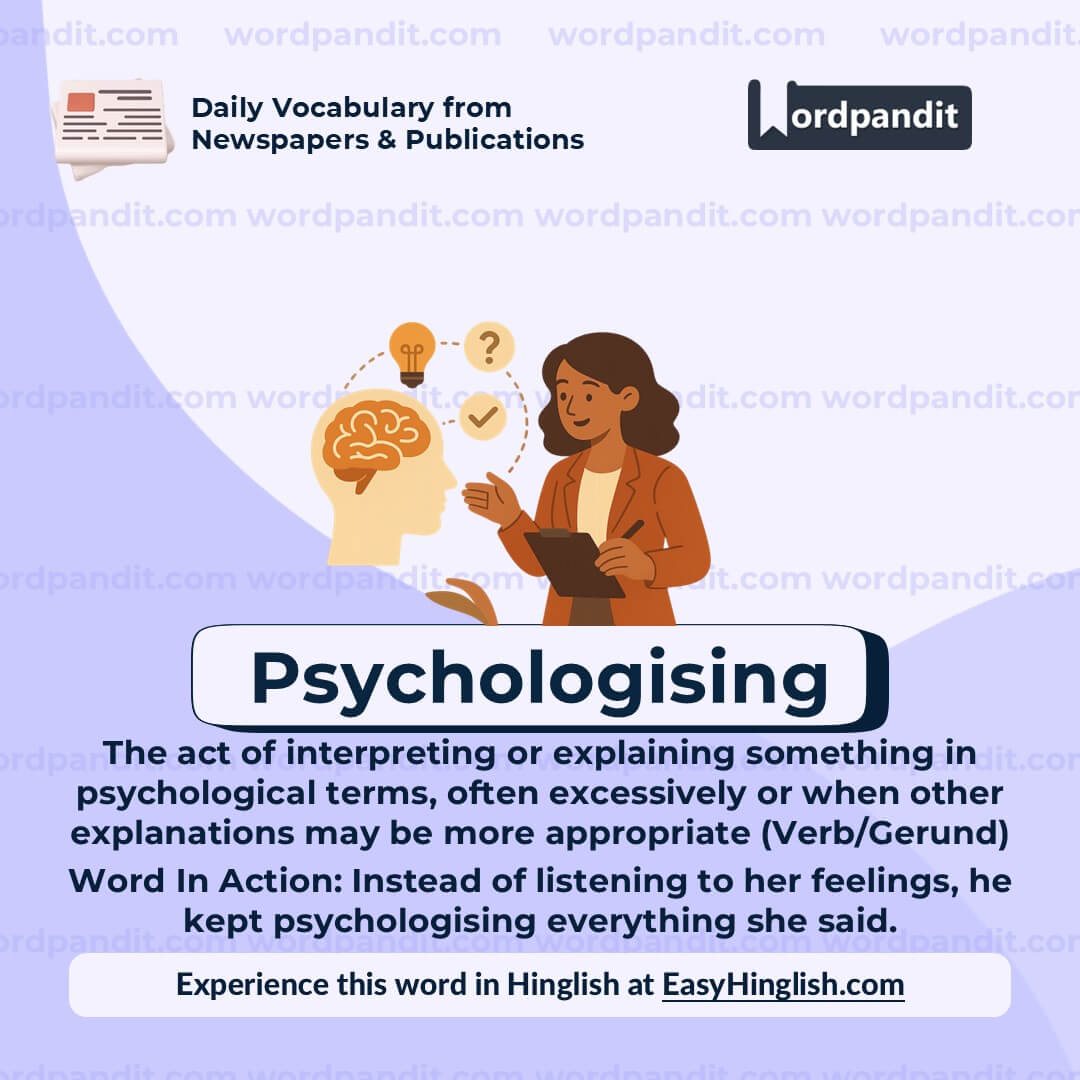
WORD-5: Psychologising
Context:
"...dismissed... as 'a psychologising whine'..." - Aeon
Explanatory Paragraph:
Psychologising meaning in English is 'the practice of explaining events, behaviors, or issues primarily through psychological interpretations, often excessively or inappropriately.' This word is used when someone reduces complex social, political, or philosophical problems to mere psychological states or personal feelings. How to use psychologising involves recognizing when analysis focuses too much on individual mental states rather than broader structural or objective factors. Psychologising is commonly used in academic critiques, philosophical discussions, and passages analyzing reductionist thinking in GRE and CAT reading comprehension.
Meaning: The act of interpreting or explaining something in psychological terms, often excessively or when other explanations may be more appropriate (Verb/Gerund); can also mean making something psychological in nature (British spelling: psychologising; American: psychologizing)
Pronunciation: sy-KOL-uh-jy-zing
Difficulty Level: ⭐⭐⭐⭐ Advanced
Etymology: Psychologising comes from 'psychology' (from Greek 'psyche' meaning soul/mind and 'logia' meaning study) plus the suffix '-ise/-ize' (to make or practice). The term emerged in the 20th century as critics noticed a tendency to over-explain social and political phenomena through individual psychology rather than considering economic, structural, or historical factors. It often carries a negative connotation, suggesting that psychological explanations are being misapplied or used to avoid addressing deeper systemic issues.
Prashant Sir's Notes:
Many students confuse psychologising with legitimate psychological analysis—the difference between psychologising and psychology is that psychology is a valid science, while psychologising suggests over-reliance on psychological explanations where they may not belong. For GRE and CAT aspirants, psychologising appears in critical passages where authors argue against reducing complex issues to mental states. Students often ask: what is the difference between psychologising and analyzing? Analysis considers multiple factors objectively, while psychologising attributes everything to psychological causes, often dismissively. In Indian academic contexts, you'll encounter this term when critics argue that caste discrimination shouldn't be psychologised as individual prejudice but recognized as structural oppression. Similarly, poverty isn't merely a psychological mindset problem but a systemic economic issue—calling anti-poverty programs that focus only on "mindset training" an example of harmful psychologising.
Synonyms & Antonyms:
Synonyms: psychoanalyzing, over-interpreting, reducing to psychology, attributing to mental states, psychological reductionism, introspecting excessively
Antonyms: objective analysis, structural analysis, material analysis, concrete reasoning, systemic thinking
Usage Examples:
- The management consultant's tendency to attribute workplace conflicts to employees' childhood issues was dismissed as unnecessary psychologising that ignored poor organizational policies.
- Professor Mehta criticized the paper for psychologising communal riots as collective anxiety rather than analyzing political manipulation and economic factors.
- Rahul's habit of psychologising every disagreement made team meetings exhausting, as colleagues wanted to discuss project deadlines, not explore everyone's emotional motivations.
- The documentary avoided psychologising the freedom fighters' sacrifices and instead focused on the historical context and political strategy behind the independence movement.
Cultural Reference:
"Critics argue that Bollywood's tendency to explain female anger through 'daddy issues' or past trauma is problematic psychologising that dismisses legitimate grievances about gender inequality and patriarchal structures in Indian society."
Think About It:
When does explaining human behavior through psychology become helpful understanding, and when does it become reductive psychologising that ignores social, economic, and political realities?
Quick Activity:
Think of a social problem in India (unemployment, pollution, corruption) and write two explanations—one that psychologises the issue and one that addresses structural causes. Notice the difference.
Memory Tip:
Remember 'PSYCHO-LOG-ISING' as 'PSYCHO-LOG-ISN'T-enough'—when you turn everything into a psychological LOG (record/analysis), you're ignoring that psychological explanations ISN'T enough for complex problems that need broader analysis.
Real-World Application:
Psychologising is commonly used in academic criticism, philosophical essays, sociology papers, and critical theory discussions to identify reductionist thinking. In GRE passages about social sciences or humanities, recognizing when an author accuses someone of psychologising helps you understand their argumentative strategy. For UPSC essay writing on social issues, avoiding psychologising demonstrates sophisticated understanding—for instance, discussing farmer suicides should address debt, crop failure, and policy failures rather than merely individual mental health. In professional contexts, the term helps critique workplace solutions that blame employee mindset rather than addressing systemic organizational problems like inadequate resources or poor management.


