

Daily Vocabulary from International Newspapers and Publications
Expand Your Vocabulary with Wordpandit’s Global Vocabulary Hub
At Wordpandit, we are committed to helping you develop a truly global vocabulary by drawing from some of the most respected international publications. This section is designed to keep you ahead of the curve by introducing you to words that define global conversations and trends.
The Power of Global Sources
To help you think and communicate on a global scale, we curate vocabulary from renowned international sources, such as:
- The New York Times
- The Washington Post
- BBC
- The Guardian
- The Economist
- Scientific American
- Psychology Today
- And many more...
Stay Global, Stay Competitive
Our daily updates from international publications ensure you are consistently exposed to new words that reflect global news and developments, making sure your vocabulary is not only current but also globally relevant.
Enhance Your Global Perspective
Whether you’re preparing for international exams, aiming to excel in global business communication, or want to enhance your language skills for personal growth, Wordpandit offers the resources you need to thrive in a global context.
Effective Learning, Global Reach
Our learning methodology combines global examples, memory aids, and interactive activities, allowing you to internalize new words effectively and apply them in real-world scenarios.
Begin Your Global Vocabulary Journey Now!

Why Choose Wordpandit?
Practical Learning: Focus on words you'll actually encounter in real-world reading, enhancing your comprehension and communication skills.
Diverse Content: From current affairs to scientific breakthroughs, our varied sources expose you to vocabulary across multiple domains.
Effortless Integration: Make Wordpandit a part of your daily routine. Just a few minutes each day can significantly boost your lexicon over time.
Your Path to Vocabulary Mastery
- Visit our Daily Vocabulary section regularly
- Explore new words and their usage in context
- Practice incorporating these words into your own writing and speech
- Track your progress as your vocabulary expands
Start Your Journey Today
Embark on your vocabulary enhancement journey with Wordpandit. By consistently engaging with our daily posts, you'll build a robust vocabulary that serves you well in academic, professional, and personal contexts.
Remember, a word a day keeps linguistic limitations at bay. Make Wordpandit your daily companion in the quest for vocabulary excellence!
WORD-1: Memoir
Context:
"A posthumous memoir by Virginia Giuffre accuses the Duke of York..." - BBC
Explanatory Paragraph:
Memoir meaning in English is 'a written account of one's personal experiences and memories from a specific period of life.' This word is used when someone writes about their own life story, focusing on significant events, relationships, or experiences rather than documenting every detail chronologically like an autobiography. How to use memoir correctly is important for students, as it frequently appears in CAT reading comprehension passages, UPSC essay topics, and IELTS writing tasks discussing biographical literature and personal narratives.
Meaning: A historical account or biography written from personal knowledge or special sources (Noun)
Pronunciation: MEM-wahr or MEM-wor
Difficulty Level: ⭐⭐ Basic to Intermediate
Etymology: Memoir comes from French 'mémoire' meaning 'memory,' which traces back to Latin 'memoria.' Originally used in the 16th century to describe historical records written by someone involved in the events, it evolved to mean personal narratives focused on the author's experiences and reflections rather than comprehensive life histories.
Prashant Sir's Notes:
Many students confuse memoir with autobiography—the difference between memoir and autobiography is crucial for exam questions. While autobiography covers your entire life chronologically, memoir usage in literature refers to focusing on specific themes, periods, or relationships from your life. For CAT and GRE aspirants, memoirs frequently appear in reading comprehension passages because they offer rich emotional content and reflective writing. In Indian English newspapers, you'll often see phrases like "political memoir" or "wartime memoir" when reviewing books by former ministers, army officers, or public figures sharing their experiences. Students often ask: what is the difference between memoir and biography? A biography is written by someone else about you, while a memoir is your own story in your own voice.
Synonyms & Antonyms:
Synonyms: autobiography (partial), personal narrative, life story, reminiscences, recollections, account, chronicle, journal, personal history, remembrances
Antonyms: fiction, novel, fabrication, invention, fantasy
Usage Examples:
- Former cricketer Virat Kohli's memoir about his struggles with mental health during the 2014 England tour became an instant bestseller across India.
- Priya decided to write a memoir about her grandmother's partition experiences, capturing stories that might otherwise be lost to history.
- The entrepreneur's memoir revealed how he built his startup from a small Bangalore office into a multinational corporation despite numerous failures.
- My mother always said she would write a memoir about her medical college days, filled with hilarious hostel stories and inspiring patient encounters.
Cultural Reference:
"Every life has a story worth telling—memoirs give voice to experiences that shaped who we became." - Common sentiment among Indian English authors and publishers
Think About It:
If you were to write a memoir today about one significant period or relationship in your life, what theme would you focus on and why?
Quick Activity:
List three people in Indian public life (politicians, cricketers, actors, activists) whose memoirs you would be interested in reading. Write one sentence explaining what period or aspect of their life you'd want them to focus on.
Memory Tip:
Think of 'Memoir' as 'ME-MORE'—it's all about ME sharing MORE of my personal memories and experiences. Unlike a complete autobiography, a memoir lets you share MORE about specific meaningful moments rather than your entire life from birth to present.
Real-World Application:
In journalism and book reviews, 'memoir' is commonly used to distinguish personal narratives from biographies and fiction. The term appears frequently in literary criticism, publishing announcements, and academic discussions about life writing. For competitive exam aspirants, understanding memoir is essential when analyzing passage tone, author's purpose, and distinguishing between factual accounts and creative works. In formal writing and book proposals, correctly identifying your work as a memoir versus autobiography affects how publishers, reviewers, and readers approach your narrative.
WORD-2: Prominent
Context:
"The book... written by the prominent accuser of sex offender Jeffrey Epstein..." - BBC
Explanatory Paragraph:
Prominent meaning in English is 'important, famous, or noticeable; standing out from others due to significance or visibility.' This word is used when describing people who hold important positions, places that are easily visible, or features that stand out noticeably. How to use prominent effectively is essential for exam preparation, as it appears frequently in CAT reading comprehension, UPSC essays, and GRE passages discussing influential figures, geographical features, or distinguishing characteristics in formal and news writing.
Meaning: Important and well-known; projecting outward or upward from a surface; conspicuous (Adjective)
Pronunciation: PROM-in-ent
Difficulty Level: ⭐⭐ Basic to Intermediate
Etymology: Prominent comes from Latin 'prominere' meaning 'to jut out,' formed from 'pro-' (forward) and 'minere' (to project). Initially used in the 15th century to describe physical objects that stuck out or protruded, the word evolved to include the figurative meaning of standing out in importance or fame. This dual meaning—both physical visibility and social importance—makes it versatile in modern English.
Prashant Sir's Notes:
Many students confuse prominent with eminent—the difference between prominent and eminent is subtle but important for competitive exams. While both mean 'distinguished,' prominent usage emphasizes visibility and being well-known or noticeable, whereas eminent stresses respect and achievement in a particular field. For CAT and UPSC aspirants, prominent frequently appears when describing public figures, geographical features, or visible characteristics. Students often ask: what is the difference between prominent and famous? Famous means widely known, while prominent suggests both visibility and importance or influence. In Indian English newspapers, you'll see "prominent industrialist," "prominent leader," or "prominent feature" regularly—the word works for both people and physical objects, making it extremely useful for descriptive writing in essays and precis.
Synonyms & Antonyms:
Synonyms: distinguished, notable, important, leading, eminent, well-known, renowned, famous, conspicuous, noticeable, striking, protruding (physical sense)
Antonyms: obscure, unknown, insignificant, unimportant, inconspicuous, minor
Usage Examples:
- Dr. Ramesh Sharma, a prominent cardiologist from Mumbai, was invited to speak at the international medical conference in Singapore.
- The Qutub Minar stands as Delhi's most prominent landmark, visible from several kilometers away on a clear day.
- Kiran Mazumdar-Shaw rose to prominence in the biotechnology industry, becoming one of India's most successful entrepreneurs despite initial skepticism.
- His prominent cheekbones and distinctive voice made him instantly recognizable even before he became a Bollywood superstar.
Cultural Reference:
"From being a prominent cricketer to becoming a prominent commentator, some players remain in the spotlight throughout their lives." - Common observation in Indian sports journalism
Think About It:
Does being prominent in society automatically mean someone is respected, or can visibility exist without genuine admiration?
Quick Activity:
Write two sentences: one using 'prominent' to describe a physical feature or landmark in your city, and another using it to describe a well-known person in any field. Notice how the word works in both contexts.
Memory Tip:
Think of 'Prominent' as 'PRO-MOUNTAIN'—imagine a mountain that projects upward prominently, visible to everyone from far away. Just like a mountain stands out in a landscape, a prominent person stands out in society. The PRO- prefix means 'forward' or 'outward,' so prominent things project forward into everyone's attention.
Real-World Application:
In journalism, business writing, and formal reports, 'prominent' is commonly used to describe influential people, important features, or noticeable characteristics without sounding overly casual. News articles use "prominent figure," "prominent role," or "prominent position" regularly when discussing leadership and influence. For competitive exam essays and precis writing, prominent helps you describe both physical visibility and social importance efficiently. In academic writing, the word appears when discussing distinguishing features, leading researchers, or conspicuous patterns in data analysis, making it valuable across multiple domains.
WORD-3: Unmerited
Context:
"Smith argued that while unmerited applause can delight a weak person, a wise person seeks to earn it." - The Daily Economy
Explanatory Paragraph:
Unmerited meaning in English is 'not deserved or earned through effort or achievement.' This word is used when describing praise, rewards, punishment, or criticism that someone receives without having done anything to warrant it. Unmerited is commonly used in formal writing, philosophical discussions, competitive exam passages, and news articles to highlight situations where recognition or consequences are given unfairly or without justification.
Meaning: Not deserved or earned; given without justification (Adjective)
Pronunciation: un-MAIR-ih-tid
Difficulty Level: ⭐⭐ Basic to Intermediate
Etymology: Unmerited comes from the Latin word 'meritus' meaning 'earned or deserved,' combined with the prefix 'un-' meaning 'not.' The word evolved through Old French 'merite' and entered English to describe anything received without being earned, particularly in contexts of praise, grace, or punishment.
Prashant Sir's Notes:
Many students confuse 'unmerited' with 'unwarranted'—while both suggest something is unjustified, the difference between unmerited and unwarranted is subtle but important. Unmerited specifically means 'not earned through effort,' while unwarranted means 'not justified by circumstances.' For CAT and GRE aspirants, unmerited frequently appears in Reading Comprehension passages about ethics, fairness, and justice. How to use unmerited correctly: it typically modifies nouns like praise, criticism, favor, punishment, or attention. In Indian English newspapers, you'll often see phrases like "unmerited privileges" when discussing nepotism or "unmerited criticism" in political discourse.
Synonyms & Antonyms:
Synonyms: undeserved, unearned, unjustified, unwarranted, gratuitous, undue, baseless, groundless, unfounded, unjust
Antonyms: deserved, earned, merited, justified, warranted, due
Usage Examples:
- The film star's son received unmerited attention from producers simply because of his family name, not his acting talent.
- Priya felt the unmerited criticism from her manager was unfair since she had completed the project ahead of schedule.
- The committee argued that giving the award to someone who hadn't contributed was unmerited and set a bad precedent.
- Rahul's unmerited confidence in the interview surprised everyone, considering he had no experience in the field whatsoever.
Cultural Reference:
"In Bollywood, star kids often face accusations of receiving unmerited opportunities, sparking debates about nepotism versus talent." - Common commentary on Indian film industry dynamics
Think About It:
Have you ever received unmerited praise that made you uncomfortable, or witnessed someone getting unmerited criticism? How did it affect your view of fairness?
Quick Activity:
Write two sentences describing situations from your college or workplace where someone received unmerited recognition or unmerited blame. Think about how it affected team morale.
Memory Tip:
Think of 'Unmerited' as 'UN-MERIT-ED'—imagine someone receiving a MERIT certificate they didn't earn, with a big "UN" stamped across it because they don't deserve it. The 'merit' root reminds you it's about what's earned or deserved.
Real-World Application:
In business communication and formal reports, 'unmerited' is used to describe situations where rewards, promotions, criticism, or attention are distributed unfairly. It appears frequently in performance reviews, ethical discussions, and opinion pieces analyzing workplace culture. Journalists use 'unmerited' when critiquing nepotism, favoritism, or unjust treatment in politics, entertainment, and corporate sectors, making it essential vocabulary for understanding contemporary Indian social discourse.
WORD-4: Stance
Context:
"But that stance discounts what many of us had been through..." - BBC
Explanatory Paragraph:
Stance meaning in English is 'a particular attitude, position, or approach toward something; or the way someone stands physically.' This word is used when describing someone's viewpoint on an issue, their official position on a matter, or their physical posture. How to use stance correctly is crucial for competitive exams, as it frequently appears in CAT reading comprehension passages, UPSC essays on policy matters, and GRE texts discussing opinions, political positions, and argumentative writing where authors take clear positions on controversial topics.
Meaning: The attitude or position adopted toward a particular issue; the way in which someone stands, especially when deliberately adopted (Noun)
Pronunciation: STANS
Difficulty Level: ⭐⭐ Basic to Intermediate
Etymology: Stance comes from Italian 'stanza' meaning 'standing place or position,' which derives from Latin 'stare' meaning 'to stand.' Originally borrowed into English in the 16th century through French, it first referred to physical positioning, particularly in sports like golf or cricket. By the 19th century, the word expanded metaphorically to include one's intellectual or political position on issues, making it equally useful for describing both physical posture and ideological positioning.
Prashant Sir's Notes:
Many students confuse stance with stand—the difference between stance and stand is that stance specifically emphasizes a deliberate position or attitude, while stand is more general. Stance usage in formal writing typically refers to official positions, policy approaches, or carefully considered viewpoints. For CAT and UPSC aspirants, stance frequently appears in passages discussing government policies, corporate strategies, or editorial opinions where the author's position on an issue is being described. In Indian English newspapers, you'll regularly see phrases like "the government's stance on taxation," "India's stance at international forums," or "the company's stance on remote work." Students often ask: what is the difference between stance and opinion? A stance is a more formal, deliberate position often backed by reasoning, while opinion can be casual or spontaneous. In RC passages, identifying the author's stance is crucial for tone and inference questions.
Synonyms & Antonyms:
Synonyms: position, attitude, viewpoint, standpoint, perspective, opinion, approach, posture (physical), outlook, point of view
Antonyms: neutrality, indifference, ambivalence, uncertainty, indecision
Usage Examples:
- The Indian government's stance on climate change has evolved significantly, with renewed commitment to renewable energy and carbon reduction targets.
- Virat Kohli adjusted his batting stance after analyzing videos of his dismissals, leading to improved performance against spin bowling.
- The company took a progressive stance on employee welfare, announcing unlimited sick leave and mental health support programs.
- Despite criticism from opposition parties, the finance minister maintained her stance that the new taxation policy would benefit small businesses.
Cultural Reference:
"India's non-aligned stance during the Cold War became a defining feature of its foreign policy, allowing it to maintain relationships with both superpowers." - Common reference in Indian political history discussions
Think About It:
Is it more admirable for leaders to maintain a consistent stance on issues regardless of public opinion, or to evolve their stance based on new evidence and changing circumstances?
Quick Activity:
Identify a current social or political issue in India. Write two sentences: one describing the government's stance on this issue, and another describing an opposing stance from critics or alternative viewpoints.
Memory Tip:
Think of 'Stance' as 'STAND + DANCE'—just like a dancer carefully positions their body in a specific stance, people carefully position their views and attitudes on important issues. Whether it's your physical stance on a cricket pitch or your political stance on education reform, you're deliberately taking a position that represents where you stand.
Real-World Application:
In political journalism, business reporting, and opinion pieces, 'stance' is commonly used to describe official positions, policy approaches, and strategic attitudes. News articles frequently reference "the government's stance," "corporate stance," or "diplomatic stance" when discussing how institutions approach controversial issues. For competitive exam essays and precis writing, using stance demonstrates sophisticated vocabulary for discussing viewpoints and positions. In editorial analysis and debate preparation, understanding different stances on an issue helps structure arguments effectively. The word appears across domains—from sports commentary describing physical positioning to policy debates describing ideological positions—making it versatile for formal communication.
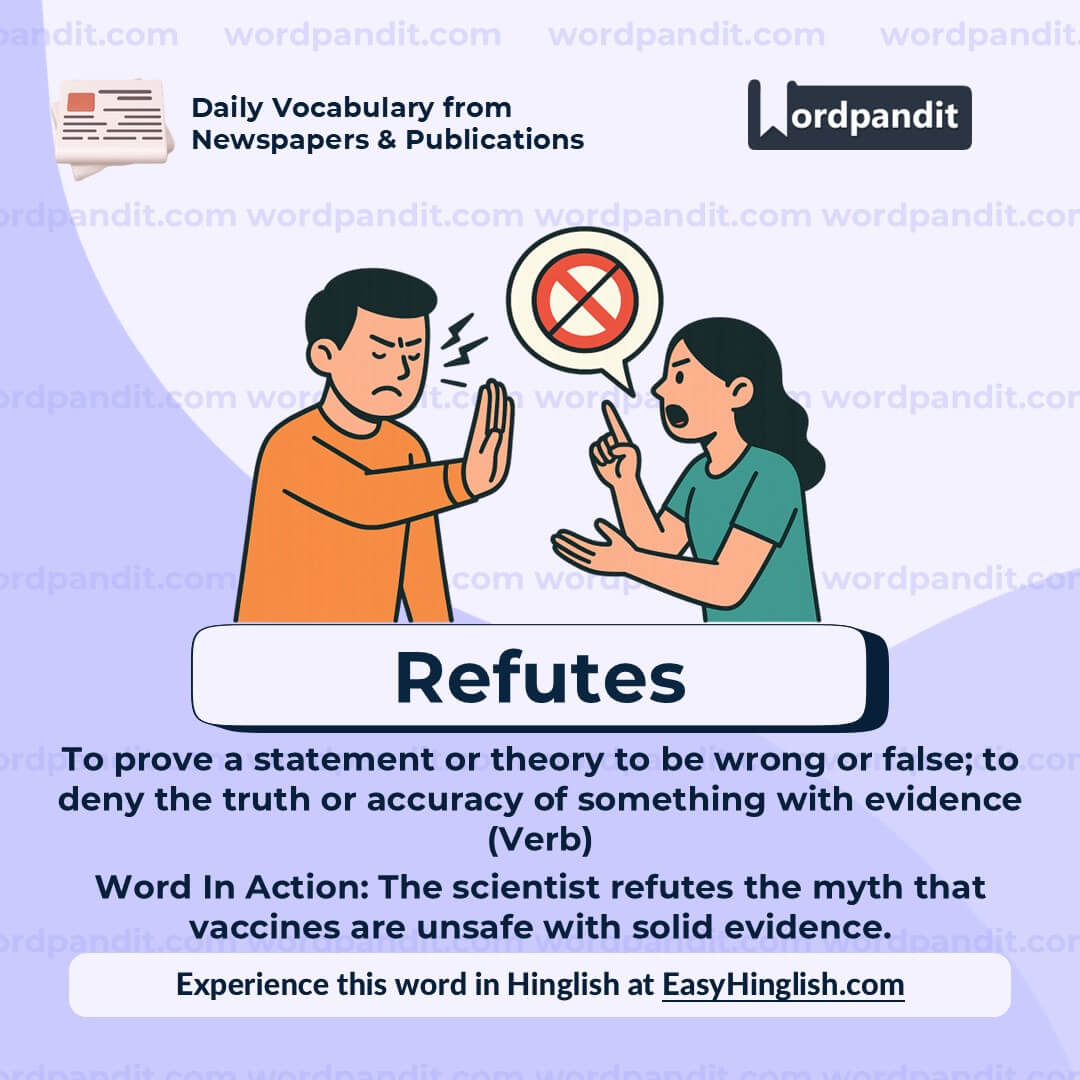
WORD-5: Refutes
Context:
"He refutes Ms Giuffre's claims..." - BBC
Explanatory Paragraph:
Refutes meaning in English is 'to prove that a statement, theory, or claim is wrong or false by providing evidence or logical arguments against it.' This word is used when someone doesn't just disagree with an argument but actively disproves it with facts, evidence, or reasoning. How to use refutes correctly is essential for competitive exams, as it frequently appears in CAT reading comprehension, GRE passages, and UPSC essays discussing debates, legal arguments, scientific theories, and situations where claims are challenged with counter-evidence in formal and academic writing.
Meaning: To prove a statement or theory to be wrong or false; to deny the truth or accuracy of something with evidence (Verb)
Pronunciation: ri-FYOOTS
Difficulty Level: ⭐⭐⭐ Intermediate
Etymology: Refutes comes from Latin 'refutare' meaning 'to check, suppress, or disprove,' formed from 're-' (back) and possibly 'futare' (to beat or strike). Entering English in the 16th century, it originally meant to disprove or prove false through argument or evidence. Unlike simply denying or disagreeing, refuting requires substantive counter-evidence or logical reasoning, which is why it remains a precise term in legal, academic, and formal discourse where claims must be systematically challenged.
Prashant Sir's Notes:
Many students confuse refutes with denies or rejects—the difference between refutes and denies is crucial for competitive exams. While deny simply means to say something is not true, refutes usage specifically means proving something false with evidence or logical arguments. For CAT and GRE reading comprehension, when an author refutes a theory, they're not just disagreeing—they're systematically disproving it. Students often ask: what is the difference between refutes and contradicts? To contradict is to say the opposite, while to refute is to prove wrong with evidence. In Indian English newspapers, you'll see "the minister refutes allegations," "scientists refute the study," or "the defense refutes charges"—notice how refutes implies evidence-based counter-arguments, not mere disagreement. This distinction is critical when answering inference questions: if someone refutes a claim, the passage will contain or imply supporting evidence for their counter-position.
Synonyms & Antonyms:
Synonyms: disproves, rebuts, contradicts, counters, debunks, discredits, invalidates, negates, challenges (with evidence)
Antonyms: confirms, validates, proves, substantiates, verifies, supports, corroborates, affirms
Usage Examples:
- The defense lawyer systematically refutes each accusation with documentary evidence, witness testimonies, and CCTV footage showing the accused elsewhere during the crime.
- Recent research from IIT Delhi refutes the long-held theory about monsoon patterns, presenting satellite data that contradicts earlier climate models.
- The opposition party leader held a press conference to refute the government's economic growth claims, presenting alternative statistics from independent agencies.
- Dr. Sharma's new study refutes the notion that traditional Indian diets lack protein, demonstrating adequate protein content through detailed nutritional analysis.
Cultural Reference:
"In parliamentary debates, opposition members often attempt to refute government claims with data and reports, making evidence-based counter-arguments a cornerstone of democratic discourse." - Common observation in Indian political analysis
Think About It:
In the age of social media, why is the ability to refute misinformation with evidence more important than ever, yet seemingly more difficult to achieve?
Quick Activity:
Think of a common myth or misconception (like "we only use 10% of our brain"). Write two sentences: one stating the myth, and another showing how scientists refute it with evidence.
Memory Tip:
Think of 'Refutes' as 'RE-SHOOTS with FACTS'—imagine someone shooting down false claims by re-shooting them with factual ammunition. When you refute something, you're not just saying "no," you're loading up evidence and systematically shooting down the false argument. The 'RE-' prefix suggests pushing back with proof, not just disagreement.
Real-World Application:
In legal proceedings, scientific journals, and formal debates, 'refutes' is the standard term for evidence-based counter-arguments that disprove claims. Court documents use "the defendant refutes the charges" when presenting exculpatory evidence. Academic papers include sections where researchers refute competing theories with experimental data. News reporting employs "officials refute allegations" when describing denial backed by evidence rather than mere statements. For competitive exam essays and debate preparation, using refutes correctly demonstrates understanding that strong arguments require evidence, not just contradiction. In critical reasoning questions, distinguishing between someone who merely denies versus someone who refutes with proof is essential for analyzing argument strength and identifying logical fallacies.


