

Daily Vocabulary from International Newspapers and Publications
Expand Your Vocabulary with Wordpandit’s Global Vocabulary Hub
At Wordpandit, we are committed to helping you develop a truly global vocabulary by drawing from some of the most respected international publications. This section is designed to keep you ahead of the curve by introducing you to words that define global conversations and trends.
The Power of Global Sources
To help you think and communicate on a global scale, we curate vocabulary from renowned international sources, such as:
- The New York Times
- The Washington Post
- BBC
- The Guardian
- The Economist
- Scientific American
- Psychology Today
- And many more...
Stay Global, Stay Competitive
Our daily updates from international publications ensure you are consistently exposed to new words that reflect global news and developments, making sure your vocabulary is not only current but also globally relevant.
Enhance Your Global Perspective
Whether you’re preparing for international exams, aiming to excel in global business communication, or want to enhance your language skills for personal growth, Wordpandit offers the resources you need to thrive in a global context.
Effective Learning, Global Reach
Our learning methodology combines global examples, memory aids, and interactive activities, allowing you to internalize new words effectively and apply them in real-world scenarios.
Begin Your Global Vocabulary Journey Now!

Why Choose Wordpandit?
Practical Learning: Focus on words you'll actually encounter in real-world reading, enhancing your comprehension and communication skills.
Diverse Content: From current affairs to scientific breakthroughs, our varied sources expose you to vocabulary across multiple domains.
Effortless Integration: Make Wordpandit a part of your daily routine. Just a few minutes each day can significantly boost your lexicon over time.
Your Path to Vocabulary Mastery
- Visit our Daily Vocabulary section regularly
- Explore new words and their usage in context
- Practice incorporating these words into your own writing and speech
- Track your progress as your vocabulary expands
Start Your Journey Today
Embark on your vocabulary enhancement journey with Wordpandit. By consistently engaging with our daily posts, you'll build a robust vocabulary that serves you well in academic, professional, and personal contexts.
Remember, a word a day keeps linguistic limitations at bay. Make Wordpandit your daily companion in the quest for vocabulary excellence!
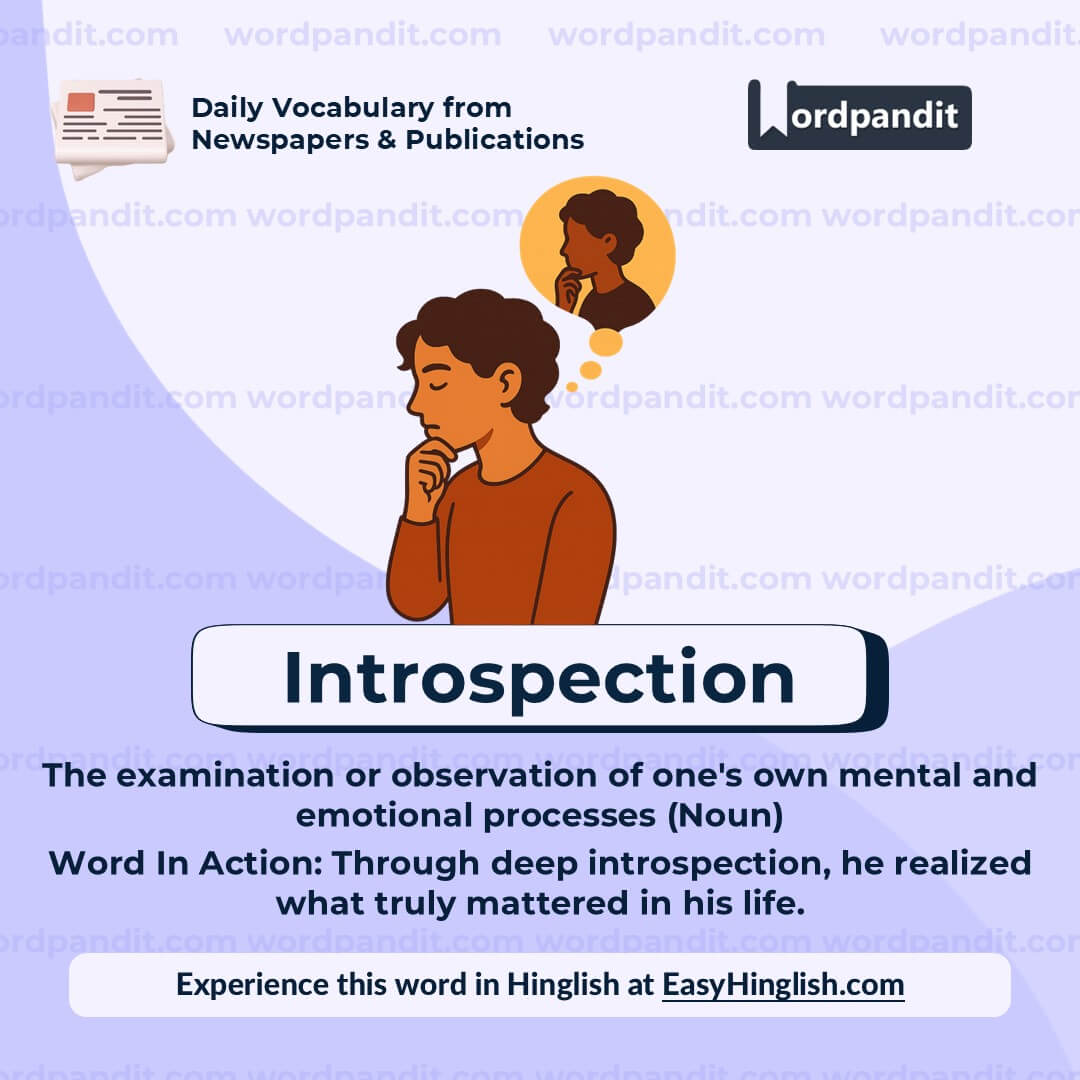
WORD-1: Introspection
Context:
"These are some of the big questions that always kick around at the start of January — happy new year, by the way! — a time for resolve and the serious introspection that (hopefully) precedes it." - The Washington Post
Explanatory Paragraph:
Introspection meaning in English is the examination of one's own thoughts, feelings, and mental processes. This word is used when someone engages in deep self-reflection to understand their motivations, behaviors, or emotional states. How to use introspection correctly becomes especially important in formal writing, psychological discussions, and competitive exam essays where analyzing internal mental processes is required. Introspection is commonly used in CAT reading comprehension passages, GRE analytical writing, and UPSC essays that deal with personal growth and self-awareness.
Meaning: The examination or observation of one's own mental and emotional processes (Noun)
Pronunciation: in-troh-SPEK-shun
Difficulty Level: ⭐⭐⭐ Intermediate
Etymology: Introspection comes from Latin 'introspicere' meaning 'to look inside,' formed from 'intro' (inward) and 'specere' (to look). The word entered English in the late 17th century through philosophical and psychological contexts, where thinkers emphasized the importance of examining one's own consciousness. Over time, it evolved from a technical philosophical term to a common word for self-reflection and personal analysis.
Prashant Sir's Notes:
Students often ask: what is the difference between introspection and reflection? While both involve thinking deeply, introspection usage in sentences specifically means examining your internal thoughts and feelings, whereas reflection can be about external events too. For CAT and GRE aspirants, introspection frequently appears in passages about psychology, philosophy, and personal development—it signals that a character or author is analyzing their inner mental state. Many students confuse introspection with meditation, but introspection is an active analytical process, while meditation focuses on quieting the mind. In Indian English newspapers, you'll often see "a period of introspection" when discussing political parties reassessing their strategies after election defeats.
Synonyms & Antonyms:
Synonyms: self-examination, self-reflection, self-analysis, soul-searching, self-observation, contemplation, meditation (in reflective sense), self-scrutiny, self-awareness, rumination
Antonyms: thoughtlessness, impulsiveness, superficiality, externalization, obliviousness, carelessness
Usage Examples:
- After losing the cricket match, Virat spent hours in introspection, analyzing what went wrong with his batting technique and mental approach.
- The company's quarterly retreat encouraged introspection among managers to identify their leadership weaknesses and areas for improvement.
- Priya's introspection revealed that her career dissatisfaction stemmed not from her job itself but from her fear of taking creative risks.
- Following the exam failure, Rahul engaged in deep introspection rather than blaming external factors, which helped him develop better study habits.
Cultural Reference:
"The unexamined life is not worth living" - This famous philosophical principle, often quoted in Indian educational contexts, emphasizes the value of introspection in leading a meaningful life.
Think About It:
In our fast-paced lives dominated by social media and constant notifications, how much time do we truly dedicate to introspection, and does this lack of self-examination affect our decision-making?
Quick Activity:
Write two sentences about a recent decision you made. In the first sentence, describe what you did. In the second, use "introspection" to explain what you discovered about yourself through analyzing that decision.
Memory Tip:
Break 'Introspection' into 'INTRO-SPECT-ION'—think of 'intro' as inward and 'spect' as spectacles or looking. Imagine putting on special spectacles that let you look inside your own mind—that's introspection! You're inspecting your internal thoughts.
Real-World Application:
Introspection is commonly used in psychological research papers, self-help literature, corporate leadership training materials, and personal development blogs. In academic writing for UPSC and GRE essays, introspection helps demonstrate sophisticated understanding of human behavior and decision-making processes. Business professionals use the term when discussing emotional intelligence, while therapists and counselors employ it when guiding clients through self-discovery processes.
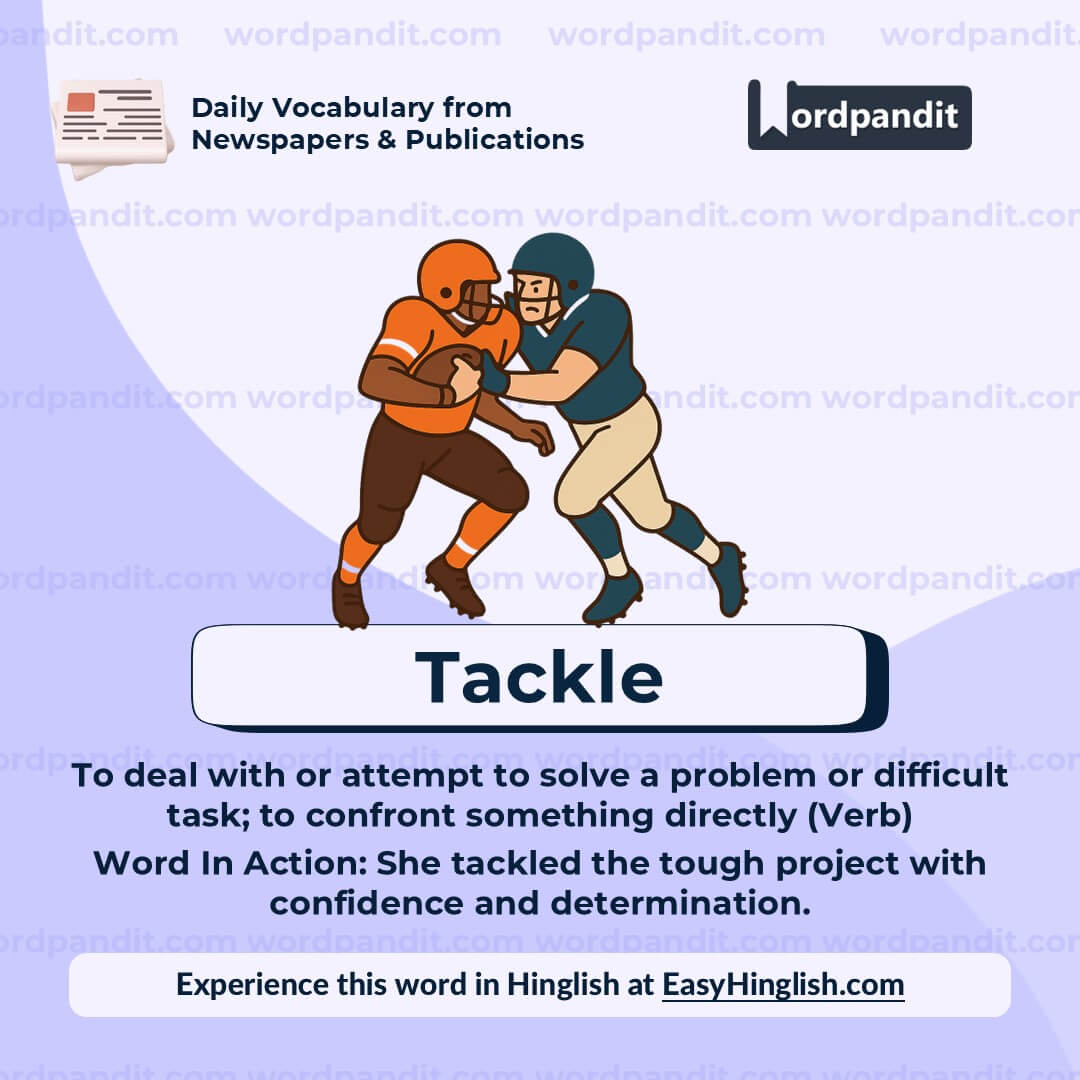
WORD-2: Tackle
Context:
"Our columnists are questioning, too, just on a slightly larger scale; to ring in the new year, a handful of Post Opinions writers will tackle what they see as the biggest question on their particular beat for 2024 and beyond." - The Washington Post
Explanatory Paragraph:
Tackle meaning in English is to make a determined effort to deal with a problem or difficult task. This word is used when someone confronts and attempts to solve challenging situations, whether in sports, work, or everyday life. How to use tackle effectively appears frequently in business communication, project management discussions, and competitive exam essays where problem-solving approaches are analyzed. Tackle is commonly used in CAT reading comprehension passages, professional emails, and news articles to indicate active engagement with difficult issues.
Meaning: To deal with or attempt to solve a problem or difficult task; to confront something directly (Verb)
Pronunciation: TAK-ul
Difficulty Level: ⭐⭐ Basic to Intermediate
Etymology: Tackle originally comes from Middle Dutch 'takel' meaning ship's rigging or equipment in the 13th century. The word evolved to mean grabbing or seizing something, which led to its sporting usage in football by the 1870s. From the physical act of grabbing or stopping an opponent, it metaphorically expanded to mean confronting and dealing with any difficult challenge or problem, becoming a common business and everyday term.
Prashant Sir's Notes:
Many students confuse tackle with solve—the difference between tackle and solve is crucial for GRE and CAT. While solve means successfully finding an answer, tackle usage in formal writing simply means attempting to deal with something, regardless of the outcome. For UPSC aspirants, tackle frequently appears in governance and policy passages where governments "tackle corruption" or "tackle unemployment"—the word emphasizes action and effort, not necessarily success. In Indian English newspapers, you'll constantly see "government tackles inflation" or "India tackles climate change"—this construction shows active engagement with complex problems. How to use tackle correctly: it always suggests a challenging situation that requires courage and determination, not simple tasks.
Synonyms & Antonyms:
Synonyms: address, confront, deal with, handle, grapple with, take on, undertake, approach, manage, face, engage with
Antonyms: avoid, evade, ignore, neglect, sidestep, dodge, bypass, overlook
Usage Examples:
- The Delhi government announced a comprehensive plan to tackle air pollution before the winter season worsens the situation.
- Sunita decided to tackle her biggest weakness first—public speaking—by joining a weekend workshop and practicing regularly.
- The startup founders had to tackle multiple challenges simultaneously, from securing funding to building their technology platform from scratch.
- Rather than procrastinating, Arjun chose to tackle his pending assignments one by one, starting with the most difficult subject.
Cultural Reference:
"When MS Dhoni walks out to tackle a difficult situation, the entire stadium knows something special is about to happen." - This reflects how tackle is used in Indian cricket commentary to describe confronting pressure situations.
Think About It:
Why do we often postpone tackling our most important problems, choosing instead to busy ourselves with easier, less meaningful tasks?
Quick Activity:
List three challenging problems you're currently facing. Write one sentence for each, using "tackle" to describe how you plan to address them this week.
Memory Tip:
Think of TACKLE like a football player tackling an opponent—you're grabbing hold of a problem head-on, not running away from it. Just as Sunil Chhetri tackles defenders on the field, you tackle problems in life by confronting them directly and with determination.
Real-World Application:
Tackle is extensively used in corporate presentations when discussing project challenges, in government policy documents when addressing social issues, and in academic research papers when describing methodology approaches. Business emails frequently use phrases like "let's tackle this issue" or "we need to tackle the client's concerns." In competitive exam essays for CAT, GRE, and UPSC, using tackle demonstrates active problem-solving vocabulary and shows familiarity with professional communication styles commonly found in reading comprehension passages.
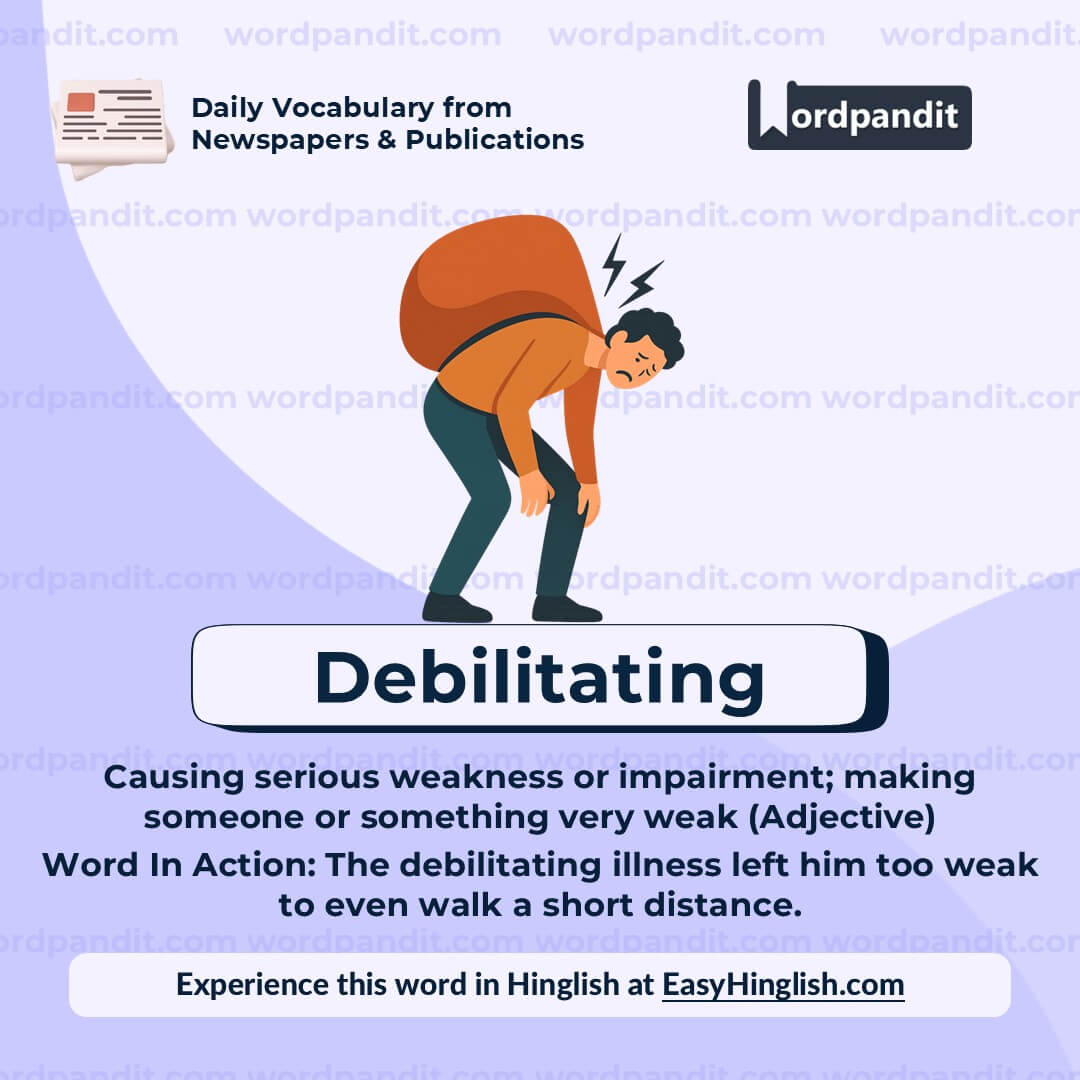
WORD-3: Debilitating
Context:
"It seems I was simultaneously burdened with two debilitating syndromes — dyslexia and ADHD."
Explanatory Paragraph:
Debilitating meaning in English is causing severe weakness, impairment, or making someone unable to function normally. This word is used when describing conditions, situations, or factors that seriously weaken a person's physical, mental, or functional capabilities. How to use debilitating appears frequently in medical contexts, psychology discussions, and descriptive writing about challenges. Debilitating is commonly used in GRE reading passages, IELTS essays, and CAT comprehension texts that discuss health issues, economic problems, or social obstacles that severely limit normal functioning.
Meaning: Causing serious weakness or impairment; making someone or something very weak (Adjective)
Pronunciation: dih-BIL-ih-tay-ting
Difficulty Level: ⭐⭐⭐ Intermediate to Advanced
Etymology: Debilitating comes from Latin 'debilitare' meaning 'to weaken,' derived from 'debilis' which means weak or feeble. The root 'de-' intensifies the meaning of weakness, while 'habilis' (able) forms the contrast. The word entered English in the 16th century primarily in medical contexts to describe diseases that weaken the body. Over centuries, it expanded beyond medical usage to describe anything that severely weakens—whether physical strength, mental capacity, economic systems, or organizational effectiveness.
Prashant Sir's Notes:
Students often ask: what is the difference between debilitating and weakening? While both involve reduced strength, debilitating usage specifically implies severe, often crippling weakness that significantly impairs normal functioning. Many students confuse debilitating with disabling—debilitating suggests ongoing weakness that makes things difficult, while disabling means completely preventing function. For CAT and GRE aspirants, debilitating frequently appears in passages about health crises, economic downturns, or psychological conditions where the severity of impact needs emphasis. In Indian English newspapers, you'll regularly see "debilitating poverty," "debilitating illness," or "debilitating drought"—the word always conveys that the condition is not just bad but severely limiting. How to use debilitating correctly: it should describe something that genuinely impairs function, not just mild inconvenience.
Synonyms & Antonyms:
Synonyms: weakening, incapacitating, crippling, enervating, exhausting, draining, enfeebling, impairing, disabling, devastating, paralyzing
Antonyms: strengthening, energizing, empowering, invigorating, fortifying, revitalizing, enabling, enhancing
Usage Examples:
- The debilitating migraine attacks forced Meera to miss important client meetings and significantly affected her career progression at the firm.
- India's agriculture sector continues to suffer from debilitating water shortages that severely limit crop yields across several states.
- Rohan struggled with debilitating anxiety before exams, which prevented him from performing at his actual capability despite thorough preparation.
- The debilitating impact of the pandemic on small businesses in Mumbai led to thousands of shop closures and widespread unemployment.
Cultural Reference:
"In the film Taare Zameen Par, the young protagonist faces debilitating challenges due to dyslexia, showing how learning disabilities can severely impact a child's confidence and academic performance." - Reference to Aamir Khan's impactful Bollywood film
Think About It:
How often do we dismiss others' struggles as minor inconveniences without recognizing they might be facing truly debilitating challenges that completely alter their daily functioning?
Quick Activity:
Write two sentences comparing a minor problem you faced recently with something that would be truly debilitating. Notice how the word's intensity changes the meaning completely.
Memory Tip:
Break 'Debilitating' into 'DE-ABILITY-TING'—the prefix 'de' means removing or reducing, and 'ability' is what you can do. So debilitating literally means "taking away your ability" to function normally. Imagine someone's abilities being stripped away, leaving them significantly weakened.
Real-World Application:
Debilitating is extensively used in medical journals and health reports when describing severe conditions like debilitating arthritis or chronic pain. In economic analysis and policy documents, experts describe debilitating poverty or debilitating debt. Corporate communications use it when discussing serious organizational challenges. For UPSC essay writing and GRE analytical writing, debilitating helps express the severity of problems—whether discussing social issues, health crises, or economic challenges—distinguishing truly serious impediments from mere difficulties.
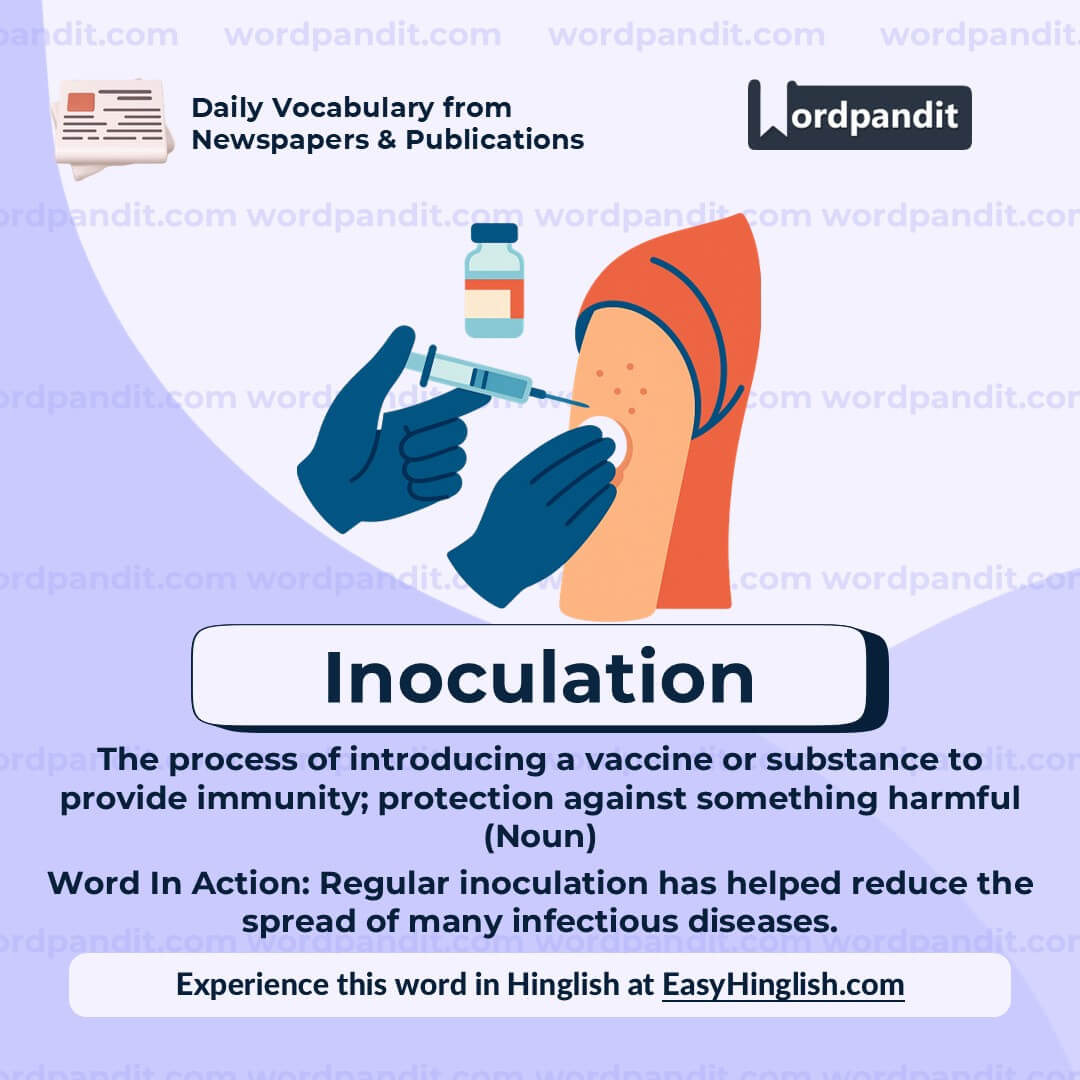
WORD-4: Inoculation
Context:
"For Karen's beat, the question refers to national political identity. For years, Karen writes, the negating mantra of 'this is not who we are' has been a constant inoculation against the ugliness of the MAGA movement." - The Washington Post
Explanatory Paragraph:
Inoculation meaning in English is the process of protecting someone against a disease or harmful influence by introducing a controlled exposure to it. This word is used when describing both medical vaccination and metaphorical protection against negative ideas or influences. How to use inoculation extends beyond medical contexts to describe psychological or ideological protection strategies. Inoculation is commonly used in GRE science passages, CAT reading comprehension on public health, and UPSC essays discussing preventive measures, whether medical immunization or building resistance to misinformation.
Meaning: The process of introducing a vaccine or substance to provide immunity; protection against something harmful (Noun)
Pronunciation: ih-nok-yoo-LAY-shun
Difficulty Level: ⭐⭐⭐ Intermediate to Advanced
Etymology: Inoculation comes from Latin 'inoculare' meaning 'to graft,' derived from 'in-' (into) and 'oculus' (eye or bud). Originally used in gardening for grafting plant buds, the term was adopted in the early 18th century for the medical practice of introducing smallpox material to create immunity. The word evolved from the literal insertion of disease material into the skin to encompass all forms of vaccination and, metaphorically, any process of building resistance by controlled exposure—whether to diseases, ideas, or propaganda.
Prashant Sir's Notes:
Many students confuse inoculation with vaccination—while related, the difference between inoculation and vaccination is subtle. Inoculation is the broader, older term referring to introducing any material for immunity, while vaccination specifically refers to using vaccines. For CAT and GRE aspirants, inoculation frequently appears in two contexts: medical/scientific passages about disease prevention, and metaphorical usage in political or psychological texts about protecting minds from harmful influences. Students often ask: how to use inoculation in non-medical contexts? Think of it as "building resistance"—just as doctors inoculate against disease, educators can inoculate students against misinformation by teaching critical thinking. In Indian English newspapers during COVID-19, you saw "mass inoculation drives" referring to nationwide vaccination campaigns, showing the term's practical public health usage.
Synonyms & Antonyms:
Synonyms: vaccination, immunization, injection, protection, preventive treatment, safeguarding, fortification (metaphorical), defense mechanism
Antonyms: infection, contamination, exposure (without protection), vulnerability, susceptibility
Usage Examples:
- The Indian government launched an aggressive inoculation campaign to vaccinate millions of children against polio, successfully eradicating the disease from the country.
- Media literacy programs serve as an inoculation against fake news, helping students recognize and resist misinformation on social platforms.
- Priya's parents believed that early exposure to diverse viewpoints was an inoculation against narrow-mindedness and prejudice later in life.
- The mandatory inoculation requirement for school admission has significantly reduced outbreaks of preventable diseases like measles and mumps in urban areas.
Cultural Reference:
"India's Pulse Polio Programme, with its Sunday inoculation drives and 'Do Boond Zindagi Ki' campaign, became one of the world's largest public health mobilization efforts, showing how mass inoculation can eliminate deadly diseases." - Reference to India's successful polio eradication campaign
Think About It:
In an age of information overload and social media echo chambers, what kind of mental inoculation do we need to protect ourselves from harmful ideologies and misinformation?
Quick Activity:
Write two sentences using "inoculation"—one in a medical context about disease prevention, and another in a metaphorical context about protecting the mind or society from harmful influences.
Memory Tip:
Think of 'Inoculation' as "IN-OCULAR-TION"—imagine inserting protection directly into your eye (ocular), which is a sensitive area needing defense. Just as you'd protect your eyes carefully, inoculation protects your body or mind by introducing small, controlled amounts of threats to build immunity and resistance.
Real-World Application:
Inoculation is extensively used in public health policy documents, medical research papers, and WHO reports discussing vaccination strategies. Beyond medicine, communication scholars use "inoculation theory" to describe how exposing people to weakened arguments builds resistance to persuasion. In UPSC essay writing on public health or GRE analytical writing on science policy, inoculation demonstrates sophisticated vocabulary for discussing prevention strategies. Journalists use it metaphorically when discussing how societies protect themselves against extremism, propaganda, or cultural erosion through education and critical thinking.
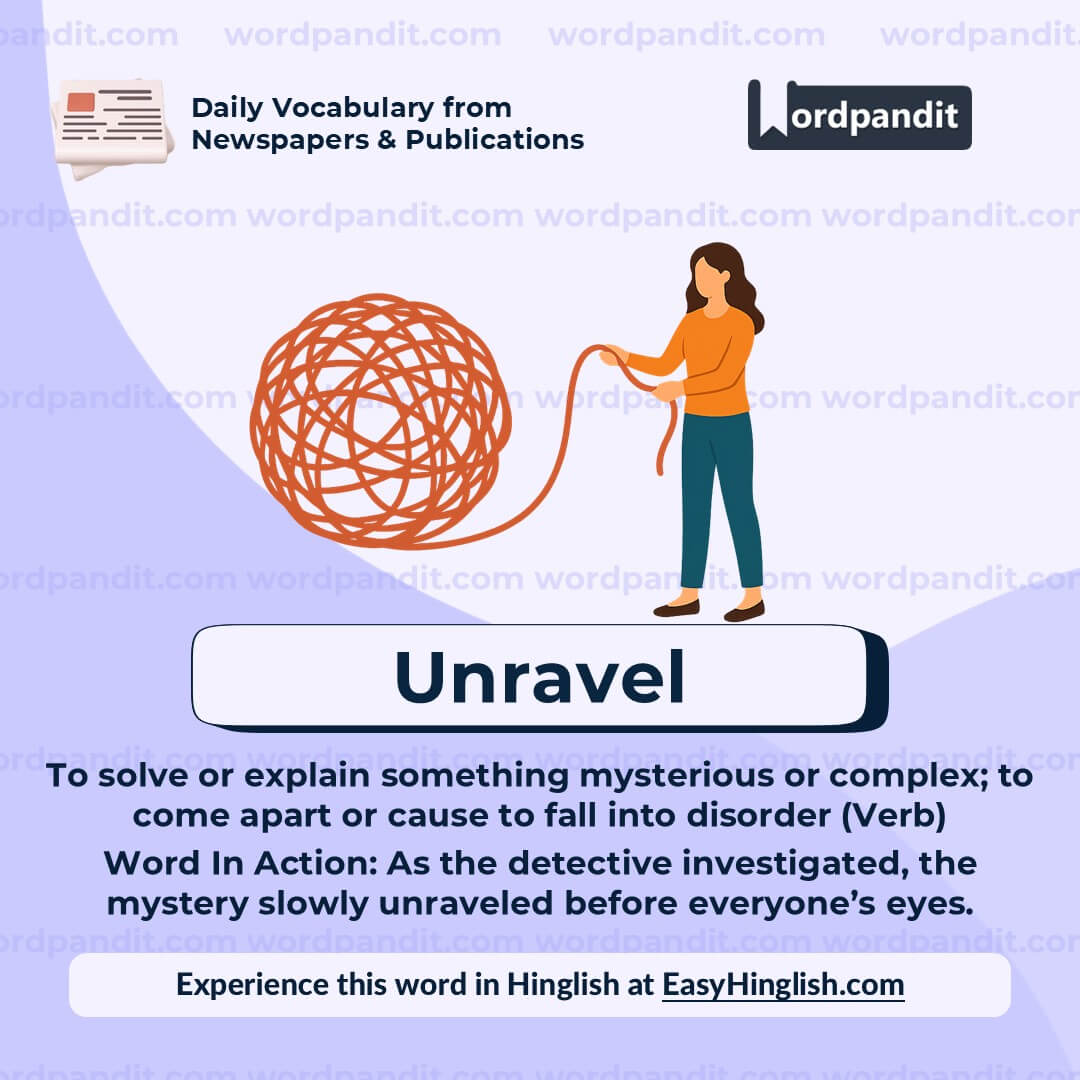
WORD-5: Unravel
Context:
"In her interview, her book, and her MOOC, Oakley describes how she went from an 18-year-old military recruit who hated math to a professor of engineering. What happened? She unravels the mysteries of learning."
Explanatory Paragraph:
Unravels meaning in English is to investigate and explain something complex, or to cause something woven or knitted to separate into threads. This word is used when describing both the literal untangling of fabric and the metaphorical process of solving mysteries or understanding complicated situations. How to use unravels correctly depends on context—it can mean solving a puzzle or watching something fall apart. Unravels is commonly used in CAT reading comprehension passages about investigations, GRE analytical writing discussing problem-solving, and news articles where complex situations are being explained or deteriorating.
Meaning: To solve or explain something mysterious or complex; to come apart or cause to fall into disorder (Verb)
Pronunciation: un-RAV-ulz
Difficulty Level: ⭐⭐⭐ Intermediate
Etymology: Unravels comes from the prefix 'un-' (reverse action) combined with 'ravel,' which paradoxically meant both to tangle and untangle in Middle Dutch 'ravelen.' The word entered English in the 17th century originally referring to separating threads from woven fabric. Over time, it developed a powerful metaphorical meaning—just as pulling a thread unravels a sweater, investigating clues unravels mysteries, or examining evidence unravels complex plots. The dual meaning persists: unraveling can mean both clarifying mysteries (positive) and things falling apart (negative).
Prashant Sir's Notes:
Students often ask: what is the difference between unravels and solves? While solve simply means finding an answer, unravels usage in formal writing suggests a gradual, careful process of untangling complexity—like a detective slowly piecing together clues. For GRE and CAT aspirants, unravels frequently appears in passages about scientific discoveries, criminal investigations, or political scandals where layer-by-layer revelation is emphasized. Many students confuse the two meanings of unravel—it can mean both "to solve/explain" (positive) as in "she unravels the mystery," and "to fall apart" (negative) as in "the plan unraveled." How to use unravels correctly: pay attention to context! In Indian English newspapers, you'll see "CBI unravels corruption network" (solving) or "coalition government unravels" (collapsing). The word always suggests something complex with multiple interconnected parts.
Synonyms & Antonyms:
Synonyms: solve, decode, decipher, untangle, disentangle, clarify, explain, uncover, expose, disintegrate (when meaning fall apart), collapse, deteriorate
Antonyms: tangle, complicate, obscure, confuse, weave together, construct, build, strengthen (when meaning fall apart)
Usage Examples:
- The investigative journalist spent months interviewing sources to unravel the complex web of corruption involving politicians and business tycoons in Mumbai.
- As the pressure mounted before board exams, Rajesh's carefully planned study schedule began to unravel, leaving him anxious and disorganized.
- Dr. Sharma's research unravels the genetic factors behind diabetes prevalence in Indian populations, offering new insights for preventive healthcare.
- The detective slowly unraveled the alibi by cross-checking phone records, CCTV footage, and witness statements until the truth emerged clearly.
Cultural Reference:
"In the film Kahaani, Vidya Balan's character methodically unravels the mystery of her missing husband, pulling at threads of evidence until the shocking truth is finally revealed." - Reflecting how Bollywood thrillers use the concept of unraveling mysteries
Think About It:
Why do some people's lives seem to unravel during stressful periods while others remain tightly woven together—is it about external circumstances or internal resilience?
Quick Activity:
Write two sentences using "unravels" with its two different meanings—one where someone unravels a mystery or problem (positive sense), and another where a situation unravels or falls apart (negative sense).
Memory Tip:
Think of 'Unravels' like pulling a loose thread on a sweater—UN-RAVEL-S. As you pull the thread, either you're carefully unraveling it to understand how it was made (solving a mystery), or the whole sweater is unraveling and falling apart (things going wrong). The same pulling action, two different outcomes!
Real-World Application:
Unravels is extensively used in investigative journalism when reporters expose corruption scandals or complex financial frauds. Scientific research papers use it when describing how studies unravel the mechanisms of diseases or natural phenomena. In business analysis, experts describe how market conditions or corporate strategies unravel under pressure. For CAT reading comprehension and GRE passages, unravels appears frequently in mystery, detective, scientific, and political contexts. UPSC essay writing benefits from using unravels to describe both problem-solving processes and institutional failures, demonstrating nuanced understanding of complexity.


