

Daily Vocabulary from International Newspapers and Publications
Expand Your Vocabulary with Wordpandit’s Global Vocabulary Hub
At Wordpandit, we are committed to helping you develop a truly global vocabulary by drawing from some of the most respected international publications. This section is designed to keep you ahead of the curve by introducing you to words that define global conversations and trends.
The Power of Global Sources
To help you think and communicate on a global scale, we curate vocabulary from renowned international sources, such as:
- The New York Times
- The Washington Post
- BBC
- The Guardian
- The Economist
- Scientific American
- Psychology Today
- And many more...
Stay Global, Stay Competitive
Our daily updates from international publications ensure you are consistently exposed to new words that reflect global news and developments, making sure your vocabulary is not only current but also globally relevant.
Enhance Your Global Perspective
Whether you’re preparing for international exams, aiming to excel in global business communication, or want to enhance your language skills for personal growth, Wordpandit offers the resources you need to thrive in a global context.
Effective Learning, Global Reach
Our learning methodology combines global examples, memory aids, and interactive activities, allowing you to internalize new words effectively and apply them in real-world scenarios.
Begin Your Global Vocabulary Journey Now!

Why Choose Wordpandit?
Practical Learning: Focus on words you'll actually encounter in real-world reading, enhancing your comprehension and communication skills.
Diverse Content: From current affairs to scientific breakthroughs, our varied sources expose you to vocabulary across multiple domains.
Effortless Integration: Make Wordpandit a part of your daily routine. Just a few minutes each day can significantly boost your lexicon over time.
Your Path to Vocabulary Mastery
- Visit our Daily Vocabulary section regularly
- Explore new words and their usage in context
- Practice incorporating these words into your own writing and speech
- Track your progress as your vocabulary expands
Start Your Journey Today
Embark on your vocabulary enhancement journey with Wordpandit. By consistently engaging with our daily posts, you'll build a robust vocabulary that serves you well in academic, professional, and personal contexts.
Remember, a word a day keeps linguistic limitations at bay. Make Wordpandit your daily companion in the quest for vocabulary excellence!
WORD-1: Predominantly
Context:
"Outbreaks of influenza virus tend to occur seasonally each year, predominantly in winter..." - Scientific American
Explanatory Paragraph:
Predominantly meaning in English is 'mainly or for the most part; to a great extent.' This word is used when something occurs most often or is most common in a particular situation, though other possibilities may exist. How to use predominantly becomes clear when you need to describe the primary characteristic or most frequent occurrence of something. Predominantly is commonly used in academic writing, research papers, news articles, and competitive exam passages like CAT and GRE to indicate the main or most significant aspect while acknowledging minor exceptions.
Meaning: Mainly or for the most part; chiefly (Adverb)
Pronunciation: prih-DOM-ih-nunt-lee
Difficulty Level: ⭐⭐⭐ Intermediate
Etymology: Predominantly comes from the Latin word 'dominari' meaning 'to rule or have power over,' through 'predominate.' The word evolved from describing physical or political dominance to its current usage indicating numerical or proportional superiority. The '-ly' suffix transformed the adjective 'predominant' into an adverb, allowing it to modify verbs and describe how something occurs mainly or chiefly.
Prashant Sir's Notes:
Many students confuse predominantly with 'completely' or 'entirely'—the key difference between predominantly and completely is that predominantly always leaves room for exceptions, while completely means 100%. For CAT and GRE aspirants, predominantly frequently appears in data interpretation passages and research-based reading comprehension where you need to identify majority trends without absolute statements. Students often ask: what is the difference between predominantly and mainly? Both are synonyms, but predominantly usage in formal writing sounds more academic and precise. In Indian English newspapers, you'll often see predominantly used in demographic reports like "India's workforce is predominantly young" or economic analyses, making it essential vocabulary for UPSC and Bank PO exams.
Synonyms & Antonyms:
Synonyms: mainly, mostly, chiefly, primarily, principally, largely, for the most part, in the main, generally, overall
Antonyms: rarely, minimally, slightly, marginally, insignificantly, secondarily
Usage Examples:
- The Indian IT industry is predominantly concentrated in cities like Bengaluru, Hyderabad, and Pune, though smaller hubs are emerging.
- Priya's investment portfolio is predominantly composed of equity mutual funds, with only a small allocation to debt instruments.
- The research data showed that CAT aspirants predominantly struggle with the quantitative aptitude section rather than verbal ability.
- Mumbai's local trains are predominantly crowded during morning rush hours, making the 9 AM local particularly challenging for commuters.
Cultural Reference:
"Indian cinema was predominantly dominated by Hindi films until regional cinema gained massive recognition through pan-India releases like Baahubali and RRR." - Commentary on the evolution of Indian film industry
Think About It:
Why do we use 'predominantly' instead of 'completely' when describing trends in society, business, or science? What does this word choice reveal about accuracy in communication?
Quick Activity:
Look at today's newspaper and find three headlines or sentences that describe majorities or trends. Rewrite them using 'predominantly' to make them more academically precise.
Memory Tip:
Think of 'Predominantly' as 'PRE-DOMINANT-ly'—imagine a cricket team where one player is the DOMINANT force (like Virat Kohli in his peak), but the team PREdominantly depends on him, though others contribute too. The word signals 'mostly but not entirely.'
Real-World Application:
Predominantly is commonly used in research papers, business reports, and data analysis to describe majority trends without making absolute claims. In corporate presentations, professionals use it to discuss market share, customer demographics, or resource allocation. For competitive exam aspirants, understanding predominantly helps in answering inference questions where you must identify what is 'mostly true' versus 'always true' in reading comprehension passages.

WORD-2: Coinciding
Context:
"...that surged in Australia and New Zealand over the past two months, coinciding with the end of winter…" - Scientific American
Explanatory Paragraph:
Coinciding meaning in English is 'happening at the same time or occurring together.' This word is used when two or more events take place simultaneously, whether by chance or design. How to use coinciding correctly involves showing the temporal relationship between events without necessarily implying causation. Coinciding is commonly used in academic writing, research articles, news reports, and competitive exam passages for CAT, GRE, and UPSC to describe concurrent occurrences and temporal patterns.
Meaning: Occurring at the same time; happening together (Verb - present participle)
Pronunciation: koh-in-SY-ding
Difficulty Level: ⭐⭐ Basic to Intermediate
Etymology: Coinciding comes from the Latin 'co-' meaning 'together' and 'incidere' meaning 'to fall upon or happen,' through Medieval Latin 'coincidere.' The word originally described things that occupied the same space or position, but evolved to emphasize temporal overlap. The concept of things 'falling together' in time perfectly captures how coinciding describes simultaneous events in modern usage.
Prashant Sir's Notes:
Many students confuse coinciding with 'causing'—the critical difference between coinciding and causing is that coinciding simply means happening at the same time, while causing implies one event leads to another. For GRE and CAT aspirants, this distinction is crucial in reading comprehension where you must identify whether the passage suggests correlation or causation. Students often ask: what is the difference between coinciding and corresponding? While both suggest alignment, coinciding usage specifically emphasizes timing, whereas corresponding focuses on matching patterns or relationships. In Indian newspapers covering festivals like Diwali coinciding with quarterly results announcements or elections coinciding with monsoon season, this word appears frequently in temporal analysis.
Synonyms & Antonyms:
Synonyms: concurrent, simultaneous, synchronous, corresponding, coexisting, overlapping, accompanying, parallel, contemporaneous, concomitant
Antonyms: separate, distinct, diverging, non-overlapping, sequential, successive
Usage Examples:
- The launch of the new smartphone coinciding with the festive season helped boost sales across Indian retail markets significantly.
- Rahul's promotion announcement coinciding with his wedding celebration made it an especially memorable month for his entire family.
- The stock market crash coinciding with the global pandemic created unprecedented challenges for investors and financial institutions worldwide.
- My board exams coinciding with IPL season was terrible timing, as I struggled to resist watching cricket matches while studying.
Cultural Reference:
"Shah Rukh Khan's comeback film 'Pathaan' coinciding with Republic Day weekend was a strategic masterstroke, resulting in record-breaking opening collections." - Analysis of Bollywood box office strategy
Think About It:
When major life events coincide—like job opportunities appearing during personal crises—is it pure chance, timing, or does the simultaneous occurrence create meaning we construct ourselves?
Quick Activity:
Write two sentences about events in your life that coincided recently—one positive coincidence and one challenging coincidence. Focus on the timing, not the causation.
Memory Tip:
Break 'Coinciding' into 'CO-IN-CIDING'—think of 'CO' as 'together' and 'INCIDING' as 'incidents happening.' Imagine two trains arriving at the platform together at the exact same moment—they're CO-incidents, coinciding perfectly in time.
Real-World Application:
Coinciding is essential in business reports and project management to describe overlapping timelines, parallel developments, or simultaneous market trends. In academic research and data analysis, it helps describe temporal correlations without implying causation. For UPSC aspirants writing essays or mains answers, using coinciding demonstrates sophisticated understanding of temporal relationships in historical events, policy implementations, or social phenomena. Journalists frequently use it when reporting events that happen at the same time, making it valuable vocabulary for current affairs analysis.
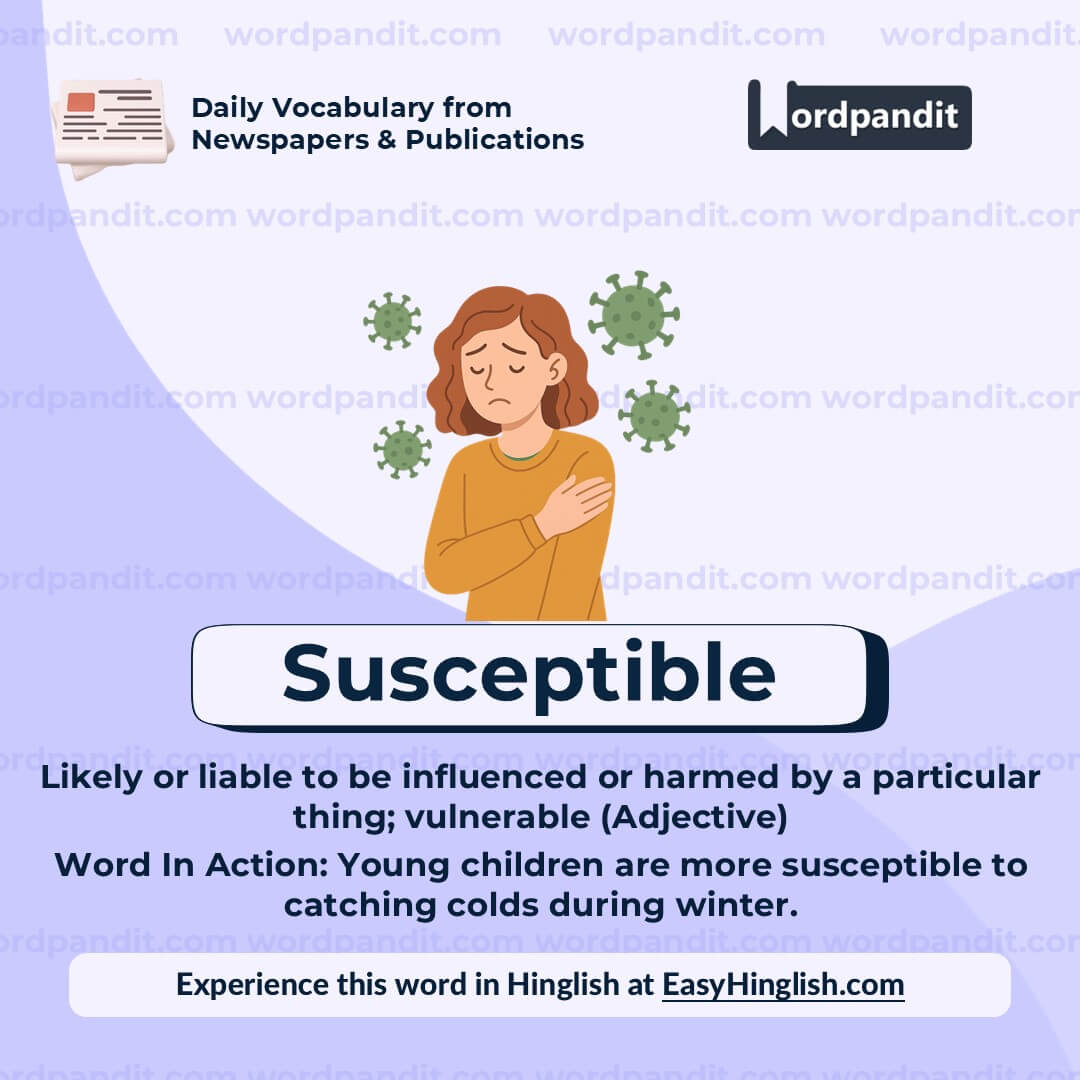
WORD-3: Susceptible
Context:
"Nations that are about to enter winter will be more susceptible to outbreaks." - Scientific American
Explanatory Paragraph:
Susceptible meaning in English is 'likely to be influenced or harmed by something; vulnerable or prone to.' This word is used when describing someone or something that is easily affected by external factors, diseases, emotions, or influences. How to use susceptible involves identifying situations where vulnerability or openness to impact exists. Susceptible is commonly used in medical writing, scientific research, psychological contexts, and competitive exam passages for CAT, GRE, and UPSC to describe vulnerability patterns and risk factors.
Meaning: Likely or liable to be influenced or harmed by a particular thing; vulnerable (Adjective)
Pronunciation: suh-SEP-tih-buhl
Difficulty Level: ⭐⭐⭐ Intermediate
Etymology: Susceptible comes from the Latin 'suscipere' meaning 'to take up or receive,' formed from 'sus-' (up from below) and 'capere' (to take). Through Late Latin 'susceptibilis,' the word evolved to describe the capacity to receive or be affected by something. Originally neutral, suggesting receptiveness, the word gradually acquired its modern sense of vulnerability, emphasizing openness to negative influences or harm rather than just general receptiveness.
Prashant Sir's Notes:
Many students confuse susceptible with 'vulnerable'—while both indicate openness to harm, the difference between susceptible and vulnerable is that susceptible emphasizes the likelihood or tendency to be affected, while vulnerable focuses on the state of being exposed. For CAT and GRE reading comprehension, susceptible usage often appears in scientific passages discussing risk factors, making it crucial for inference questions. Students often ask: how to use susceptible correctly with prepositions? Remember: you're susceptible TO something (diseases, influence, criticism), not susceptible FOR or OF. In Indian English medical reporting, you'll frequently see "children are more susceptible to seasonal infections" or "diabetic patients are susceptible to complications," making this word essential for UPSC health policy questions and general awareness sections in Bank PO exams.
Synonyms & Antonyms:
Synonyms: vulnerable, prone, liable, inclined, predisposed, subject to, open to, receptive, exposed, at risk, sensitive
Antonyms: resistant, immune, invulnerable, protected, insusceptible, unaffected, impervious
Usage Examples:
- Young children and elderly citizens are particularly susceptible to respiratory infections during Delhi's severe winter pollution episodes.
- Investors who make emotional decisions are more susceptible to market manipulation and panic selling during volatile trading sessions.
- Students preparing for competitive exams without proper guidance are susceptible to misinformation from unverified online sources and coaching scams.
- Priya realized she was susceptible to social media influence and decided to limit her screen time to maintain better mental health.
Cultural Reference:
"In the film '3 Idiots,' Rancho warns that students who blindly follow conventional paths are susceptible to losing their passion and creativity in pursuit of grades and placements." - Reflection on educational pressure in Indian society
Think About It:
Are we all equally susceptible to advertising and social media influence, or does self-awareness create immunity? What makes some people more susceptible than others?
Quick Activity:
Identify three situations where you feel most susceptible to external influence—peer pressure, advertising, emotional manipulation, or health risks. Write one sentence for each explaining why.
Memory Tip:
Think of 'Susceptible' as 'SUS-ACCEPT-able'—imagine someone who ACCEPTS everything SUSpiciously easily, like accepting candy from strangers. If you're too accepting and open, you're susceptible to harm or influence. The 'ACCEPT' sound in the middle reminds you that susceptible people accept negative influences too readily.
Real-world Application:
Susceptible is extensively used in medical literature, public health advisories, and epidemiological reports to identify at-risk populations. In cybersecurity and IT communications, professionals use it to describe systems vulnerable to attacks or breaches. For UPSC aspirants writing mains answers on health policy, social issues, or disaster management, using susceptible demonstrates analytical thinking about vulnerability patterns. Business analysts use this word when discussing market segments susceptible to economic downturns or consumer groups susceptible to marketing strategies, making it valuable for MBA entrance exams and corporate communications.
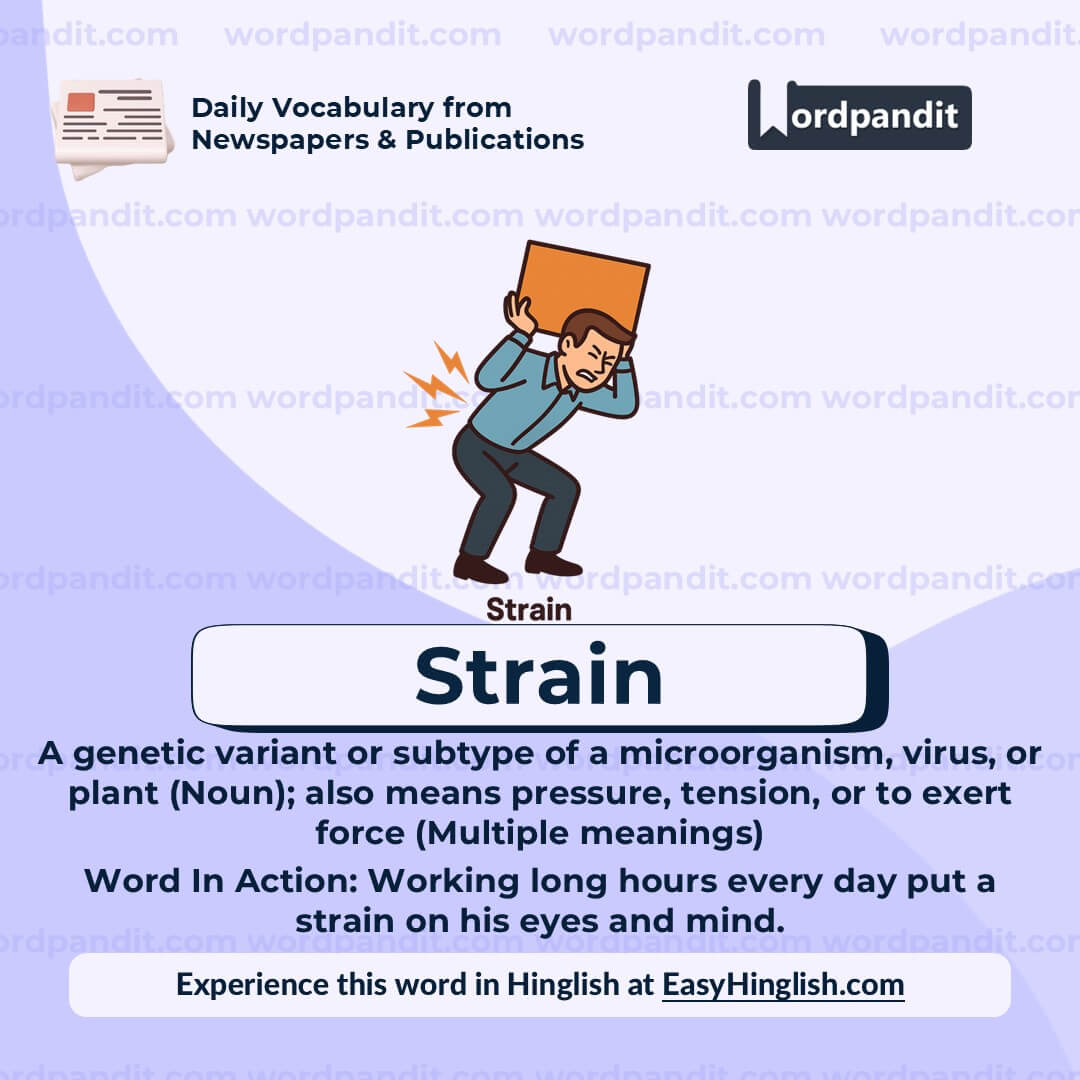
WORD-4: Strain
Context:
"...a strain of influenza A, called H3N2, that surged in Australia and New Zealand…" - Scientific American
Explanatory Paragraph:
Strain meaning in English is 'a particular breed, stock, or variety of an organism, especially a microorganism or virus with genetically distinct characteristics.' This word is used when describing variations within a species, particularly in medical, biological, and agricultural contexts. How to use strain becomes important when discussing different versions of diseases, bacteria, or plants that share common ancestry but have unique features. Strain is commonly used in scientific research, medical reports, news articles about epidemics, and competitive exam passages for UPSC, CAT, and GRE to describe biological variants and disease types.
Meaning: A genetic variant or subtype of a microorganism, virus, or plant (Noun); also means pressure, tension, or to exert force (Multiple meanings)
Pronunciation: strayn
Difficulty Level: ⭐⭐ Basic to Intermediate
Etymology: Strain comes from the Old English 'streon' meaning 'gain, acquisition, or offspring,' related to Latin 'struere' meaning 'to build or pile up.' In biological contexts, the word evolved to mean a lineage or stock of organisms sharing common characteristics. The connection between 'offspring' and modern usage is clear—a strain represents a line of descent with particular genetic traits. Interestingly, the same word also means 'tension or pressure,' derived from Latin 'stringere' (to draw tight), showing how English has merged two etymologically distinct words into one spelling.
Prashant Sir's Notes:
Many students confuse strain with 'virus' or 'disease'—the critical difference between strain and virus is that a virus is the type of pathogen, while a strain is a specific variant within that virus type. For UPSC aspirants, understanding strain usage is essential for science and technology questions, especially during pandemic-related current affairs. Students often ask: what is the difference between strain and variant? Both terms are nearly interchangeable in biology, but strain is more commonly used in microbiology and medical contexts, while variant has become popular in recent COVID-19 discussions. In Indian newspapers covering health crises, you'll see "new strain of dengue detected in Kerala" or "drug-resistant strain of tuberculosis," making this vocabulary crucial for general awareness sections in SSC, Bank PO, and civil services exams. Remember that strain has multiple meanings—biological variant, physical tension, or pressure—so context determines which meaning applies.
Synonyms & Antonyms:
Synonyms: variant, type, variety, stock, breed, lineage, subtype, form (in biological context); pressure, tension, stress, burden (in physical/emotional context)
Antonyms: ease, relaxation, relief (when referring to tension); uniformity, sameness (when referring to variants)
Usage Examples:
- Health authorities in Mumbai identified a new strain of dengue virus that showed resistance to conventional treatment protocols used in previous outbreaks.
- Agricultural scientists at IARI developed a high-yield strain of wheat specifically adapted to drought-prone regions of Rajasthan and Madhya Pradesh.
- The research paper analyzed how different strains of the same bacterial species exhibited varying levels of antibiotic resistance across Indian hospitals.
- Working night shifts for three consecutive months put severe strain on Amit's health, forcing him to reconsider his career priorities.
Cultural Reference:
"During the COVID-19 pandemic, news channels constantly discussed the Delta and Omicron strains, making terms like 'mutant strain' and 'variant of concern' part of everyday Indian household conversations." - Observation on pandemic vocabulary in Indian media
Think About It:
Why do new strains of diseases emerge more frequently in our interconnected world, and how does global travel accelerate the spread of novel strains across continents?
Quick Activity:
Search today's health news and identify three different contexts where the word 'strain' is used—biological, physical, or emotional. Write one sentence for each context showing the different meanings.
Memory Tip:
Think of 'Strain' as 'S-TRAIN'—imagine different types of trains (local, express, Rajdhani) on the same railway track. Just like Indian Railways has different strains (types) of trains serving different purposes, viruses and bacteria have different strains with unique characteristics. Each strain is part of the same family but has distinct features, just like different train types share the same tracks but offer different services.
Real-World Application:
Strain is essential vocabulary in medical research papers, pharmaceutical documentation, and public health announcements describing disease variants. Microbiologists and healthcare professionals use it when discussing antimicrobial resistance, vaccine development, and epidemic tracking. For competitive exam aspirants, especially UPSC candidates writing science and technology or health policy answers, understanding strain helps analyze passages on biotechnology, genetic engineering, and epidemiology. The word also appears frequently in agriculture and plant breeding contexts, making it valuable for prelims questions on green revolution, crop development, and food security topics.
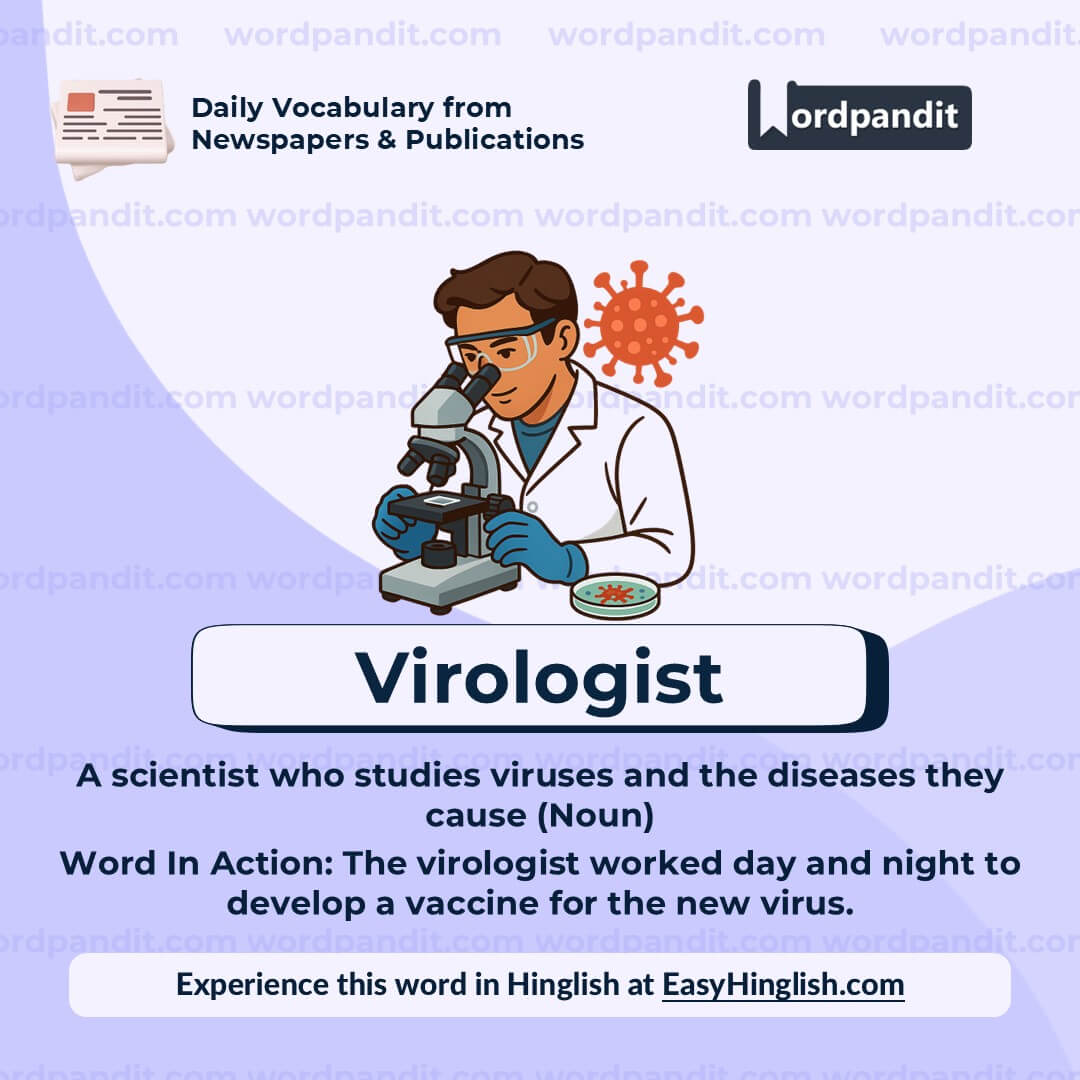
WORD-5: Virologist
Context:
"...says Vinod Balasubramaniam, a molecular virologist at Monash University Malaysia…" - Scientific American
Explanatory Paragraph:
Virologist meaning in English is 'a scientist who specializes in the study of viruses and viral diseases.' This word is used when referring to professionals who research how viruses function, spread, and cause infections in humans, animals, and plants. How to use virologist correctly involves understanding that these experts work on vaccine development, disease outbreaks, and understanding viral behavior at molecular levels. Virologist is commonly used in medical journalism, scientific publications, public health reports, and competitive exam passages for UPSC, CAT, and GRE when discussing infectious diseases, pandemic responses, and medical research.
Meaning: A scientist who studies viruses and the diseases they cause (Noun)
Pronunciation: vy-ROL-uh-jist
Difficulty Level: ⭐⭐⭐ Intermediate
Etymology: Virologist is formed from 'virus' (from Latin meaning 'poison or slimy liquid') and the Greek suffix '-logist' (from 'logos' meaning 'study' or 'knowledge'). The term emerged in the early 20th century as virology became a distinct scientific discipline, separate from bacteriology and microbiology. As scientists discovered that certain infectious agents were smaller than bacteria and required living cells to reproduce, the field of virology was born, and specialists in this area became known as virologists. The suffix '-logist' indicates someone who studies a particular subject systematically.
Prashant Sir's Notes:
Many students confuse virologist with 'microbiologist'—the key difference between virologist and microbiologist is that virologists specifically study viruses, while microbiologists study all microscopic organisms including bacteria, fungi, and viruses. For UPSC science and technology questions, understanding virologist usage helps you recognize expert credentials in passages about disease outbreaks and medical research. Students often ask: what is the difference between virologist and immunologist? While virologists study viruses themselves, immunologists focus on the immune system's response to infections. During the COVID-19 pandemic, Indian virologists from ICMR, NIV Pune, and AIIMS became household names, making this vocabulary essential for current affairs. In competitive exam reading comprehension, when you see someone identified as a virologist, they're the authoritative source on viral diseases, vaccine efficacy, and epidemic predictions—this helps you answer inference and tone questions correctly.
Synonyms & Antonyms:
Synonyms: virus researcher, infectious disease specialist, epidemiologist (broader), microbiologist (broader), medical researcher, viral disease expert
Antonyms: (No direct antonyms, but contrasting professions) layperson, non-specialist, generalist
Usage Examples:
- Dr. Gagandeep Kang, a leading Indian virologist, has contributed extensively to rotavirus vaccine research that has saved millions of children's lives globally.
- The press conference featured renowned virologists from ICMR explaining how the new influenza strain differed from previous seasonal variants circulating in India.
- Aspiring to become a virologist, Sneha pursued her PhD in microbiology with specialization in viral pathogenesis at NCBS Bangalore.
- News channels interviewed several virologists during the Nipah virus outbreak in Kerala, seeking expert opinions on containment strategies and transmission patterns.
Cultural Reference:
"The 2011 film 'Contagion' brought virologists into mainstream consciousness, showing how these scientists race against time to understand deadly pathogens—a scenario that became reality during COVID-19 when virologists worldwide became media personalities explaining pandemic science." - Observation on scientific expertise in popular culture
Think About It:
Why did virologists suddenly become trusted public figures during the pandemic, and what does this reveal about our relationship with scientific expertise during crises?
Quick Activity:
Search for news articles featuring Indian virologists discussing recent health concerns. Note how their credentials are presented and why their expertise gives weight to their statements. Write two sentences using 'virologist' in different contexts.
Memory Tip:
Break 'Virologist' into 'VIRUS + OLOGIST'—think of 'OLOGIST' as 'one who studies' (like psychologist studies psyche, biologist studies biology). A virologist is simply a VIRUS + OLOGIST = someone who studies viruses. Imagine a detective with a magnifying glass examining tiny viruses under a microscope—that's your virologist, the virus detective!
Real-World Application:
Virologist appears frequently in medical journalism, scientific publications, and public health communications, especially during disease outbreaks and vaccination campaigns. For UPSC aspirants, understanding this term helps in science and technology, current affairs, and health policy questions. When reading comprehension passages quote virologists, they represent authoritative scientific voices whose statements carry credibility on disease transmission, vaccine development, and epidemic management. In mains answer writing, referencing virologists from institutions like NIV Pune, ICMR, or AIIMS adds expert validation to arguments about healthcare infrastructure and pandemic preparedness. The term is also valuable for SSC and Bank PO general awareness sections covering health and science topics.


