

Daily Vocabulary from International Newspapers and Publications
Expand Your Vocabulary with Wordpandit’s Global Vocabulary Hub
At Wordpandit, we are committed to helping you develop a truly global vocabulary by drawing from some of the most respected international publications. This section is designed to keep you ahead of the curve by introducing you to words that define global conversations and trends.
The Power of Global Sources
To help you think and communicate on a global scale, we curate vocabulary from renowned international sources, such as:
- The New York Times
- The Washington Post
- BBC
- The Guardian
- The Economist
- Scientific American
- Psychology Today
- And many more...
Stay Global, Stay Competitive
Our daily updates from international publications ensure you are consistently exposed to new words that reflect global news and developments, making sure your vocabulary is not only current but also globally relevant.
Enhance Your Global Perspective
Whether you’re preparing for international exams, aiming to excel in global business communication, or want to enhance your language skills for personal growth, Wordpandit offers the resources you need to thrive in a global context.
Effective Learning, Global Reach
Our learning methodology combines global examples, memory aids, and interactive activities, allowing you to internalize new words effectively and apply them in real-world scenarios.
Begin Your Global Vocabulary Journey Now!

Why Choose Wordpandit?
Practical Learning: Focus on words you'll actually encounter in real-world reading, enhancing your comprehension and communication skills.
Diverse Content: From current affairs to scientific breakthroughs, our varied sources expose you to vocabulary across multiple domains.
Effortless Integration: Make Wordpandit a part of your daily routine. Just a few minutes each day can significantly boost your lexicon over time.
Your Path to Vocabulary Mastery
- Visit our Daily Vocabulary section regularly
- Explore new words and their usage in context
- Practice incorporating these words into your own writing and speech
- Track your progress as your vocabulary expands
Start Your Journey Today
Embark on your vocabulary enhancement journey with Wordpandit. By consistently engaging with our daily posts, you'll build a robust vocabulary that serves you well in academic, professional, and personal contexts.
Remember, a word a day keeps linguistic limitations at bay. Make Wordpandit your daily companion in the quest for vocabulary excellence!
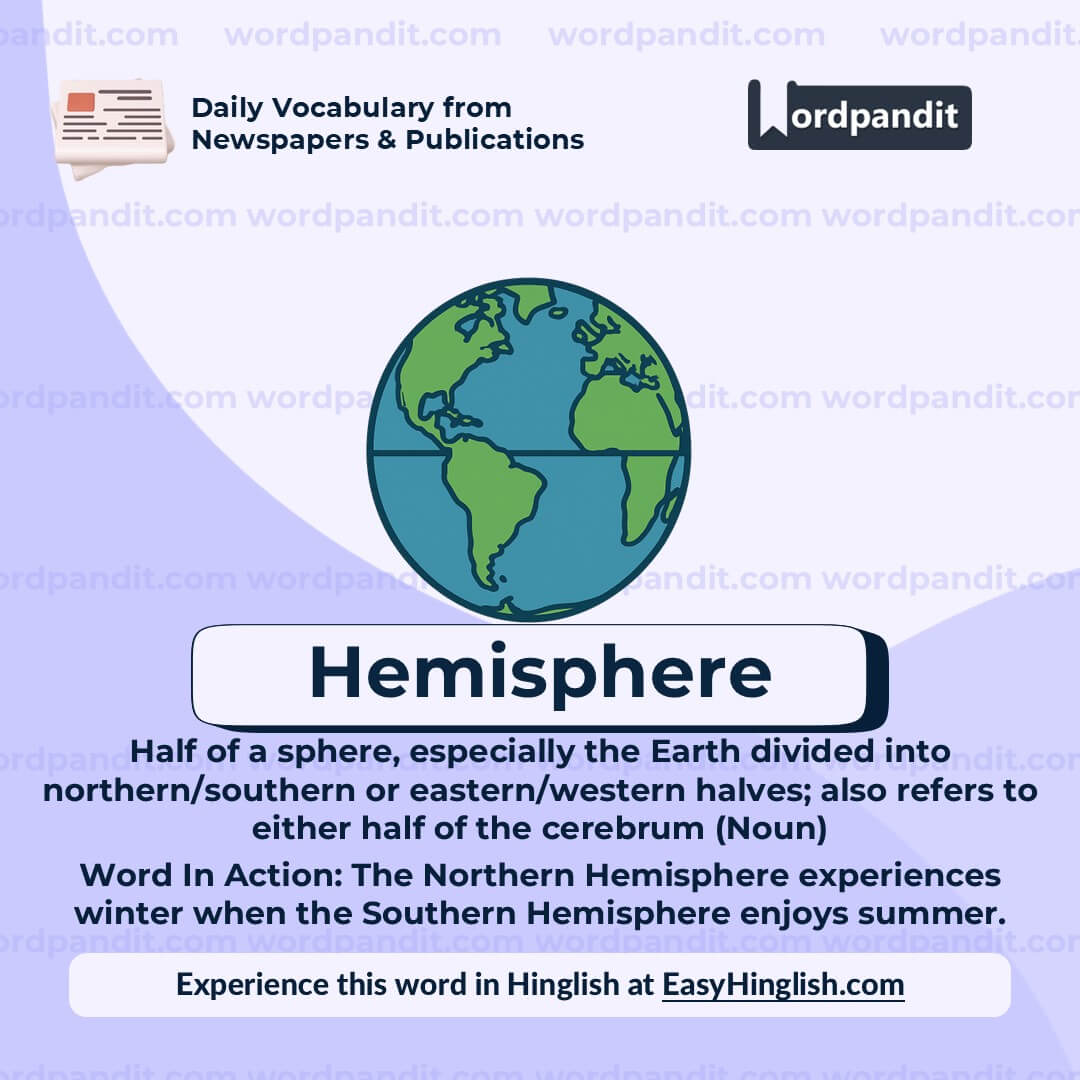
WORD-1: Hemisphere
Context:
"...meaning there are more chances for virus transmission between hemispheres." - Scientific American
Explanatory Paragraph:
Hemisphere meaning in English is 'half of a sphere or globe, especially half of the Earth divided by the equator or a meridian.' This word is used when referring to geographical divisions of the Earth, such as the Northern and Southern hemispheres, or the Eastern and Western hemispheres. How to use hemisphere correctly depends on the context—it appears frequently in geography lessons, weather reports, international news, and competitive exam passages related to global phenomena, climate patterns, and geopolitics.
Meaning: Half of a sphere or the Earth, typically divided by the equator or a meridian; also refers to half of the brain (Noun)
Pronunciation: HEM-is-feer
Difficulty Level: ⭐⭐ Basic to Intermediate
Etymology: Hemisphere comes from Greek 'hemi-' meaning 'half' and 'sphaira' meaning 'sphere or ball.' The word entered English through Latin 'hemisphaerium' in the late 14th century, originally used in astronomy and geography to describe half of the celestial sphere or Earth. Over time, its usage expanded to brain anatomy, referring to the left and right halves of the cerebrum.
Prashant Sir's Notes:
Many students confuse hemisphere with 'atmosphere'—remember that hemisphere usage in sentences specifically refers to half of something spherical, while atmosphere refers to the layer of gases surrounding Earth. For UPSC and GRE aspirants, hemisphere frequently appears in passages about climate change, migration patterns, and global health issues. The difference between hemisphere and sphere is simple: hemisphere is always half, while sphere is the complete round object. In Indian newspapers, you'll often see 'Northern Hemisphere' when discussing seasonal patterns affecting India, or 'Western Hemisphere' in geopolitical articles about America. Students often ask: what is the difference between hemisphere and equator? The equator is the imaginary line that divides hemispheres—it's the boundary, not the half itself.
Synonyms & Antonyms:
Synonyms: half-sphere, half-globe, division (in geographical context), section, semi-sphere, half (in general usage)
Antonyms: whole sphere, complete globe, entirety, totality
Usage Examples:
- During winter in the Northern Hemisphere, countries like India experience cooler temperatures while Australia in the Southern Hemisphere enjoys summer.
- The research study analyzed disease transmission patterns across both hemispheres to understand seasonal variations in viral infections.
- Climate scientists noted that deforestation in the Western Hemisphere has significant impacts on global weather systems affecting monsoons in Asia.
- Priya explained to her younger brother that when it's daytime in their hemisphere, people on the other side experience night.
Cultural Reference:
"The Northern Hemisphere contains most of the world's landmass and population, including India, making its climate patterns crucial for global agriculture and economy." - Common reference in environmental studies and UPSC preparation materials
Think About It:
Why do seasons occur at opposite times in the Northern and Southern Hemispheres, and how does this affect international trade and tourism between countries like India and Australia?
Quick Activity:
Look at a world map and identify which hemisphere India belongs to (both North-South and East-West divisions). Then list three countries from the opposite hemispheres and note what season they're currently experiencing.
Memory Tip:
Think of 'HEMI-sphere' as 'HALF-sphere'—just remember that 'hemi' sounds like 'half' in Hindi (आधा). Visualize cutting a cricket ball perfectly in half—each half is a hemisphere. Or imagine the Earth as a big ladoo cut in half by the equator!
Real-World Application:
Hemisphere is commonly used in geography textbooks, weather forecasts, scientific research papers, and international news reports to describe global patterns and regional divisions. In UPSC Geography and GRE Reading Comprehension passages, understanding hemisphere distinctions is essential for answering questions about climate zones, migration patterns, and seasonal phenomena. Business professionals use the term when discussing international markets, such as "expanding operations in the Eastern Hemisphere" or analyzing "consumer trends across hemispheres."
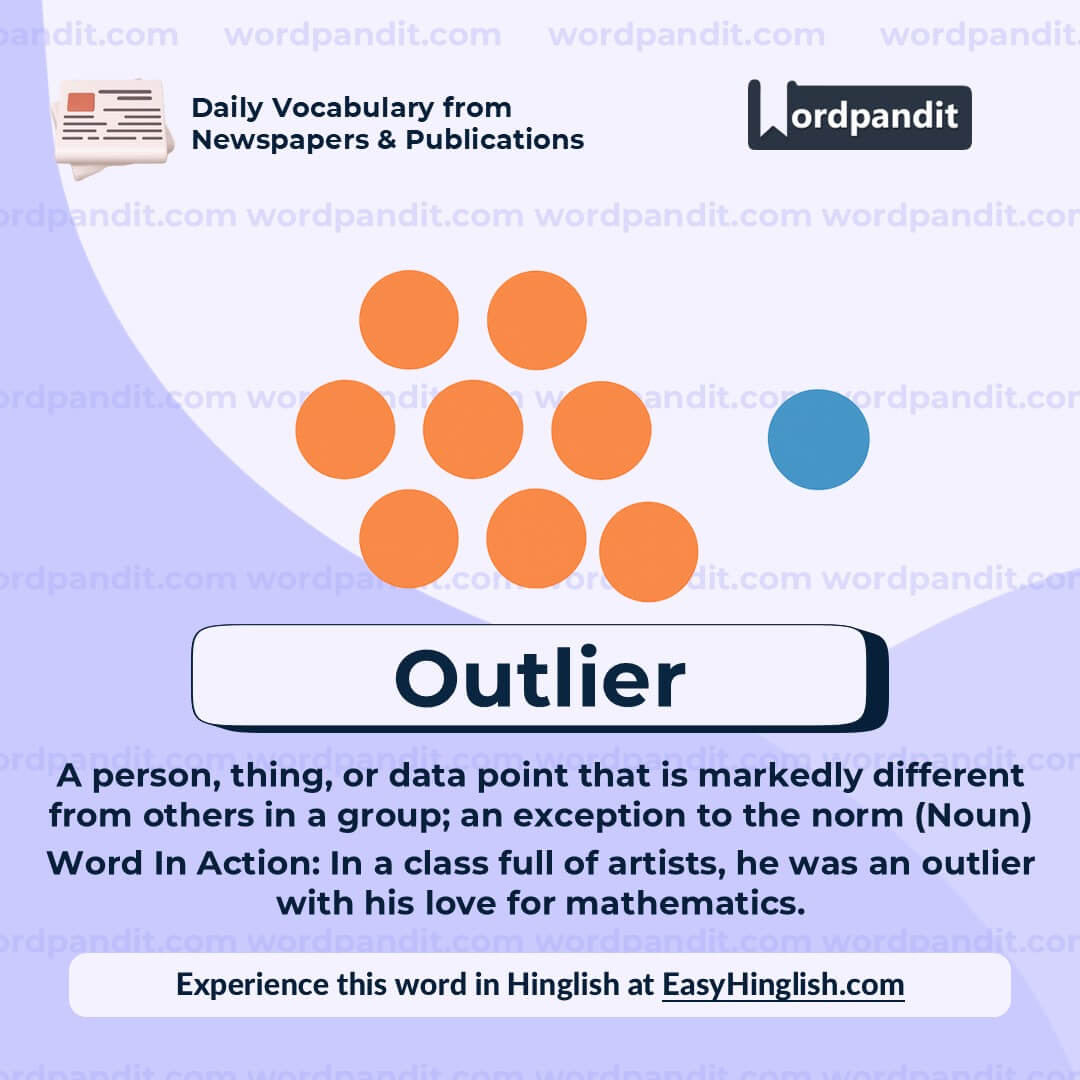
WORD-2: Outlier
Context:
"Not an outlier." - Scientific American
Explanatory Paragraph:
Outlier meaning in English is 'a data point, person, or thing that differs significantly from others in a group or set.' This word is used when something stands apart from the normal pattern or expected range, whether in statistics, performance, or behavior. How to use outlier correctly is important for CAT, GRE, and data interpretation sections, as it commonly appears in passages discussing statistical analysis, research findings, and exceptional cases that don't fit the standard trend.
Meaning: A person or thing that is markedly different from others in a group; a statistical data point that falls outside the normal range (Noun)
Pronunciation: OUT-ly-er
Difficulty Level: ⭐⭐⭐ Intermediate
Etymology: Outlier comes from the combination of 'out' and 'lie' (in the sense of 'to be situated'), with the suffix '-er' indicating an agent noun. Originally used in the 17th century to describe someone who lived away from their place of work or residence, the term evolved in the 20th century to become a statistical term for data points that deviate significantly from other observations. The modern meaning gained popularity through Malcolm Gladwell's book "Outliers" (2008), which examined exceptionally successful people.
Prashant Sir's Notes:
Students often ask: what is the difference between outlier and exception? While both refer to something unusual, outlier usage in data analysis specifically means a value that falls far outside the statistical norm, whereas exception is more general. For CAT and GRE aspirants, outlier frequently appears in Data Interpretation and Reading Comprehension passages about research methodology and statistical significance. Many students confuse outlier with 'anomaly'—the difference between outlier and anomaly is subtle: outlier is primarily used in quantitative contexts with measurable data, while anomaly can describe any irregular occurrence. In Indian English newspapers, you'll see phrases like "India's economic growth was an outlier among developing nations" or "the exceptionally high score was treated as an outlier in the exam analysis." How to use outlier in sentences: it typically follows patterns like "X is an outlier" or "X stands as an outlier among Y."
Synonyms & Antonyms:
Synonyms: anomaly, exception, aberration, deviation, irregularity, oddity, nonconformist, maverick (for people), statistical extreme
Antonyms: norm, standard, typical case, average, conformist, representative sample
Usage Examples:
- Rajesh's CAT score of 99.9 percentile made him an outlier among the students from his small-town coaching center in Jaipur.
- The company identified the exceptionally high sales figure from the Mumbai branch as an outlier before calculating the average quarterly performance.
- India's vaccination drive during the pandemic was an outlier in terms of scale, administering over a billion doses in record time.
- Statisticians removed the outlier data points from the survey results to get a more accurate picture of typical consumer behavior.
Cultural Reference:
"Sachin Tendulkar's career statistics make him an outlier in cricket history—no other batsman has scored 100 international centuries." - Common reference in sports journalism and discussions about exceptional achievement
Think About It:
Should outliers in exam results be celebrated as exceptional talent or investigated to ensure fairness? How do coaching institutes in India handle students who are statistical outliers in their performance?
Quick Activity:
Write two sentences using 'outlier'—one describing a person who achieved something exceptional in their field, and another explaining a data point that doesn't fit the pattern in a statistical context.
Memory Tip:
Think of 'OUT-lier' as someone or something that 'lies OUT' of the normal range—picture a cricket ball that lies far outside the boundary line while all others are clustered near the pitch. The word literally means "lying outside" the expected pattern!
Real-World Application:
Outlier is commonly used in data analysis reports, research papers, business presentations, and competitive exam passages involving statistics and quantitative reasoning. In CAT Data Interpretation sections, identifying outliers is crucial for accurate analysis and answering questions about trends and patterns. Corporate analysts use the term when presenting quarterly results, such as "the exceptional revenue from the festive season was an outlier and should not influence annual projections." Academic researchers mention outliers when discussing methodology, ensuring their conclusions aren't skewed by extreme values that don't represent the typical pattern.
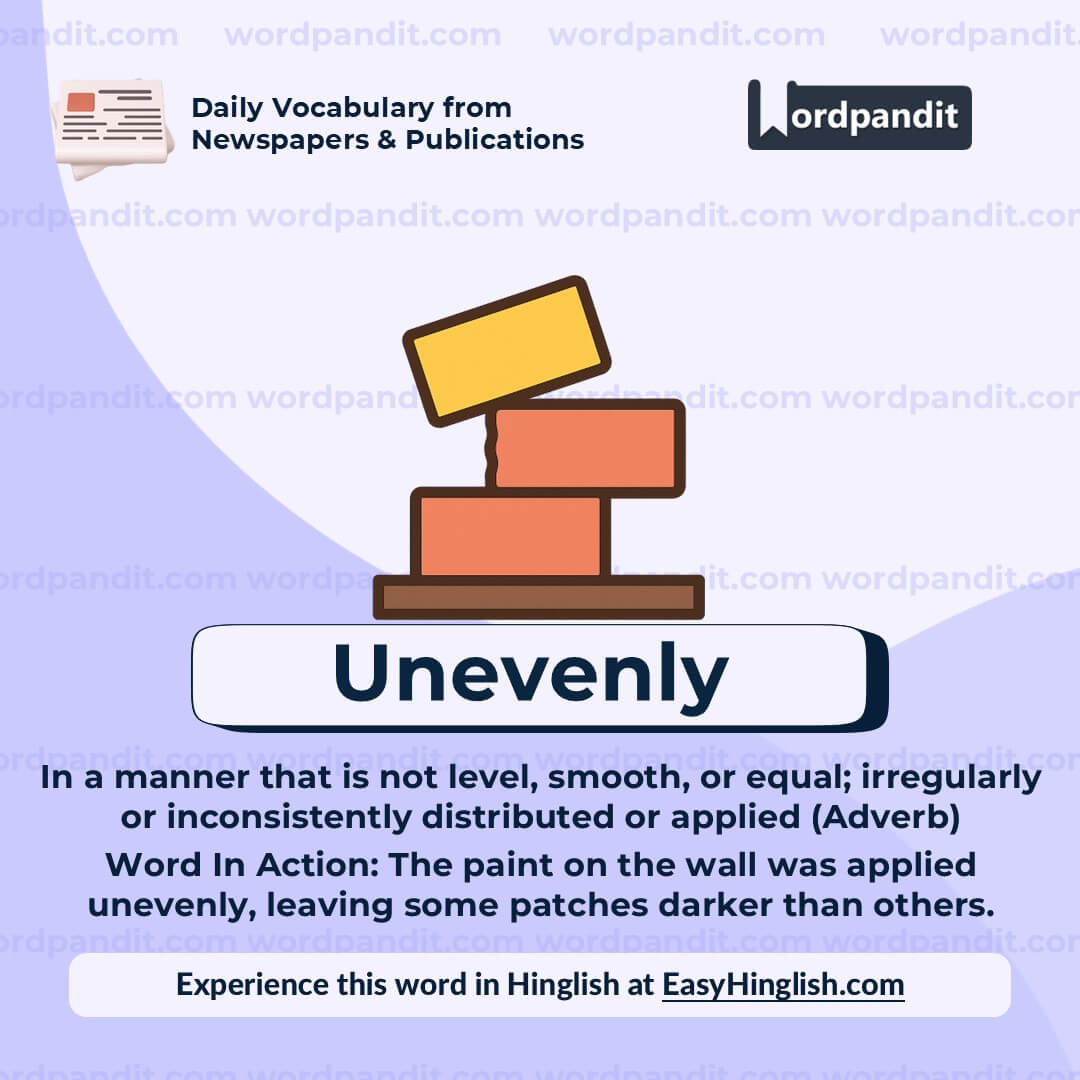
WORD-3: Unevenly
Context:
"...the ranks of choosers continued to expand, albeit highly unevenly…" - Aeon
Explanatory Paragraph:
Unevenly meaning in English is 'in a manner that is not uniform, regular, or equal; in an inconsistent or irregular way.' This word is used when describing distributions, progress, or patterns that vary significantly across different areas, groups, or time periods. Unevenly is commonly used in economic reports, social studies, news analysis, and competitive exam passages to highlight disparities, irregular patterns, or inconsistent development across regions, populations, or sectors.
Meaning: In a manner that is not level, smooth, or equal; irregularly or inconsistently distributed or applied (Adverb)
Pronunciation: un-EE-ven-lee
Difficulty Level: ⭐⭐ Basic to Intermediate
Etymology: Unevenly is formed from 'uneven' (from Old English 'un-' meaning 'not' and 'efen' meaning 'level or equal') plus the adverb suffix '-ly.' The word has been used since Middle English to describe things that lack uniformity or smoothness. Its usage expanded from describing physical surfaces to abstract concepts like distribution of resources, development patterns, and social progress, reflecting growing awareness of inequality and disparity.
Prashant Sir's Notes:
Many students confuse unevenly with 'unfairly'—while both indicate problems, the difference between unevenly and unfairly is crucial. Unevenly simply describes irregular distribution without moral judgment, while unfairly implies injustice. For UPSC aspirants, unevenly frequently appears in passages about economic development, where "growth distributed unevenly across states" is a common phrase. How to use unevenly correctly in exam essays: pair it with concrete examples showing disparity—"resources allocated unevenly" is stronger than just "unequal resources." In Indian newspapers, you'll constantly see "development has progressed unevenly" when discussing rural-urban divides or regional disparities across India.
Synonyms & Antonyms:
Synonyms: irregularly, inconsistently, disparately, asymmetrically, disproportionately, variably, patchily, raggedly, lopsidedly
Antonyms: evenly, uniformly, equally, consistently, regularly, smoothly
Usage Examples:
- Economic reforms have benefited India unevenly, with metropolitan areas prospering while rural regions continue to struggle with basic infrastructure.
- Rainfall during the monsoon season was distributed unevenly across Maharashtra, causing floods in Konkan while Vidarbha faced drought conditions.
- The CAT reading passage discussed how educational resources are allocated unevenly across government schools in different states.
- Sunita noticed that her manager's attention was divided unevenly among team members, with seniors receiving most of the mentoring time.
Cultural Reference:
"The benefits of India's IT boom have been distributed unevenly—Bangalore and Hyderabad thrived while smaller cities lagged behind in attracting investment." - Common observation in discussions about India's economic development
Think About It:
When opportunities and resources are distributed unevenly across society, does it create a responsibility for those who benefit more to help bridge the gap?
Quick Activity:
Identify three areas in your city or state where development has progressed unevenly—compare infrastructure, education, or employment between different neighborhoods or districts.
Memory Tip:
Think of 'Unevenly' as 'UN-EVEN-LY'—imagine a road that is NOT EVEN (bumpy and irregular). When something happens unevenly, it's like that bumpy road—some parts high, some low, nothing smooth or equal. Picture Mumbai's pothole-filled roads during monsoon—that's unevenly distributed maintenance!
Real-World Application:
Unevenly is extensively used in economic reports, policy documents, news articles about development and inequality, and academic papers analyzing social patterns. In Indian journalism, it appears frequently in discussions about regional disparities—"internet penetration has grown unevenly across states" or "vaccine distribution proceeded unevenly in rural areas." For competitive exams like CAT and UPSC, recognizing unevenly in passages helps identify themes of inequality, disparity, and unbalanced progress, which are critical for answering inference and tone-based questions accurately.

WORD-4: Entrench
Context:
"...further entrenching the idea of humans as, fundamentally, choosers." - Aeon
Explanatory Paragraph:
Entrench meaning in English is 'to establish something so firmly that it becomes very difficult to change or remove.' This word is used when describing ideas, practices, systems, or positions that become deeply embedded and resistant to modification. Entrench is commonly used in political analysis, social commentary, business strategy discussions, and competitive exam passages to describe how beliefs, power structures, or practices become solidly established and hard to challenge or eliminate.
Meaning: To establish something firmly and securely, making it difficult to change; to fix deeply in a position (Verb)
Pronunciation: en-TRENCH
Difficulty Level: ⭐⭐⭐ Intermediate
Etymology: Entrench comes from the prefix 'en-' meaning 'in' and 'trench,' which refers to a defensive ditch dug by soldiers. Originating in the 16th century as a military term for digging defensive positions, it literally meant to surround with a trench for protection. The word evolved metaphorically to describe any position, belief, or practice that becomes so firmly established it's as difficult to remove as soldiers dug into fortified trenches—a powerful image from warfare applied to ideas and social structures.
Prashant Sir's Notes:
Students often ask: what is the difference between entrench and establish? While both mean to set something up, entrench usage specifically implies deep-rooted resistance to change—it's not just established but stubbornly固定. For CAT and GRE aspirants, entrench frequently appears in RC passages about social reform, political systems, or organizational change where the author discusses barriers to progress. How to use entrench correctly: it almost always has a slightly negative connotation, suggesting rigidity. In Indian newspapers, you'll see "caste prejudices remain deeply entrenched" or "corruption has become entrenched in the system"—the word signals that changing these things will be extremely difficult, not just challenging.
Synonyms & Antonyms:
Synonyms: embed, ingrain, implant, fix firmly, root, establish deeply, solidify, anchor, fortify, dig in
Antonyms: remove, uproot, dislodge, eliminate, eradicate, displace, weaken
Usage Examples:
- Gender stereotypes have become so deeply entrenched in Indian society that even progressive families unconsciously reinforce traditional roles.
- The company's hierarchical culture was entrenched over decades, making Rajesh's attempts to introduce flat organizational structures nearly impossible.
- The GRE passage argued that colonial-era educational systems entrenched linguistic divisions that persist in postcolonial nations today.
- Despite multiple reform attempts, the practice of dowry remains entrenched in several communities across rural and urban India.
Cultural Reference:
"In the film 'Article 15,' the protagonist battles against entrenched caste discrimination within the police system—a powerful portrayal of how deeply embedded social evils resist change." - Analysis of contemporary Indian cinema
Think About It:
What beliefs or practices in your own life have become so entrenched that you follow them without questioning, even though they might no longer serve you?
Quick Activity:
Write two sentences describing one positive practice and one negative stereotype that have become entrenched in Indian educational or workplace culture.
Memory Tip:
Break 'Entrench' into 'EN-TRENCH'—imagine soldiers dug deep into a TRENCH during war, so deep they can't easily get out. When an idea becomes entrenched, it's like being stuck in that deep trench—extremely difficult to climb out or remove. Think of corruption or casteism as being IN a TRENCH—deeply buried and hard to eliminate!
Real-World Application:
Entrench is commonly used in political commentary, social analysis, business strategy reports, and reform-focused discussions to describe resistant systems or beliefs. Indian editorial writers frequently use it when discussing systemic problems—"patriarchal values remain entrenched despite legal reforms" or "the quota system has entrenched divisions rather than bridging them." For UPSC essay writing and CAT RC passages, recognizing entrench helps you identify the author's concern about rigid, unchangeable systems. Understanding this word signals that simple solutions won't work—deeply entrenched problems require sustained, systemic intervention.
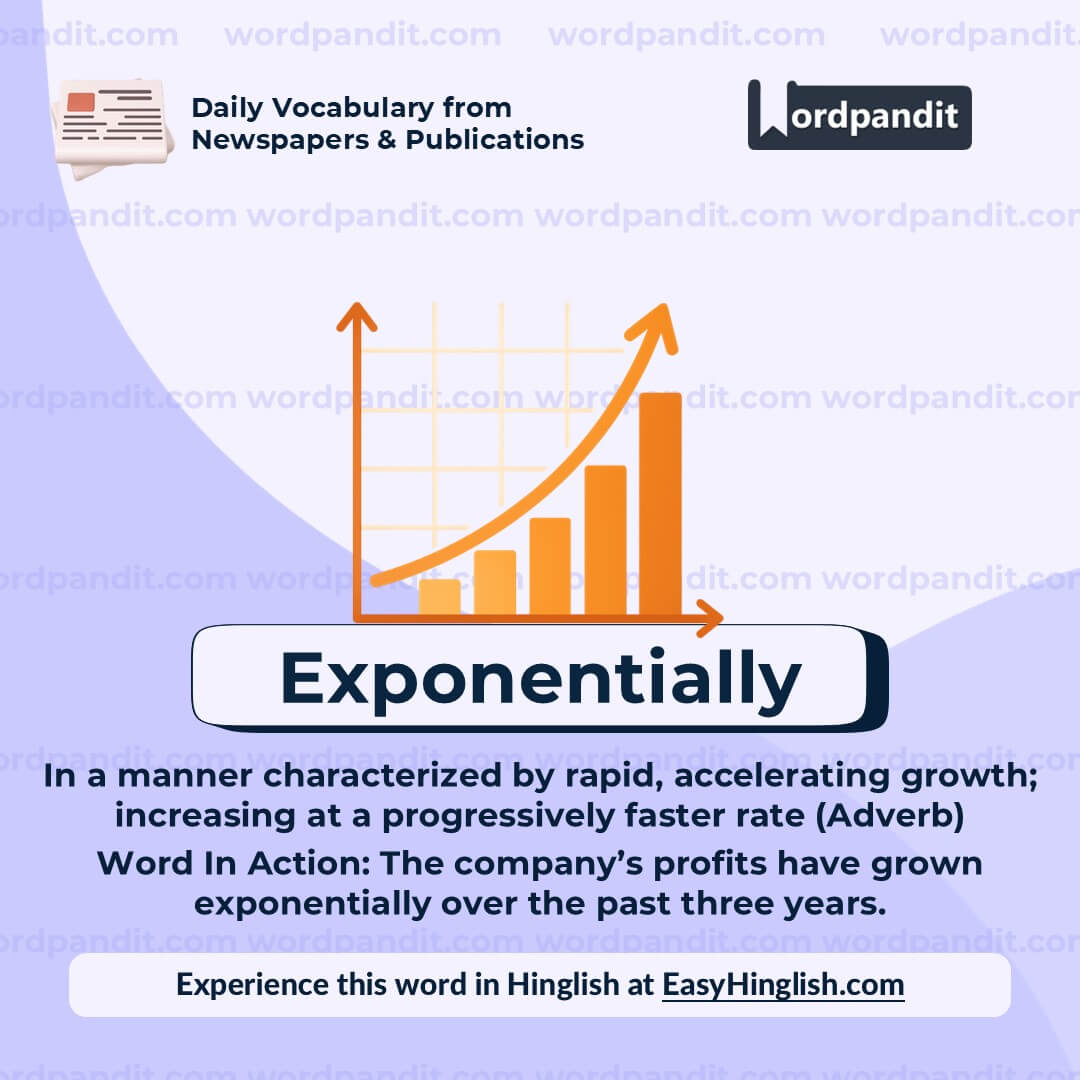
WORD-5: Exponentially
Context:
"...the sheer number of both choice-making opportunities and options has grown exponentially…" - Aeon
Explanatory Paragraph:
Exponentially meaning in English is 'at a rate that becomes progressively faster; increasing rapidly by large amounts in relation to the growing total.' This word is used when describing growth or change that accelerates dramatically over time, doubling or multiplying rather than simply adding. Exponentially is commonly used in mathematics, technology reports, business growth analyses, scientific papers, and competitive exam passages to emphasize rapid, accelerating increases that far exceed linear or steady growth patterns.
Meaning: In a manner characterized by rapid, accelerating growth; increasing at a progressively faster rate (Adverb)
Pronunciation: eks-poh-NEN-shuh-lee
Difficulty Level: ⭐⭐⭐ Intermediate
Etymology: Exponentially derives from 'exponential,' which comes from Latin 'exponere' meaning 'to set forth or explain,' through the mathematical term 'exponent.' In mathematics, an exponent indicates how many times a number is multiplied by itself (like 2³ = 2×2×2). The adverb form emerged in the 20th century as scientific and technological advances created a need to describe growth patterns that weren't just fast, but increasingly faster—like compound interest or viral spread, where each step multiplies rather than adds.
Prashant Sir's Notes:
Many students confuse exponentially with 'rapidly' or 'quickly'—but the difference between exponentially and rapidly is critical for CAT and GRE math sections. Exponentially specifically means multiplying growth (2, 4, 8, 16, 32...), while rapidly just means fast. For competitive exam aspirants, exponentially appears in data interpretation questions about compound growth rates, population increase, or technology adoption curves. How to use exponentially correctly: it should describe accelerating growth, not just speed. In Indian business news, you'll see "Jio subscribers grew exponentially" because they doubled repeatedly in short periods—that's true exponential growth, unlike "sales increased rapidly" which might just mean steady fast growth.
Synonyms & Antonyms:
Synonyms: rapidly, dramatically, explosively, geometrically, astronomically, increasingly, progressively (though these don't capture the precise mathematical meaning)
Antonyms: linearly, steadily, gradually, slowly, arithmetically, incrementally
Usage Examples:
- India's internet users have grown exponentially from 50 million in 2010 to over 800 million today, fundamentally transforming digital commerce.
- During the pandemic, misinformation spread exponentially across WhatsApp groups, with each person forwarding messages to multiple contacts who forwarded further.
- The CAT quantitative section tested whether candidates understood that compound interest grows exponentially while simple interest increases linearly over time.
- Priya noticed her startup's customer acquisition costs were rising exponentially as competition increased, doubling every quarter despite her best efforts.
Cultural Reference:
"The growth of Indian startups entering unicorn status has increased exponentially—from just one in 2011 to over 100 by 2023, reshaping India's entrepreneurial landscape." - Economic Times coverage of India's startup ecosystem
Think About It:
If AI capabilities are growing exponentially while human understanding of AI ethics grows linearly, what challenges might this gap create for society?
Quick Activity:
Calculate this exponential pattern: If you save ₹100 on day 1, then double it each day (₹200, ₹400, ₹800...), how much would you have by day 10? Compare this to saving ₹100 daily linearly.
Memory Tip:
Think of 'Exponentially' as 'EXPO-NENTIALLY'—imagine an EXPO (exhibition) where one person tells two friends, those two tell four friends, those four tell eight—the crowd grows EXPONENTIALLY! Or remember the classic rice-on-chessboard story: 1 grain doubles to 2, then 4, 8, 16, 32...by square 64, you'd need more rice than exists on Earth. That's exponential growth!
Real-World Application:
Exponentially is extensively used in technology reports, financial analysis, epidemiology, population studies, and business growth projections to describe accelerating patterns. In Indian media, it appears when discussing digital adoption—"smartphone penetration grew exponentially in tier-2 cities" or "COVID cases increased exponentially during the second wave." For CAT Data Interpretation and GRE Quantitative Reasoning, understanding exponential vs linear growth is crucial for interpreting graphs correctly. When you see exponentially in RC passages, it signals dramatic, multiplying change rather than gradual increase, which often impacts the author's tone and argument about urgency or transformation.


