

Daily Vocabulary from International Newspapers and Publications
Expand Your Vocabulary with Wordpandit’s Global Vocabulary Hub
At Wordpandit, we are committed to helping you develop a truly global vocabulary by drawing from some of the most respected international publications. This section is designed to keep you ahead of the curve by introducing you to words that define global conversations and trends.
The Power of Global Sources
To help you think and communicate on a global scale, we curate vocabulary from renowned international sources, such as:
- The New York Times
- The Washington Post
- BBC
- The Guardian
- The Economist
- Scientific American
- Psychology Today
- And many more...
Stay Global, Stay Competitive
Our daily updates from international publications ensure you are consistently exposed to new words that reflect global news and developments, making sure your vocabulary is not only current but also globally relevant.
Enhance Your Global Perspective
Whether you’re preparing for international exams, aiming to excel in global business communication, or want to enhance your language skills for personal growth, Wordpandit offers the resources you need to thrive in a global context.
Effective Learning, Global Reach
Our learning methodology combines global examples, memory aids, and interactive activities, allowing you to internalize new words effectively and apply them in real-world scenarios.
Begin Your Global Vocabulary Journey Now!

Why Choose Wordpandit?
Practical Learning: Focus on words you'll actually encounter in real-world reading, enhancing your comprehension and communication skills.
Diverse Content: From current affairs to scientific breakthroughs, our varied sources expose you to vocabulary across multiple domains.
Effortless Integration: Make Wordpandit a part of your daily routine. Just a few minutes each day can significantly boost your lexicon over time.
Your Path to Vocabulary Mastery
- Visit our Daily Vocabulary section regularly
- Explore new words and their usage in context
- Practice incorporating these words into your own writing and speech
- Track your progress as your vocabulary expands
Start Your Journey Today
Embark on your vocabulary enhancement journey with Wordpandit. By consistently engaging with our daily posts, you'll build a robust vocabulary that serves you well in academic, professional, and personal contexts.
Remember, a word a day keeps linguistic limitations at bay. Make Wordpandit your daily companion in the quest for vocabulary excellence!
WORD-1: Flourishing
Context:
"...choice has become more and more important to conceptions of human flourishing." - Aeon
Explanatory Paragraph:
Flourishing meaning in English is 'growing or developing in a healthy, vigorous, and successful way.' This word is used when describing someone or something that is thriving, prospering, and reaching their full potential. How to use flourishing in sentences depends on the context—it appears frequently in formal writing, philosophical discussions, business reports, and competitive exam passages to describe positive growth, whether referring to individuals, communities, economies, or ideas.
Meaning: Growing or developing in a healthy, vigorous, and successful way; thriving and prospering (Verb/Adjective)
Pronunciation: FLUR-ish-ing
Difficulty Level: ⭐⭐ Basic to Intermediate
Etymology: Flourishing comes from the Latin word 'florere' meaning 'to bloom or flower,' through Old French 'florir.' The word evolved from its literal botanical sense of plants blooming into a broader metaphorical meaning of thriving and prospering in any aspect of life, capturing the image of something blossoming to its fullest potential.
Prashant Sir's Notes:
Many students confuse 'flourishing' with simply 'successful'—while success can be temporary or limited to one area, flourishing meaning encompasses holistic well-being and sustained growth. The difference between flourishing and thriving is subtle: flourishing often implies a more complete state of optimal functioning, frequently used in philosophical and well-being contexts. For CAT and GRE aspirants, flourishing appears in Reading Comprehension passages about human development, economics, and social progress. In Indian English newspapers, you'll often see phrases like "flourishing startup ecosystem" or "India's flourishing economy"—the word signals not just growth, but vibrant, healthy expansion. How to use flourishing correctly: it works both as a verb (businesses are flourishing) and as an adjective (a flourishing career), making it versatile for exam essays.
Synonyms & Antonyms:
Synonyms: thriving, prospering, blooming, burgeoning, booming, blossoming, growing, successful, vigorous, developing
Antonyms: declining, failing, withering, struggling, deteriorating, languishing
Usage Examples:
- Despite economic challenges, India's digital payment sector is flourishing with UPI transactions crossing 10 billion monthly.
- Priya's design consultancy has been flourishing since she started focusing on sustainable architecture for Indian homes.
- The research suggests that human flourishing depends not just on material wealth but also on meaningful relationships and purpose.
- Bangalore's café culture is flourishing, with new specialty coffee shops opening in every neighborhood across the city.
Cultural Reference:
"The best measure of a nation's progress is not GDP alone, but whether its citizens are flourishing in health, education, and happiness." - Common theme in development economics discussions
Think About It:
What does true flourishing mean to you—is it about career success, personal relationships, or something deeper that combines multiple aspects of life?
Quick Activity:
Write two sentences describing an area of your life that is currently flourishing and one area where you'd like to see more flourishing. What's the difference between them?
Memory Tip:
Think of 'Flourishing' as 'FLOWER-ishing'—just like a flower blooms and grows beautifully, when something is flourishing, it's blossoming and thriving in its environment. Picture a garden full of vibrant, healthy flowers to remember the word.
Real-World Application:
Flourishing is commonly used in business reports, economic analysis, and academic writing to describe positive development and growth. In corporate communications, you'll see it in phrases like "flourishing partnership" or "flourishing market presence." For competitive exam essays, particularly in topics about development, well-being, and progress, flourishing helps you articulate concepts beyond mere success—it conveys vitality, health, and sustained positive growth.
WORD-2: Conception
Context:
"...choice has become more and more important to conceptions of human flourishing." - Aeon
Explanatory Paragraph:
Conception meaning in English is 'the way in which something is perceived, understood, or interpreted; a mental idea or understanding.' This word is used when referring to how people think about, understand, or define abstract concepts and ideas. How to use conception effectively is important in academic writing, philosophical discussions, and competitive exam passages where authors explore different ways of understanding complex topics like justice, freedom, or success.
Meaning: The way in which something is perceived or understood; a mental idea or notion (Noun)
Pronunciation: kun-SEP-shun
Difficulty Level: ⭐⭐⭐ Intermediate
Etymology: Conception comes from the Latin word 'concipere' meaning 'to take in or receive,' formed from 'con-' (together) and 'capere' (to take). The word originally referred to the biological process of becoming pregnant but evolved to encompass the mental process of forming ideas and understanding—the mind 'taking in' and forming concepts, mirroring the physical process of creation.
Prashant Sir's Notes:
Students often ask: what is the difference between conception and concept? While a concept is the actual idea itself, conception refers to the way that idea is understood or formed. For CAT and GRE aspirants, conception frequently appears in Reading Comprehension passages about philosophy, sociology, and cultural studies. The conception usage in formal writing typically appears in phrases like "our conception of democracy" or "changing conceptions of success"—it signals that we're discussing interpretations and understanding rather than fixed definitions. In Indian English academic writing, you'll often see "traditional conceptions versus modern conceptions" when discussing cultural shifts. Many students confuse conception with perception—conception is about understanding and mental frameworks, while perception is about what we sense or observe directly.
Synonyms & Antonyms:
Synonyms: understanding, notion, idea, perception, interpretation, view, belief, thought, concept, perspective
Antonyms: misunderstanding, misconception, ignorance, confusion, misinterpretation
Usage Examples:
- India's conception of secularism differs significantly from Western models, emphasizing equal respect for all religions rather than separation.
- Rahul's conception of work-life balance changed completely after becoming a father, prioritizing family time over late-night office hours.
- The author challenges traditional conceptions of leadership by arguing that vulnerability and empathy are strengths, not weaknesses.
- Our conception of education has evolved from rote memorization to critical thinking and creativity in modern Indian schools.
Cultural Reference:
"Every generation develops its own conception of what it means to be successful—for our grandparents it was stability, for our parents it was prosperity, for us it might be purpose." - Common observation in discussions about changing values
Think About It:
How has your conception of happiness changed over the years, and what experiences shaped this evolution in your understanding?
Quick Activity:
Write two sentences explaining your conception of a successful career. Then write how your parents' conception of the same thing might differ from yours.
Memory Tip:
Think of 'Conception' as 'CON-cept-SHUN'—it's the action or way of forming a concept in your mind. Just like an architect's conception of a building before construction begins, it's your mental blueprint or understanding of an idea.
Real-World Application:
Conception is essential in academic essays, research papers, and analytical writing where you discuss how ideas are understood differently across cultures, time periods, or disciplines. In UPSC essays and CAT RC passages, you'll encounter phrases like "contemporary conceptions of governance" or "evolving conceptions of human rights." Using conception correctly demonstrates sophisticated thinking—it shows you understand that ideas aren't fixed but are interpreted and understood in various ways by different people and societies.
WORD-3: Banality
Context:
"...he was in a certain sense uttering what had become a banality." - Aeon
Explanatory Paragraph:
Banality meaning in English is 'the quality of being boring, ordinary, and lacking originality; something so common that it has lost meaning or impact.' This word is used when describing statements, ideas, or situations that are uninteresting because they are predictable, overused, or trite. Banality appears frequently in literary criticism, social commentary, and competitive exam passages to describe the dullness of everyday life or the emptiness of clichéd expressions and repeated ideas.
Meaning: The quality of being unoriginal, boring, and commonplace; a trite or predictable remark (Noun)
Pronunciation: buh-NAL-ih-tee
Difficulty Level: ⭐⭐⭐ Intermediate
Etymology: Banality comes from the French word 'banal' meaning 'common to all' or 'ordinary,' which originated from 'ban,' referring to feudal rights that were shared by all vassals. Initially, 'banal' simply meant 'common' without negative connotation, but over time it evolved to carry the sense of something being so common that it became boring, trivial, and lacking any freshness or originality.
Prashant Sir's Notes:
Many students confuse banality with simplicity—the difference between banality and simplicity is crucial: simple can be elegant and profound, while banal is always negative, suggesting something is dull because it's been done to death. For GRE and CAT aspirants, banality frequently appears in RC passages about art, literature, and social criticism. How to use banality correctly: it refers both to the quality itself (the banality of his speech) and to specific trite remarks (he spoke in banalities). In Indian English writing, you'll often see phrases like "the banality of Bollywood dialogues" or "escaping the banality of corporate life"—it signals predictable, unoriginal content. Students often ask: what is the difference between banality and cliché? A cliché is a specific overused phrase, while banality is the broader quality of being unoriginal and boring. In exam essays, using banality shows sophisticated vocabulary when critiquing lack of originality.
Synonyms & Antonyms:
Synonyms: triteness, ordinariness, dullness, predictability, commonplaceness, staleness, cliché, platitude, mediocrity, tedium
Antonyms: originality, novelty, freshness, creativity, uniqueness, innovation
Usage Examples:
- The film critic dismissed the movie as another exercise in banality, with predictable plot twists and recycled Bollywood tropes.
- Sharma's presentation was filled with banalities about teamwork and dedication that everyone had heard countless times before in corporate meetings.
- The poet's early work showed promise, but his recent collection descended into banality, repeating the same tired metaphors about love.
- Escaping the banality of daily routine, Meera decided to quit her monotonous job and travel across Rajasthan for six months.
Cultural Reference:
"Hannah Arendt wrote about 'the banality of evil,' suggesting that terrible acts often come not from monsters but from ordinary people following routine orders—a concept that revolutionized how we understand moral responsibility." - Philosophy of ethics
Think About It:
In an age of social media where everyone shares similar content and opinions, how do you avoid falling into the banality of repeating what everyone else is saying?
Quick Activity:
Identify three banalities you've heard this week—common phrases or ideas repeated so often they've lost meaning. Now try to express the same ideas in fresh, original ways.
Memory Tip:
Think of 'Banality' as 'BANAL-ity' where 'banal' sounds like 'BORING-ALL'—when something is banal, it's boring to all because everyone has seen or heard it before. Picture a boring, repetitive daily routine to remember the dullness and lack of originality the word conveys.
Real-World Application:
Banality is commonly used in literary criticism, film reviews, cultural commentary, and academic writing to critique lack of originality. In competitive exam essays, particularly for topics on creativity, media, or social issues, banality helps you articulate sophisticated criticism of repetitive or unoriginal content. You'll find it in phrases like "the banality of modern advertising" or "avoiding the banality of conventional thinking"—essential vocabulary for analyzing cultural and intellectual mediocrity in UPSC, CAT, and GRE writing tasks.
WORD-4: Grapple
Context:
"...an essential story to grapple with if we want to try to understand what has been gained and lost…" - Aeon
Explanatory Paragraph:
Grapple meaning in English is 'to struggle with or work hard to deal with something difficult; to wrestle physically or mentally with a problem or challenge.' This word is used when describing serious engagement with complex issues, showing effort to understand or overcome difficulties. How to use grapple in sentences depends on context—it appears in academic writing, news analysis, and competitive exam passages to convey the intensity of intellectual or practical struggle, often followed by the preposition 'with.'
Meaning: To engage in a struggle or close fight; to struggle with or work hard to deal with or understand something (Verb)
Pronunciation: GRAP-ul
Difficulty Level: ⭐⭐ Basic to Intermediate
Etymology: Grapple comes from the Old French word 'grapil' meaning 'hook' or 'grappling iron,' a device used to seize and hold ships. The word evolved from this literal sense of hooking and holding something firmly to the metaphorical meaning of seizing and wrestling with problems or ideas—just as a grappling hook grabs and holds tight, when you grapple with an issue, you're firmly engaged in trying to master or understand it.
Prashant Sir's Notes:
Students often ask: what is the difference between grapple and struggle? While both involve difficulty, grapple implies more active, determined engagement—you're not just suffering through something, you're actively wrestling with it to gain understanding or control. For CAT and GRE aspirants, grapple frequently appears in Reading Comprehension passages about intellectual challenges, policy debates, and philosophical questions. Grapple usage in formal writing almost always includes 'with'—you grapple with a problem, not grapple a problem. In Indian English newspapers, you'll see phrases like "India grapples with infrastructure challenges" or "scientists grapple with climate data"—the word signals ongoing, serious effort rather than quick resolution. How to use grapple correctly in exam essays: it works beautifully when discussing complex social issues, showing that problems require sustained intellectual or practical engagement rather than simple solutions.
Synonyms & Antonyms:
Synonyms: wrestle, struggle, contend, battle, tackle, deal with, confront, face, engage with, come to grips with
Antonyms: avoid, ignore, evade, sidestep, surrender, abandon, give up
Usage Examples:
- Indian policymakers continue to grapple with the challenge of providing quality education to millions of students in rural areas.
- Anjali spent weeks grappling with the calculus concepts before finally understanding how derivatives work in real-world applications.
- The startup had to grapple with funding issues, regulatory hurdles, and intense competition all at the same time.
- As Rohan grappled with the decision to study abroad or accept the local job offer, he realized both choices had merit.
Cultural Reference:
"Like Arjuna grappling with his moral dilemma on the battlefield of Kurukshetra, we too must wrestle with difficult choices where no option seems entirely right." - Common reference to the Bhagavad Gita's central conflict
Think About It:
What's the most difficult concept or problem you're currently grappling with, and what makes it so challenging to resolve or understand?
Quick Activity:
Write two sentences about an issue India is currently grappling with as a nation, and one personal challenge you're grappling with in your own life.
Memory Tip:
Think of 'Grapple' as 'GRAB-pull'—imagine grabbing hold of a difficult problem and pulling it toward you to wrestle with it intensely. Or picture a wrestler grappling with an opponent, holding tight and not letting go—that's how you grapple with complex ideas and challenges.
Real-World Application:
Grapple is essential in academic essays, policy analysis, and editorial writing where you discuss how individuals, organizations, or nations deal with complex challenges. In UPSC essays and CAT RC passages, you'll encounter it in contexts like "grappling with ethical dilemmas" or "societies grappling with modernization." Using grapple demonstrates sophisticated expression—it shows you understand that serious problems require sustained, active engagement rather than passive observation or quick fixes, making it perfect for discussing contemporary challenges in competitive exam writing.
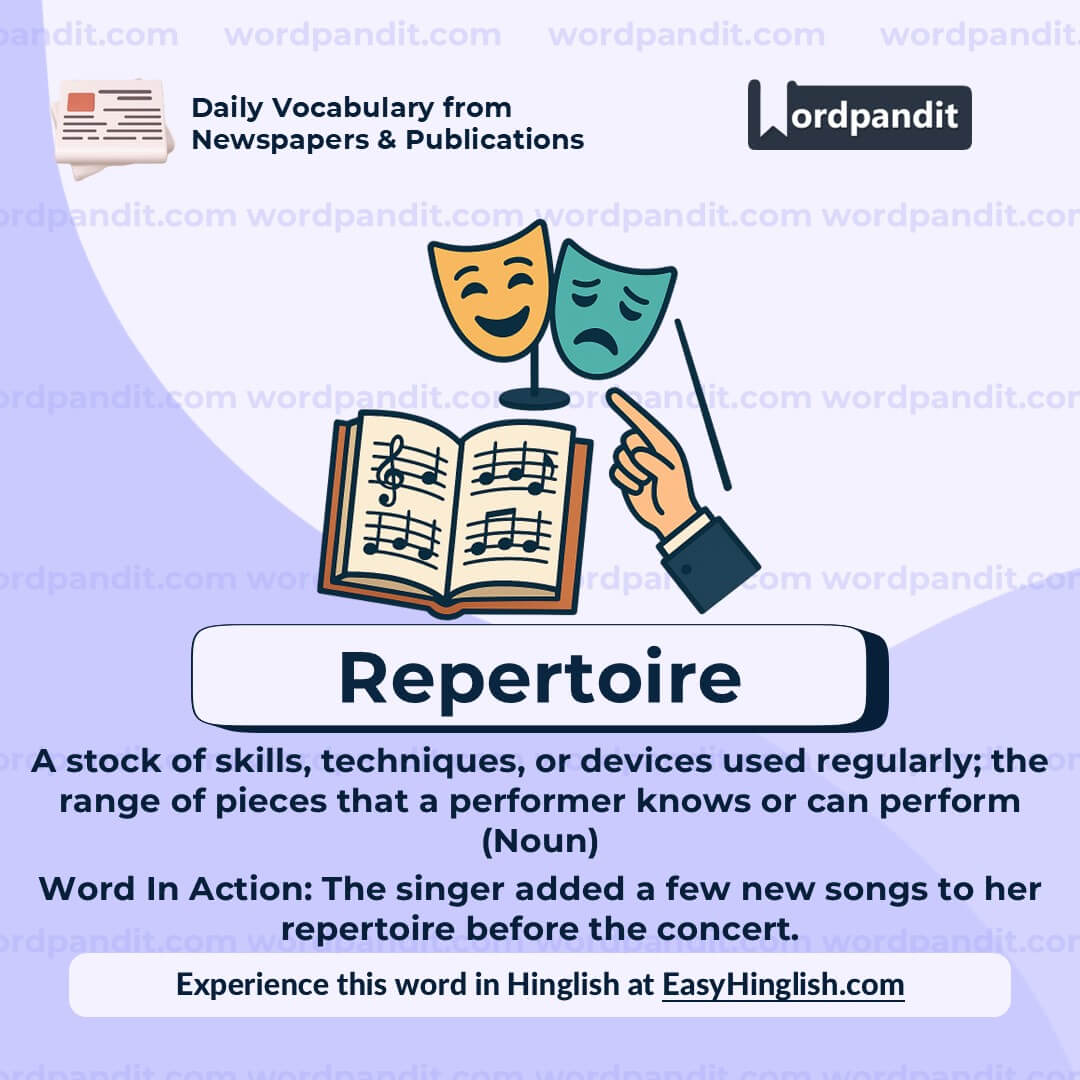
WORD-5: Repertoire
Context:
"...an expanded repertoire of choice, including in ideas, reading matter, marriage, children, career…" - Aeon
Explanatory Paragraph:
Repertoire meaning in English is 'the complete range or stock of skills, techniques, abilities, or items that a person or group has available to use.' This word is used when referring to the full collection of things someone can do or has at their disposal. Repertoire appears commonly in discussions about performance, professional skills, and personal capabilities in formal writing, business contexts, and competitive exam passages to describe the breadth and variety of someone's abilities or available options.
Meaning: A stock of skills, techniques, or devices used regularly; the range of pieces that a performer knows or can perform (Noun)
Pronunciation: REP-er-twahr
Difficulty Level: ⭐⭐⭐ Intermediate
Etymology: Repertoire comes from the French word 'répertoire' meaning 'index' or 'list,' derived from the Late Latin 'repertorium' meaning 'inventory' or 'list,' from 'reperire' (to find or discover). Originally used in theatrical contexts to refer to the list of plays a company could perform, the word expanded to encompass any collection of skills, pieces, or techniques that someone has mastered and can draw upon when needed.
Prashant Sir's Notes:
Many students confuse repertoire with portfolio—while portfolio refers to a collection of work you've done (especially creative work), repertoire refers to the range of things you can do or perform. The difference between repertoire and skills is that skills are individual abilities, while repertoire is the complete collection of those abilities available for use. For GRE and CAT aspirants, repertoire frequently appears in RC passages about arts, professional development, and adaptability. How to use repertoire correctly: it's often followed by 'of' (repertoire of skills, repertoire of responses). In Indian English business writing, you'll see phrases like "expanding your professional repertoire" or "a limited repertoire of management techniques"—it signals the breadth and variety of capabilities. Repertoire usage in sentences works beautifully when discussing versatility and range, whether in performance arts or professional contexts.
Synonyms & Antonyms:
Synonyms: collection, range, stock, store, inventory, array, arsenal, set, catalog, assortment
Antonyms: limitation, restriction, scarcity, deficiency, lack
Usage Examples:
- Lata Mangeshkar's musical repertoire included thousands of songs across multiple Indian languages, showcasing her extraordinary versatility as a playback singer.
- To succeed in today's job market, Vikram needs to expand his repertoire beyond coding to include project management and communication skills.
- The yoga instructor's repertoire of techniques allowed her to customize sessions for students with different fitness levels and health conditions.
- Indian diplomacy has developed a sophisticated repertoire of strategies for navigating complex international relationships and regional conflicts over decades.
Cultural Reference:
"A.R. Rahman's repertoire spans classical Carnatic music, Bollywood melodies, electronic fusion, and Hollywood soundtracks—demonstrating how a diverse repertoire enables creative innovation across genres." - Common observation about versatility in Indian music
Think About It:
If you were to describe your current repertoire of skills and abilities, what would be included, and what new additions would make you more versatile?
Quick Activity:
List five skills in your current professional or academic repertoire. Now identify three new skills you want to add to expand your repertoire in the next year.
Memory Tip:
Think of 'Repertoire' as 'REPEAT-WORE'—imagine a performer who has a collection of outfits they can wear repeatedly for different performances. Similarly, your repertoire is the collection of skills and abilities you can use repeatedly in various situations. The French pronunciation 'twahr' sounds sophisticated, just like having a broad repertoire!
Real-World Application:
Repertoire is essential vocabulary in professional development discussions, performance reviews, artistic criticism, and strategic planning. In business writing and resumes, phrases like "broad repertoire of leadership skills" or "expanding technical repertoire" demonstrate professional versatility. For CAT and GRE essays on topics like adaptability, education, or professional success, using repertoire shows sophisticated understanding that success requires not just isolated skills but a diverse collection of capabilities. In UPSC essays about governance or diplomacy, discussing "India's repertoire of soft power tools" elevates your analytical expression.


