

Daily Vocabulary from International Newspapers and Publications
Expand Your Vocabulary with Wordpandit’s Global Vocabulary Hub
At Wordpandit, we are committed to helping you develop a truly global vocabulary by drawing from some of the most respected international publications. This section is designed to keep you ahead of the curve by introducing you to words that define global conversations and trends.
The Power of Global Sources
To help you think and communicate on a global scale, we curate vocabulary from renowned international sources, such as:
- The New York Times
- The Washington Post
- BBC
- The Guardian
- The Economist
- Scientific American
- Psychology Today
- And many more...
Stay Global, Stay Competitive
Our daily updates from international publications ensure you are consistently exposed to new words that reflect global news and developments, making sure your vocabulary is not only current but also globally relevant.
Enhance Your Global Perspective
Whether you’re preparing for international exams, aiming to excel in global business communication, or want to enhance your language skills for personal growth, Wordpandit offers the resources you need to thrive in a global context.
Effective Learning, Global Reach
Our learning methodology combines global examples, memory aids, and interactive activities, allowing you to internalize new words effectively and apply them in real-world scenarios.
Begin Your Global Vocabulary Journey Now!

Why Choose Wordpandit?
Practical Learning: Focus on words you'll actually encounter in real-world reading, enhancing your comprehension and communication skills.
Diverse Content: From current affairs to scientific breakthroughs, our varied sources expose you to vocabulary across multiple domains.
Effortless Integration: Make Wordpandit a part of your daily routine. Just a few minutes each day can significantly boost your lexicon over time.
Your Path to Vocabulary Mastery
- Visit our Daily Vocabulary section regularly
- Explore new words and their usage in context
- Practice incorporating these words into your own writing and speech
- Track your progress as your vocabulary expands
Start Your Journey Today
Embark on your vocabulary enhancement journey with Wordpandit. By consistently engaging with our daily posts, you'll build a robust vocabulary that serves you well in academic, professional, and personal contexts.
Remember, a word a day keeps linguistic limitations at bay. Make Wordpandit your daily companion in the quest for vocabulary excellence!

WORD-1: Instalment
Context:
"In this instalment of the YouTube series Great Art Explained, the UK curator, gallerist and video essayist James Payne provides a rich and rewarding tour of The School of Athens (1509-11) by Raphael – a Renaissance masterpiece from one of the era's most dynamic and visionary artists." - Aeon
Explanatory Paragraph:
Instalment meaning in English is 'one part of a series that is released or published separately over time.' This word is used when something larger—like a story, payment, or content series—is divided into smaller parts delivered at different intervals. How to use instalment correctly depends on the context: it appears in discussions about serialized content (web series, article series), payment plans (EMI instalments), and episodic releases. Instalment is commonly used in formal writing, entertainment journalism, and financial contexts across CAT, GRE, and UPSC passages.
Meaning: One part of something that is divided into several parts and released or paid separately over a period of time (Noun)
Pronunciation: in-STAWL-ment
Difficulty Level: ⭐⭐ Basic to Intermediate
Etymology: Instalment comes from the Old French word 'estaler' meaning 'to fix or arrange,' which evolved through Anglo-French 'estallment.' The word originally referred to the arrangement of payments into fixed portions, and later expanded to describe any content or series divided into sequential parts delivered over time.
Prashant Sir's Notes:
Many students confuse instalment with 'episode'—while both refer to parts of a series, instalment usage in formal writing emphasizes the sequential, planned nature of release, whether it's content or payments. The difference between instalment and episode is that instalment carries a more formal, structured connotation and applies beyond entertainment to financial contexts (loan instalments, EMI). For CAT and GRE aspirants, instalment frequently appears in RC passages about publishing, streaming platforms, or financial planning. In Indian English newspapers, you'll often see 'the third instalment of the article series' or 'pay in monthly instalments'—this usage highlights both content serialization and payment structures common in Indian contexts.
Synonyms & Antonyms:
Synonyms: episode, part, segment, portion, chapter, section, phase, payment, tranche, installment
Antonyms: whole, entirety, lump sum, complete version, full payment
Usage Examples:
- The Hindu published the final instalment of its investigative series on corporate governance violations in Indian startups.
- Priya paid her MBA tuition fees in six equal instalments rather than making a single lump-sum payment upfront.
- Netflix released the second instalment of Sacred Games to massive viewership, breaking streaming records across India.
- Rahul's car loan requires him to pay ₹15,000 in monthly instalments over the next five years.
Cultural Reference:
"The latest instalment in the Baahubali franchise became one of Indian cinema's biggest blockbusters, proving that serialized storytelling works powerfully across cultures." - Commentary on Indian film series
Think About It:
Why has instalment-based content—from web series to newspaper columns—become so popular in the digital age? Does breaking content into instalments increase engagement or fragment our attention?
Quick Activity:
List three things in your life that you experience or pay for in instalments—content series you follow, EMI payments, or serialized articles. Write one sentence explaining why the instalment format works for each.
Memory Tip:
Think of 'Instalment' as 'IN-STALL-MENT'—imagine content being STALLED or stopped IN between, requiring you to wait for the next INSTALLMENT before you can continue. Just like waiting for the next episode of your favorite show!
Real-World Application:
In journalism and media writing, 'instalment' is essential for describing serialized content—whether it's a multi-part investigation, a YouTube series, or a podcast released in parts. The word also dominates financial journalism and business communication when discussing payment plans, EMI schemes, and loan structures. For competitive exam essays, using 'instalment' demonstrates sophisticated understanding of how information and financial obligations are structured in modern society.

WORD-2: Frescoes
Context:
"Payne sets the fresco in the context of its location in what was then the Pope's private library at the Vatican, where it represented philosophy as a pillar of human knowledge, alongside companion frescoes depicting theology, poetry and law." - Aeon
Explanatory Paragraph:
Frescoes meaning in English is 'paintings done on freshly laid, still-wet plaster on walls or ceilings.' This word is used when describing a specific artistic technique where pigments are applied to wet plaster, becoming permanently bonded as the surface dries. How to use frescoes correctly involves understanding that they represent both an art form and a historical preservation method. Frescoes are commonly used in art history discussions, architectural descriptions, and cultural heritage contexts that appear in GRE, UPSC, and general competitive exam passages about Renaissance art, ancient civilizations, and Indian temple architecture.
Meaning: Paintings made on wet plaster on walls or ceilings, where the colors penetrate the plaster and become fixed as it dries (Noun, plural of fresco)
Pronunciation: FRES-kohz
Difficulty Level: ⭐⭐⭐ Intermediate
Etymology: Frescoes comes from the Italian word 'fresco' meaning 'fresh,' derived from the Germanic root related to 'fresh.' The term specifically refers to 'fresco' painting technique where artists work on fresh, wet plaster. This method dates back to ancient civilizations and became particularly renowned during the Italian Renaissance, producing masterpieces that have survived centuries because the paint literally becomes part of the wall.
Prashant Sir's Notes:
Students often ask: what is the difference between frescoes and murals? While both are wall paintings, frescoes specifically use the wet-plaster technique, making them more permanent and durable. Fresco usage in art history passages signals discussions about Renaissance masters like Michelangelo or ancient civilizations. For UPSC aspirants preparing for Art & Culture sections, frescoes frequently appear when discussing Ajanta and Ellora caves, where ancient Indian artists used similar techniques. In Indian English newspapers covering heritage conservation, you'll see 'restoration of ancient frescoes' or 'frescoes depicting Buddhist themes'—this connects global art history with India's rich cultural legacy. Remember: frescoes aren't just paintings; they're paintings that become one with the architecture itself.
Synonyms & Antonyms:
Synonyms: wall paintings, murals (broader term), ceiling paintings, plaster paintings, frescos (alternate spelling)
Antonyms: canvas paintings, easel art, portable artwork, panel paintings, movable paintings
Usage Examples:
- The Ajanta caves contain stunning Buddhist frescoes that have survived over 1,500 years despite exposure to monsoon humidity and time.
- Michelangelo's frescoes on the Sistine Chapel ceiling took four years to complete and remain among humanity's greatest artistic achievements.
- The Archaeological Survey of India launched a mission to restore deteriorating frescoes in Kerala's Mattancherry Palace using traditional techniques.
- Unlike canvas paintings that can be moved, frescoes are permanent fixtures that require on-site conservation and climate control for preservation.
Cultural Reference:
"The ancient frescoes of Ajanta represent the pinnacle of Indian classical art, depicting Jataka tales with colors that still captivate visitors after fifteen centuries." - From discussions on India's UNESCO World Heritage sites
Think About It:
Why did ancient civilizations from Rome to India choose frescoes as their primary medium for important artistic and religious expressions? What does the permanence of frescoes tell us about how these cultures viewed art and legacy?
Quick Activity:
Research and write three sentences about one famous fresco site—either the Ajanta Caves, Sistine Chapel, or Pompeii. Focus on what makes these frescoes historically or artistically significant.
Memory Tip:
Think of 'FRES-coes' as 'FRESH-goes'—the paint goes onto FRESH, wet plaster and becomes permanent as it dries. Or remember: 'FRESCO = FRESH + CO(lor)' painted together on wet walls, just like the fresh rotis your mom makes stick to the tawa while still wet!
Real-World Application:
In art criticism, museum descriptions, and cultural heritage documentation, 'frescoes' is essential vocabulary for discussing wall-based art forms. The word appears frequently in UPSC Art & Culture syllabus materials, travel journalism about historical sites, and conservation reports. For competitive exam essays on cultural preservation or art history, using 'frescoes' demonstrates sophisticated understanding of artistic techniques and historical contexts, particularly when discussing Indian monuments and European Renaissance masterpieces.
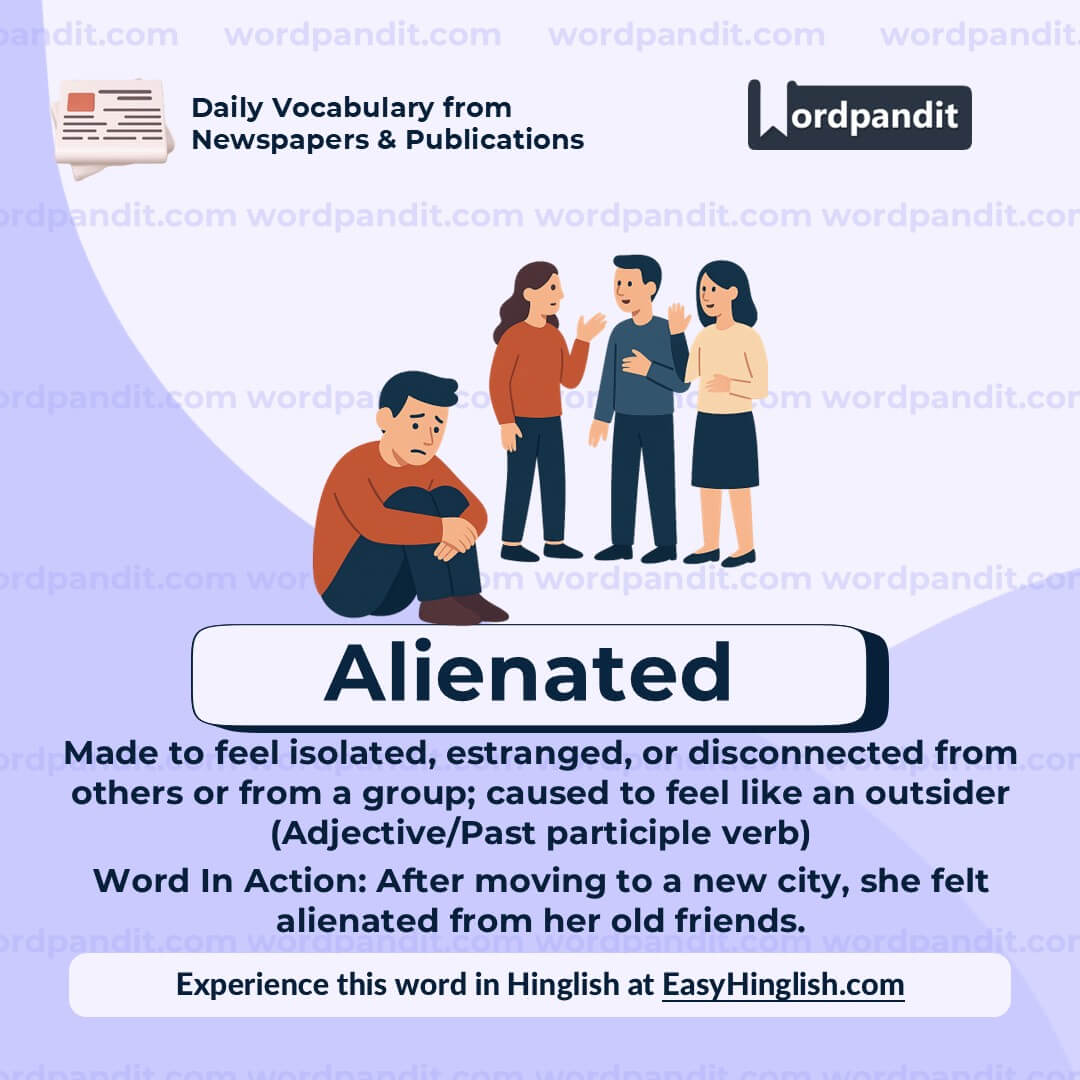
WORD-3: Alienated
Context:
"Growing up in a tumultuous household and feeling alienated from her peers, Raina never felt comfortable in her body." - Aeon
Explanatory Paragraph:
Alienated meaning in English is 'feeling isolated, estranged, or disconnected from others or from society.' This word is used when describing emotional or social disconnection, whether from people, groups, communities, or even from oneself. How to use alienated depends on context: it can describe personal feelings of isolation, social exclusion, or the deliberate act of pushing someone away. Alienated is commonly used in psychology discussions, sociology passages, literature analysis, and social commentary that frequently appear in CAT, GRE, and UPSC reading comprehension sections dealing with human relationships and societal issues.
Meaning: Made to feel isolated, estranged, or disconnected from others or from a group; caused to feel like an outsider (Adjective/Past participle verb)
Pronunciation: AY-lee-uh-nay-ted
Difficulty Level: ⭐⭐⭐ Intermediate
Etymology: Alienated comes from the Latin word 'alienatus,' past participle of 'alienare' meaning 'to make foreign or estrange,' derived from 'alienus' meaning 'belonging to another' or 'foreign.' The root 'alius' means 'other.' Originally used in legal contexts to describe property transfer, the word evolved to describe emotional and social disconnection, capturing the profound human experience of feeling like an outsider or stranger even among one's own community.
Prashant Sir's Notes:
Many students confuse alienated with 'isolated'—while both involve separation, the difference between alienated and isolated is crucial: alienated specifically implies a sense of being an outsider or stranger, often with emotional disconnection, while isolated simply means physically alone. Alienated usage in CAT and GRE RC passages typically appears in discussions about social identity, workplace dynamics, or psychological states. For UPSC aspirants, alienated frequently appears in sociology and essay papers discussing marginalized communities or youth disconnect. In Indian English newspapers, you'll see 'alienated voters,' 'students feeling alienated from the education system,' or 'communities alienated by development policies'—this reflects real social challenges in rapidly changing Indian society. Pro tip: When you see 'alienated' in a passage, the author is usually building toward discussing belonging, identity, or social justice.
Synonyms & Antonyms:
Synonyms: estranged, isolated, disconnected, detached, separated, excluded, ostracized, marginalized, disaffected, distanced
Antonyms: connected, included, integrated, accepted, embraced, welcomed, belonged, united, attached, engaged
Usage Examples:
- Many migrant workers in Mumbai feel alienated from mainstream society despite contributing significantly to the city's economy and infrastructure.
- Rohan's constant criticism of his team members alienated him from his colleagues, making collaboration increasingly difficult.
- The new education policy aims to address why tribal students often feel alienated from conventional classroom environments.
- After moving to Bangalore for her job, Priya felt alienated from her hometown community and struggled to build new connections.
Cultural Reference:
"In the film Udaan, the protagonist feels deeply alienated from his authoritarian father and the oppressive industrial town, capturing the universal struggle of youth seeking identity and belonging." - From discussions on Indian cinema's portrayal of generational conflict
Think About It:
In an increasingly digital world where we're more "connected" than ever through social media, why do so many young Indians report feeling alienated and lonely? Does technology bring us together or push us apart?
Quick Activity:
Write two sentences describing situations where people might feel alienated—one about a workplace scenario and one about a social situation. Focus on capturing the emotional experience of disconnection.
Memory Tip:
Break 'Alienated' into 'ALIEN-ATED'—think of feeling like an ALIEN who has been made to feel (ATED) like an outsider. Just like an alien would feel on Earth, alienated people feel like strangers even in familiar places. Or remember: ALIEN = outsider, so ALIENATED = made to feel like an outsider!
Real-World Application:
In sociology research papers, psychology articles, and opinion pieces, 'alienated' is crucial for discussing social disconnection, identity crises, and marginalization. The word frequently appears in UPSC essay topics on social issues, CAT RC passages about workplace dynamics or generational conflicts, and GRE passages exploring human psychology. For formal writing about education, migration, workplace culture, or social policy, using 'alienated' demonstrates nuanced understanding of human emotional and social experiences beyond simple isolation.
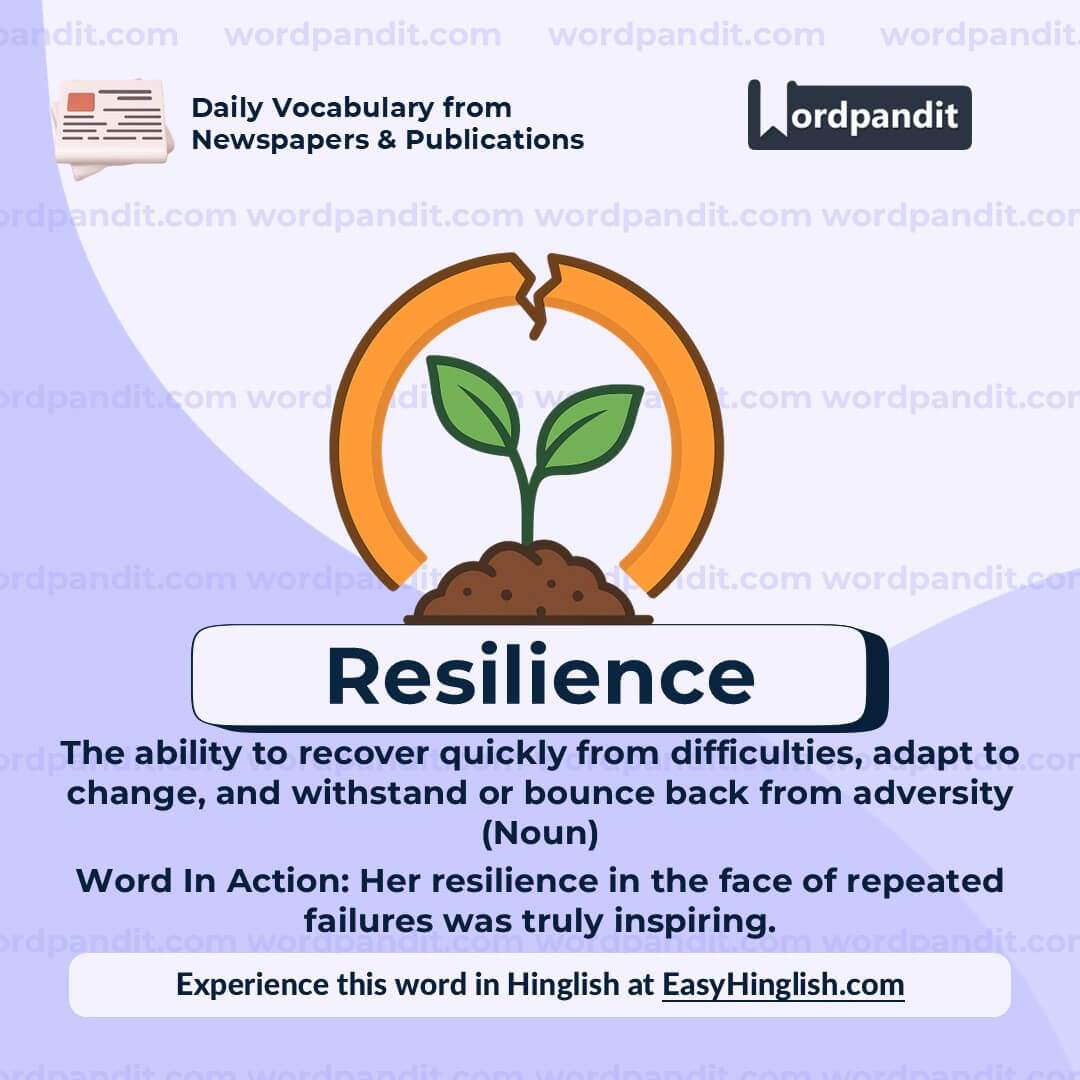
WORD-4: Resilience
Context:
"In doing so, the film reveals the ways in which environmental justice and Indigenous rights struggles are profoundly intertwined, as well as the deep resilience of the Sarayaku people." - Aeon
Explanatory Paragraph:
Resilience meaning in English is 'the capacity to recover quickly from difficulties, adapt to challenges, and bounce back from adversity.' This word is used when describing the ability of individuals, communities, or systems to withstand stress, overcome obstacles, and maintain functionality despite setbacks. How to use resilience correctly involves recognizing it applies to physical, emotional, social, and even ecological contexts. Resilience is commonly used in psychology articles, business leadership discussions, disaster management reports, and social science passages that regularly appear in CAT, GRE, UPSC, and other competitive exams.
Meaning: The ability to recover quickly from difficulties, adapt to change, and withstand or bounce back from adversity (Noun)
Pronunciation: rih-ZIL-yence
Difficulty Level: ⭐⭐⭐ Intermediate
Etymology: Resilience comes from the Latin word 'resilire' meaning 'to rebound' or 'leap back,' formed from 're-' (back) and 'salire' (to jump or leap). Originally used in physics to describe materials that spring back to their original shape after being bent or compressed, the word evolved in the 20th century to describe human psychological strength and adaptability. This metaphorical extension beautifully captures how people, like elastic materials, can return to form after being stretched or stressed by life's challenges.
Prashant Sir's Notes:
Students often ask: what is the difference between resilience and perseverance? While both involve facing challenges, resilience emphasizes the ability to bounce back and adapt, while perseverance focuses on persistent effort despite obstacles. Resilience usage in competitive exam passages typically signals discussions about overcoming adversity, disaster recovery, or psychological strength. For UPSC aspirants, resilience frequently appears in essay topics about community development, climate adaptation, and governance challenges. In Indian English newspapers, you'll see 'economic resilience post-pandemic,' 'resilience of Indian farmers,' or 'building resilient cities'—these phrases reflect India's ongoing challenges with climate change, economic shocks, and social transformation. For CAT and GRE, when you encounter 'resilience' in RC passages, the author usually discusses positive adaptation or recovery, making it a tone indicator for optimistic or solution-focused content.
Synonyms & Antonyms:
Synonyms: adaptability, toughness, flexibility, elasticity, robustness, durability, fortitude, buoyancy, hardiness, strength
Antonyms: fragility, weakness, vulnerability, brittleness, rigidity, frailty, delicacy
Usage Examples:
- Mumbai's resilience was evident when the city resumed normal operations within hours after the devastating floods during monsoon season.
- Indian startups demonstrated remarkable resilience during the pandemic, pivoting their business models and emerging stronger despite economic challenges.
- The resilience of farmers in drought-prone regions like Marathwada showcases human adaptability in the face of climate uncertainties.
- Workplace resilience training has become essential for IT professionals in Bangalore dealing with high-pressure deadlines and constant technological changes.
Cultural Reference:
"Team India's resilience in winning the Border-Gavaskar Trophy 2021 despite injuries and setbacks demonstrated the mental toughness that defines champion teams." - From cricket commentary celebrating India's historic victory
Think About It:
Can resilience be taught and developed, or is it an inherent quality some people possess? What role do family support systems and community networks play in building resilience, especially in Indian society?
Quick Activity:
Identify three examples of resilience you've observed recently—in your personal life, in news stories, or in your community. Write one sentence explaining what made each example demonstrate true resilience rather than just persistence.
Memory Tip:
Think of 'Resilience' as 'RE-BOUNCE-SILENCE'—imagine a rubber ball that REbounds silently no matter how hard you throw it down. Just like that bouncing ball, resilient people bounce back from difficulties! Or connect it to 'spring' (from the Latin root)—resilience is like a spring that returns to shape after being compressed.
Real-World Application:
In corporate communications, policy documents, and leadership articles, 'resilience' is essential vocabulary for discussing organizational strength, crisis management, and adaptive capacity. The word dominates disaster management reports, climate change discussions, and psychological research papers. For UPSC essays on topics like sustainable development, disaster preparedness, or social welfare, using 'resilience' demonstrates sophisticated understanding of how systems and people cope with challenges. In business contexts, 'building resilient teams' or 'economic resilience' has become standard terminology for describing adaptability in uncertain environments.
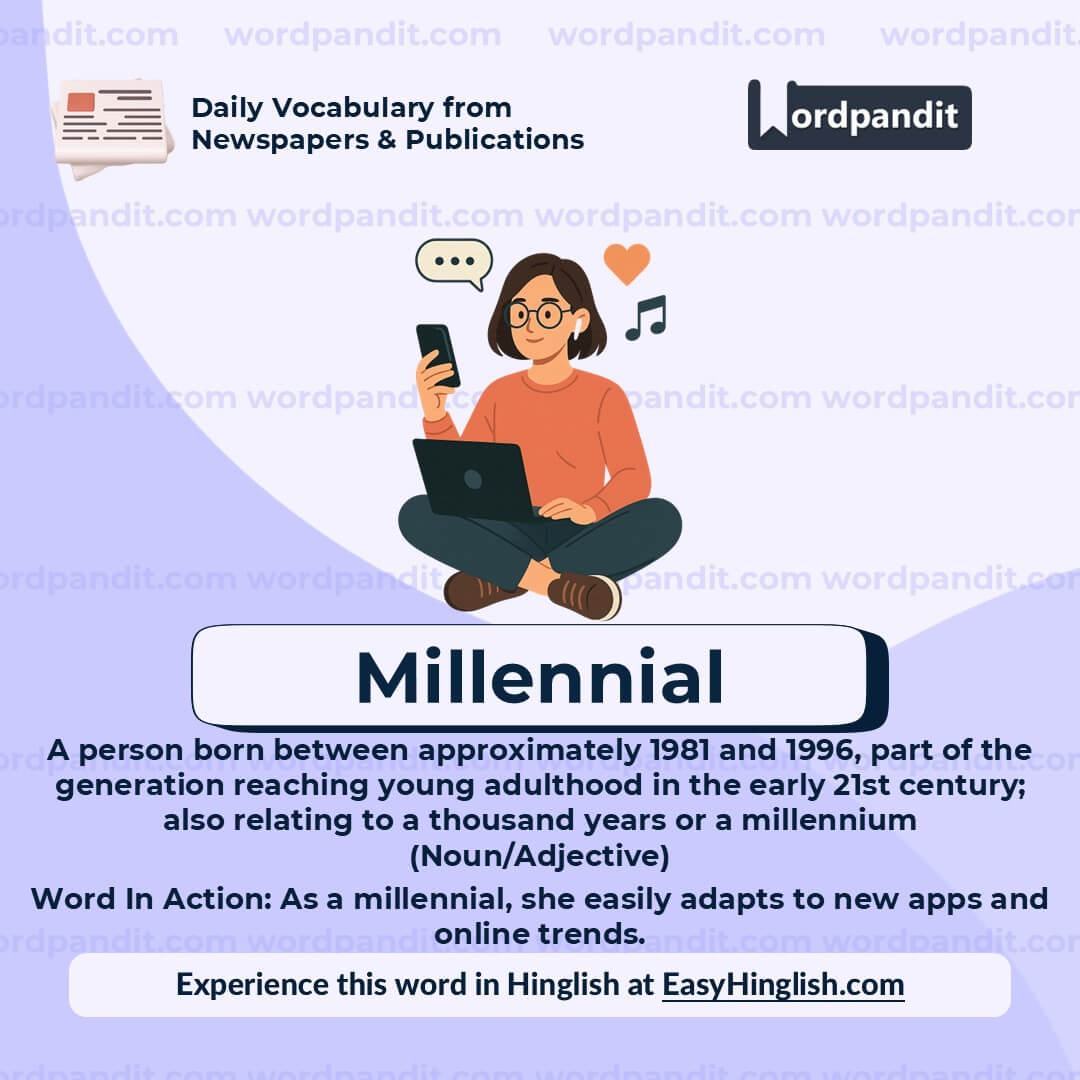
WORD-5: Millennial
Context:
"This is usually where I come in, as the expert mediator in the family. Like any good millennial, I turned to the internet for help in guiding the decision." - Aeon
Explanatory Paragraph:
Millennial meaning in English is 'a person born roughly between 1981 and 1996, belonging to the generation that came of age around the year 2000.' This word is used when describing a specific demographic cohort characterized by digital fluency, social media engagement, and experiencing major global events like 9/11 and the 2008 financial crisis during their formative years. How to use millennial correctly involves understanding it as both a demographic term and a cultural identifier associated with specific attitudes, behaviors, and values. Millennial is commonly used in marketing discussions, sociological analyses, workplace articles, and generational studies that appear in CAT, GRE, and UPSC passages about social trends and demographic shifts.
Meaning: A person born between approximately 1981 and 1996, part of the generation reaching young adulthood in the early 21st century; also relating to a thousand years or a millennium (Noun/Adjective)
Pronunciation: mih-LEN-ee-ul
Difficulty Level: ⭐⭐ Basic to Intermediate
Etymology: Millennial comes from 'millennium,' which derives from Latin 'mille' (thousand) and 'annus' (year), literally meaning 'a thousand years.' The term was popularized in the 1980s to describe the generation that would come of age around the year 2000—the new millennium. While 'millennial' originally referred to anything spanning or relating to a thousand years, its modern usage almost exclusively describes this specific generational cohort, making it one of the most recognized demographic labels in contemporary discourse.
Prashant Sir's Notes:
Many students confuse millennial with 'Gen Z'—the difference between millennial and Gen Z is crucial for demographic discussions: millennials (born 1981-1996) grew up during the internet's rise and remember life before smartphones, while Gen Z (born 1997-2012) are true digital natives who never knew a world without the internet. Millennial usage in CAT and GRE passages often appears in marketing case studies, workplace dynamics discussions, or sociological analyses. For UPSC essay papers on topics like 'Changing Youth Aspirations' or 'Digital India,' understanding millennials is essential—this generation forms India's largest workforce segment. In Indian English newspapers, you'll see 'millennial consumers driving e-commerce growth,' 'millennial voters shaping elections,' or 'millennials delaying marriage and homeownership'—these phrases reflect how this generation has transformed Indian society, from Flipkart shoppers to startup founders. Remember: in India, millennials witnessed liberalization, the tech boom, and social media's rise, making them bridge-builders between traditional and digital India.
Synonyms & Antonyms:
Synonyms: Generation Y, Gen Y, digital natives (partial overlap), echo boomers, 80s/90s kids
Antonyms: Baby boomer, Gen X, Gen Z, traditionalist, Silent Generation
Usage Examples:
- Millennial consumers in India prefer online shopping and digital payments, driving companies like Swiggy, Zomato, and PayTM to massive valuations.
- As a millennial employee, Rajesh values work-life balance and meaningful work over traditional job security and hierarchical career paths.
- Marketing strategies targeting millennials must incorporate social media influencers, as this generation trusts peer recommendations over traditional advertising.
- Indian millennials witnessed economic liberalization's impact firsthand, shaping their entrepreneurial mindset and global outlook compared to previous generations.
Cultural Reference:
"Zindagi Na Milegi Dobara perfectly captures millennial aspirations—friendship, travel, breaking free from conventional paths, and choosing experiences over material success." - From discussions on Bollywood's portrayal of generational values
Think About It:
Are the stereotypes about millennials—being entitled, job-hopping, and addicted to technology—fair assessments, or do they reflect generational bias? How has the Indian millennial experience differed from Western millennials due to our unique economic and cultural context?
Quick Activity:
Write three sentences comparing millennials with the previous generation (Gen X) or the next generation (Gen Z). Focus on one specific aspect: technology use, career attitudes, or social values.
Memory Tip:
Remember 'Millennial' by connecting 'MILLENNIUM' (the year 2000)—millennials are the generation who came of age around the MILLENNIUM, the turn of the century. Or think: 'MILLE-nnial' = 'MILLE-(thousand)' from Latin—the generation of the new thousand-year period. They're the Y2K generation who grew up as the calendar hit 2000!
Real-World Application:
In marketing reports, HR policies, and demographic analyses, 'millennial' is essential vocabulary for discussing consumer behavior, workplace trends, and social change. The word dominates business journalism, startup ecosystem discussions, and policy papers on employment and housing. For UPSC essays on topics like 'Demographic Dividend,' 'Digital Transformation,' or 'Changing Family Structures,' understanding millennials is crucial—they represent India's largest working-age population. In corporate communications about talent management or customer targeting, 'millennial preferences' and 'millennial mindset' have become standard terminology for strategic planning.


