

Daily Vocabulary from International Newspapers and Publications
Expand Your Vocabulary with Wordpandit’s Global Vocabulary Hub
At Wordpandit, we are committed to helping you develop a truly global vocabulary by drawing from some of the most respected international publications. This section is designed to keep you ahead of the curve by introducing you to words that define global conversations and trends.
The Power of Global Sources
To help you think and communicate on a global scale, we curate vocabulary from renowned international sources, such as:
- The New York Times
- The Washington Post
- BBC
- The Guardian
- The Economist
- Scientific American
- Psychology Today
- And many more...
Stay Global, Stay Competitive
Our daily updates from international publications ensure you are consistently exposed to new words that reflect global news and developments, making sure your vocabulary is not only current but also globally relevant.
Enhance Your Global Perspective
Whether you’re preparing for international exams, aiming to excel in global business communication, or want to enhance your language skills for personal growth, Wordpandit offers the resources you need to thrive in a global context.
Effective Learning, Global Reach
Our learning methodology combines global examples, memory aids, and interactive activities, allowing you to internalize new words effectively and apply them in real-world scenarios.
Begin Your Global Vocabulary Journey Now!

Why Choose Wordpandit?
Practical Learning: Focus on words you'll actually encounter in real-world reading, enhancing your comprehension and communication skills.
Diverse Content: From current affairs to scientific breakthroughs, our varied sources expose you to vocabulary across multiple domains.
Effortless Integration: Make Wordpandit a part of your daily routine. Just a few minutes each day can significantly boost your lexicon over time.
Your Path to Vocabulary Mastery
- Visit our Daily Vocabulary section regularly
- Explore new words and their usage in context
- Practice incorporating these words into your own writing and speech
- Track your progress as your vocabulary expands
Start Your Journey Today
Embark on your vocabulary enhancement journey with Wordpandit. By consistently engaging with our daily posts, you'll build a robust vocabulary that serves you well in academic, professional, and personal contexts.
Remember, a word a day keeps linguistic limitations at bay. Make Wordpandit your daily companion in the quest for vocabulary excellence!
WORD-1: Shrank
Context:
"And, lo and behold, after several months the tumour actually shrank and eventually disappeared." - Aeon
Explanatory Paragraph:
Shrank meaning in English is 'became smaller in size or reduced in volume or amount.' This word is the past tense of 'shrink' and is used when describing something that has decreased physically or metaphorically. How to use shrank correctly depends on context—it appears in medical reports describing tumour reduction, business articles about market contraction, and everyday conversations about clothes becoming smaller. Shrank is commonly used in formal writing, scientific journals, news articles, and competitive exam passages to indicate reduction or decrease.
Meaning: Became smaller or decreased in size, amount, or value (Verb - past tense)
Pronunciation: SHRANGK
Difficulty Level: ⭐⭐ Basic to Intermediate
Etymology: Shrank comes from the Old English word 'scrincan' meaning 'to wrinkle, shrivel up, or waste away.' The word has Germanic roots and evolved through Middle English to describe the action of becoming smaller or contracting. Interestingly, the irregular past tense form 'shrank' (instead of 'shrinked') reflects its ancient Anglo-Saxon origins, where strong verbs changed their internal vowels to show past tense.
Prashant Sir's Notes:
Many students confuse 'shrank' with 'shrunk'—both are past forms of 'shrink,' but shrank is simple past while shrunk is past participle (used with 'has' or 'have'). The difference between shrank and shrunk matters in competitive exams: say "the economy shrank last quarter" but "the economy has shrunk over three years." For CAT and GRE aspirants, shrank frequently appears in data interpretation passages discussing economic contractions, market reductions, or demographic changes. In Indian English newspapers, you'll often see phrases like "GDP shrank by 2%" or "workforce shrank during the pandemic"—this usage in business reporting is crucial for RC comprehension.
Synonyms & Antonyms:
Synonyms: contracted, reduced, decreased, diminished, dwindled, lessened, receded, compressed, withered, deflated
Antonyms: expanded, grew, enlarged, increased, swelled, inflated
Usage Examples:
- India's informal sector workforce shrank dramatically during the 2020 lockdown, affecting millions of daily wage earners across the country.
- Priya's confidence shrank when she entered the intimidating interview room at the Bangalore tech company's headquarters.
- The glacier in the Himalayas shrank by 15 percent over the past decade due to rising temperatures and climate change.
- Rahul was disappointed when his new cotton kurta shrank after the first wash, becoming too tight to wear comfortably.
Cultural Reference:
"Just like MS Dhoni's risk-taking appetite never shrank under pressure, true champions maintain their courage even when circumstances become difficult." - Cricket commentary on maintaining composure
Think About It:
Have you noticed how our attention spans have shrank in the age of social media and instant content? What does this mean for deep learning and sustained concentration?
Quick Activity:
Write two sentences using 'shrank'—one describing a physical change (like clothing or objects) and another describing an abstract change (like confidence, population, or economy).
Memory Tip:
Remember 'shrank' by thinking of the vowel sound itself shrinking: shriNk becomes shrANk—the 'i' shrinks to an 'a' in the past tense! Or visualize a sweater in hot water that "SHRANK" with a dramatic sound effect.
Real-World Application:
Shrank is commonly used in business reports, economic analyses, medical case studies, and news articles to describe measurable reductions. In corporate presentations, you'll see phrases like "market share shrank" or "profit margins shrank." For UPSC aspirants, this word frequently appears in passages about demographic transitions, economic downturns, environmental changes, and healthcare outcomes. In academic writing, understanding the correct usage of shrank versus shrunk demonstrates grammatical precision that examiners specifically look for in descriptive and analytical essays.
WORD-2: Bragging
Context:
"That whole episode definitely earned my dad some bragging rights." - Aeon
Explanatory Paragraph:
Bragging meaning in English is 'talking with excessive pride about one's achievements, possessions, or abilities.' This word is used when someone boasts or shows off about their accomplishments in a way that might annoy others. How to use bragging depends on context—it can describe harmless pride or irritating self-promotion. Bragging is commonly used in everyday conversation, informal writing, and competitive exam passages to describe human behavior related to pride and self-presentation, making it essential vocabulary for understanding character descriptions and social dynamics.
Meaning: Talking boastfully about one's achievements or possessions (Verb - present participle/gerund; can also function as noun or adjective)
Pronunciation: BRAG-ing
Difficulty Level: ⭐⭐ Basic to Intermediate
Etymology: Bragging comes from the Middle English word 'braggen,' which meant 'to make a loud sound' or 'to boast.' The word likely has Scandinavian origins, possibly from Old Norse 'bragr' meaning 'the best' or 'poetry of praise.' Over centuries, the meaning evolved from simply making noise to specifically describing boastful talk about oneself. The connection between loud sound and boasting reflects the attention-seeking nature of bragging behavior across cultures.
Prashant Sir's Notes:
Students often ask: what is the difference between bragging and boasting? While both mean talking proudly about yourself, bragging usage in English tends to be more informal and carries a slightly more negative tone than boasting. For CAT and GRE aspirants, understanding 'bragging rights' is crucial—this idiomatic phrase means 'the privilege of proudly talking about an achievement.' In RC passages, when authors describe characters as bragging, it usually signals a negative trait or sets up irony. In Indian context, you'll see phrases like "bragging about IIT admission" or "bragging about salary package"—recognize that this word always implies some level of social judgment about showing off.
Synonyms & Antonyms:
Synonyms: boasting, showing off, gloating, crowing, swaggering, vaunting, flaunting, blowing one's own trumpet (idiom), tooting one's own horn (idiom)
Antonyms: modest, humble, self-effacing, understating, downplaying, deprecating
Usage Examples:
- Vikram kept bragging about his promotion on social media, posting screenshots of his new designation every other day.
- After India won the cricket match, fans had genuine bragging rights over their Pakistani friends for weeks.
- The startup founder's constant bragging about funding rounds alienated potential partners who valued humility in business relationships.
- Sneha found her colleague's bragging about foreign trips exhausting, especially since everyone in the office faced similar work pressures.
Cultural Reference:
"In the film '3 Idiots,' Chatur's bragging about his future success and memorization skills contrasts sharply with Rancho's humble approach to genuine learning—showing how bragging often masks insecurity." - Bollywood character analysis
Think About It:
In the age of Instagram and LinkedIn, has bragging become normalized as 'personal branding,' or is there still a fine line between sharing achievements and showing off?
Quick Activity:
Identify three situations where sharing an achievement would be appropriate versus bragging. What makes the difference? Write down your criteria for this distinction.
Memory Tip:
Think of "BRAGGING" as "BRINGING ATTENTION, GRABBING GLORY"—the double 'G' in the middle represents the exaggerated, repeated nature of boastful talk. Or remember the Hindi equivalent "शेखी बघारना" (shekhi bagharna) which has the same negative connotation.
Real-World Application:
Bragging appears frequently in character descriptions in literature, personality assessments in organizational behavior studies, and social commentary in opinion pieces. For UPSC essay writing, understanding bragging helps discuss topics like social media culture, narcissism, or workplace dynamics. In CAT RC passages, characters who engage in bragging often face ironic outcomes or serve as foils to more humble protagonists. Recognizing bragging behavior in passages helps you identify author tone, predict plot developments, and answer inference questions about character motivation and social relationships.
WORD-3: Repositories
Context:
"To understand why this matters, we must first recognise that languages serve as vessels for knowledge – they are not merely communication tools, but repositories of specialised understanding." - Aeon
Explanatory Paragraph:
Repositories meaning in English is 'places or containers where things are stored or deposited for safekeeping, particularly large collections of information, knowledge, or resources.' This word is used when describing storage systems—both physical and digital—that preserve valuable materials systematically. How to use repositories correctly depends on the domain: in technology, it refers to code storage systems like GitHub; in academics, it means databases of research papers; in general usage, it describes any comprehensive storage location. Repositories is commonly used in formal writing, academic papers, technical documentation, and competitive exam passages discussing information management and knowledge preservation.
Meaning: Places where large amounts of information, knowledge, or objects are stored and maintained (Noun - plural form)
Pronunciation: rih-POZ-ih-tor-eez
Difficulty Level: ⭐⭐⭐ Intermediate
Etymology: Repositories comes from the Latin word 'repositorium,' derived from 'reponere' meaning 'to place back' or 'to store.' The prefix 're-' means 'back' and 'ponere' means 'to place,' so the original concept was about placing things back in their designated storage location. The word entered English in the 15th century, initially referring to physical storage places like warehouses or burial vaults. Over time, especially in the digital age, repositories evolved to encompass virtual storage systems for data, code, and knowledge, making it essential vocabulary in technology and academic contexts.
Prashant Sir's Notes:
Many students confuse 'repositories' with simple 'storage'—the key difference is that repositories imply organized, systematic, and often accessible collections rather than just random storage. For GRE and CAT aspirants, repositories frequently appears in passages about digital libraries, genetic databases, or cultural preservation. Students often ask: what is the difference between repository and archive? While both store information, repositories usage emphasizes active access and contribution (like GitHub where developers constantly update code), whereas archives typically store historical records less frequently accessed. In Indian academic context, you'll encounter phrases like "NCBI repositories for genomic data" or "institutional repositories of IITs"—understanding this term is crucial for comprehending research methodology passages in UPSC and other competitive exams.
Synonyms & Antonyms:
Synonyms: storage facilities, databases, archives, vaults, depositories, warehouses, storehouses, collections, reserves, libraries
Antonyms: dispersal points, distribution centers, outlets, sources of depletion
Usage Examples:
- Indian universities are creating digital repositories of ancient Sanskrit manuscripts to preserve centuries-old knowledge for future generations.
- GitHub serves as one of the world's largest repositories of open-source code, enabling developers from Mumbai to Silicon Valley to collaborate seamlessly.
- The National Archives of India functions as repositories of the country's historical documents, housing records dating back to the colonial period.
- Ananya's grandmother's mind served as repositories of traditional recipes and folk remedies that had been passed down through generations.
Cultural Reference:
"Indian temples have historically served as repositories not just of religious practices but of classical music, dance forms, and architectural knowledge—much like how the Thanjavur libraries preserved Tamil literature for centuries." - Commentary on cultural preservation
Think About It:
As artificial intelligence systems become repositories of human knowledge, what happens to traditional repositories like libraries and human memory? Are we gaining efficiency but losing something irreplaceable?
Quick Activity:
List three different types of repositories you interact with regularly—they could be physical (like libraries) or digital (like cloud storage). For each, write one sentence explaining what kind of information or objects they store.
Memory Tip:
Break 'REPOSITORIES' into 'RE-POSIT-ORIES': think "RE-place things in their POSITION in organized stORIES of knowledge." Or visualize a library repository where you "re-position" books back in their systematic storage locations—the 'posit' (position/place) is at the heart of the word.
Real-World Application:
Repositories is essential vocabulary in technology, research, and academic writing. In software development job descriptions and tech articles, you'll see "code repositories" and "version control repositories." For UPSC aspirants, this word appears in passages about digital governance, e-governance initiatives like DigiLocker, scientific research infrastructure, and cultural preservation projects. In CAT RC passages, repositories often appears in contexts discussing knowledge management, information systems, or institutional memory. Understanding repositories for competitive exams also means recognizing it in phrases like "repositories of traditional knowledge" (protecting indigenous wisdom) or "data repositories" (scientific databases), which frequently appear in current affairs and policy-related reading comprehension.
WORD-4: Retelling
Context:
"The act of retelling is also used to describe how people rewrite their own life stories — reframing past experiences to find meaning, healing, or identity." - Aeon
Explanatory Paragraph:
Retelling meaning in English is 'the act of telling a story or recounting events again, often with new interpretations, perspectives, or emphasis.' This word is used when someone narrates something that has already been told before, whether it's a personal experience, a historical event, or a classic tale. How to use retelling correctly involves understanding that it implies more than mere repetition—it suggests reinterpretation or a fresh perspective on familiar material. Retelling is commonly used in literary criticism, psychology, narrative therapy, and competitive exam passages discussing storytelling, memory, and cultural transmission of knowledge.
Meaning: The act of telling a story or describing events again, often with modifications or new perspectives (Noun/Gerund; can also function as present participle)
Pronunciation: ree-TEL-ing
Difficulty Level: ⭐⭐ Basic to Intermediate
Etymology: Retelling is formed from the prefix 're-' meaning 'again' combined with 'telling' from Old English 'tellan' meaning 'to count, relate, or narrate.' The prefix 're-' comes from Latin, while 'tell' has Germanic roots, making this a hybrid word. The concept of retelling has existed as long as oral traditions, but the specific compound word gained prominence in the 20th century with the rise of narrative psychology and postmodern literary criticism. The word emphasizes that stories are never static—each retelling potentially transforms the original narrative through the teller's perspective and the audience's context.
Prashant Sir's Notes:
Many students confuse 'retelling' with 'repetition'—but the difference between retelling and repeating is crucial for exam comprehension. Repetition means saying exactly the same thing again, while retelling usage implies reinterpretation or adding new perspective. For CAT and GRE aspirants, retelling frequently appears in passages about psychology, literature, and cultural studies—especially when discussing how myths get adapted or how therapy helps patients reframe traumatic experiences. In Indian context, think of how the Ramayana has countless retellings across languages and regions—each version reinterprets the core story through different cultural lenses. When you see "retelling" in RC passages, the author is usually highlighting themes of perspective, memory, or transformation rather than just simple narration.
Synonyms & Antonyms:
Synonyms: recounting, narrating again, recapitulating, rehashing, restating, reinterpreting, re-narrating, retelling, recasting, reframing
Antonyms: original telling, first account, initial narration, concealing, suppressing
Usage Examples:
- Devdutt Pattanaik's retelling of Hindu mythology makes ancient stories accessible to modern Indian readers through contemporary language and interpretations.
- The therapist encouraged Meera's retelling of her childhood trauma, helping her reframe the experience from a victim's narrative to a survivor's story.
- Bollywood's retelling of Shakespeare's plays in Indian settings—like 'Omkara' adapting 'Othello'—demonstrates how stories transcend cultural boundaries through creative reinterpretation.
- Grandfather's retelling of Partition stories changed over the years, each version emphasizing different emotions as he processed the historical trauma.
Cultural Reference:
"Chitra Banerjee Divakaruni's 'The Palace of Illusions' is a powerful retelling of the Mahabharata from Draupadi's perspective, giving voice to a character traditionally viewed through male narratives." - Indian feminist literature
Think About It:
How does social media enable constant retelling of our own lives through carefully curated posts? Are we becoming authors of fictional versions of ourselves?
Quick Activity:
Think of a family story you've heard multiple times from different relatives. Write two sentences describing how the retelling changed based on who told it and what details they emphasized or omitted.
Memory Tip:
Remember 'RETELLING' by breaking it as 'RE-TELLING': the prefix 'RE' means 'again,' so you're literally "telling again"—but with the understanding that each retelling adds new layers. Think of how cricket commentators keep retelling Kapil Dev's 175 not out—each retelling adds new analysis and perspective to the same historic innings.
Real-World Application:
Retelling is crucial vocabulary in literary analysis, psychology papers, and cultural studies. For UPSC essays on topics like oral traditions, cultural preservation, or media influence, understanding retelling helps discuss how narratives shape collective memory and identity. In CAT RC passages, retelling often appears in contexts about narrative therapy, mythological adaptations, historical revisionism, or storytelling traditions. Recognizing this word signals that the passage will explore themes of perspective, interpretation, memory, or transformation. In professional contexts, retelling appears in marketing (brand storytelling), journalism (perspective pieces), and education (pedagogical approaches to teaching history through multiple narratives).
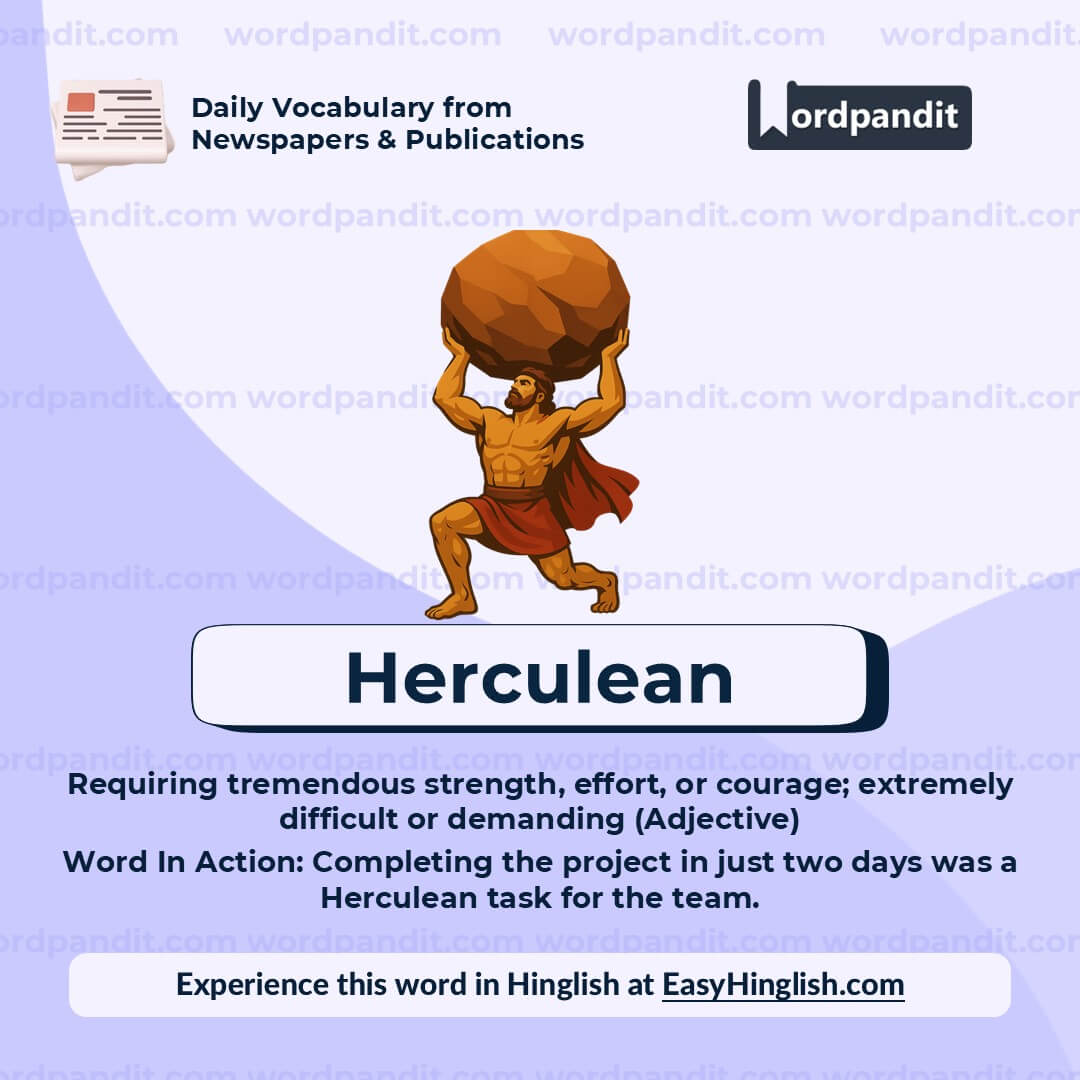
WORD-5: Herculean
Context:
"A study from 2020 showed that 88 per cent of the world's languages face such severe neglect in AI technologies that bringing them up to speed would require herculean – perhaps impossible – efforts. It wouldn't be surprising if the status quo is not too different even now." - Aeon
Explanatory Paragraph:
Herculean meaning in English is 'requiring enormous strength, effort, or determination; extremely difficult or demanding, often seeming nearly impossible.' This word is used when describing tasks, challenges, or efforts that demand extraordinary capabilities beyond normal human capacity. How to use herculean correctly involves recognizing its emphasis on both difficulty and the exceptional effort required—not just hard work, but work of almost superhuman proportions. Herculean is commonly used in formal writing, journalistic articles, business reports, and competitive exam passages to emphasize the magnitude of challenges in projects, reforms, or achievements.
Meaning: Requiring tremendous strength, effort, or courage; extremely difficult or demanding (Adjective)
Pronunciation: her-kyoo-LEE-uhn
Difficulty Level: ⭐⭐⭐ Intermediate
Etymology: Herculean comes from Hercules (Greek: Heracles), the legendary hero of Greek and Roman mythology famous for completing twelve seemingly impossible labors as penance. These included slaying the nine-headed Hydra, capturing the Cretan Bull, and cleaning the Augean stables in a single day. The word entered English in the late 16th century as a direct reference to these mythological feats. Over time, 'herculean' evolved from specifically referencing Hercules to becoming a general adjective describing any task requiring superhuman effort. The capitalization has become optional in modern usage, though many writers still capitalize it to acknowledge its mythological origins.
Prashant Sir's Notes:
Students often ask: what is the difference between herculean and difficult? While both describe challenging tasks, herculean usage specifically emphasizes near-impossible scale and the need for extraordinary effort—it's not just difficult, it's monumentally challenging. For CAT, GRE, and UPSC aspirants, herculean frequently appears in passages about large-scale projects, policy reforms, or scientific breakthroughs. Many students confuse 'herculean' with 'heroic'—heroic describes brave actions, while herculean specifically emphasizes the tremendous effort and difficulty involved. In Indian context, you'll see phrases like "the herculean task of implementing GST across 29 states" or "herculean efforts to eradicate polio"—these aren't just difficult tasks but ones requiring coordinated, sustained, extraordinary effort. Watch for this word in RC passages about infrastructure projects, social reforms, or technological challenges where the author wants to emphasize scale and difficulty.
Synonyms & Antonyms:
Synonyms: monumental, colossal, enormous, mammoth, formidable, daunting, arduous, strenuous, superhuman, gargantuan, titanic
Antonyms: easy, simple, effortless, manageable, trivial, minor, negligible
Usage Examples:
- The Indian Space Research Organisation faced a herculean challenge in launching the Mangalyaan Mars mission with a budget smaller than a Hollywood movie.
- Cleaning up the Ganga River requires herculean efforts involving coordination between multiple states, industries, and millions of citizens.
- After the pandemic, small business owners in Delhi made herculean attempts to rebuild their enterprises despite financial losses and supply chain disruptions.
- Preparing for three competitive exams simultaneously while working full-time proved a herculean task for Rajesh, testing his mental and physical endurance.
Cultural Reference:
"Just as Hercules completed twelve impossible labors, India's vaccination drive to immunize 1.4 billion people against COVID-19 was truly a herculean achievement of logistics and determination." - Commentary on India's vaccination campaign
Think About It:
In an age of AI and automation, are we creating new herculean tasks for ourselves, or are we finally equipped to solve the herculean challenges our ancestors could only dream of addressing?
Quick Activity:
Identify two current challenges facing India that could be described as herculean. Write one sentence for each explaining why they deserve this description rather than just being called "difficult."
Memory Tip:
Remember 'HERCULEAN' by connecting it to 'HERCULES + CLEAN'—imagine Hercules cleaning the Augean stables (one of his impossible labors) in a single day! Or think of the Hindi phrase "बहुत बड़ा काम" (bahut bada kaam) meaning "very big task," but multiply that difficulty by ten. The 'HERCUL' part directly reminds you of the superhuman Greek hero.
Real-World Application:
Herculean is essential vocabulary in project management reports, policy analysis, business journalism, and academic writing about large-scale initiatives. For UPSC essay writing, this word effectively describes challenges in topics like climate change mitigation, poverty eradication, or infrastructure development. In CAT RC passages, herculean signals that the author is emphasizing extraordinary difficulty—often setting up discussion of innovative solutions or explaining why certain goals remain unachieved. Corporate presentations use "herculean efforts" to acknowledge team achievements in turnaround situations or crisis management. Understanding herculean for competitive exams helps you identify tone, recognize hyperbole versus literal difficulty assessments, and comprehend passages about ambitious projects, whether in technology, governance, or social transformation.


