

Daily Vocabulary from International Newspapers and Publications
Expand Your Vocabulary with Wordpandit’s Global Vocabulary Hub
At Wordpandit, we are committed to helping you develop a truly global vocabulary by drawing from some of the most respected international publications. This section is designed to keep you ahead of the curve by introducing you to words that define global conversations and trends.
The Power of Global Sources
To help you think and communicate on a global scale, we curate vocabulary from renowned international sources, such as:
- The New York Times
- The Washington Post
- BBC
- The Guardian
- The Economist
- Scientific American
- Psychology Today
- And many more...
Stay Global, Stay Competitive
Our daily updates from international publications ensure you are consistently exposed to new words that reflect global news and developments, making sure your vocabulary is not only current but also globally relevant.
Enhance Your Global Perspective
Whether you’re preparing for international exams, aiming to excel in global business communication, or want to enhance your language skills for personal growth, Wordpandit offers the resources you need to thrive in a global context.
Effective Learning, Global Reach
Our learning methodology combines global examples, memory aids, and interactive activities, allowing you to internalize new words effectively and apply them in real-world scenarios.
Begin Your Global Vocabulary Journey Now!

Why Choose Wordpandit?
Practical Learning: Focus on words you'll actually encounter in real-world reading, enhancing your comprehension and communication skills.
Diverse Content: From current affairs to scientific breakthroughs, our varied sources expose you to vocabulary across multiple domains.
Effortless Integration: Make Wordpandit a part of your daily routine. Just a few minutes each day can significantly boost your lexicon over time.
Your Path to Vocabulary Mastery
- Visit our Daily Vocabulary section regularly
- Explore new words and their usage in context
- Practice incorporating these words into your own writing and speech
- Track your progress as your vocabulary expands
Start Your Journey Today
Embark on your vocabulary enhancement journey with Wordpandit. By consistently engaging with our daily posts, you'll build a robust vocabulary that serves you well in academic, professional, and personal contexts.
Remember, a word a day keeps linguistic limitations at bay. Make Wordpandit your daily companion in the quest for vocabulary excellence!
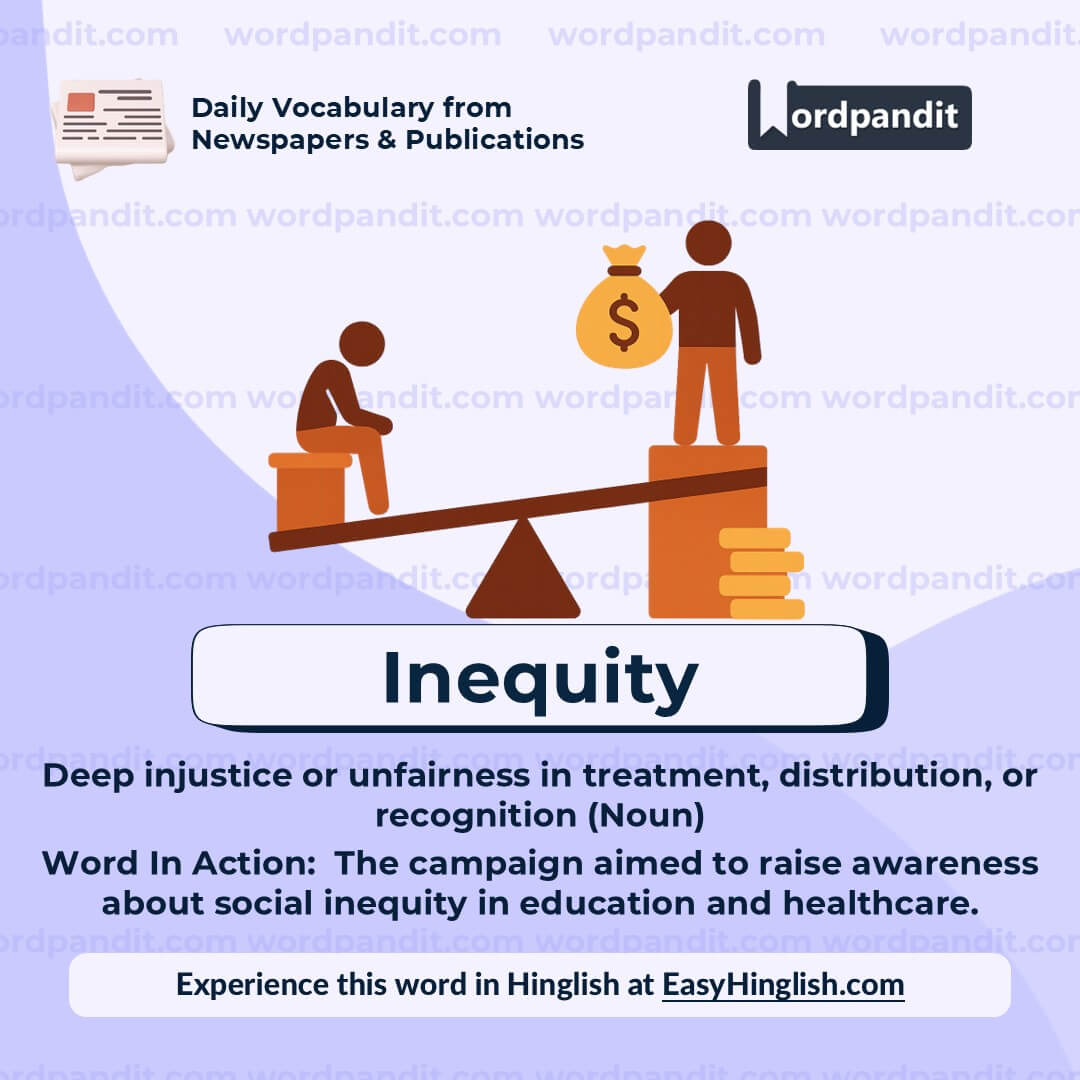
WORD-1: Inequity
Context:
"A prelude to the inequity in recognition…" - The Indian Express
Explanatory Paragraph:
Inequity meaning in English is 'a situation of deep injustice or unfairness, especially in how people are treated or resources are distributed.' This word is used when describing systematic imbalances where some individuals or groups receive unfair treatment compared to others. How to use inequity correctly is important for discussing social issues—it commonly appears in formal writing, newspaper editorials, policy discussions, and competitive exam passages addressing themes of justice, governance, and social reform.
Meaning: Deep injustice or unfairness in treatment, distribution, or recognition (Noun)
Pronunciation: in-EK-wi-tee
Difficulty Level: ⭐⭐⭐ Intermediate
Etymology: Inequity comes from Latin 'aequitas' meaning 'evenness or fairness,' with the prefix 'in-' meaning 'not.' The word evolved through Old French to describe situations lacking fairness or justice. Unlike its close cousin 'inequality' which simply means 'difference,' inequity specifically carries the moral weight of injustice and unfairness in that difference.
Prashant Sir's Notes:
Many students confuse inequity with inequality—this is a critical distinction for competitive exams. The difference between inequity and inequality is that inequality simply means 'unequal distribution' (which could be fair, like merit-based rewards), while inequity usage specifically signals unjust or unfair treatment. For UPSC essay papers and CAT RC passages, when you see inequity, the author is making a moral judgment about injustice. In Indian newspapers covering reservations, healthcare access, or gender issues, you'll notice 'inequity' appears when writers want to emphasize the unfairness, not just the difference. How to use inequity in sentences: pair it with systemic issues like 'gender inequity in pay,' 'healthcare inequity in rural areas,' or 'inequity in educational opportunities.'
Synonyms & Antonyms:
Synonyms: injustice, unfairness, bias, discrimination, imbalance, disparity (with moral judgment), partiality, prejudice
Antonyms: equity, fairness, justice, impartiality, equality, evenhandedness
Usage Examples:
- The stark inequity in healthcare access between urban metros and rural villages remains one of India's biggest challenges.
- Priya's research paper highlighted the gender inequity in corporate boardrooms, where women hold less than fifteen percent of leadership positions.
- The Supreme Court's judgment addressed the historical inequity faced by marginalized communities in land ownership and economic opportunities.
- Rahul noticed the inequity when his colleague with identical qualifications received a promotion while he was overlooked without explanation.
Cultural Reference:
"The greatest challenge facing modern India is not inequality of income, but inequity in opportunity—where your birth decides your future more than your talent does." - Common theme in Indian social commentary and UPSC essay topics
Think About It:
Can economic growth truly be sustainable if it's built on a foundation of social inequity, or does persistent unfairness eventually undermine prosperity for everyone?
Quick Activity:
Identify three examples of inequity in your daily surroundings—whether in education, workplace, or society. Write one sentence describing each situation and why it represents unfair treatment rather than just difference.
Memory Tip:
Think of inequity as "IN-EQUITY"—imagine equity (fairness) with "IN" blocking it, preventing fairness from reaching everyone. Picture a cricket match where one team gets biased umpiring decisions—that's not just unequal, it's inequitable because it's fundamentally unfair and unjust.
Real-World Application:
In policy documents, research papers, and editorial writing, 'inequity' is the preferred term when discussing social justice issues that require corrective action. Journalists use it in articles about healthcare disparities, educational access, wage gaps, and systemic discrimination. For competitive exam essays, using 'inequity' instead of the vaguer 'inequality' shows analytical depth—it signals you understand not just that differences exist, but that they represent moral failures requiring intervention.
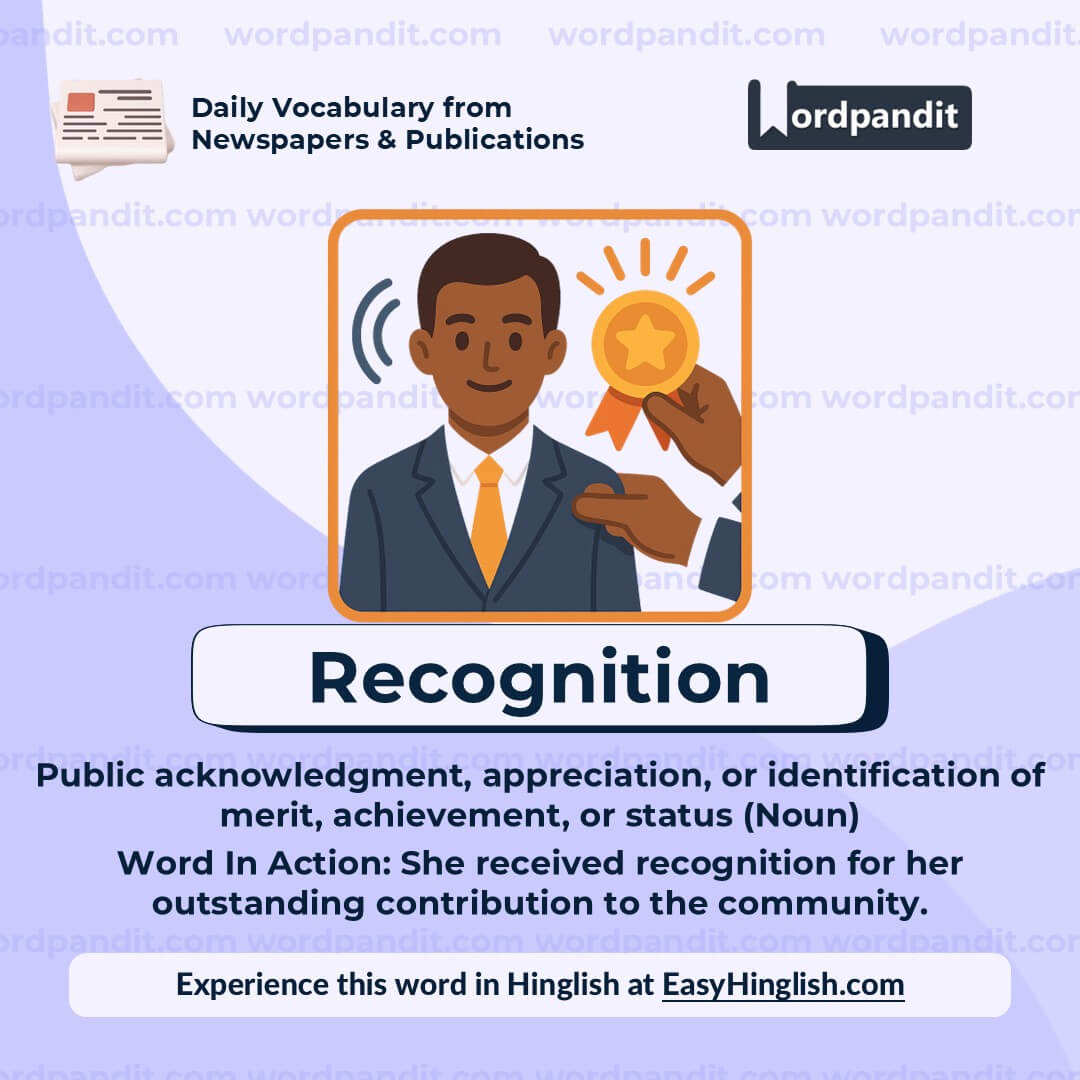
WORD-2: Recognition
Context:
"Time would, arguably, redress the balance, with TIME magazine ranking both among the 100 most influential people…" - The Indian Express
Explanatory Paragraph:
Recognition meaning in English is 'the public acknowledgment or appreciation of someone's achievements, qualities, or status.' This word is used when describing how individuals or groups receive credit, honor, or formal acknowledgment for their contributions or accomplishments. How to use recognition effectively is essential in professional and academic contexts—it commonly appears in workplace communications, award ceremonies, news articles about achievements, and competitive exam passages discussing success, validation, and social status.
Meaning: Public acknowledgment, appreciation, or identification of merit, achievement, or status (Noun)
Pronunciation: rek-uhg-NISH-uhn
Difficulty Level: ⭐⭐ Basic to Intermediate
Etymology: Recognition comes from Latin 'recognoscere' meaning 'to know again or recall,' formed from 're-' (again) and 'cognoscere' (to know). The word evolved through Old French 'recognition' to describe the act of acknowledging or identifying something previously known. Over time, it developed the additional meaning of honoring achievements or granting formal acknowledgment, which is how we primarily use it today in professional and social contexts.
Prashant Sir's Notes:
Students often ask: what is the difference between recognition and appreciation? While both involve acknowledgment, recognition usage specifically implies formal or public acknowledgment of achievement or status, whereas appreciation is more about expressing gratitude or valuing something. For CAT and GRE reading comprehension, when you encounter 'recognition' in passages about careers or social movements, it typically signals themes of validation, visibility, or overcoming being overlooked. In Indian English newspapers, you'll frequently see phrases like 'gained international recognition' or 'long-overdue recognition'—these constructions indicate someone finally receiving the acknowledgment they deserved. How to use recognition in formal writing: it often pairs with verbs like 'receive,' 'gain,' 'deserve,' 'seek,' or 'lack,' making it perfect for discussing professional success and social justice issues.
Synonyms & Antonyms:
Synonyms: acknowledgment, appreciation, acceptance, validation, credit, honor, tribute, acclaim, identification, awareness
Antonyms: ignorance, disregard, neglect, oversight, anonymity, obscurity
Usage Examples:
- After years of groundbreaking research, Dr. Sharma finally received international recognition when her work was published in Nature journal.
- The employee recognition program at Infosys aims to celebrate outstanding performance and motivate teams across all departments.
- Many women scientists in India worked without recognition for decades before historians began documenting their crucial contributions to ISRO's early missions.
- Kapil's cricket academy gained recognition after three of his students were selected for the Indian national under-19 team.
Cultural Reference:
"Recognition is not just about awards and accolades—it's about being seen, being valued, and having your work matter." - A recurring theme in Bollywood biopics like 'Pad Man' and 'Mission Mangal' that celebrate unsung heroes finally receiving their due acknowledgment.
Think About It:
Why do some people crave public recognition while others are content working without acknowledgment? Does the value of work change based on whether it receives recognition?
Quick Activity:
Think of someone in your life whose work or contributions deserve more recognition. Write three sentences explaining what they do and why their efforts should be more widely acknowledged.
Memory Tip:
Break 'Recognition' into 'RE-COGNITION'—think of it as 'knowing again' or 'acknowledging what you know.' Imagine Virat Kohli being recognized at an airport—people KNOW who he is AGAIN and acknowledge his status. The 'RE' (again) + 'COGNITION' (knowing) = publicly acknowledging someone's identity or achievements.
Real-World Application:
In professional communication, 'recognition' is essential vocabulary for HR policies, performance reviews, award nominations, and LinkedIn recommendations. Business leaders use it when discussing employee motivation and retention strategies. In academic and journalistic writing, recognition appears in discussions about social movements, gender equality, scientific achievements, and cultural contributions. For competitive exams like UPSC, understanding 'recognition' is crucial for essay topics on social justice, meritocracy, and institutional reform—the word frequently appears in questions about marginalized communities seeking acknowledgment of their rights and contributions.

WORD-3: Ambitious
Context:
"Governments are announcing ambitious plans and pledging huge resources." - The Indian Express
Explanatory Paragraph:
Ambitious meaning in English is 'showing a strong desire and determination to achieve success, or describing goals that are challenging and require significant effort.' This word is used when referring to people who have high aspirations or when describing plans and projects that are bold and far-reaching. How to use ambitious correctly depends on context—it can describe personal drive or characterize grand schemes. Ambitious commonly appears in business communications, political discourse, exam essays, and news articles discussing development goals, career trajectories, and transformative initiatives.
Meaning: Having a strong desire for success or achievement; describing goals that are challenging and require great effort (Adjective)
Pronunciation: am-BISH-uhs
Difficulty Level: ⭐⭐ Basic to Intermediate
Etymology: Ambitious comes from Latin 'ambitiosus' meaning 'going around canvassing for votes,' derived from 'ambire' (to go around), from 'ambi-' (around) and 'ire' (to go). In ancient Rome, politicians would literally walk around seeking support, which gave the word its association with strong desire for advancement and success. The word evolved through Old French to English, gradually shifting from its political origins to describe anyone with high aspirations or bold plans requiring significant determination.
Prashant Sir's Notes:
Many students confuse ambitious with optimistic or confident—the difference between ambitious and optimistic is crucial for CAT RC passages. Ambitious usage specifically signals high goals requiring effort and risk, while optimistic just means expecting positive outcomes. For GRE and UPSC aspirants, when you see 'ambitious' modifying plans or projects, it often carries a double meaning: bold and admirable, but also potentially unrealistic or risky. In Indian English newspapers covering government schemes like 'ambitious infrastructure projects' or 'ambitious renewable energy targets,' the word subtly questions feasibility while acknowledging scale. How to use ambitious in your own writing: when describing people, it's generally positive ('an ambitious entrepreneur'), but when describing plans, consider adding qualifiers like 'overly ambitious' or 'realistically ambitious' to show nuanced thinking—this impresses CAT essay evaluators.
Synonyms & Antonyms:
Synonyms: aspiring, determined, driven, goal-oriented, enterprising, bold, audacious, challenging (for plans), aggressive (in business context), visionary
Antonyms: unambitious, complacent, modest, humble, unassuming, content, aimless, lackadaisical
Usage Examples:
- The government's ambitious target of achieving five trillion dollar economy by 2027 requires unprecedented reforms and investment across multiple sectors.
- Priya is an ambitious software engineer who left her comfortable job at TCS to launch her own fintech startup in Bangalore.
- The Chief Minister unveiled an ambitious rural electrification scheme promising 24-hour power supply to every village within three years.
- Rahul's ambitious plan to complete his CA, MBA, and CFA simultaneously proved too demanding, forcing him to prioritize one qualification.
Cultural Reference:
"In the film '3 Idiots,' Rancho represents the ambitious dreamer who pursues excellence and innovation over conventional success, reminding us that true ambition is about passion, not just achievement." - A defining portrayal of ambition in Indian popular culture that distinguishes healthy aspiration from rat-race mentality.
Think About It:
Is being ambitious always a positive trait, or can excessive ambition lead to unethical choices and burnout? Where should one draw the line between healthy aspiration and destructive obsession?
Quick Activity:
Write down three ambitious goals you have for the next five years. For each goal, note one realistic step you can take this month to move closer to achieving it.
Memory Tip:
Think of ambitious as "AIM-BITIOUS"—imagine someone with perfect AIM who is BITING at opportunities. Picture Dhoni aiming for the boundary in the final over—that focused determination and bold goal-setting is what makes someone ambitious. The word itself sounds like "I'm big on this"—passionate about achieving something significant.
Real-World Application:
In professional settings, 'ambitious' appears in job descriptions seeking driven candidates, performance reviews praising goal-oriented employees, and business proposals outlining transformative projects. Political journalism uses it to describe policy initiatives and development schemes, often with implicit commentary on feasibility. For competitive exams, ambitious is essential vocabulary for essays on economic development, personal success, leadership qualities, and national progress. In CAT reading comprehension, when authors describe plans as 'overly ambitious' or 'admirably ambitious,' they're signaling their stance on feasibility—recognizing this tone helps answer inference questions correctly.
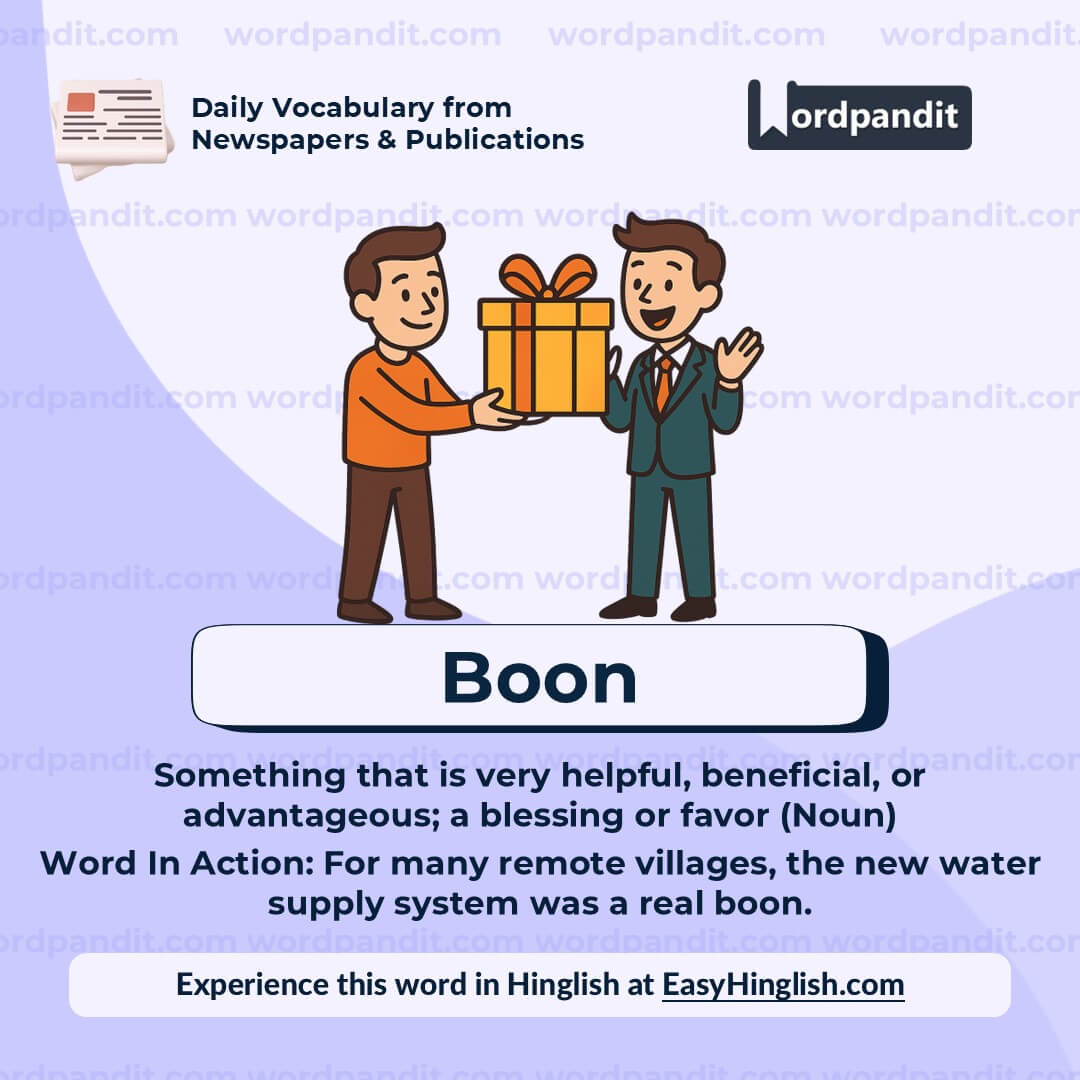
WORD-4: Boon
Context:
"Amazon and other online distributors can be both a boon and a bane." - Scroll
Explanatory Paragraph:
Boon meaning in English is 'something that is extremely helpful, beneficial, or seen as a blessing or advantage.' This word is used when describing developments, innovations, or circumstances that bring significant positive impact or relief. How to use boon effectively is important for expressing gratitude or acknowledging benefits—it commonly appears in editorial writing, policy discussions, technology reviews, and competitive exam passages discussing progress, innovation, and social change, often in the phrase 'a boon for' or paired contrastingly with 'bane.'
Meaning: Something that is very helpful, beneficial, or advantageous; a blessing or favor (Noun)
Pronunciation: BOON
Difficulty Level: ⭐⭐ Basic to Intermediate
Etymology: Boon comes from Old Norse 'bón' meaning 'a prayer or request,' which entered Middle English through Scandinavian influence. Originally, it referred to a favor or gift granted in response to a petition, often in medieval contexts where knights would ask boons of their lords. Over centuries, the word evolved from meaning 'a granted favor' to its modern usage describing anything that brings significant benefit or advantage, losing its connection to requesting and retaining only the sense of blessing or fortunate circumstance.
Prashant Sir's Notes:
The most common exam pattern you'll encounter is 'boon and bane'—this phrase appears constantly in CAT RC passages and UPSC essays discussing technology, globalization, or social media. The difference between boon and benefit is subtle but important: while 'benefit' is neutral and general, boon usage carries emotional weight suggesting something almost miraculous or providential. For competitive exam aspirants, remember that 'boon' typically follows the article 'a' ('a boon for farmers') rather than standing alone. In Indian English newspapers, you'll see constructions like 'rainfall proved a boon' or 'digitalization has been a boon'—these express relief or gratitude. How to use boon in essays: it's perfect for discussing how technology, reforms, or natural events have positively transformed situations, especially when you want to emphasize unexpected or significant benefits rather than just routine advantages.
Synonyms & Antonyms:
Synonyms: blessing, advantage, benefit, godsend, windfall, asset, help, favor, gift, convenience
Antonyms: bane, curse, disadvantage, affliction, burden, hindrance, misfortune, plague
Usage Examples:
- The monsoon rains arrived right on schedule this year, proving a boon for farmers across Maharashtra who had feared another drought.
- Remote work has been a boon for young professionals in tier-2 cities, allowing them to earn metropolitan salaries while living near family.
- UPI payment systems have emerged as a boon for small shopkeepers, eliminating the need for expensive card machines and reducing cash-handling risks.
- While social media can be a boon for staying connected with distant relatives, Anjali found it became a bane when she spent hours scrolling mindlessly each day.
Cultural Reference:
"In Indian mythology, sages would grant boons to devotees after years of penance—Lord Rama received celestial weapons as boons, while Ravana's boon of invincibility became the source of his downfall, showing how boons can transform destinies." - This cultural understanding of boons as powerful gifts shapes how Indians use the word in everyday contexts.
Think About It:
Can something that starts as a boon eventually become a bane? Think about technologies like smartphones or social media—at what point does convenience turn into dependence or addiction?
Quick Activity:
List three modern inventions or services that you consider boons in your daily life. For each, write one sentence explaining specifically how it has made your life easier or better.
Memory Tip:
Think of boon as "BOOM"—when something is a boon, it creates a positive BOOM or explosion of benefits in your life! Or remember the mythological connection: in every Indian epic, gods grant BOONS to devotees as special blessings. Imagine Hanuman receiving the boon of immortality—something extraordinarily helpful and beneficial. The rhyme with "moon" also helps: just as the moon brings pleasant light on dark nights, a boon brings welcome help in difficult situations.
Real-World Application:
In journalism and editorial writing, 'boon' appears frequently when discussing technological innovations, policy reforms, or natural phenomena that benefit populations. Business analysts use it to describe market opportunities or regulatory changes that favor industries. For competitive exams, boon is essential vocabulary for essays on development, technology impact, agricultural reforms, and social change. The phrase 'boon and bane' is particularly valuable for UPSC mains where balanced analysis is rewarded—it allows you to acknowledge both positive and negative aspects of any issue. In CAT reading comprehension, recognizing 'boon' signals the author's positive evaluation, helping you identify tone and answer inference questions accurately.

WORD-5: Robust
Context:
"The publishing industry in India is fairly robust (if insular)." - Scroll
Explanatory Paragraph:
Robust meaning in English is 'strong, healthy, and capable of withstanding difficult conditions or challenges without breaking down.' This word is used when describing systems, structures, economies, or physical health that demonstrate resilience and vigor. How to use robust correctly varies by context—it can describe physical strength, economic stability, or system reliability. Robust commonly appears in business reports, economic analyses, technical documentation, and competitive exam passages discussing sustainability, durability, and effectiveness of policies, systems, or organizations.
Meaning: Strong, healthy, and resilient; capable of withstanding stress or adverse conditions (Adjective)
Pronunciation: roh-BUST
Difficulty Level: ⭐⭐⭐ Intermediate
Etymology: Robust comes from Latin 'robustus' meaning 'strong and hardy,' derived from 'robur' meaning 'oak tree or strength.' The ancient Romans associated oak trees with exceptional strength and durability, making 'robur' their metaphor for power and resilience. The word traveled through Old French 'robuste' into English in the 16th century, initially describing physical health and strength. Over time, its application expanded to describe anything demonstrating durability—economies, arguments, systems, or organizations—while retaining its core meaning of strength that withstands challenges.
Prashant Sir's Notes:
Students often ask: what is the difference between robust and strong? While both indicate power, robust usage specifically emphasizes resilience and the ability to function well under stress or adverse conditions. For CAT and UPSC aspirants, when you encounter 'robust' in passages about economies, systems, or industries, it signals sustainability and resistance to shocks—not just temporary strength. In Indian English business journalism, you'll frequently see phrases like 'robust growth,' 'robust demand,' or 'robust performance'—these don't just mean 'good' but specifically indicate strength that persists despite challenges. How to use robust in formal writing: it pairs excellently with nouns like framework, system, economy, health, debate, or growth. For GRE, remember that 'robust' can also describe vigorous arguments or healthy debates, showing intellectual strength. Pro tip: in RC passages, 'robust' often appears when authors want to praise resilience while acknowledging external pressures—look for this pattern in questions about author's tone.
Synonyms & Antonyms:
Synonyms: strong, sturdy, resilient, vigorous, hardy, durable, powerful, sound, healthy, solid, stable, rugged
Antonyms: weak, fragile, frail, delicate, feeble, vulnerable, unstable, flimsy
Usage Examples:
- India's pharmaceutical sector has remained remarkably robust despite global supply chain disruptions, maintaining steady exports to over 200 countries.
- The professor encouraged robust debate in her classroom, welcoming students to challenge ideas vigorously while maintaining respectful discourse.
- After implementing the new quality control measures, the manufacturing unit developed a robust system that reduced defects by forty percent.
- Ramesh maintained robust health well into his seventies through regular yoga practice, balanced diet, and an active lifestyle in his Pune neighborhood.
Cultural Reference:
"Indian cricket's robust domestic structure—from Ranji Trophy to IPL—has created a pipeline of talent that keeps producing world-class players generation after generation, proving that robust systems sustain long-term success." - A common observation in sports commentary about institutional strength.
Think About It:
What makes some institutions and systems robust enough to survive for centuries while others collapse within years? Is it better to build robust systems that resist change or flexible ones that adapt quickly?
Quick Activity:
Identify two robust systems or institutions in Indian society that have withstood significant challenges over decades. Write one sentence for each explaining what makes them resilient and strong.
Memory Tip:
Think of robust as "ROBO-BUST"—imagine a robot with a strong bust or chest that cannot be broken, continuing to function perfectly even when hit or stressed. Or remember its origin from 'robur' meaning oak tree: picture a massive oak tree standing strong through storms, seasons, and time—that unwavering strength through challenges is what makes something robust. In Hindi, you might think of it as similar to 'mazboot' (मजबूत) but with added emphasis on lasting resilience.
Real-World Application:
In business and economic reporting, 'robust' is the go-to adjective for describing healthy, sustainable growth or performance that withstands market volatility. Technical writers use it to describe systems, software, or infrastructure that reliably handle stress and errors. Medical professionals employ it when discussing good health and strong immune systems. For competitive exams, robust is crucial vocabulary for essays on economic policy, institutional reform, healthcare systems, and infrastructure development. In CAT reading comprehension and UPSC passages, recognizing 'robust' helps identify arguments about sustainability versus temporary success—questions often test whether you understand this distinction. Banking and SSC exams frequently feature 'robust' in passages about financial systems, regulatory frameworks, and economic indicators.


