

Daily Vocabulary from International Newspapers and Publications
Expand Your Vocabulary with Wordpandit’s Global Vocabulary Hub
At Wordpandit, we are committed to helping you develop a truly global vocabulary by drawing from some of the most respected international publications. This section is designed to keep you ahead of the curve by introducing you to words that define global conversations and trends.
The Power of Global Sources
To help you think and communicate on a global scale, we curate vocabulary from renowned international sources, such as:
- The New York Times
- The Washington Post
- BBC
- The Guardian
- The Economist
- Scientific American
- Psychology Today
- And many more...
Stay Global, Stay Competitive
Our daily updates from international publications ensure you are consistently exposed to new words that reflect global news and developments, making sure your vocabulary is not only current but also globally relevant.
Enhance Your Global Perspective
Whether you’re preparing for international exams, aiming to excel in global business communication, or want to enhance your language skills for personal growth, Wordpandit offers the resources you need to thrive in a global context.
Effective Learning, Global Reach
Our learning methodology combines global examples, memory aids, and interactive activities, allowing you to internalize new words effectively and apply them in real-world scenarios.
Begin Your Global Vocabulary Journey Now!

Why Choose Wordpandit?
Practical Learning: Focus on words you'll actually encounter in real-world reading, enhancing your comprehension and communication skills.
Diverse Content: From current affairs to scientific breakthroughs, our varied sources expose you to vocabulary across multiple domains.
Effortless Integration: Make Wordpandit a part of your daily routine. Just a few minutes each day can significantly boost your lexicon over time.
Your Path to Vocabulary Mastery
- Visit our Daily Vocabulary section regularly
- Explore new words and their usage in context
- Practice incorporating these words into your own writing and speech
- Track your progress as your vocabulary expands
Start Your Journey Today
Embark on your vocabulary enhancement journey with Wordpandit. By consistently engaging with our daily posts, you'll build a robust vocabulary that serves you well in academic, professional, and personal contexts.
Remember, a word a day keeps linguistic limitations at bay. Make Wordpandit your daily companion in the quest for vocabulary excellence!

WORD-1: Legerdemain
Context:
"Accounting legerdemain flattered last quarter's numbers." - The Wall Street Journal
Explanatory Paragraph:
Legerdemain meaning in English is 'skillful deception or trickery, especially through clever manipulation of facts or figures.' This word is used when someone uses cunning methods to deceive others, particularly in contexts involving financial manipulation, political maneuvering, or any situation where the truth is cleverly obscured. How to use legerdemain effectively: it commonly appears in formal writing, business journalism, and competitive exam passages to describe sophisticated forms of deception or sleight of hand, both literal and metaphorical.
Meaning: Skillful trickery or deception; sleight of hand (Noun)
Pronunciation: lej-er-duh-MAYN
Difficulty Level: ⭐⭐⭐⭐ Advanced
Etymology: Legerdemain comes from Middle French 'léger de main,' literally meaning 'light of hand.' Originally used to describe the manual dexterity of stage magicians performing tricks, the word evolved by the 16th century to encompass any form of clever deception or trickery. The connection between a magician's nimble fingers and financial or political manipulation makes this word particularly powerful in describing sophisticated forms of deceit.
Prashant Sir's Notes:
Many students confuse legerdemain with simple lying, but legerdemain usage specifically implies skillful, almost artful deception—there's a craftsmanship to it. What is the difference between legerdemain and fraud? While fraud is straightforward dishonesty, legerdemain carries a sense of clever manipulation that impresses even as it deceives. For CAT and GRE aspirants, legerdemain frequently appears in business and political contexts in Reading Comprehension passages, often describing corporate accounting tricks or political maneuvering. In Indian newspapers like The Hindu and Business Standard, you'll see phrases like "financial legerdemain" or "statistical legerdemain" when journalists discuss creative accounting by companies or governments massaging economic data before elections.
Synonyms & Antonyms:
Synonyms: trickery, deception, sleight of hand, chicanery, subterfuge, artifice, manipulation, prestidigitation, jugglery, hocus-pocus
Antonyms: honesty, transparency, candor, straightforwardness, forthrightness, sincerity
Usage Examples:
- The Finance Ministry's budget presentation involved considerable statistical legerdemain to hide the actual fiscal deficit before the general elections.
- Through accounting legerdemain, the Bangalore-based startup inflated its valuation from ₹500 crores to ₹2000 crores within six months.
- The politician's verbal legerdemain during the debate allowed him to avoid answering direct questions about his assets and income sources.
- Priya realized her colleague Rahul used psychological legerdemain to take credit for her ideas during team presentations to senior management.
Cultural Reference:
"Just as a magician uses legerdemain to distract the audience while performing a trick, some corporate leaders use financial legerdemain to distract investors while hiding uncomfortable truths." - Common observation in business journalism
Think About It:
In the age of quarterly earnings reports and social media metrics, how much legerdemain do companies and individuals employ to present a more flattering picture of reality?
Quick Activity:
Think of a recent news story involving a company, politician, or public figure. Write one sentence describing how they might have used legerdemain to present information in a misleading way.
Memory Tip:
Think of 'Legerdemain' as 'LEDGER-REMAIN'—imagine an accountant making problematic numbers REMAIN hidden in the LEDGER through clever tricks. Or remember the French origin 'léger de main' (light of hand)—like a magician's quick hands fooling your eyes, financial legerdemain fools investors' understanding.
Real-World Application:
Legerdemain is commonly used in business journalism, financial analysis, and political commentary to describe sophisticated manipulation of information. Business reporters use it when discussing creative accounting practices, earnings management, or statistical manipulation. In competitive exam essays and formal writing, using 'legerdemain' instead of simple words like 'trickery' demonstrates vocabulary sophistication and adds a nuanced layer meaning—it suggests the deception required skill and planning, not just dishonesty.
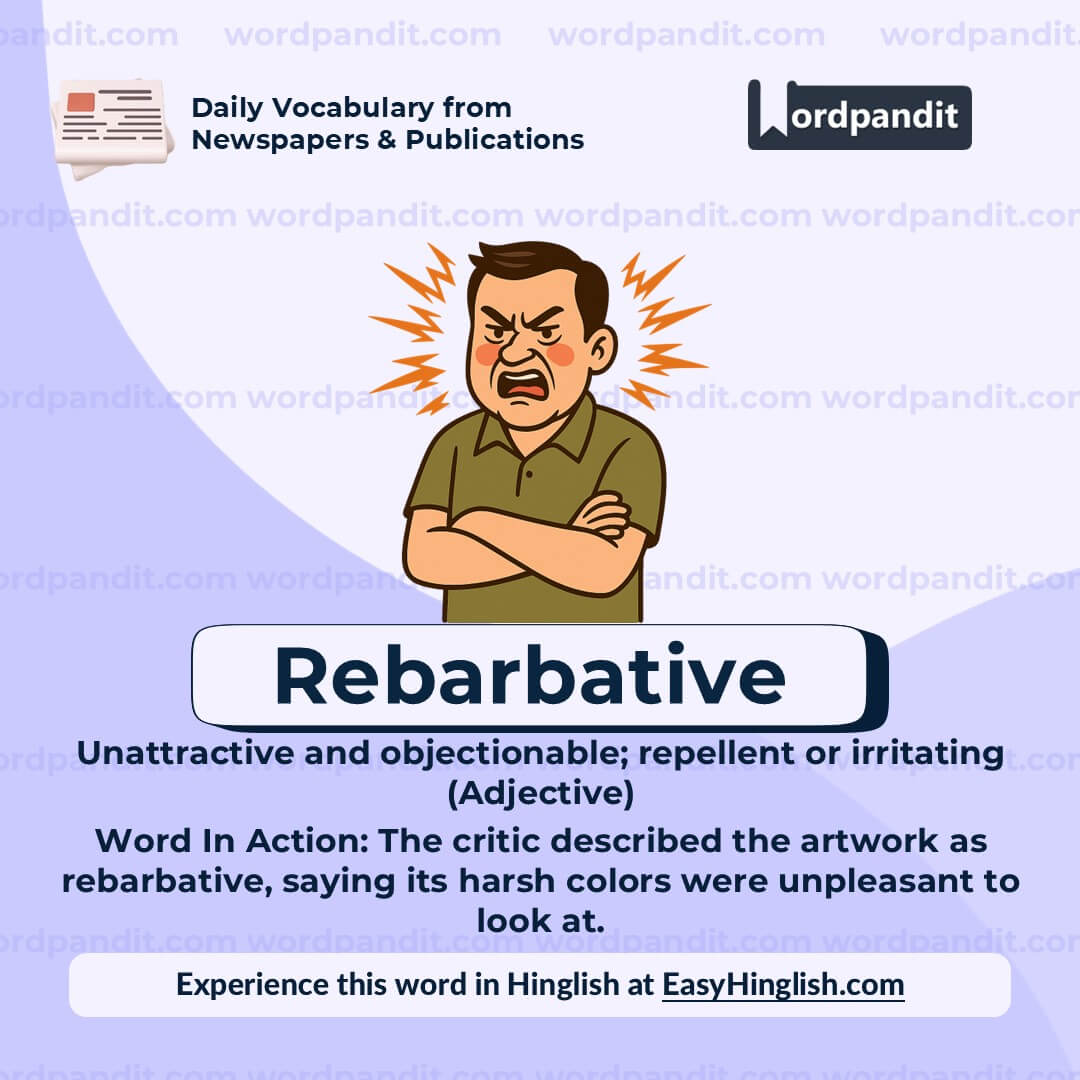
WORD-2: Rebarbative
Context:
"The bill's rebarbative language alienated moderates." - The Guardian
Explanatory Paragraph:
Rebarbative meaning in English is 'unattractive, objectionable, or causing irritation and repulsion.' This word is used when describing something or someone that is off-putting, disagreeable, or repellent in nature. How to use rebarbative in formal contexts: it commonly appears in literary criticism, political analysis, and competitive exam passages to describe harsh language, unpleasant personalities, or repugnant ideas that push people away. Rebarbative is particularly useful in UPSC, CAT, and GRE readings when authors want to express strong disapproval or describe something genuinely unpleasant.
Meaning: Unattractive and objectionable; repellent or irritating (Adjective)
Pronunciation: rih-BAR-buh-tiv
Difficulty Level: ⭐⭐⭐⭐ Advanced
Etymology: Rebarbative comes from French 'rébarbatif,' which derives from 'rebarbe' meaning 'to face beard to beard' or 'to oppose face to face.' The imagery suggests two bearded men confronting each other bristling and hostile, creating an unpleasant, prickly encounter. This vivid origin evolved into the modern meaning of anything that is repellent or causes aversion, retaining that sense of bristling unpleasantness that makes people want to back away.
Prashant Sir's Notes:
Students often ask: what is the difference between rebarbative and repulsive? While both describe something unpleasant, rebarbative usage specifically emphasizes the bristling, irritating quality that pushes people away gradually, whereas repulsive suggests immediate disgust. For GRE and CAT aspirants, rebarbative frequently appears in literary criticism and political commentary passages where authors describe harsh rhetoric or off-putting writing styles. In Indian English newspapers, particularly in op-eds in The Hindu or Indian Express, you'll encounter phrases like "rebarbative tone" or "rebarbative prose" when critics discuss polarizing political speeches or poorly written policy documents. The word carries a sophisticated edge—using rebarbative instead of simply "unpleasant" shows you understand nuanced vocabulary for describing different types of disagreeable qualities.
Synonyms & Antonyms:
Synonyms: repellent, off-putting, objectionable, disagreeable, irritating, unpleasant, unattractive, forbidding, grating, offensive
Antonyms: attractive, appealing, pleasant, agreeable, charming, inviting, engaging, welcoming
Usage Examples:
- The political manifesto's rebarbative rhetoric alienated urban voters who might have otherwise supported the party's economic policies in Mumbai and Bangalore.
- Professor Sharma's rebarbative teaching style, filled with sarcasm and dismissive comments, made students avoid his optional courses despite his expertise.
- The company's rebarbative customer service policies, requiring multiple escalations for simple refunds, drove loyal customers to competitors like Amazon and Flipkart.
- Arvind found his neighbor's rebarbative personality—constantly complaining and criticizing—made casual conversations in the elevator unbearably awkward.
Cultural Reference:
"Some political leaders adopt such rebarbative language during campaigns that they succeed in energizing their base while simultaneously repelling potential swing voters." - Common observation in Indian political analysis
Think About It:
In today's social media age, why do some people deliberately adopt rebarbative communication styles online, and does it serve their purpose or ultimately isolate them?
Quick Activity:
Identify two examples from recent news or social media where someone's rebarbative language or behavior caused backlash. Write one sentence explaining why their approach was counterproductive.
Memory Tip:
Think of 'Rebarbative' as 'RE-BARB-ative'—imagine someone with a prickly BARB or thorn that makes you want to move away and say "RE" (no) to approaching them. Or picture two bearded men arguing face-to-face (the original meaning), creating such an unpleasant, bristling encounter that everyone around them feels repelled.
Real-World Application:
Rebarbative is commonly used in literary criticism, political commentary, and formal reviews to describe writing styles, personalities, or ideas that are deliberately or inadvertently off-putting. Journalists and essayists use it when analyzing why certain political speeches fail to connect with audiences or why particular books receive negative reactions. In competitive exam essays, particularly for UPSC or GRE Analytical Writing, using 'rebarbative' demonstrates sophisticated vocabulary for critiquing arguments or describing rhetorical failures—it's more precise than 'unpleasant' and conveys the specific quality of pushing audiences away.
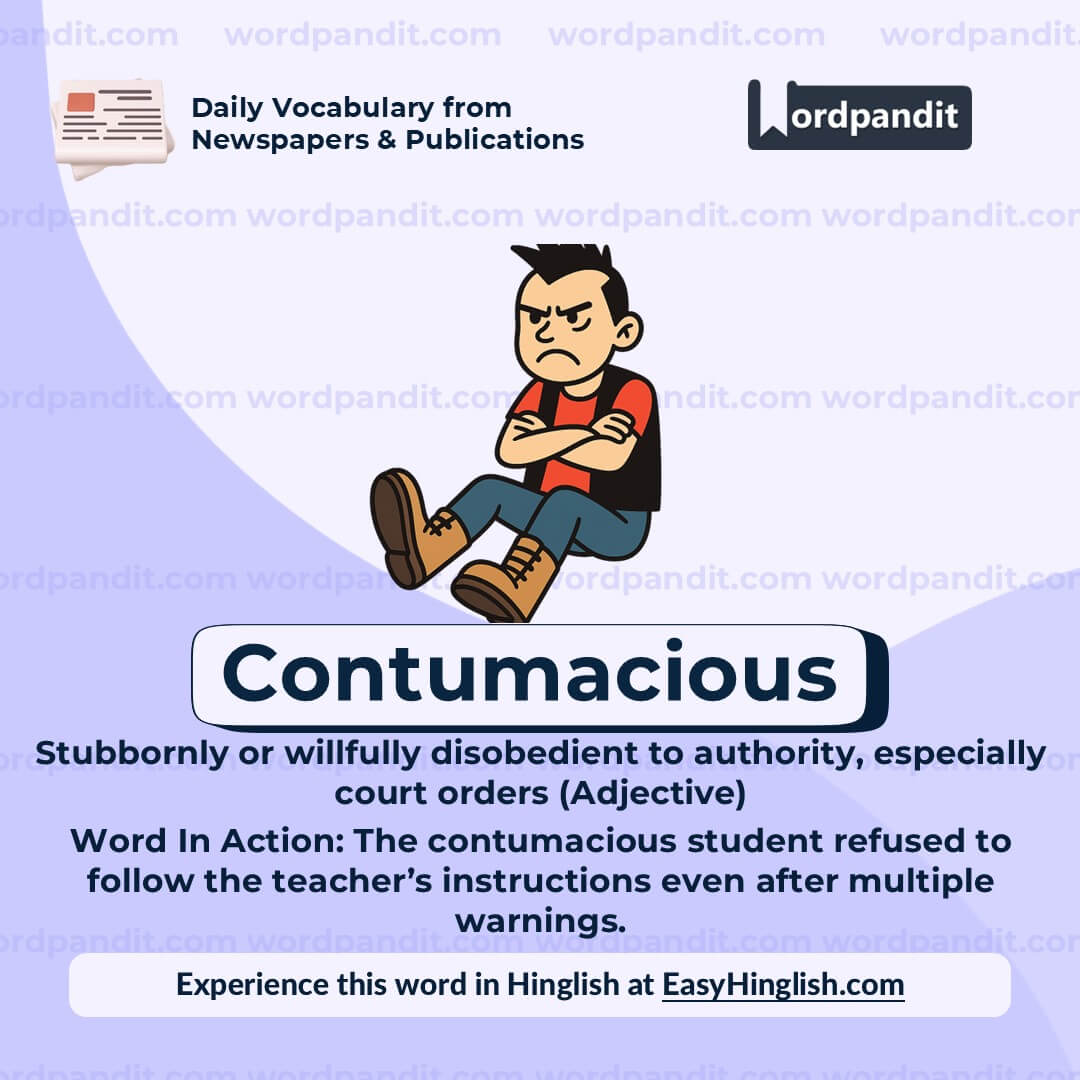
WORD-3: Contumacious
Context:
"The court fined the firm for contumacious non-compliance." - The Washington Post
Explanatory Paragraph:
Contumacious meaning in English is 'stubbornly disobedient or rebellious, especially toward authority or court orders.' This word is used when describing deliberate, willful defiance of legal or official directives, going beyond simple non-compliance to imply contemptuous resistance. How to use contumacious in legal and formal contexts: it commonly appears in court judgments, legal journalism, and competitive exam passages dealing with legal matters, particularly when authorities or individuals openly refuse to obey lawful orders. Contumacious behavior suggests not just disobedience but a contemptuous attitude toward the authority being defied.
Meaning: Stubbornly or willfully disobedient to authority, especially court orders (Adjective)
Pronunciation: kon-too-MAY-shus
Difficulty Level: ⭐⭐⭐⭐ Advanced
Etymology: Contumacious comes from Latin 'contumax,' meaning 'insolent' or 'stubborn,' which itself derives from 'tumere' meaning 'to swell.' The root suggests someone whose pride or stubbornness has 'swollen up,' making them refuse to submit to proper authority. This word entered English legal terminology in the 15th century and has retained its strong association with courtroom contexts, where it describes defendants or witnesses who willfully refuse to comply with judicial orders, showing contempt for the court's authority.
Prashant Sir's Notes:
Many students confuse contumacious with simply 'disobedient,' but contumacious usage specifically implies willful, contemptuous defiance of legitimate authority, particularly legal authority. What is the difference between contumacious and defiant? While defiant suggests open resistance, contumacious carries the additional legal weight of contempt—it's defiance that shows disrespect for lawful orders. For UPSC aspirants studying legal affairs and CAT students encountering legal passages, contumacious frequently appears in contexts involving contempt of court, regulatory violations, or corporate non-compliance. In Indian newspapers like The Hindu and Business Standard, you'll see phrases like "contumacious disregard" when reporting on companies ignoring SEBI orders, politicians defying Election Commission directives, or witnesses refusing to appear before investigative agencies despite summons.
Synonyms & Antonyms:
Synonyms: disobedient, defiant, rebellious, insubordinate, recalcitrant, obstinate, intractable, refractory, willful, unruly
Antonyms: obedient, compliant, submissive, docile, cooperative, amenable, dutiful, respectful
Usage Examples:
- The Supreme Court held the mining company in contumacious contempt for continuing operations in Goa despite explicit orders to halt extraction activities.
- Several Delhi-based restaurants showed contumacious behavior by refusing to display mandatory calorie information despite repeated warnings from the Food Safety Authority.
- The witness's contumacious refusal to appear before the CBI despite three summons resulted in a non-bailable warrant being issued against him.
- Rajesh's contumacious attitude toward his manager's instructions—openly ignoring deadlines and dismissing feedback—eventually led to his termination from the Bangalore IT firm.
Cultural Reference:
"When corporate entities display contumacious disregard for regulatory orders, it undermines the entire framework of governance and rule of law." - Frequently cited principle in Indian Supreme Court judgments on contempt
Think About It:
When does standing up for one's principles cross the line from courageous civil disobedience into contumacious behavior that undermines legitimate legal authority?
Quick Activity:
Find a recent news article about someone or some organization being held in contempt of court. Write two sentences explaining whether their behavior was truly contumacious or simply a misunderstanding of legal requirements.
Memory Tip:
Think of 'Contumacious' as 'CON-TOO-MUCH-US'—someone who is CON (against) authority with TOO MUCH stubbornness in US (themselves). Or remember the Latin root 'tumere' (to swell)—imagine someone's ego and stubbornness SWELLING up so much that they refuse to obey any authority, especially courts.
Real-World Application:
Contumacious is commonly used in legal journalism, court judgments, and regulatory reporting to describe willful non-compliance with official orders. Lawyers and judges use it in contempt proceedings when parties deliberately ignore court directives. In competitive exam essays, particularly for UPSC where legal awareness is tested, using 'contumacious' instead of simply 'disobedient' demonstrates sophisticated legal vocabulary and understanding of the distinction between accidental non-compliance and deliberate, contemptuous defiance of legitimate authority. The word appears frequently in Reading Comprehension passages dealing with corporate governance, regulatory frameworks, and judicial matters.
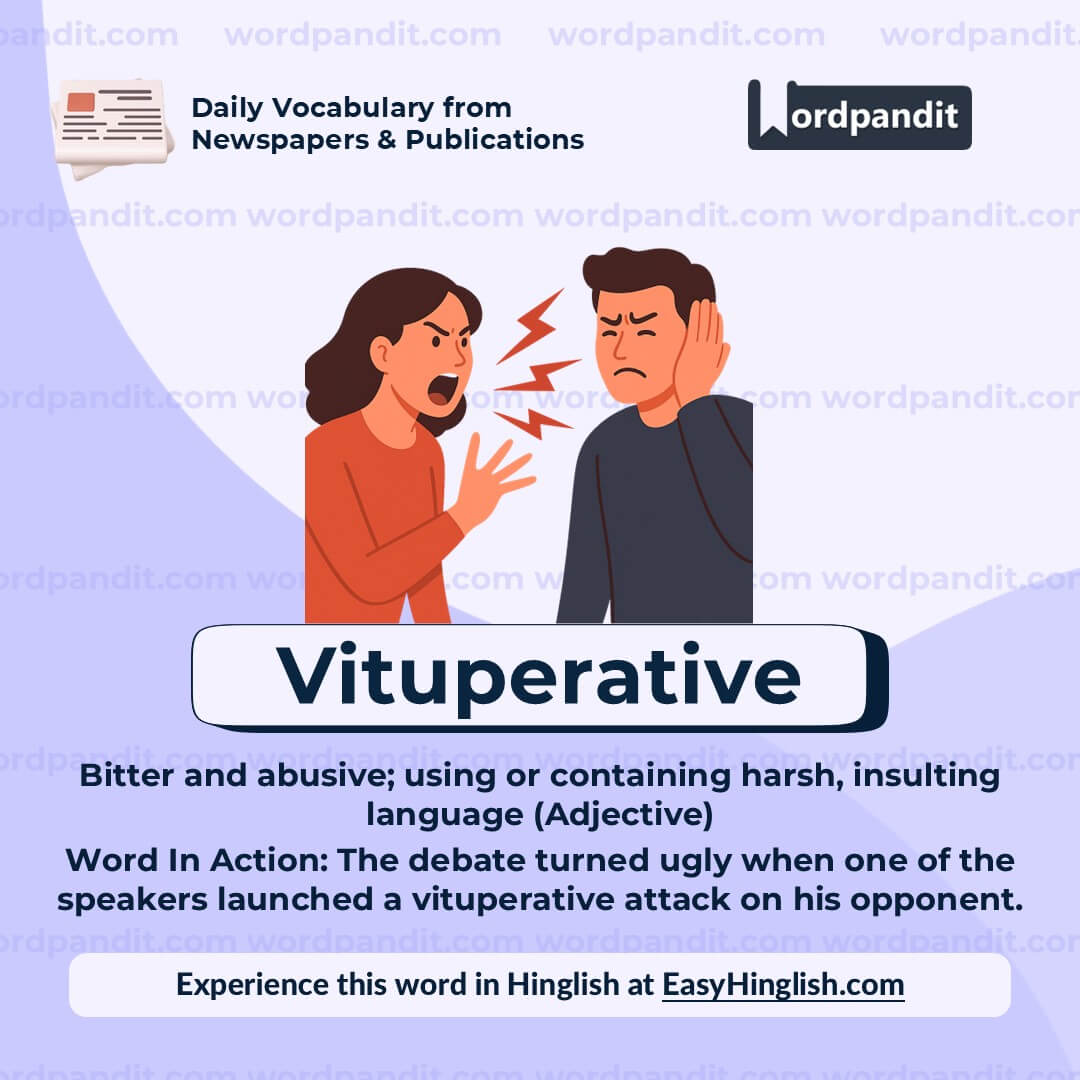
WORD-4: Vituperative
Context:
"Debate in parliament turned vituperative after the leak." - The Washington Post
Explanatory Paragraph:
Vituperative meaning in English is 'bitter and abusive; characterized by harsh, scathing criticism and verbal attacks.' This word is used when describing language or speech that goes beyond mere disagreement to express intense condemnation through insulting and offensive words. How to use vituperative effectively: it commonly appears in political journalism, literary criticism, and competitive exam passages to describe heated arguments, harsh criticism, or aggressive verbal exchanges. Vituperative language suggests not just strong disagreement but a sustained, bitter attack intended to condemn and humiliate the target.
Meaning: Bitter and abusive; using or containing harsh, insulting language (Adjective)
Pronunciation: vy-TOO-per-uh-tiv or vye-TOO-puh-ray-tiv
Difficulty Level: ⭐⭐⭐⭐ Advanced
Etymology: Vituperative comes from Latin 'vituperare,' meaning 'to blame, censure, or find fault,' which combines 'vitium' (fault or defect) and 'parare' (to prepare or make). The word literally means 'to make faults' or 'to attribute blame.' It entered English in the 16th century through religious and political discourse, where harsh verbal attacks and condemnations were common. The word retains its association with sustained, bitter criticism that goes beyond simple disagreement to express deep condemnation and contempt.
Prashant Sir's Notes:
Students often ask: what is the difference between vituperative and critical? While critical simply means expressing disapproval, vituperative usage specifically implies bitter, abusive language with personal attacks—it's criticism that has turned venomous. For CAT, GRE, and UPSC aspirants, vituperative frequently appears in Reading Comprehension passages about political debates, media criticism, or historical conflicts where language became particularly harsh. In Indian English newspapers, especially during election seasons or parliamentary debates, you'll encounter phrases like "vituperative rhetoric" or "vituperative exchanges" when journalists describe heated arguments in the Lok Sabha or Rajya Sabha. Many students confuse vituperative with passionate—remember, passion can be positive, but vituperative is always negative, involving insults and abuse. The word signals that discourse has deteriorated from reasoned debate into personal attacks.
Synonyms & Antonyms:
Synonyms: abusive, scathing, caustic, venomous, acrimonious, bitter, harsh, insulting, invective, defamatory, excoriating
Antonyms: complimentary, praising, laudatory, respectful, gentle, kind, conciliatory, diplomatic, tactful
Usage Examples:
- The parliamentary session descended into vituperative exchanges between ruling and opposition members after allegations of corruption surfaced against senior ministers.
- Social media debates about the Citizenship Amendment Act became increasingly vituperative, with participants abandoning reasoned arguments for personal attacks and inflammatory language.
- The film critic's vituperative review of the Bollywood blockbuster attacked not just the movie but questioned the director's competence and intelligence.
- Meera regretted sending that vituperative email to her colleague Arjun; what should have been constructive feedback became a bitter personal attack she couldn't take back.
Cultural Reference:
"During the Emergency period, political discourse in India often turned vituperative, with leaders on both sides using harsh, condemnatory language rather than engaging in substantive policy debates." - Common observation in Indian political history analysis
Think About It:
In an age of social media where vituperative language spreads instantly and amplifies rapidly, what responsibility do public figures and ordinary citizens have to maintain civil discourse?
Quick Activity:
Read the comments section of any controversial news article today. Identify two examples of vituperative language and rewrite them as constructive criticism without the harsh, abusive tone.
Memory Tip:
Think of 'Vituperative' as 'VIPER-ative'—like a VIPER's venomous bite, vituperative words are poisonous and meant to hurt. Or break it down as 'VIT-U-PER-ative': imagine someone saying "VIT (with) U (you), PER (person), I'm ACTIVE" in attacking you verbally with harsh, abusive language. The Latin root 'vitium' (fault) helps too—vituperative speech is all about aggressively pointing out faults.
Real-World Application:
Vituperative is commonly used in political journalism, media analysis, and opinion pieces to describe deteriorating public discourse and heated debates. Journalists use it when parliamentary proceedings or public debates turn from policy discussion into personal attacks. In competitive exam essays, particularly for UPSC where questions often involve analyzing political discourse or media responsibility, using 'vituperative' demonstrates sophisticated vocabulary for critiquing the quality of public debate. The word is especially useful in GRE and CAT Reading Comprehension when analyzing tone—recognizing vituperative language helps identify when authors have moved from reasoned argument to emotional attack, which is crucial for understanding passage structure and author intent.
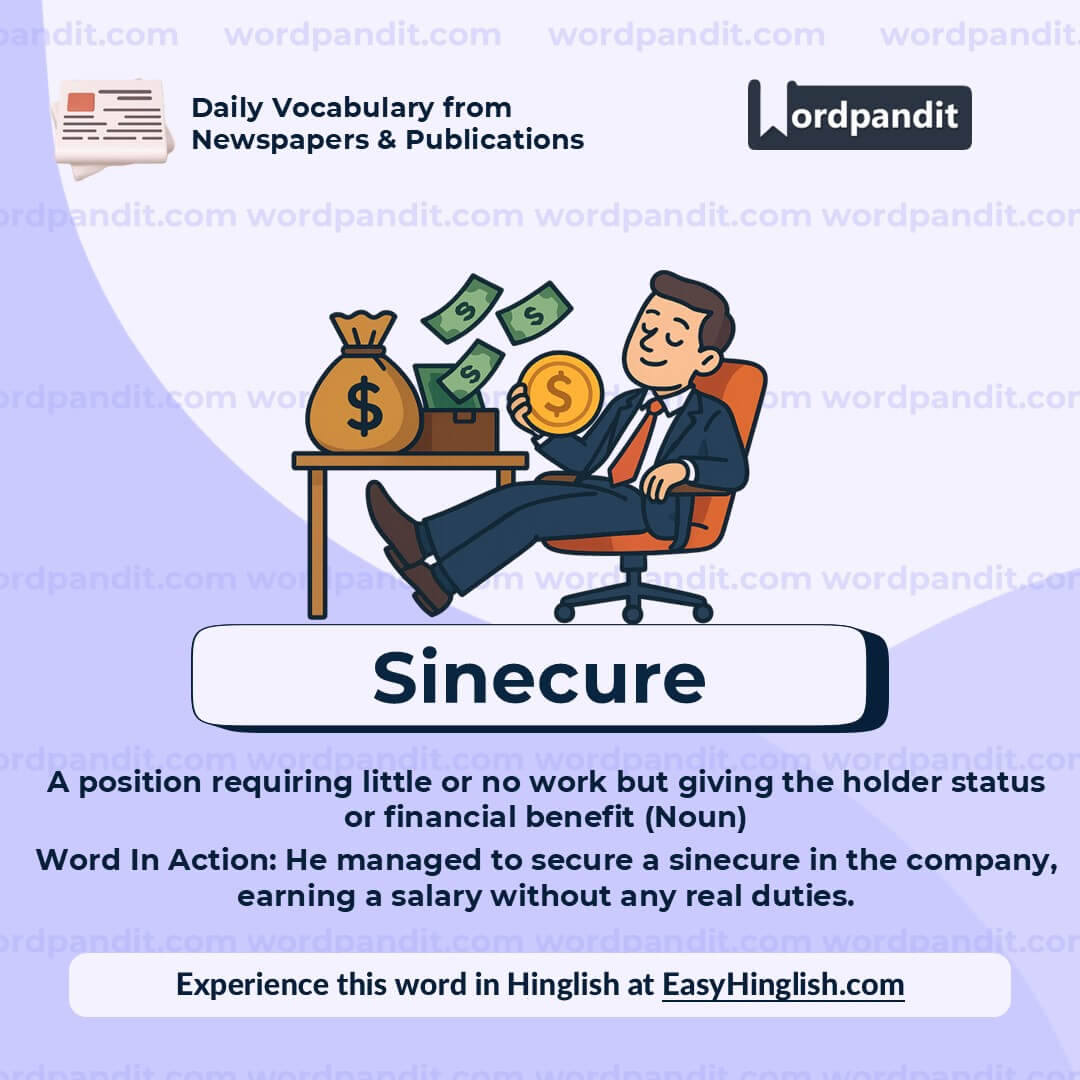
WORD-5: Sinecure
Context:
"Critics called the new advisory role a sinecure for allies." - The Washington Post
Explanatory Paragraph:
Sinecure meaning in English is 'a position or job that requires little or no work but provides a salary or benefits, often given as a reward or favor.' This word is used when describing positions that offer payment and prestige without demanding actual responsibilities or effort. How to use sinecure in political and professional contexts: it commonly appears in journalism, political commentary, and competitive exam passages dealing with patronage, bureaucracy, or organizational inefficiency. Sinecure positions are often criticized as examples of nepotism, cronyism, or institutional waste where connected individuals enjoy comfortable positions without contributing meaningful work.
Meaning: A position requiring little or no work but giving the holder status or financial benefit (Noun)
Pronunciation: SY-nih-kyoor or SIN-ih-kyoor
Difficulty Level: ⭐⭐⭐⭐ Advanced
Etymology: Sinecure comes from Medieval Latin 'sine cura,' literally meaning 'without care' or 'without responsibility.' The term originated in the church, where certain ecclesiastical positions provided income to clergy without requiring them to perform the usual pastoral duties or 'cure of souls.' By the 17th century, the word had expanded beyond religious contexts to describe any position offering payment without demanding actual work. This practice became particularly associated with political patronage systems where loyal supporters were rewarded with comfortable, undemanding positions funded by public money.
Prashant Sir's Notes:
Many students confuse sinecure with simply an 'easy job,' but sinecure usage specifically implies a position that requires virtually no work at all while still providing compensation—it's not just easy, it's essentially do-nothing. What is the difference between sinecure and honorary position? While honorary positions give prestige without payment, sinecures provide salary or benefits without requiring work—that's the crucial distinction. For UPSC aspirants studying governance and CAT students analyzing organizational ethics, sinecure frequently appears in passages about political patronage, bureaucratic inefficiency, or corporate board appointments. In Indian newspapers like The Hindu and Indian Express, you'll encounter phrases like "sinecure positions" when journalists discuss nominated Rajya Sabha members, government advisory boards with no real powers, or chairperson roles in PSUs that have become parking spots for retired bureaucrats and political allies rather than functional positions.
Synonyms & Antonyms:
Synonyms: cushy job, gravy train, soft option, easy berth, plum position, nominal position, figurehead role, honorary post (with pay)
Antonyms: demanding position, arduous role, taxing job, challenging assignment, burdensome responsibility
Usage Examples:
- The government appointed several retired bureaucrats to the National Commission as a sinecure, providing them ₹2 lakh monthly salaries without any defined responsibilities or deliverables.
- Opposition parties criticized the creation of new advisory councils as sinecures for party loyalists who lost recent elections in Karnataka and Maharashtra.
- Ravi's uncle secured him a sinecure position on the company's board—he attended one meeting quarterly, contributed nothing, and collected ₹50,000 per sitting fee.
- The professor's endowed chair had essentially become a sinecure after he stopped teaching classes, yet continued receiving his full salary and research grants from IIT Delhi.
Cultural Reference:
"In the British colonial administration in India, many sinecure positions were created for well-connected individuals, allowing them to draw salaries while actual governance work was done by junior officers." - Common observation in Indian administrative history
Think About It:
In modern India, how many government advisory boards, statutory committees, and public sector chairperson roles have become sinecures, and what does this cost taxpayers in terms of both money and lost opportunities for genuine reform?
Quick Activity:
Search recent news for government appointments to boards or commissions. Identify one that might be a sinecure and write two sentences explaining why, based on the position's actual powers and responsibilities versus its compensation.
Memory Tip:
Remember 'Sinecure' from its Latin roots: 'SINE' (without) + 'CURE' (care/responsibility) = a position WITHOUT CARE or work required. Think of it as 'SIGN-and-CURE'—you just SIGN your name to collect payment and you're CURED of having to do any actual work! Or imagine someone saying "SIN-lessly SECURE" because they get paid without sinning by working hard.
Real-World Application:
Sinecure is commonly used in political journalism, governance analysis, and corporate commentary to criticize patronage appointments and organizational inefficiency. Journalists use it when discussing nominated positions, advisory boards, or ceremonial roles that provide compensation without demanding accountability. In competitive exam essays, particularly for UPSC where questions often involve governance reforms and efficient administration, using 'sinecure' demonstrates sophisticated vocabulary for analyzing systemic problems in public institutions. The word is valuable in discussing topics like political patronage, bureaucratic reform, PSU governance, and the need for accountability in public appointments—all frequent themes in Indian administrative and political discourse.


