

Daily Vocabulary from International Newspapers and Publications
Expand Your Vocabulary with Wordpandit’s Global Vocabulary Hub
At Wordpandit, we are committed to helping you develop a truly global vocabulary by drawing from some of the most respected international publications. This section is designed to keep you ahead of the curve by introducing you to words that define global conversations and trends.
The Power of Global Sources
To help you think and communicate on a global scale, we curate vocabulary from renowned international sources, such as:
- The New York Times
- The Washington Post
- BBC
- The Guardian
- The Economist
- Scientific American
- Psychology Today
- And many more...
Stay Global, Stay Competitive
Our daily updates from international publications ensure you are consistently exposed to new words that reflect global news and developments, making sure your vocabulary is not only current but also globally relevant.
Enhance Your Global Perspective
Whether you’re preparing for international exams, aiming to excel in global business communication, or want to enhance your language skills for personal growth, Wordpandit offers the resources you need to thrive in a global context.
Effective Learning, Global Reach
Our learning methodology combines global examples, memory aids, and interactive activities, allowing you to internalize new words effectively and apply them in real-world scenarios.
Begin Your Global Vocabulary Journey Now!

Why Choose Wordpandit?
Practical Learning: Focus on words you'll actually encounter in real-world reading, enhancing your comprehension and communication skills.
Diverse Content: From current affairs to scientific breakthroughs, our varied sources expose you to vocabulary across multiple domains.
Effortless Integration: Make Wordpandit a part of your daily routine. Just a few minutes each day can significantly boost your lexicon over time.
Your Path to Vocabulary Mastery
- Visit our Daily Vocabulary section regularly
- Explore new words and their usage in context
- Practice incorporating these words into your own writing and speech
- Track your progress as your vocabulary expands
Start Your Journey Today
Embark on your vocabulary enhancement journey with Wordpandit. By consistently engaging with our daily posts, you'll build a robust vocabulary that serves you well in academic, professional, and personal contexts.
Remember, a word a day keeps linguistic limitations at bay. Make Wordpandit your daily companion in the quest for vocabulary excellence!
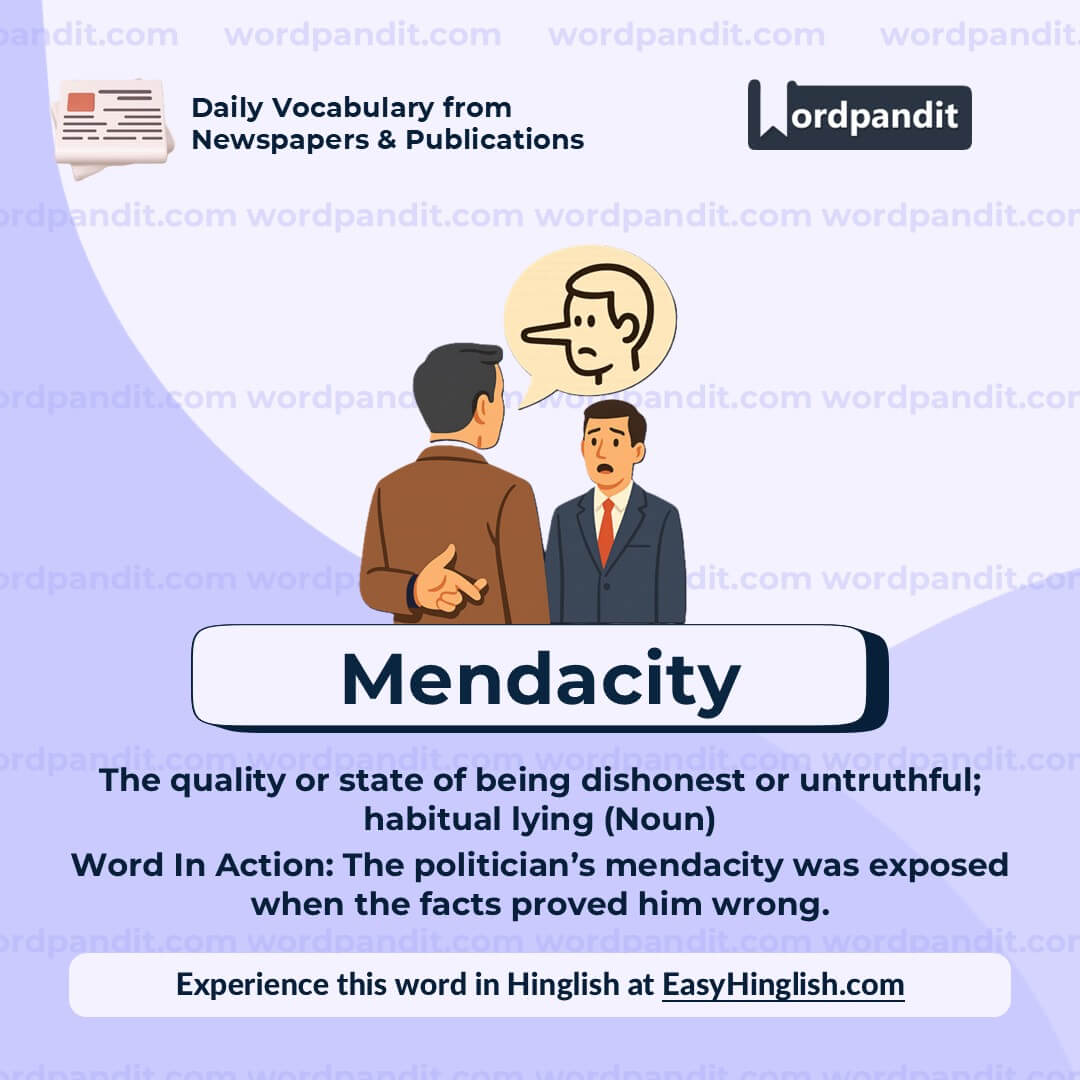
WORD-1: Mendacity
Context:
"Voters punished the party's perceived mendacity during the campaign." - The Washington Post
Explanatory Paragraph:
Mendacity meaning in English is the quality of being untruthful or dishonest, especially in a deliberate and habitual way. This word is used when describing persistent lying or deception, particularly in politics, business, or public life. How to use mendacity effectively depends on understanding that it suggests not just casual dishonesty but a deeper pattern of falsehood. Mendacity is commonly found in formal writing, political commentary, newspaper editorials, and competitive exam passages where character flaws or institutional dishonesty are being critiqued.
Meaning: The quality or state of being dishonest or untruthful; habitual lying (Noun)
Pronunciation: men-DA-suh-tee
Difficulty Level: ⭐⭐⭐ Advanced
Etymology: Mendacity comes from Latin 'mendax' meaning 'lying or false,' which itself derives from 'mendum' meaning 'fault or defect.' The word entered English through French in the 1640s, carrying the weight of deliberate and repeated dishonesty rather than simple mistakes or occasional lies. Over time, it has become particularly associated with political and institutional deception.
Prashant Sir's Notes:
Many students confuse mendacity with 'dishonesty'—while both relate to lying, mendacity usage specifically emphasizes a habitual, almost ingrained pattern of deception. The difference between mendacity and dishonesty is that mendacity suggests a deeper moral failing, making it perfect for CAT and GRE Reading Comprehension passages about corrupt politicians or unethical corporations. For UPSC aspirants, mendacity frequently appears in editorials about governance and public accountability—when you see this word in The Hindu or Indian Express, it's signaling serious ethical criticism. In Indian English newspapers, you'll often encounter phrases like "political mendacity" or "corporate mendacity," especially during election seasons or scam investigations.
Synonyms & Antonyms:
Synonyms: dishonesty, untruthfulness, deceit, deception, falsehood, lying, duplicity, fabrication, prevarication, falseness
Antonyms: honesty, truthfulness, integrity, sincerity, frankness, candor
Usage Examples:
- The inquiry committee's report exposed the mendacity of senior officials who had falsified data for years to secure promotions.
- Priya lost all trust in her business partner after discovering the mendacity behind his financial projections and investor promises.
- The opposition leader's speech highlighted the government's mendacity regarding unemployment figures, citing independent research that contradicted official claims.
- After years of his mendacity about working late, Sameer's wife finally discovered he was actually meeting friends at the cricket stadium.
Cultural Reference:
"The film 'Scam 1992' brilliantly portrayed the mendacity of financial institutions during the securities scandal, showing how systemic lying can collapse entire markets." - Commentary on Harshad Mehta's stock market manipulation
Think About It:
In Indian politics and corporate culture, why does mendacity often go unpunished until a major scandal erupts, and what does this say about our accountability systems?
Quick Activity:
Find three recent news headlines from Indian newspapers that could be rewritten using the word "mendacity" to describe political or corporate behavior. Write one sentence for each explaining the mendacity involved.
Memory Tip:
Think of "Mendacity" as "MEN-DA-CITY"—imagine a whole CITY full of MEN who DA (do) nothing but lie. Picture Mumbai or Delhi where everyone in power is constantly lying, and you'll remember mendacity means habitual, widespread dishonesty.
Real-World Application:
In editorial writing and opinion pieces, mendacity is a powerful word for criticizing politicians, corporations, or institutions engaged in systematic deception. Journalists use it when simple words like "lying" feel insufficient to capture the scale and deliberateness of dishonesty. For competitive exam essays on governance, corruption, or business ethics, using "mendacity" demonstrates sophisticated vocabulary while precisely conveying moral condemnation of habitual untruthfulness.
WORD-2: Effulgent
Context:
"An effulgent sunrise greeted marathoners at the quay." - The Washington Post
Explanatory Paragraph:
Effulgent meaning in English is shining brilliantly or radiating intense light and splendor. This word is used when describing something that glows with exceptional brightness or radiance, going beyond merely being bright to suggest almost dazzling luminosity. How to use effulgent correctly involves applying it to sources of light, beauty, or glory that seem to pour forth radiance—like the sun, stars, or metaphorically to describe radiant personalities or moments. Effulgent commonly appears in literary writing, poetry, descriptive passages in competitive exams, and formal prose where vivid imagery is needed.
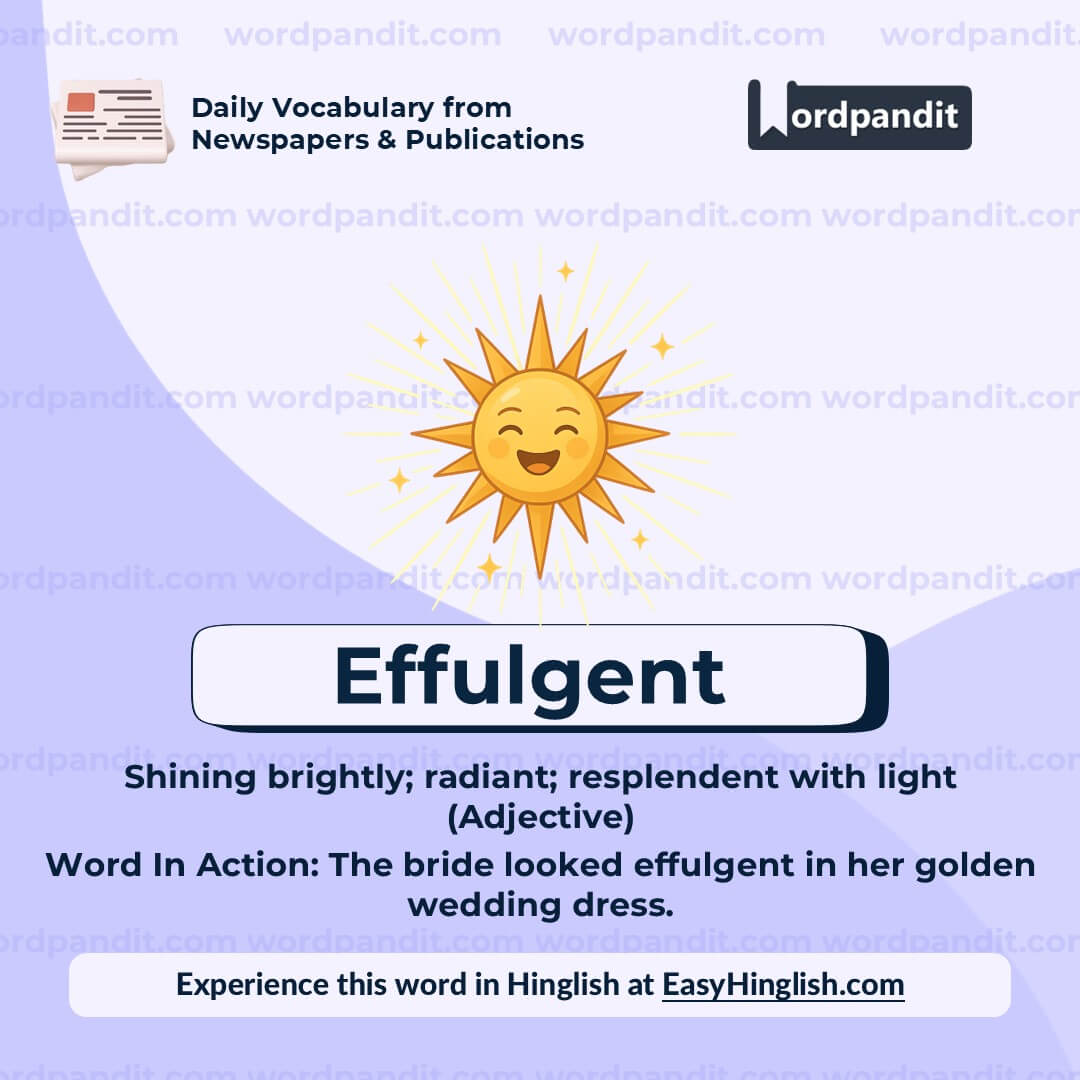
Meaning: Shining brightly; radiant; resplendent with light (Adjective)
Pronunciation: eh-FUL-jent
Difficulty Level: ⭐⭐⭐⭐ Advanced
Etymology: Effulgent comes from Latin 'effulgere,' combining 'ex-' (out) and 'fulgere' (to shine). The word literally means "to shine out" or "to shine forth," capturing the idea of light radiating outward. It entered English in the 18th century as a poetic and elevated term, primarily used in literature to describe extraordinary brightness or radiance that seems to emanate from within.
Prashant Sir's Notes:
Students often ask: what is the difference between effulgent and bright? While "bright" is simple and common, effulgent usage specifically conveys a sense of glorious, almost overwhelming radiance—think of the difference between a regular bulb and the sun at dawn. For CAT and GRE aspirants, effulgent frequently appears in descriptive RC passages where authors paint vivid scenes using elevated vocabulary. In competitive exam essays, using effulgent instead of "bright" or "shining" demonstrates sophisticated language skills, but use it sparingly—only when describing truly spectacular radiance. How to use effulgent in sentences: pair it with naturally radiant things like sunrise, moonlight, jewels, or metaphorically with smiles and personalities. In Indian English writing, you might see "the effulgent Diwali diyas" or "an effulgent performance by the maestro," connecting physical and metaphorical brilliance.
Synonyms & Antonyms:
Synonyms: radiant, resplendent, brilliant, luminous, gleaming, glowing, dazzling, incandescent, lustrous, bright (though less intense)
Antonyms: dim, dull, dark, murky, shadowy, lackluster
Usage Examples:
- The effulgent rangoli outside Meera's house during Diwali caught every neighbor's attention with its bright colors and intricate patterns.
- Kohli's effulgent century at the Wankhede Stadium left spectators mesmerized, as his performance seemed to illuminate the entire ground.
- The bride entered the mandap wearing effulgent gold jewelry that sparkled under the ceremonial lights, creating an almost celestial appearance.
- After months of preparation, Anjali's effulgent presentation at the conference earned her recognition as an emerging thought leader in her field.
Cultural Reference:
"In Rabindranath Tagore's poetry, he often described the Bengali sunrise over the Ganges as effulgent, capturing how the morning light transforms the sacred river into liquid gold." - Reference to Tagore's descriptive imagery
Think About It:
Why do we use words like "effulgent" to describe not just physical light but also moments of joy, success, or beauty in our lives?
Quick Activity:
Write two sentences using "effulgent"—one describing a natural phenomenon you've witnessed in India (sunrise over mountains, Diwali lights, moonlight), and another using it metaphorically to describe someone's talent or personality.
Memory Tip:
Break "Effulgent" into "E-FULL-GENT"—imagine a FULL GENTLEMAN made entirely of light, so bright and radiant that he's not just glowing but FULLY shining. Picture Amitabh Bachchan in a white outfit under stage lights, completely effulgent and commanding attention.
Real-World Application:
Effulgent is particularly valuable in creative writing, descriptive essays, and literary analysis for competitive exams. Travel writers use it to describe spectacular natural scenes—the Taj Mahal at sunrise, Kerala backwaters at golden hour, or Himalayan peaks in morning light. In GRE essay writing or CAT descriptive questions, using "effulgent" instead of common words like "bright" or "beautiful" elevates your vocabulary score while painting more vivid imagery for readers.
WORD-3: Querulous
Context:
"A querulous press conference tested viewers' patience." - The Washington Post
Explanatory Paragraph:
Querulous meaning in English is complaining in an irritating or whining manner, often habitually or about trivial matters. This word is used when describing someone whose tone is persistently petulant, fault-finding, and dissatisfied, going beyond normal criticism to suggest annoying repetition. How to use querulous effectively involves recognizing that it carries a negative judgment—it doesn't just mean someone has complaints, but that their manner of complaining is tiresome and peevish. Querulous commonly appears in character descriptions in literature, behavioral analyses in psychology texts, and critical commentary in newspapers and competitive exam passages.
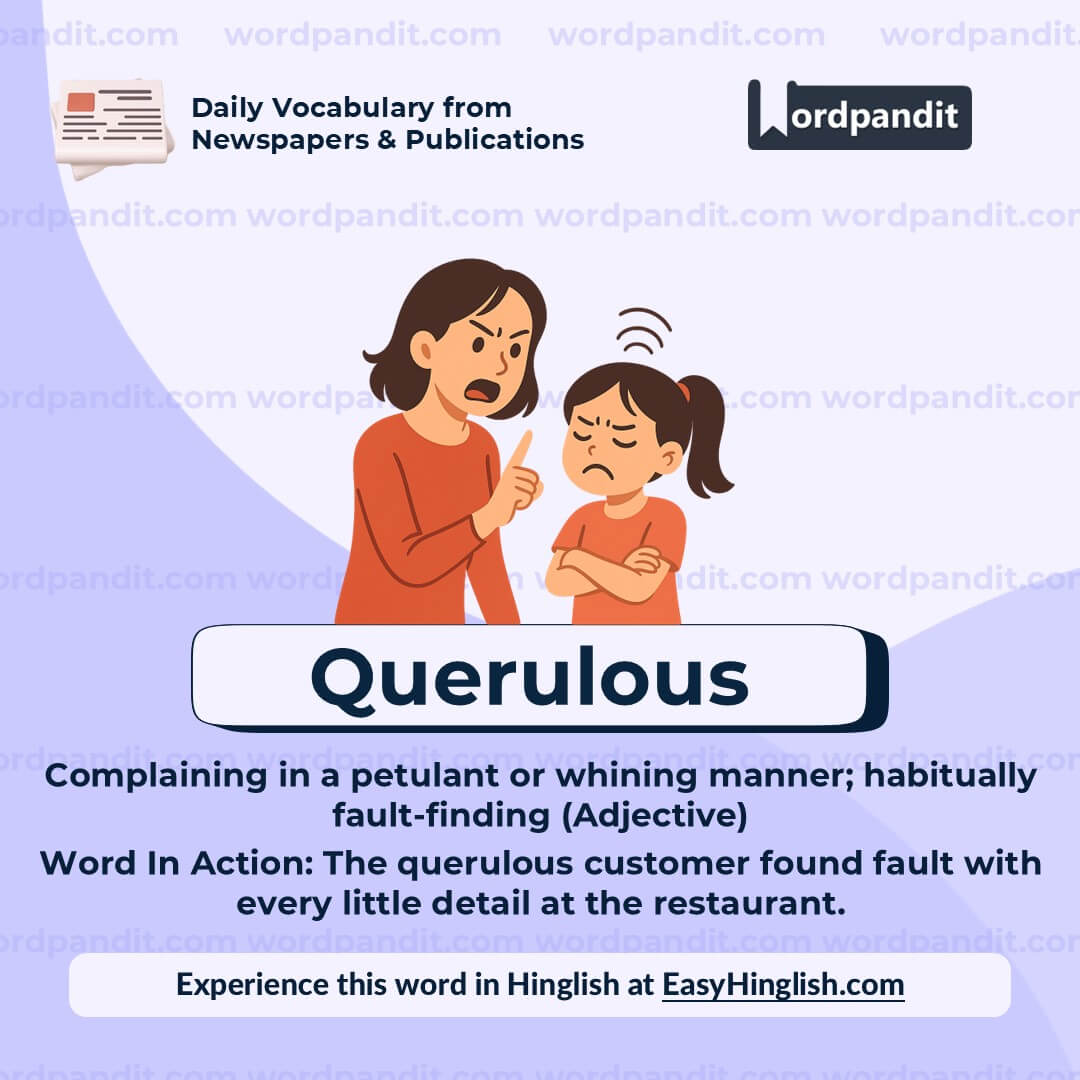
Meaning: Complaining in a petulant or whining manner; habitually fault-finding (Adjective)
Pronunciation: KWER-uh-lus
Difficulty Level: ⭐⭐⭐ Advanced
Etymology: Querulous comes from Latin 'querulus' meaning 'complaining,' which derives from 'queri' meaning 'to complain or lament.' The word entered English in the late 15th century, bringing with it not just the sense of complaint but specifically the irritating, whining quality of persistent fault-finding. Over centuries, it has maintained its negative connotation, suggesting that the complaining is excessive, petty, or delivered in an unpleasant tone.
Prashant Sir's Notes:
Many students confuse querulous with 'critical' or 'questioning'—while all involve expressing dissatisfaction, querulous usage specifically emphasizes the annoying, whining tone of the complaints. The difference between querulous and critical is crucial: a critical person offers constructive analysis, while a querulous person just whines habitually. For GRE and CAT aspirants, querulous frequently appears in character-description passages where authors paint someone as tiresome or difficult. In UPSC essay writing, you might use "querulous opposition" to describe unproductive political criticism that focuses on whining rather than solutions. How to use querulous in Reading Comprehension: when you encounter this word, the author is signaling disapproval of someone's complaining manner—it's always a negative characterization. In Indian English newspapers, especially in political commentary, you'll see phrases like "the querulous tone of the debate" when describing unproductive parliamentary sessions.
Synonyms & Antonyms:
Synonyms: complaining, whining, petulant, peevish, fretful, irritable, grumpy, cantankerous, fault-finding, carping
Antonyms: content, cheerful, satisfied, pleasant, agreeable, uncomplaining
Usage Examples:
- The querulous customer spent twenty minutes complaining about minor issues with his order at the Bangalore restaurant, exhausting the entire staff.
- Sharma Uncle's querulous comments about every decision the housing society made eventually led residents to stop seeking his opinion altogether.
- The film critic's querulous review focused on trivial details like background music volume rather than addressing the movie's actual narrative strengths.
- After a long day at work, Ravi found his mother-in-law's querulous tone about household matters particularly draining and difficult to endure.
Cultural Reference:
"In the sitcom 'Sarabhai vs Sarabhai,' Maya Sarabhai's querulous observations about middle-class habits provided much of the show's humor, though her complaints were delivered with sophisticated sarcasm rather than mere whining." - Analysis of character dynamics in popular Indian television
Think About It:
Why do some people develop a querulous personality over time, and how does constant complaining affect their relationships with family, colleagues, and friends?
Quick Activity:
Think of someone you know who tends to be querulous. Write two sentences describing their behavior using the word, then write one sentence about how you would handle their complaints constructively.
Memory Tip:
Think of "Querulous" as "QUARREL-US"—imagine someone who wants to QUARREL with US about everything in an annoying, whining way. Picture that one relative at family gatherings who complains about the food, the arrangements, the weather, and everything else with a constant whining tone.
Real-World Application:
Querulous is essential vocabulary for character descriptions in essays and creative writing for competitive exams. In workplace communication and HR contexts, it helps describe unproductive employee behavior professionally without using harsh words. For CAT Reading Comprehension, recognizing "querulous" immediately signals the author's negative judgment of a character. In formal reports or performance reviews, using "querulous approach" diplomatically captures persistent complaining behavior that needs addressing.
WORD-4: Salubrious
Context:
"Urban planners tout salubrious green corridors." - The Washington Post
Explanatory Paragraph:
Salubrious meaning in English is health-giving or promoting health and well-being, particularly referring to climate, environment, or living conditions. This word is used when describing places, conditions, or practices that contribute positively to physical or mental health. How to use salubrious correctly involves applying it to environments like mountain air, coastal climates, green spaces, or healthy lifestyles rather than to medicine or treatments. Salubrious commonly appears in urban planning documents, environmental writing, travel literature, and competitive exam passages discussing public health and quality of life.
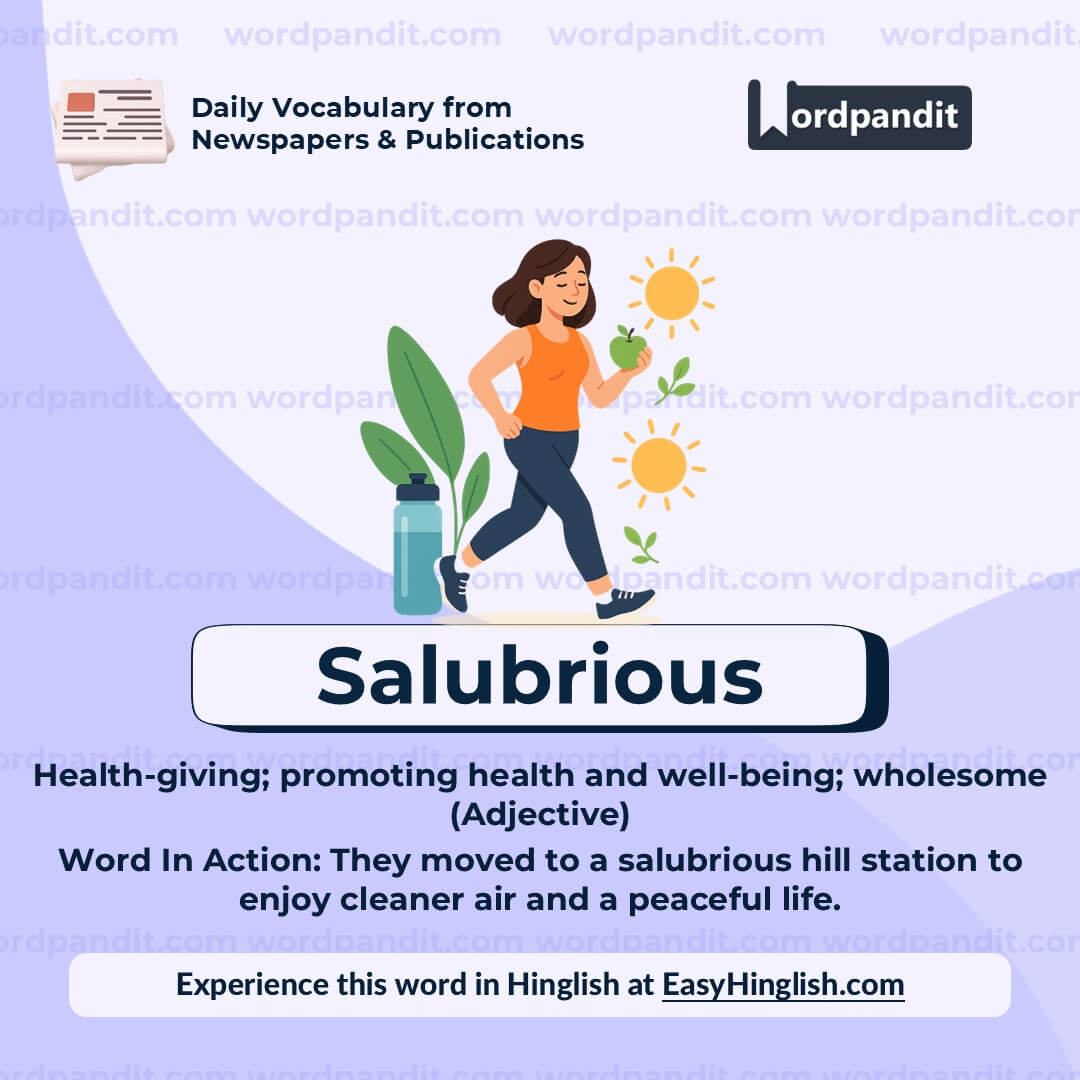
Meaning: Health-giving; promoting health and well-being; wholesome (Adjective)
Pronunciation: suh-LOO-bree-us
Difficulty Level: ⭐⭐⭐ Advanced
Etymology: Salubrious comes from Latin 'salubris' meaning 'promoting health,' which derives from 'salus' meaning 'health or welfare.' The word entered English in the 16th century, particularly used to describe climates and locations believed to promote good health. Interestingly, 'salus' also gave us words like 'salutation' (wishing someone good health) and 'salute,' connecting health wishes with greetings across languages.
Prashant Sir's Notes:
Many students confuse salubrious with 'healthy'—while both relate to health, salubrious usage specifically describes environments, climates, or conditions that promote health rather than describing someone's physical state. The difference between salubrious and healthy is that you would say "healthy person" but "salubrious climate." For CAT and GRE aspirants, salubrious frequently appears in passages about urban development, environmental policy, or wellness tourism where the focus is on health-promoting spaces. In UPSC essays on sustainable development or public health, using "salubrious living conditions" demonstrates sophisticated vocabulary while discussing quality of life indicators. How to use salubrious for competitive exams: it's perfect for describing hill stations, coastal areas, parks, clean air zones, and wellness retreats. In Indian English newspapers, you'll often see "salubrious environs" when discussing smart cities or planned townships like Lavasa or Auroville that emphasize environmental health.
Synonyms & Antonyms:
Synonyms: healthful, wholesome, healthy, beneficial, health-giving, invigorating, restorative, sanitary, hygienic, salutary
Antonyms: unhealthy, unwholesome, insalubrious, noxious, harmful, detrimental, unhygienic
Usage Examples:
- Many Bengaluru tech professionals escape to the salubrious climate of Coorg on weekends, seeking relief from the city's pollution and stress.
- The government's Smart Cities Mission aims to create salubrious urban environments with adequate green spaces, clean air, and pedestrian-friendly infrastructure.
- Dr. Mehta recommended that his patient spend a month in the salubrious hill station of Shimla to recover from respiratory issues.
- The residential complex advertised its salubrious features including rooftop gardens, jogging tracks, and pollution-free zones to attract health-conscious buyers.
Cultural Reference:
"During the British Raj, hill stations like Ooty and Darjeeling were established as salubrious retreats where colonial officials escaped the oppressive summer heat of the plains, inadvertently creating India's first wellness tourism destinations." - Historical context of Indian hill stations
Think About It:
As Indian cities grow increasingly polluted and crowded, how can we ensure that salubrious living environments remain accessible to all citizens, not just the wealthy?
Quick Activity:
List three locations in India that you consider salubrious and explain in one sentence each what makes them health-giving. Then describe one change your own city could make to become more salubrious.
Memory Tip:
Think of "Salubrious" as "SALUTE-BREEZY-US"—imagine standing in a clean, breezy environment so healthy that you want to SALUTE it! Picture yourself in Manali or Munnar with fresh mountain air, where every breath makes you feel healthier and you naturally want to salute the salubrious surroundings.
Real-World Application:
Salubrious is invaluable in real estate marketing, urban planning reports, and environmental impact assessments where describing health-promoting features adds professional credibility. Travel writers use it extensively when describing wellness destinations, hill stations, and eco-resorts. For competitive exam essays on urbanization, public health, or sustainable development, "salubrious" demonstrates nuanced vocabulary while discussing quality of life. In business proposals for residential or hospitality projects, using "salubrious environment" elevates the presentation beyond simple terms like "healthy place."
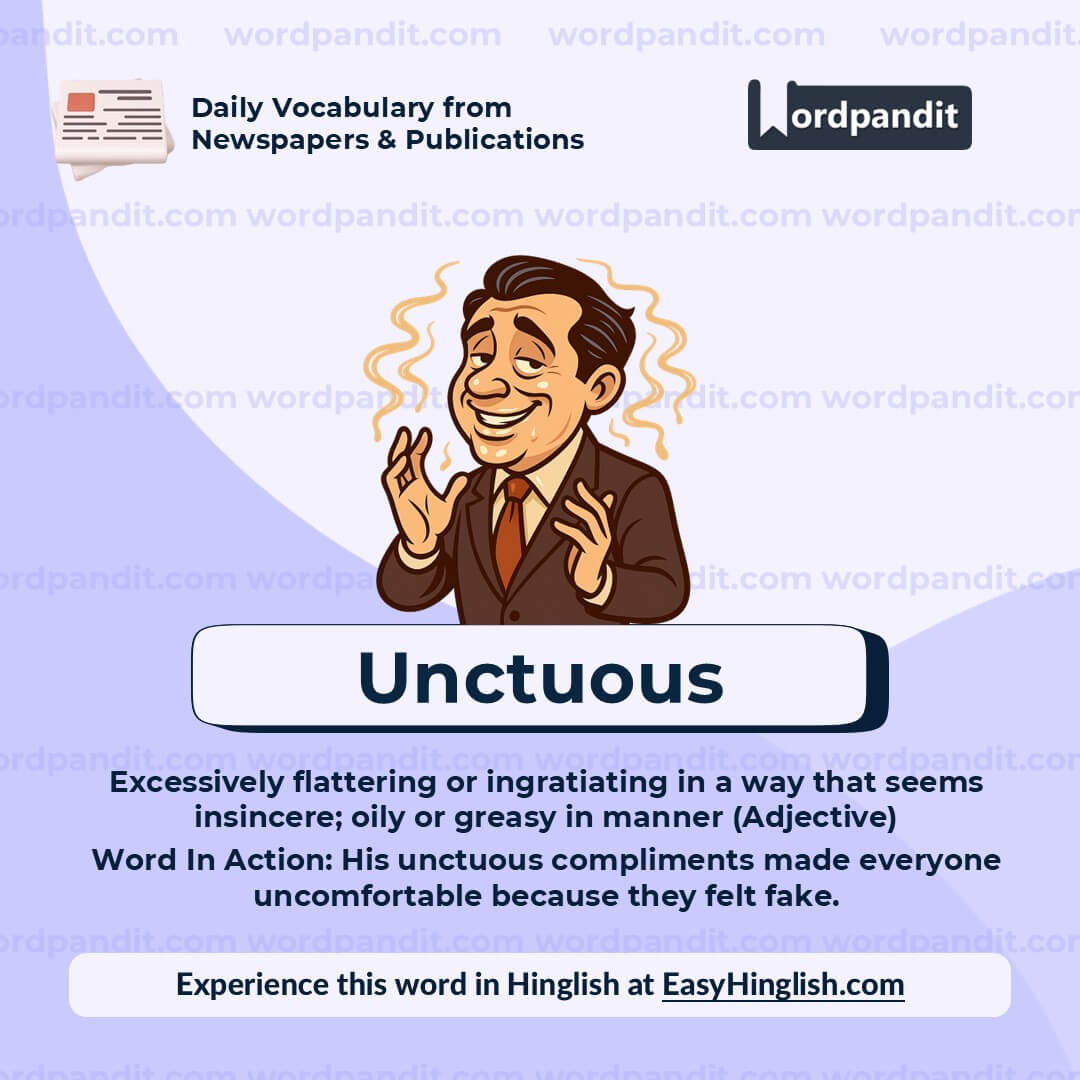
WORD-5: Unctuous
Context:
"An unctuous apology failed to quell outrage." - The Washington Post
Explanatory Paragraph:
Unctuous meaning in English is excessively flattering or ingratiating in a way that seems insincere or oily. This word is used when describing behavior, speech, or manner that appears overly smooth, fawning, or sycophantic, suggesting false charm or manipulative politeness. How to use unctuous effectively involves recognizing that it always carries a negative judgment—it describes someone trying too hard to please in a way that feels fake or sleazy. Unctuous commonly appears in character descriptions in literature, political commentary, business writing about deceptive practices, and competitive exam passages analyzing manipulative behavior.
Meaning: Excessively flattering or ingratiating in a way that seems insincere; oily or greasy in manner (Adjective)
Pronunciation: UNK-choo-us
Difficulty Level: ⭐⭐⭐⭐ Advanced
Etymology: Unctuous comes from Latin 'unctum' meaning 'anointed' or 'greased,' from 'unguere' meaning 'to anoint or smear with oil.' The word originally referred to oily or greasy substances in the 14th century. By the 17th century, it evolved metaphorically to describe people whose manner was as slippery and smooth as oil—suggesting false sincerity and manipulative charm. This connection between physical oiliness and slippery character has persisted in English.
Prashant Sir's Notes:
Students often ask: what is the difference between unctuous and polite? While polite behavior is genuinely respectful, unctuous usage describes excessive, insincere politeness that feels manipulative. The difference between unctuous and flattering is crucial for GRE and CAT Reading Comprehension—flattery can be genuine, but unctuous always implies falsehood. For competitive exam aspirants, unctuous frequently appears in passages critiquing politicians, salespeople, or characters who use fake charm to manipulate others. How to use unctuous in sentences: it typically describes manner, tone, smile, apology, or praise—things that can be excessively smooth. In Indian English newspapers, especially during election coverage, you'll encounter "unctuous campaign promises" or "unctuous corporate statements" when journalists expose insincere public relations efforts. For UPSC essay writing on ethics or governance, "unctuous bureaucrats" perfectly captures officials who are overly deferential to superiors but dismissive to ordinary citizens.
Synonyms & Antonyms:
Synonyms: obsequious, sycophantic, ingratiating, oily, smarmy, fawning, servile, groveling, flattering (in a false way), slick
Antonyms: sincere, genuine, frank, candid, straightforward, honest, blunt
Usage Examples:
- The salesman's unctuous manner made Priya uncomfortable as he praised every decision she made while clearly trying to close the deal.
- After the controversy, the minister's unctuous public statement full of flowery language failed to address the actual corruption allegations against him.
- Rajesh couldn't stand his colleague's unctuous behavior toward the boss, constantly complimenting him while criticizing the same decisions behind his back.
- The real estate agent's unctuous assurances about the property's "pristine condition" crumbled when the inspection revealed major structural issues.
Cultural Reference:
"In the film '3 Idiots,' the character Chatur exemplifies unctuous behavior with his excessively flattering speeches to the director, using borrowed words he doesn't understand—a perfect example of insincere, slippery charm designed purely for personal advancement." - Analysis of character manipulation in Bollywood
Think About It:
Why do people resort to unctuous behavior in professional and social settings, and how can we distinguish between genuine politeness and manipulative insincerity?
Quick Activity:
Write two sentences describing unctuous behavior you've observed—perhaps in advertisements, political speeches, or workplace interactions. Then write one sentence about how you would respond to such behavior.
Memory Tip:
Think of "Unctuous" as "UNCLE-UOUS"—imagine that overly sweet UNCLE at weddings who gives exaggerated compliments that feel fake and oily, like he's been dipped in ghee! His excessive praise slides off you like oil because you know it's completely insincere. Remember: unctuous = oily and fake.
Real-World Application:
Unctuous is essential vocabulary for analyzing persuasive communication, marketing tactics, and political rhetoric in competitive exam essays. Journalists use it to critique insincere corporate apologies, hollow political promises, or manipulative advertising campaigns. In GRE and CAT Reading Comprehension passages, identifying "unctuous" immediately reveals the author's critical stance toward a character or statement. For business communication and consumer awareness writing, describing something as unctuous helps readers recognize manipulative sales tactics or false sincerity in public relations.


