Daily Vocabulary from International Newspapers and Publications
Expand Your Vocabulary with Wordpandit’s Global Vocabulary Hub
At Wordpandit, we are committed to helping you develop a truly global vocabulary by drawing from some of the most respected international publications. This section is designed to keep you ahead of the curve by introducing you to words that define global conversations and trends.
The Power of Global Sources
To help you think and communicate on a global scale, we curate vocabulary from renowned international sources, such as:
- The New York Times
- The Washington Post
- BBC
- The Guardian
- The Economist
- Scientific American
- Psychology Today
- And many more...
Stay Global, Stay Competitive
Our daily updates from international publications ensure you are consistently exposed to new words that reflect global news and developments, making sure your vocabulary is not only current but also globally relevant.
Enhance Your Global Perspective
Whether you’re preparing for international exams, aiming to excel in global business communication, or want to enhance your language skills for personal growth, Wordpandit offers the resources you need to thrive in a global context.
Effective Learning, Global Reach
Our learning methodology combines global examples, memory aids, and interactive activities, allowing you to internalize new words effectively and apply them in real-world scenarios.
Begin Your Global Vocabulary Journey Now!

Why Choose Wordpandit?
Practical Learning: Focus on words you'll actually encounter in real-world reading, enhancing your comprehension and communication skills.
Diverse Content: From current affairs to scientific breakthroughs, our varied sources expose you to vocabulary across multiple domains.
Effortless Integration: Make Wordpandit a part of your daily routine. Just a few minutes each day can significantly boost your lexicon over time.
Your Path to Vocabulary Mastery
- Visit our Daily Vocabulary section regularly
- Explore new words and their usage in context
- Practice incorporating these words into your own writing and speech
- Track your progress as your vocabulary expands
Start Your Journey Today
Embark on your vocabulary enhancement journey with Wordpandit. By consistently engaging with our daily posts, you'll build a robust vocabulary that serves you well in academic, professional, and personal contexts.
Remember, a word a day keeps linguistic limitations at bay. Make Wordpandit your daily companion in the quest for vocabulary excellence!
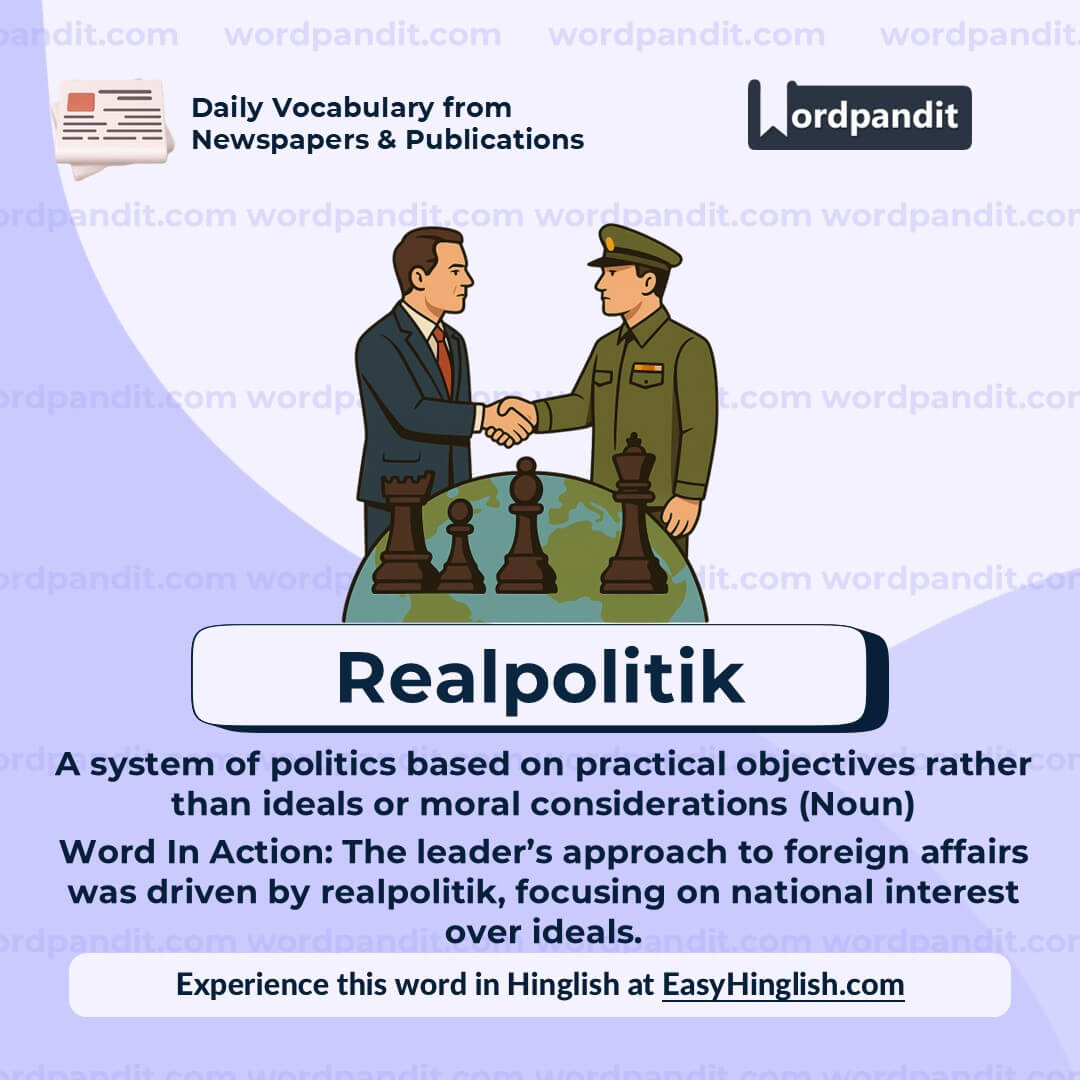
WORD-1: Realpolitik
Context:
"The alliance's shift reflects realpolitik more than shared values." - The New York Times
Explanatory Paragraph:
Realpolitik meaning in English is a practical approach to politics based on power and national interests rather than moral principles or ideologies. This word is used when describing political decisions driven by practical considerations and strategic advantages instead of ethical concerns or theoretical ideals. How to use realpolitik becomes clear in discussions of international relations, diplomacy, and competitive exam passages on political science, where it signals pragmatic decision-making that prioritizes results over values.
Meaning: A system of politics based on practical objectives rather than ideals or moral considerations (Noun)
Pronunciation: ree-AHL-poh-lee-teek
Difficulty Level: ⭐⭐⭐⭐ Advanced
Etymology: Realpolitik comes directly from German, combining 'real' (realistic or practical) with 'politik' (politics). The term was coined in 19th-century Germany to describe Otto von Bismarck's pragmatic approach to unifying Germany through calculated alliances and strategic wars rather than liberal idealism. It entered English political vocabulary to describe any politics divorced from moral considerations and focused purely on practical outcomes and national interests.
Prashant Sir's Notes:
Many students confuse realpolitik with practical politics, but the difference between realpolitik and pragmatism is crucial—realpolitik specifically involves setting aside moral or ethical considerations entirely for strategic gains. For UPSC aspirants, realpolitik frequently appears in international relations passages describing India's balancing act between traditional allies and emerging partnerships. In Indian newspaper editorials, you'll often see realpolitik usage when analyzing India's relationships with countries like Russia, USA, and China, where strategic interests override ideological alignments. The phrase "realpolitik demands" is your signal that morality is being sacrificed for practical advantage.
Synonyms & Antonyms:
Synonyms: pragmatism, practical politics, power politics, political realism, realism, expediency, opportunism, Machiavellianism, strategic pragmatism, interest-based politics
Antonyms: idealism, moralism, principled politics, ethical governance, value-based diplomacy, ideological purity
Usage Examples:
- India's decision to continue oil imports from Russia despite Western sanctions exemplifies realpolitik, prioritizing economic stability over diplomatic pressure.
- The Prime Minister's outreach to rival nations was pure realpolitik, setting aside historical grievances to secure strategic trade agreements and border security.
- In the corporate world, Sunita's alliance with her former competitor was criticized as realpolitik, but it saved both companies from bankruptcy.
- Professor Mehta explained that realpolitik has always guided India's non-aligned movement, balancing relationships with both superpowers during the Cold War era.
Cultural Reference:
"In cricket diplomacy between India and Pakistan, realpolitik often trumps hostility—when strategic interests align, even historic rivals find common ground on the field." - Commentary on India-Pakistan cricket relations
Think About It:
Can a democracy truly practice realpolitik without betraying the ethical values it claims to represent, or is strategic compromise necessary for national survival?
Quick Activity:
Find two recent news headlines about India's foreign policy decisions and identify which ones reflect realpolitik. Write one sentence explaining why practical interests outweighed moral considerations in each case.
Memory Tip:
Think of "REAL-politik" as "REAL politics"—not the idealistic politics of textbooks, but the REAL messy world where countries do what benefits them most, regardless of what's morally right. Imagine a politician saying "Let's be REAL here" before making a ruthless but practical decision.
Real-World Application:
Realpolitik is commonly used in newspaper editorials, international relations analysis, and UPSC essays to describe pragmatic foreign policy decisions that prioritize national interests over ideological consistency. In business journalism, the term appears when companies form unexpected alliances or make ethically questionable decisions for market dominance. For competitive exam passages, recognizing realpolitik helps identify authors' critiques of purely interest-based decision-making in governance and diplomacy.
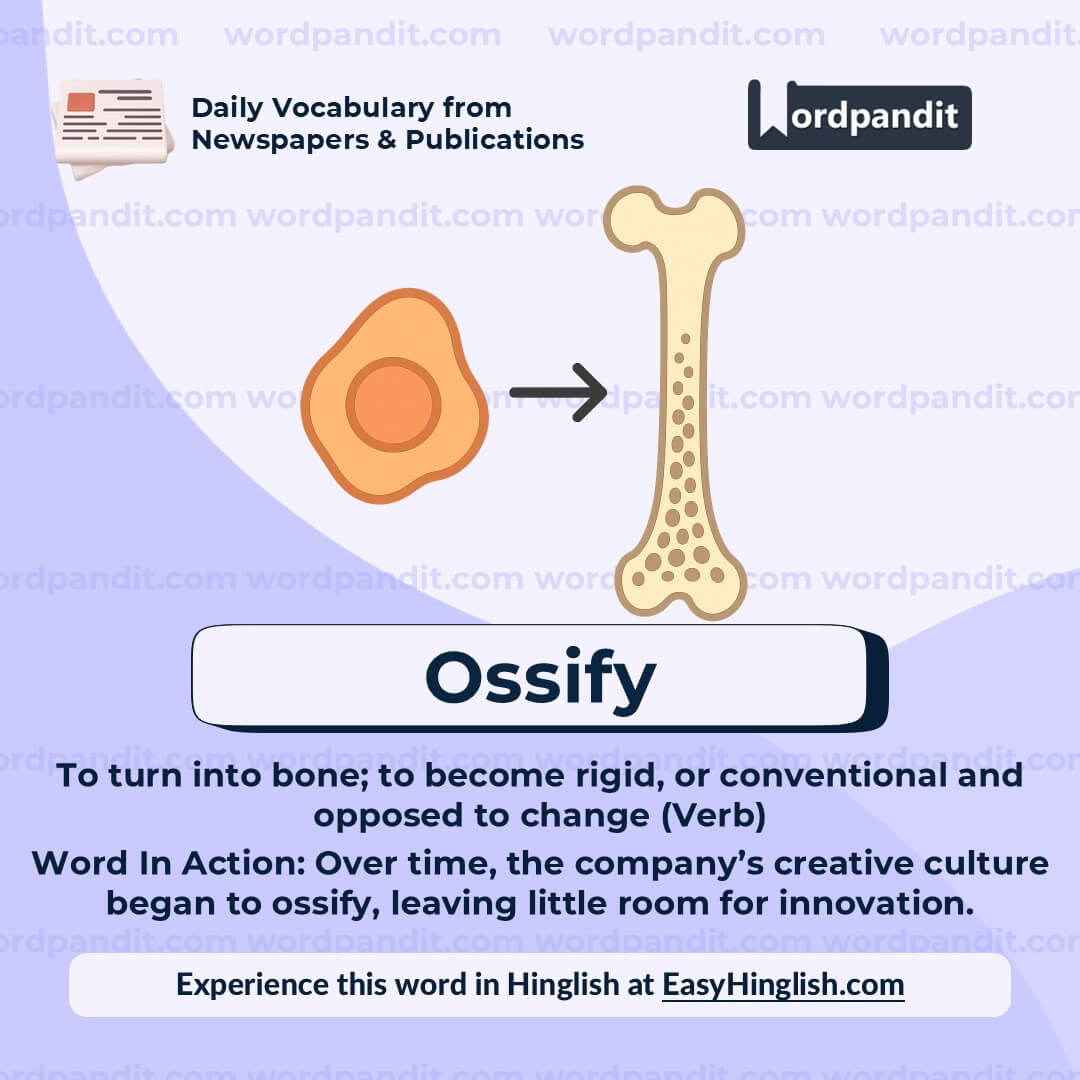
WORD-2: Ossify
Context:
"Without reform, the party risks an ossified hierarchy." - The Times
Explanatory Paragraph:
Ossify meaning in English is to become rigid, inflexible, or unable to change, like bones hardening with age. This word is used when describing systems, ideas, or organizations that have become fixed and resistant to adaptation or innovation. Ossify is commonly used in formal writing, political analysis, and competitive exam passages to describe institutions or thinking patterns that have lost their flexibility and dynamism, making them outdated or ineffective in changing circumstances.
Meaning: To turn into bone; to become rigid, or conventional and opposed to change (Verb)
Pronunciation: AH-sih-fy
Difficulty Level: ⭐⭐⭐ Intermediate
Etymology: Ossify comes from Latin 'os' meaning 'bone' combined with the suffix '-fy' meaning 'to make or become.' Originally a medical term describing the biological process of cartilage turning into bone, the word evolved metaphorically in the 19th century to describe ideas, institutions, or attitudes becoming rigid and inflexible. The connection between physical hardening and mental inflexibility made it a powerful metaphor in political and social commentary.
Prashant Sir's Notes:
Students often ask: what is the difference between ossify and stagnate? While both suggest lack of progress, ossify specifically emphasizes becoming rigid and unable to change, whereas stagnate means simply not moving forward. For CAT and GRE aspirants, ossify frequently appears in passages criticizing outdated institutions or bureaucratic systems. How to use ossify correctly: it works best with abstract nouns like traditions, hierarchies, thinking, or systems. In Indian English newspapers, you'll see phrases like "ossified bureaucracy" or "ossified social structures" when discussing resistance to reform in government departments or caste-based practices that refuse to evolve with modern times.
Synonyms & Antonyms:
Synonyms: harden, rigidify, petrify, fossilize, calcify, stiffen, become inflexible, crystallize, set in stone, become hidebound
Antonyms: evolve, adapt, modernize, reform, flex, change, innovate, transform, rejuvenate, revitalize
Usage Examples:
- The Indian education system has ossified over decades, still relying on rote memorization while the world has moved toward critical thinking and skill-based learning.
- Ramesh worried that staying in the same job for twenty years would ossify his thinking and make him irrelevant in the rapidly changing tech industry.
- Many traditional businesses ossified during the pandemic, unable to adapt to digital models, while agile startups thrived by embracing change.
- The company's ossified corporate culture, with its rigid hierarchies and resistance to new ideas, drove away talented young professionals seeking innovation.
Cultural Reference:
"Bollywood's storytelling risks becoming ossified if it continues to recycle the same formulas—audiences now demand fresh narratives that reflect contemporary India." - Film critic's commentary on evolving cinema
Think About It:
Which aspects of Indian society have ossified to the point where they actively harm progress, and what would it take to make them flexible again?
Quick Activity:
Identify one tradition or practice in your community that has ossified and write two sentences explaining how it could be reformed to remain relevant while respecting its original purpose.
Memory Tip:
Remember "OSSI-fy" by thinking of "BONES-ify"—just as your bones (os in Latin) harden and become rigid as you age, ideas and institutions ossify when they become old, hard, and inflexible. Imagine an old bone that cannot bend—that's exactly what happens to ossified thinking!
Real-World Application:
Ossify is commonly used in editorial writing, business analysis, and organizational management discussions to critique systems that have become resistant to necessary change. In UPSC essays and CAT reading comprehension passages, the term appears when authors discuss institutional reform, bureaucratic inefficiency, or social progress. Journalists use "ossified" to describe political parties, government departments, or corporate structures that cling to outdated practices despite changing circumstances, making it essential vocabulary for understanding contemporary policy debates.
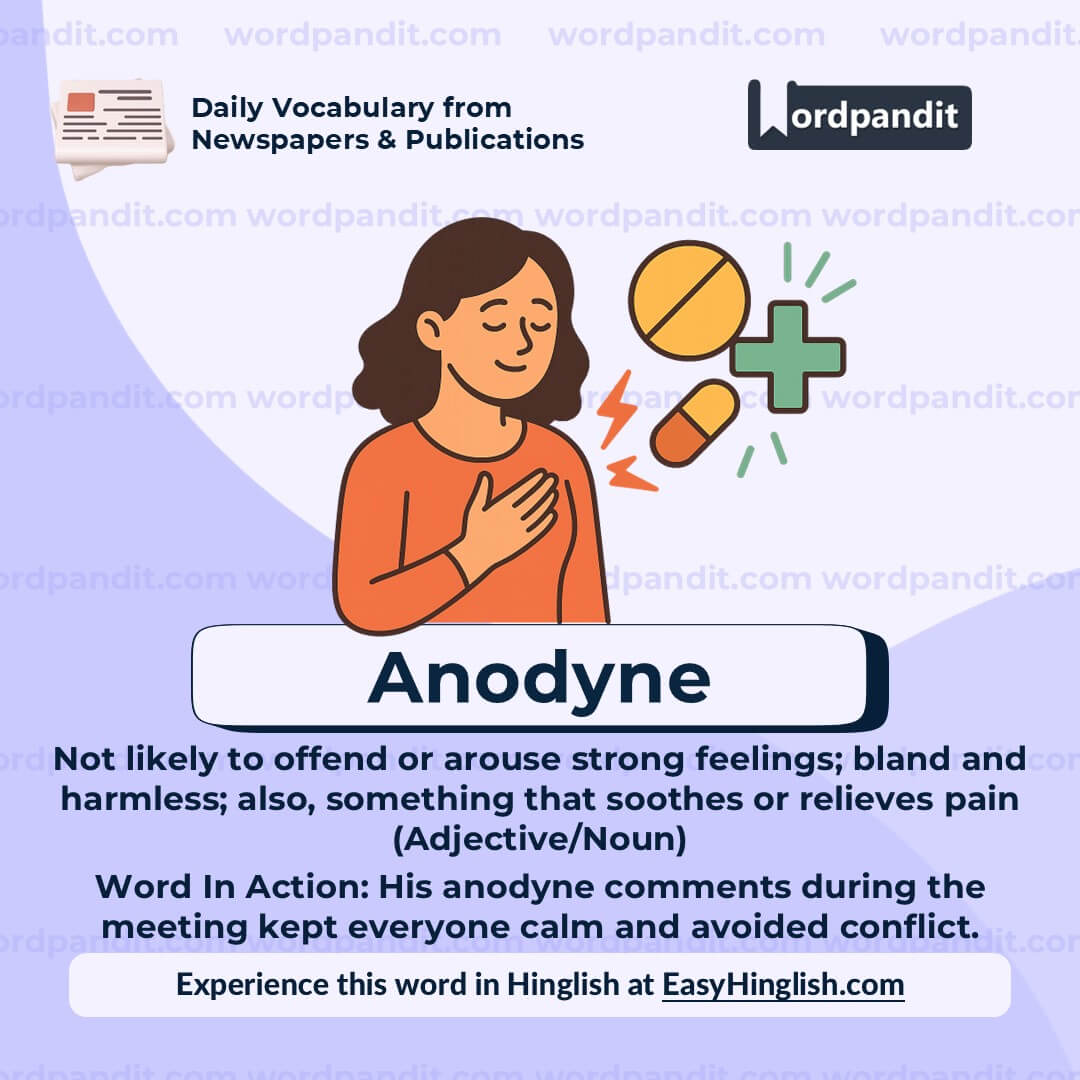
WORD-3: Anodyne
Context:
"The communiqué's anodyne language masked deep divisions." - The Washington Post
Explanatory Paragraph:
Anodyne meaning in English is bland, inoffensive, and unlikely to provoke disagreement or cause offense, often deliberately so. This word is used when describing statements, language, or content that has been made so neutral and non-controversial that it loses meaningful substance. Anodyne is commonly used in political commentary, media analysis, and competitive exam passages to describe diplomatic statements, corporate communications, or public speeches that avoid taking any strong position to prevent controversy or conflict.
Meaning: Not likely to offend or arouse strong feelings; bland and harmless; also, something that soothes or relieves pain (Adjective/Noun)
Pronunciation: AN-uh-dyne
Difficulty Level: ⭐⭐⭐⭐ Advanced
Etymology: Anodyne comes from Greek 'anodynos,' combining 'an-' (without) and 'odyne' (pain), literally meaning "without pain." Originally used in medicine to describe pain-relieving substances, the word evolved metaphorically in the 19th century to describe anything that soothes or avoids causing distress. In modern usage, it has acquired a somewhat negative connotation, suggesting that something is so carefully neutral that it becomes meaningless or unhelpfully bland, particularly in political or corporate contexts.
Prashant Sir's Notes:
Many students confuse anodyne with neutral, but the difference between anodyne and neutral is that anodyne carries a critical undertone—it suggests something is excessively bland to the point of being unhelpful or evasive. For GRE and CAT aspirants, anodyne frequently appears in passages analyzing political rhetoric or corporate speak where strong stances are avoided. How to use anodyne correctly: it typically modifies words like statement, response, comments, or language. In Indian English newspapers, you'll see "anodyne remarks" when analyzing government responses to controversies—when officials say something that sounds meaningful but actually commits to nothing. The anodyne usage signals that real issues are being glossed over with safe, meaningless words.
Synonyms & Antonyms:
Synonyms: bland, innocuous, inoffensive, harmless, mild, neutral, safe, unremarkable, uncontroversial, pallid, insipid, vapid
Antonyms: provocative, controversial, bold, incendiary, inflammatory, sharp, pointed, combative, confrontational, challenging
Usage Examples:
- The minister's anodyne statement on unemployment failed to address the anger of millions of jobless youth demanding concrete policy action.
- After the data breach scandal, the company CEO issued an anodyne apology that acknowledged no specific wrongdoing and promised vague "improvements."
- Priya's presentation was so anodyne that despite its polished delivery, no one could remember a single meaningful point she made about the marketing strategy.
- The film's anodyne approach to caste discrimination, avoiding any real critique, disappointed audiences expecting bold social commentary from the acclaimed director.
Cultural Reference:
"When cricket boards issue anodyne statements about 'looking into' match-fixing allegations without naming anyone or promising action, fans know it's just damage control, not accountability." - Sports journalism commentary
Think About It:
Why do politicians and corporate leaders prefer anodyne language when addressing serious issues, and does this approach ultimately help or harm public trust?
Quick Activity:
Find a recent political statement or corporate press release online and rewrite one anodyne sentence to make it more direct and meaningful, actually committing to a specific position or action.
Memory Tip:
Think of "AN-AVOID-yne"—statements that AVOID taking any real stance or causing any discomfort. Or remember that anodyne originally meant painkiller, so anodyne language is designed to "kill the pain" of controversy by being so bland that nobody can object to it—but also nobody gains anything from it!
Real-World Application:
Anodyne is commonly used in political analysis, media criticism, and business journalism to describe statements that deliberately avoid substance or controversy. In UPSC essay writing and CAT reading comprehension passages, the term appears when authors critique evasive communication by governments or corporations facing scandals. Editorial writers use "anodyne response" or "anodyne remarks" to signal that officials are dodging accountability with safe, meaningless language. Understanding anodyne helps decode when public figures are saying much while committing to nothing.

WORD-4: Demarche
Context:
"Paris issued a formal demarche over the missile test." - The Times
Explanatory Paragraph:
Demarche meaning in English is a formal diplomatic representation or protest made by one government to another regarding a specific issue. This word is used when describing official channels of communication in international relations where one country registers its concerns, objections, or demands with another. Demarche is commonly used in news articles covering foreign policy, diplomatic reporting, and competitive exam passages on international relations, signaling a serious but measured step in diplomatic protocol short of severing relations or taking hostile action.
Meaning: A formal diplomatic statement, protest, or initiative; a course of action in diplomacy (Noun)
Pronunciation: day-MARSH or dih-MARCH
Difficulty Level: ⭐⭐⭐⭐ Advanced
Etymology: Demarche comes from French 'démarche,' literally meaning 'a step' or 'a walk,' derived from 'démarcher' (to take steps). The word entered diplomatic vocabulary in the 18th century to describe the formal steps taken by one nation to communicate with another through official channels. It retained its French spelling and pronunciation in English, reflecting its origins in European diplomatic protocol. The term emphasizes the procedural and formal nature of diplomatic communication, distinguishing official government-to-government communication from informal discussions.
Prashant Sir's Notes:
Students often ask: what is the difference between demarche and protest? While both involve objection, a demarche is specifically a formal diplomatic communication through official channels, often delivered by an ambassador to a foreign ministry. For UPSC aspirants preparing for international relations, demarche for competitive exams signals escalation in diplomatic tensions without military action. In Indian English newspapers, you'll see phrases like "India summoned the Pakistani High Commissioner to issue a demarche" after cross-border incidents. How to use demarche: it's typically preceded by verbs like "issue," "deliver," "lodge," or "present." When you see demarche usage in exam passages about diplomacy, it indicates countries are using formal mechanisms to express displeasure while keeping communication channels open.
Synonyms & Antonyms:
Synonyms: diplomatic protest, formal representation, official communication, diplomatic note, formal objection, representation, diplomatic initiative, official complaint, diplomatic step
Antonyms: informal chat, casual conversation, silent acceptance, diplomatic approval, endorsement, agreement
Usage Examples:
- India delivered a strong demarche to the Chinese embassy after PLA troops were spotted in disputed border areas near Ladakh, demanding immediate withdrawal.
- The Ministry of External Affairs summoned the British High Commissioner to lodge a demarche protesting remarks about India's internal affairs made by UK parliamentarians.
- Following the arrest of Indian fishermen, the government issued a demarche to Sri Lanka seeking their immediate release and compensation for damages.
- Professor Sharma explained that a demarche is often the first formal step in diplomatic escalation, allowing countries to register displeasure before considering economic sanctions or military responses.
Cultural Reference:
"When Pakistan's Foreign Secretary was summoned for a demarche after the Uri attack, the diplomatic protocol remained intact even as tempers flared—a reminder that even in conflict, nations follow established rules of engagement." - Analysis of India-Pakistan diplomatic relations
Think About It:
Why do countries maintain the formality of demarches even during serious conflicts when everyone knows the real negotiations happen through back channels?
Quick Activity:
Search today's news for any recent diplomatic incident involving India and identify whether a demarche was issued. Write two sentences explaining what triggered it and what message it conveyed.
Memory Tip:
Remember "de-MARCH" as a diplomatic MARCH to someone's embassy—imagine an ambassador formally marching to the foreign ministry to deliver an official complaint. The word sounds like "march" because it's about taking formal steps in diplomacy. Think: "They de-marched to deliver the message!"
Real-World Application:
Demarche is commonly used in international news reporting, diplomatic cables, and foreign policy analysis to describe formal government-to-government communications. In UPSC mains answers on international relations and CAT passages about global affairs, the term signals escalating diplomatic tensions managed through official channels. Journalists covering India's foreign policy use demarche when reporting on border disputes with China, Pakistan's cross-border terrorism, or Western criticism of domestic policies. Understanding this term helps decode the severity and formal nature of diplomatic incidents in news analysis.
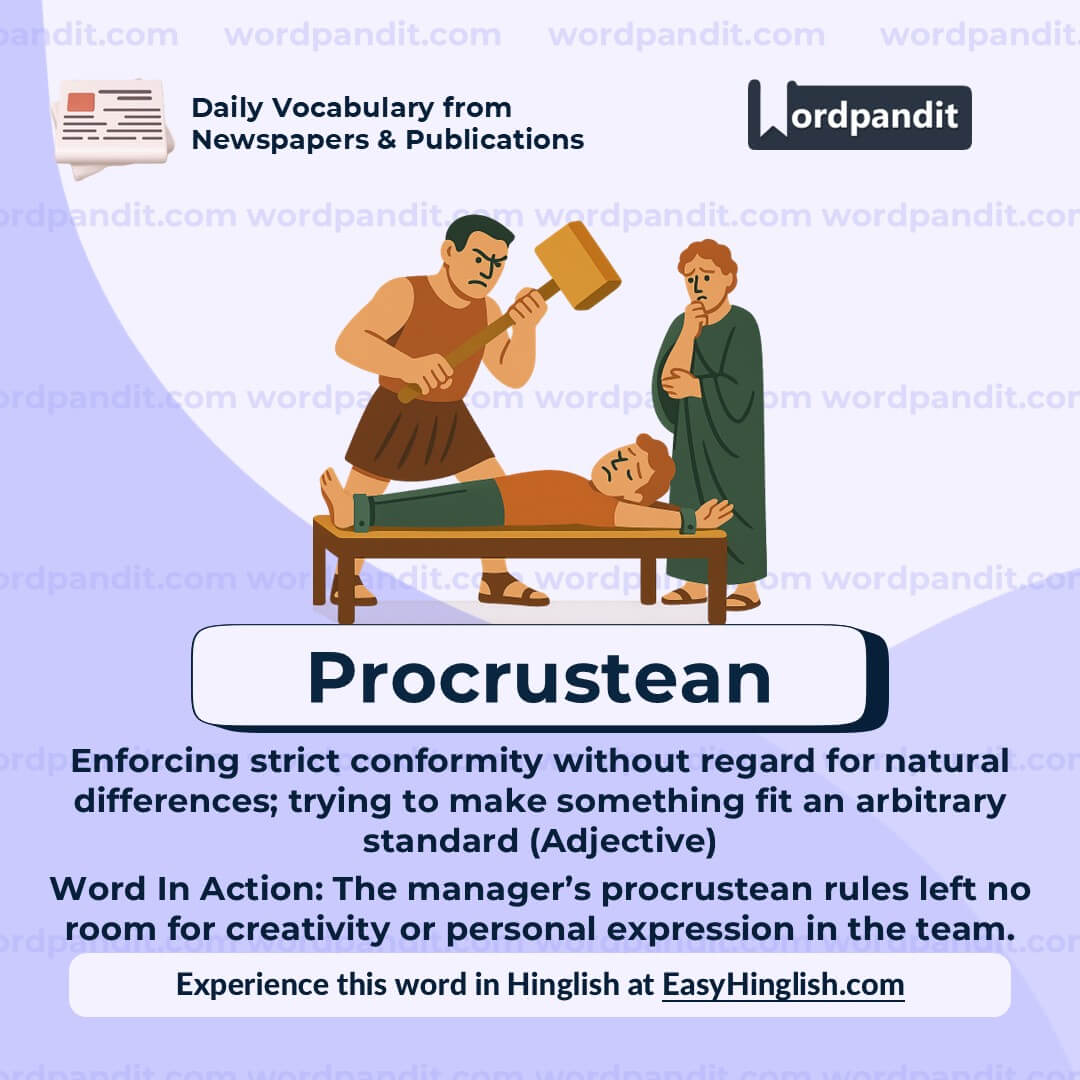
WORD-5: Procrustean
Context:
"A procrustean quota risks stifling regional autonomy." - The Washington Post
Explanatory Paragraph:
Procrustean meaning in English is enforcing uniformity or conformity without regard for natural variation or individuality, often by violent or arbitrary means. This word is used when describing systems, rules, or approaches that force everything to fit one rigid standard, cutting off or stretching what doesn't naturally fit. Procrustean is commonly used in academic writing, policy criticism, and competitive exam passages to describe inflexible frameworks that ignore diversity and context, making it particularly relevant for discussing one-size-fits-all solutions that harm rather than help.
Meaning: Enforcing strict conformity without regard for natural differences; trying to make something fit an arbitrary standard (Adjective)
Pronunciation: proh-KRUS-tee-uhn
Difficulty Level: ⭐⭐⭐⭐ Advanced
Etymology: Procrustean comes from Greek mythology, specifically from Procrustes, a villainous innkeeper who offered hospitality to travelers. He had an iron bed and would force guests to fit it exactly—stretching short people on a rack and cutting off the limbs of tall people. The hero Theseus eventually killed Procrustes using his own method. The word entered English in the 19th century as a powerful metaphor for any system that forces conformity by violently disregarding natural differences. It's one of the most vivid examples of mythology enriching our vocabulary with precise descriptive power.
Prashant Sir's Notes:
Many students confuse procrustean with strict or rigid, but the difference between procrustean and rigid is crucial—procrustean specifically means forcing artificial uniformity on things that are naturally different. For CAT and GRE reading comprehension, procrustean frequently appears in passages critiquing standardized testing, uniform policies, or centralized planning that ignores local contexts. How to use procrustean correctly: it works with words like approach, method, policy, standards, or framework. In Indian English newspapers, you'll see "procrustean policies" when discussing one-size-fits-all solutions like uniform GST rates for all states or standardized curricula ignoring regional linguistic diversity. The procrustean usage for UPSC essays signals that diversity is being sacrificed for artificial uniformity—think of how British colonial administration forced uniform laws across diverse Indian regions.
Synonyms & Antonyms:
Synonyms: rigid, inflexible, arbitrary, draconian, ruthless, one-size-fits-all, cookie-cutter, standardizing, conformist, uncompromising
Antonyms: flexible, adaptive, accommodating, tailored, customized, individualized, context-sensitive, nuanced, diverse, pluralistic
Usage Examples:
- The procrustean education policy mandating identical curriculum across tribal, rural, and urban schools ignores vastly different learning contexts and student needs throughout India.
- Applying Silicon Valley's work culture as a procrustean standard for all Indian startups fails to account for different market realities, resources, and employee expectations.
- Critics argued that the procrustean reservation quota fixed at the same percentage for all states disregarded their unique demographic compositions and historical inequalities.
- Rajesh found his company's procrustean performance evaluation system frustrating because it judged creative roles by the same metrics as sales positions, ignoring fundamental differences in their work.
Cultural Reference:
"Bollywood's procrustean formula of hero-villain-romance forced every regional story into the same mold until OTT platforms allowed diverse narratives to flourish in their natural forms." - Commentary on evolution of Indian cinema
Think About It:
Where in Indian society do we see procrustean approaches forcing artificial uniformity, and what valuable diversity are we losing in the process?
Quick Activity:
Identify one procrustean policy or rule in your school, workplace, or government that forces everyone into the same mold. Write two sentences explaining what natural differences it ignores and how it could be made more flexible.
Memory Tip:
Remember "Pro-CRUST-ean" by imagining a pizza chef who forces every topping to fit the CRUST exactly—cutting off pepperoni that hangs over and stretching small pieces to cover gaps. Just as Procrustes forced travelers to fit his bed by stretching or cutting them, procrustean policies force everyone to fit one rigid standard, no matter how unnatural!
Real-World Application:
Procrustean is commonly used in policy analysis, educational reform debates, and organizational management critiques to describe systems that enforce rigid uniformity. In UPSC mains essays on federalism, diversity, or decentralization, the term effectively critiques centralized policies that ignore regional variations. CAT reading comprehension passages use procrustean when discussing standardization versus customization in business or education. Editorial writers employ "procrustean approach" or "procrustean standards" to argue against one-size-fits-all solutions in healthcare, education, or economic policy, making it essential vocabulary for nuanced policy discussions.