

Daily Vocabulary from International Newspapers and Publications
Expand Your Vocabulary with Wordpandit’s Global Vocabulary Hub
At Wordpandit, we are committed to helping you develop a truly global vocabulary by drawing from some of the most respected international publications. This section is designed to keep you ahead of the curve by introducing you to words that define global conversations and trends.
The Power of Global Sources
To help you think and communicate on a global scale, we curate vocabulary from renowned international sources, such as:
- The New York Times
- The Washington Post
- BBC
- The Guardian
- The Economist
- Scientific American
- Psychology Today
- And many more...
Stay Global, Stay Competitive
Our daily updates from international publications ensure you are consistently exposed to new words that reflect global news and developments, making sure your vocabulary is not only current but also globally relevant.
Enhance Your Global Perspective
Whether you’re preparing for international exams, aiming to excel in global business communication, or want to enhance your language skills for personal growth, Wordpandit offers the resources you need to thrive in a global context.
Effective Learning, Global Reach
Our learning methodology combines global examples, memory aids, and interactive activities, allowing you to internalize new words effectively and apply them in real-world scenarios.
Begin Your Global Vocabulary Journey Now!

Why Choose Wordpandit?
Practical Learning: Focus on words you'll actually encounter in real-world reading, enhancing your comprehension and communication skills.
Diverse Content: From current affairs to scientific breakthroughs, our varied sources expose you to vocabulary across multiple domains.
Effortless Integration: Make Wordpandit a part of your daily routine. Just a few minutes each day can significantly boost your lexicon over time.
Your Path to Vocabulary Mastery
- Visit our Daily Vocabulary section regularly
- Explore new words and their usage in context
- Practice incorporating these words into your own writing and speech
- Track your progress as your vocabulary expands
Start Your Journey Today
Embark on your vocabulary enhancement journey with Wordpandit. By consistently engaging with our daily posts, you'll build a robust vocabulary that serves you well in academic, professional, and personal contexts.
Remember, a word a day keeps linguistic limitations at bay. Make Wordpandit your daily companion in the quest for vocabulary excellence!
WORD-1: Fentanyl
Context:
"Separately, Mr. Trump said he would cut in half 20 percent tariffs he had imposed on Chinese goods to pressure China to do more to control fentanyl trafficking." - New York Times
Explanatory Paragraph:
Fentanyl meaning in English is a powerful synthetic opioid drug that is 50 to 100 times stronger than morphine and is used medically for severe pain but has become a major substance in illegal drug trafficking. How to use fentanyl in sentences typically involves discussions about drug policy, public health crises, or law enforcement efforts. Fentanyl is commonly mentioned in news articles about the opioid epidemic, international drug trafficking, and border security issues, making it relevant for competitive exam aspirants studying current affairs for UPSC, CAT reading comprehension passages, or general awareness sections in Bank PO and SSC exams.
Meaning: A synthetic opioid pain medication that is extremely potent and often involved in drug overdoses and illegal trafficking (Noun)
Pronunciation: FEN-tuh-nil
Difficulty Level: ⭐⭐⭐ Intermediate
Etymology: Fentanyl was first synthesized in 1959 by Belgian chemist Paul Janssen. The name is derived from the chemical structure, combining "phenyl" (a chemical group) with modifications to create this synthetic compound. Originally developed as a powerful medical painkiller for surgery and cancer treatment, the word entered mainstream vocabulary in the 2010s as illegal fentanyl manufacturing became a global crisis, particularly affecting North America.
Prashant Sir's Notes:
For UPSC and competitive exam aspirants, fentanyl frequently appears in current affairs related to Indo-US relations, international drug cartels, and border security discussions. Many students ask: what is the difference between fentanyl and other opioids like morphine or heroin? The key distinction is potency—fentanyl is exponentially more powerful, which makes it extremely dangerous but also explains why it dominates illegal drug markets. In Indian newspapers, you'll often see fentanyl usage in sentences about international cooperation on drug control, particularly in contexts discussing China's role in precursor chemical exports. Understanding this term is crucial because it appears in geopolitical passages about US-China relations and global health crises in RC sections.
Synonyms & Antonyms:
Related Terms: synthetic opioid, narcotic, painkiller, controlled substance, illicit drug, pharmaceutical opioid
Opposite Context: natural remedy, non-addictive medication, over-the-counter drug, safe painkiller
Usage Examples:
- The Indian government has tightened regulations on pharmaceutical companies to prevent illegal fentanyl production within the country's borders.
- US border authorities seized a major shipment of fentanyl being smuggled from Mexico, highlighting the ongoing crisis.
- Public health experts warn that fentanyl contamination in other street drugs has made recreational drug use exponentially more dangerous.
- During the bilateral talks, the Indian and American delegations discussed cooperation on controlling precursor chemicals used in fentanyl manufacturing.
Cultural Reference:
"The fentanyl crisis has become America's deadliest drug epidemic, claiming over 70,000 lives annually and driving diplomatic pressure on manufacturing source countries." - Global health policy discussions
Think About It:
Why has fentanyl become the focal point of international diplomatic tensions between major powers, and how does drug policy intersect with trade relations?
Quick Activity:
Read today's newspaper and identify one article mentioning fentanyl or drug trafficking. Write a two-sentence summary explaining the geopolitical context involved.
Memory Tip:
Think of "FEN-tuh-nil" as "FATAL-nil"—remember that this synthetic drug is so powerful that even a tiny amount can be fatal, which is why it dominates news about drug overdoses and international trafficking.
Real-World Application:
Fentanyl is commonly used in international relations articles, public health reports, law enforcement briefings, and geopolitical analyses to discuss drug policy, border security, and diplomatic pressure between nations. For competitive exam aspirants, understanding this term is essential when analyzing RC passages about US-China relations, global health crises, or contemporary challenges in international cooperation. The word signals discussions about synthetic drug manufacturing, cross-border trafficking networks, and the intersection of public health policy with international diplomacy.
WORD-2: Truce
Context:
"China's Ministry of Commerce announced that President Trump and Xi Jinping had agreed to a one-year extension of the truce that the two countries had put in place earlier this year after tit-for-tat escalations drove up tariffs on each other's imports to more than 100 percent." - New York Times
Explanatory Paragraph:
Truce meaning in English is a temporary agreement to stop fighting or conflict, often used in contexts of war, disputes, or competitions. This word is used when opposing parties agree to pause hostilities without necessarily resolving the underlying issues permanently. How to use truce correctly involves understanding that it implies a temporary cessation rather than a permanent peace. Truce is commonly used in news articles about international relations, trade wars, military conflicts, and diplomatic negotiations, making it essential vocabulary for UPSC, CAT reading comprehension, GRE, and current affairs sections in competitive exams.
Meaning: A temporary agreement between enemies or opponents to stop fighting or arguing for a certain period (Noun)
Pronunciation: TROOS
Difficulty Level: ⭐⭐ Basic to Intermediate
Etymology: Truce comes from Middle English 'trewe' and Old English 'trēow,' meaning faith or pledge, which traces back to Proto-Germanic roots related to trust and belief. Historically, truces were formalized agreements between warring armies to temporarily stop combat, often to collect the dead or negotiate terms. The word evolved to encompass any temporary cessation of conflict, from medieval battlefield agreements to modern diplomatic and trade disputes, maintaining its core meaning of a time-limited pause in hostilities.
Prashant Sir's Notes:
Many students confuse truce with peace treaty—the difference between truce and peace treaty is crucial for competitive exams. A truce is temporary and tactical, while a peace treaty is a permanent, formal resolution. For CAT and UPSC aspirants, truce frequently appears in passages about international trade disputes, ceasefire agreements, and diplomatic negotiations. In Indian English newspapers, you'll often see "truce between rival parties" or "electoral truce" during sensitive political periods. The usage of truce in sentences typically signals that underlying tensions remain unresolved—this is your clue in RC passages that the conflict may resume. Remember: truce equals temporary timeout, not permanent solution.
Synonyms & Antonyms:
Synonyms: ceasefire, armistice, peace agreement, suspension of hostilities, temporary peace, moratorium, standstill, détente
Antonyms: conflict, warfare, hostilities, battle, confrontation, aggression
Usage Examples:
- India and Pakistan declared a temporary truce along the Line of Control to facilitate humanitarian relief operations during the natural disaster.
- The two rival companies called a truce in their price war after both suffered significant financial losses in the market.
- During Diwali, the feuding neighbors agreed to a truce so that their children could celebrate together without tension.
- The cricket board negotiated a truce between the warring state associations to ensure the domestic season could proceed smoothly.
Cultural Reference:
"In the famous Christmas Truce of 1914, soldiers from opposing trenches temporarily stopped fighting to celebrate together—a powerful reminder that humanity can transcend conflict." - Historical accounts of World War I
Think About It:
Why do truces often fail to become permanent peace agreements, and what does this tell us about the nature of unresolved conflicts in international relations?
Quick Activity:
Write two sentences describing a situation from your own life or current news where opposing parties agreed to a temporary truce without resolving the underlying disagreement.
Memory Tip:
Think of "TRUCE" as "TRUE-CEASE"—it's a TRUE CEASEfire, but remember it's only temporary. Imagine two cricket teams agreeing to pause their rivalry during a rain break—the competition isn't over, just paused.
Real-World Application:
Truce is commonly used in international news coverage, diplomatic communications, business negotiations, and conflict analysis to describe temporary cessations in disputes without permanent resolution. In competitive exam essays and reading comprehension passages, understanding this term is essential when analyzing geopolitical tensions, trade wars, or military conflicts. Writers use truce to signal that underlying issues remain unresolved and hostilities may resume, making it a key word for identifying the author's perspective on whether a conflict has truly ended or merely paused.
WORD-3: Retaliatory
Context:
"A readout from China did not say what agreements were made on Thursday but did allude to China's recent retaliatory measures such as a move to cut off supplies of critical minerals." - New York Times
Explanatory Paragraph:
Retaliatory meaning in English is characterized by the act of responding to an attack or injury by inflicting similar harm in return, essentially seeking revenge or payback. This word is used when describing actions taken specifically in response to perceived wrongs or hostile acts by others. How to use retaliatory in sentences involves contexts where one party strikes back after being attacked first, whether in trade, military action, or diplomatic relations. Retaliatory is commonly used in news articles about international trade disputes, military conflicts, legal proceedings, and business competition, making it crucial vocabulary for UPSC international relations, CAT reading comprehension passages, GRE, and current affairs sections in Bank PO and SSC exams.
Meaning: Characterized by a desire to harm someone in return for an injury or wrong they have caused; involving retaliation or revenge (Adjective)
Pronunciation: rih-TAL-ee-uh-tor-ee
Difficulty Level: ⭐⭐⭐ Intermediate
Etymology: Retaliatory comes from the Latin word 'retaliare,' meaning 'to pay back in kind,' which itself is formed from 're-' (back) and 'talis' (such). The concept entered English through Medieval Latin 'retaliatio' in the early 17th century during a period when legal and military terminology was heavily influenced by Latin. The word evolved from its original legal context of "an eye for an eye" justice to encompass any reciprocal hostile action in diplomacy, trade, warfare, or personal disputes, maintaining its core meaning of striking back in response to an initial harm.
Prashant Sir's Notes:
For competitive exam aspirants, retaliatory frequently appears in passages about trade wars, military conflicts, and diplomatic tensions—particularly in India-Pakistan relations or US-China dynamics. Students often ask: what is the difference between retaliatory and preemptive? Retaliatory actions are responses to something that already happened, while preemptive actions are taken to prevent something from happening. In Indian newspapers, you'll see "retaliatory tariffs," "retaliatory strikes," or "retaliatory measures" whenever one country responds to another's hostile action. The usage of retaliatory in sentences always implies a cause-and-effect sequence—someone acted first, and this is the payback. For UPSC international relations, understanding this word helps you identify escalation cycles in conflicts where each side keeps responding to the other's moves.
Synonyms & Antonyms:
Synonyms: vengeful, reciprocal, punitive, vindictive, counterstrike, responsive, payback-oriented, revenge-seeking, reprisal-based
Antonyms: conciliatory, forgiving, peaceful, accommodating, non-responsive, passive, unprovoked
Usage Examples:
- India imposed retaliatory tariffs on American goods after the United States increased duties on Indian steel and aluminum exports.
- The company filed a retaliatory lawsuit against its former employee who had first sued them for wrongful termination.
- Pakistan's military announced retaliatory airstrikes following the cross-border incident, escalating tensions in the region significantly.
- Priya faced retaliatory action from her manager after she reported workplace harassment to the human resources department.
Cultural Reference:
"In cricket, a bouncer is often seen as a retaliatory delivery after a batsman has hit the bowler for consecutive boundaries—a psychological battle within the rules." - Cricket commentary tradition
Think About It:
Why do retaliatory actions often lead to endless cycles of conflict rather than resolution, and how can nations or individuals break free from this pattern?
Quick Activity:
Find one example from current news where a country or organization took retaliatory measures against another. Write two sentences explaining what triggered the retaliation and what form it took.
Memory Tip:
Break "Retaliatory" into "RE-TALI-ATORY"—think "RE-TALLY-ATORY" where you're keeping a TALLY and going back (RE) to settle the score. Like Dhoni hitting a six after being sledged by opposition players—that's retaliatory batting!
Real-World Application:
Retaliatory is commonly used in international relations articles, trade policy reports, military briefings, legal documents, and business news to describe actions taken specifically in response to previous hostile moves. For competitive exam aspirants, this term is essential when analyzing RC passages about trade wars, military escalations, or diplomatic disputes where understanding the sequence of actions—who struck first and who struck back—is crucial to comprehending the passage's logic. Writers use retaliatory to signal a reactive rather than initiating action, helping readers identify cause-and-effect relationships in complex conflicts.
WORD-4: Afloat
Context:
"President Trump has been pressuring countries to stop buying oil from Russia, which uses energy sales to keep its economy afloat and fund its military." - New York Times
Explanatory Paragraph:
Afloat meaning in English is floating on water without sinking, or more commonly in figurative usage, managing to survive financially or operationally despite difficulties. This word is used when describing something or someone that is barely managing to continue existing or functioning, especially in economic or business contexts. How to use afloat in sentences typically involves discussions about financial survival, economic stability, or literally staying on the surface of water. Afloat is commonly used in business journalism, economic reports, financial analysis, and metaphorical descriptions in competitive exam passages for CAT, GRE, UPSC, and Bank PO, where understanding figurative language is essential.
Meaning: Floating on water; or figuratively, managing to survive or continue despite financial or operational difficulties (Adjective/Adverb)
Pronunciation: uh-FLOAT
Difficulty Level: ⭐⭐ Basic to Intermediate
Etymology: Afloat comes from Old English 'on flote,' combining 'a-' (meaning 'on' or 'in') and 'float' (from Old English 'flotian,' meaning to rest on water). Originally used only in its literal maritime sense of ships staying above water, the word developed its metaphorical meaning in the 18th century during the expansion of maritime trade when staying afloat became synonymous with business survival. The figurative use emerged from the parallel between a sinking ship and a failing business, making it a perfect economic metaphor that persists in modern financial journalism.
Prashant Sir's Notes:
Many students confuse afloat with prosperous or thriving—but the difference between afloat and thriving is significant for RC comprehension. Afloat means barely surviving, just managing to avoid failure, while thriving means doing extremely well. For CAT and GRE aspirants, afloat usage in passages signals struggle and difficulty, not success. In Indian English newspapers, you'll frequently see "keeping businesses afloat" during economic downturns or "staying afloat amid competition." When you encounter afloat for UPSC or Bank PO exams, it indicates financial stress or challenging circumstances. Think of it this way: a boat afloat isn't sailing smoothly—it's just not sinking yet. This subtle distinction changes your understanding of passage tone completely.
Synonyms & Antonyms:
Synonyms: surviving, solvent, operational, functioning, staying alive, in business, above water (figurative), managing, sustaining
Antonyms: sinking, failing, bankrupt, collapsed, underwater (figurative), insolvent, defunct
Usage Examples:
- Many small businesses in Mumbai struggled to stay afloat during the pandemic lockdown without government support or customer traffic.
- The airline industry required massive bailout packages to keep major carriers afloat amid travel restrictions and plummeting demand.
- Rajesh took a second job to keep his family afloat after his company reduced salaries by thirty percent.
- The coaching institute barely stayed afloat by shifting to online classes when physical centers were forced to shut down.
Cultural Reference:
"Like the Indian cricket team staying afloat in a tough tournament—not dominating, but surviving match by match until they find their rhythm." - Sports commentary metaphor
Think About It:
When businesses or economies are described as staying afloat, does this suggest resilience and determination, or does it reveal underlying systemic weaknesses that need addressing?
Quick Activity:
Write two sentences about a business, person, or country that is currently struggling to stay afloat. Use the word both literally and figuratively in your examples.
Memory Tip:
Think of "A-FLOAT" as "A boat that FLOATs"—but just barely! Imagine a boat with a small leak that's still floating but taking on water. That's exactly what "staying afloat" means economically—surviving, but barely, just like that leaky boat hasn't sunk yet.
Real-World Application:
Afloat is commonly used in economic journalism, business reports, financial analyses, and policy discussions to describe entities that are managing to survive despite significant challenges. For competitive exam aspirants, understanding this term is essential when analyzing RC passages about economic crises, business struggles, or government interventions, as it signals precarious survival rather than prosperity. Writers use afloat to convey that while complete failure has been avoided, the situation remains fragile and uncertain, helping readers gauge the severity of economic or financial challenges being discussed.
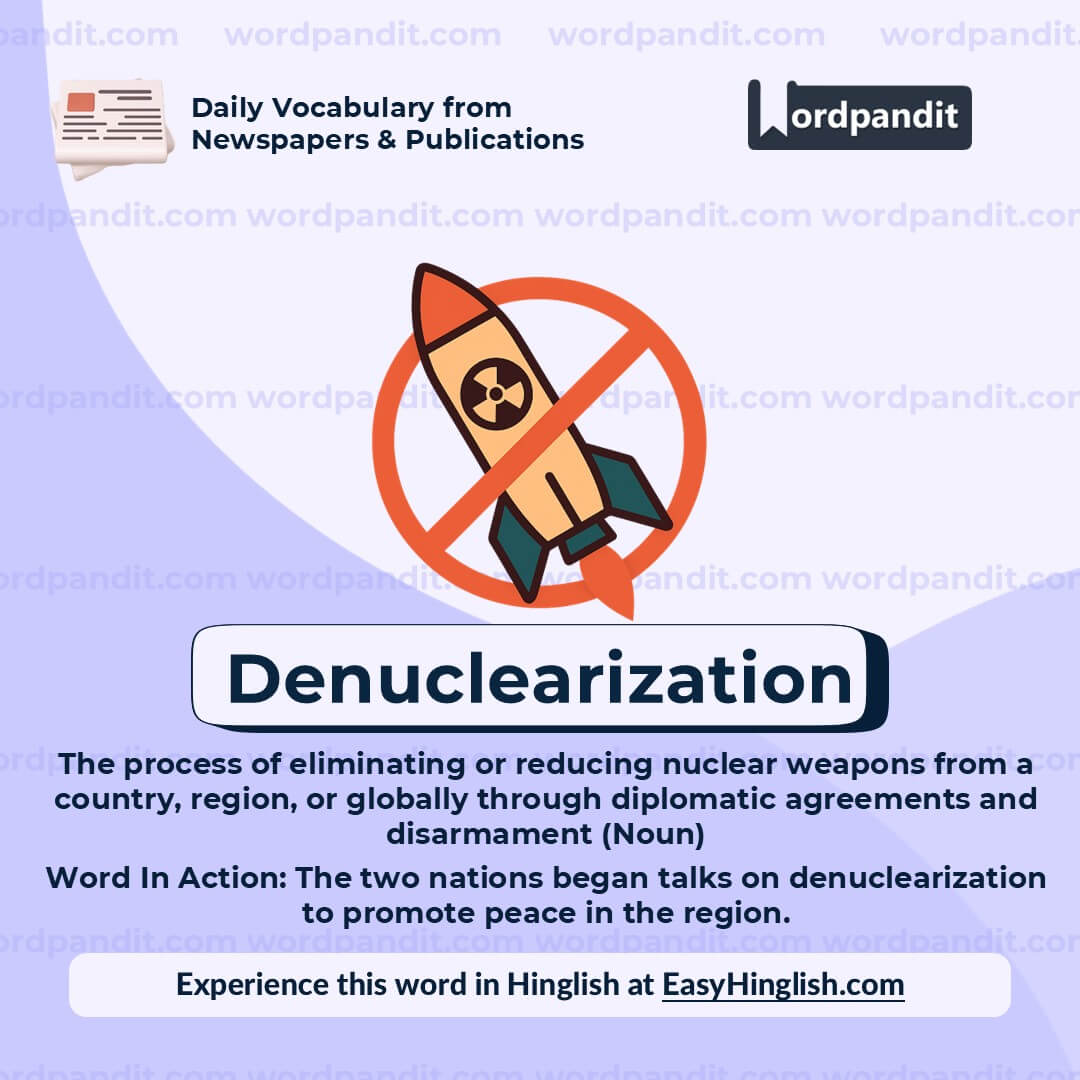
WORD-5: Denuclearization
Context:
"'I think we have it pretty well locked up,' Trump said, adding that he would 'like to see a denuclearization.'" - New York Times
Explanatory Paragraph:
Denuclearization meaning in English is the process of removing or eliminating nuclear weapons from a country, region, or the entire world, often through diplomatic negotiations and international treaties. This word is used when describing efforts to reduce or completely dismantle nuclear arsenals, either unilaterally or through multilateral agreements. How to use denuclearization correctly involves understanding that it refers specifically to nuclear weapons removal, not just nuclear energy. Denuclearization is commonly used in international relations articles, diplomatic negotiations coverage, UPSC international affairs questions, CAT reading comprehension passages on geopolitics, and current affairs sections in competitive exams where understanding global security issues is essential.
Meaning: The process of eliminating or reducing nuclear weapons from a country, region, or globally through diplomatic agreements and disarmament (Noun)
Pronunciation: dee-NOO-klee-ur-eye-ZAY-shun
Difficulty Level: ⭐⭐⭐⭐ Advanced
Etymology: Denuclearization is a modern compound word formed from the prefix 'de-' (meaning removal or reversal), 'nuclear' (from Latin 'nucleus' meaning kernel or core, referring to atomic nuclei), and the suffix '-ization' (indicating a process). The term emerged in the late 1950s and gained prominence during the Cold War era when nuclear disarmament became a critical global concern. It became particularly significant after the Cuban Missile Crisis of 1962 and remains central to international diplomacy, especially regarding North Korea, Iran, and nuclear non-proliferation treaties.
Prashant Sir's Notes:
For UPSC international relations and CAT RC passages, denuclearization frequently appears in contexts about North Korea, Iran nuclear deal, or global disarmament treaties. Students often ask: what is the difference between denuclearization and disarmament? While disarmament refers to reducing all weapons broadly, denuclearization specifically targets nuclear weapons elimination. In Indian newspapers, you'll see "complete denuclearization of the Korean peninsula" or discussions about Pakistan's nuclear program in South Asian security contexts. The usage of denuclearization in sentences typically appears with modifiers like "complete," "verifiable," or "irreversible"—these adjectives signal whether the process is trustworthy or just diplomatic rhetoric. For UPSC aspirants, understanding this term is crucial because India's nuclear policy, the NPT (Nuclear Non-Proliferation Treaty), and regional security dynamics are frequently tested topics.
Synonyms & Antonyms:
Synonyms: nuclear disarmament, nuclear elimination, atomic weapons removal, nuclear dismantlement, weapons decommissioning, nuclear rollback
Antonyms: nuclearization, nuclear proliferation, nuclear armament, weapons buildup, nuclear expansion, arms race
Usage Examples:
- The denuclearization of the Korean Peninsula has been a primary objective of international diplomacy for over three decades without significant success.
- India maintains that complete global denuclearization is the only acceptable long-term solution, though it refuses to sign the NPT in its current discriminatory form.
- South Africa remains the only country to have voluntarily achieved complete denuclearization by dismantling its nuclear weapons program in the early 1990s.
- The Iran nuclear deal aimed at partial denuclearization by limiting uranium enrichment capabilities rather than eliminating them entirely, which critics called insufficient.
Cultural Reference:
"The dream of denuclearization evokes memories of Mahatma Gandhi's vision of a world free from weapons of mass destruction—a moral imperative that still guides India's disarmament advocacy." - Indian diplomatic discourse
Think About It:
If nuclear weapons have prevented major wars between superpowers through deterrence, does complete denuclearization make the world safer or potentially more unstable?
Quick Activity:
Research and write two sentences about one country's denuclearization efforts—either successful like South Africa or ongoing like North Korea. Explain what motivated or hindered the process.
Memory Tip:
Break "Denuclearization" into "DE-NUCLEAR-IZATION"—think of it as removing (DE) the NUCLEAR weapons through a process (IZATION). Imagine removing the nuclear "nucleus" from a country's arsenal, just like removing the core from an apple—you're taking away the dangerous center.
Real-World Application:
Denuclearization is commonly used in international relations coverage, diplomatic negotiations reporting, security policy analyses, and treaty discussions to describe nuclear weapons elimination efforts. For competitive exam aspirants preparing for UPSC, CAT, or GRE, this term is essential when analyzing passages about North Korea, Iran, global security architecture, or India's nuclear doctrine. Understanding denuclearization helps decode complex geopolitical passages where the author's stance on nuclear weapons, international treaties, and regional security becomes central to comprehension questions, particularly in distinguishing between genuine disarmament commitments and strategic ambiguity.


