

Daily Vocabulary from International Newspapers and Publications
Expand Your Vocabulary with Wordpandit’s Global Vocabulary Hub
At Wordpandit, we are committed to helping you develop a truly global vocabulary by drawing from some of the most respected international publications. This section is designed to keep you ahead of the curve by introducing you to words that define global conversations and trends.
The Power of Global Sources
To help you think and communicate on a global scale, we curate vocabulary from renowned international sources, such as:
- The New York Times
- The Washington Post
- BBC
- The Guardian
- The Economist
- Scientific American
- Psychology Today
- And many more...
Stay Global, Stay Competitive
Our daily updates from international publications ensure you are consistently exposed to new words that reflect global news and developments, making sure your vocabulary is not only current but also globally relevant.
Enhance Your Global Perspective
Whether you’re preparing for international exams, aiming to excel in global business communication, or want to enhance your language skills for personal growth, Wordpandit offers the resources you need to thrive in a global context.
Effective Learning, Global Reach
Our learning methodology combines global examples, memory aids, and interactive activities, allowing you to internalize new words effectively and apply them in real-world scenarios.
Begin Your Global Vocabulary Journey Now!

Why Choose Wordpandit?
Practical Learning: Focus on words you'll actually encounter in real-world reading, enhancing your comprehension and communication skills.
Diverse Content: From current affairs to scientific breakthroughs, our varied sources expose you to vocabulary across multiple domains.
Effortless Integration: Make Wordpandit a part of your daily routine. Just a few minutes each day can significantly boost your lexicon over time.
Your Path to Vocabulary Mastery
- Visit our Daily Vocabulary section regularly
- Explore new words and their usage in context
- Practice incorporating these words into your own writing and speech
- Track your progress as your vocabulary expands
Start Your Journey Today
Embark on your vocabulary enhancement journey with Wordpandit. By consistently engaging with our daily posts, you'll build a robust vocabulary that serves you well in academic, professional, and personal contexts.
Remember, a word a day keeps linguistic limitations at bay. Make Wordpandit your daily companion in the quest for vocabulary excellence!
WORD-1: Seclusion
Context:
"Prominent public figures who are far from comfortable seclusion in so-called ivory towers. Historians occupy a central, privileged position for crafting and re-crafting shared meanings and political identities." - Aeon
Explanatory Paragraph:
Seclusion meaning in English is 'the state of being private and away from other people.' This word is used when describing someone or something that is isolated or withdrawn from society, either by choice or circumstance. How to use seclusion correctly depends on context—it appears frequently in formal writing, news articles about privacy, and competitive exam passages discussing isolation, retreat, or separation from public life.
Meaning: The state of being private and away from other people; isolation (Noun)
Pronunciation: sih-KLOO-zhun
Difficulty Level: ⭐⭐ Basic to Intermediate
Etymology: Seclusion comes from Latin 'secludere' meaning 'to shut off or separate,' formed from 'se-' (apart) and 'claudere' (to close). The word entered English in the 17th century, evolving to describe both physical isolation and the deliberate choice to withdraw from society or public attention.
Prashant Sir's Notes:
Many students confuse seclusion with solitude—the difference between seclusion and solitude is that seclusion often implies enforced or protective isolation, while solitude is peaceful aloneness by choice. For CAT and GRE aspirants, seclusion frequently appears in Reading Comprehension passages about artists, scholars, or political figures who withdraw from public life. In Indian English newspapers, you'll often see "living in seclusion" when describing politicians post-retirement or celebrities avoiding media attention. The word carries a sense of deliberate separation, making it perfect for formal writing about privacy and withdrawal.
Synonyms & Antonyms:
Synonyms: isolation, privacy, solitude, retreat, withdrawal, separation, remoteness, concealment, shelter, segregation
Antonyms: exposure, publicity, openness, sociability, accessibility, company
Usage Examples:
- After the election defeat, the former Chief Minister chose voluntary seclusion at his farmhouse in Lonavala.
- Priya's meditation retreat offered complete seclusion from phones, internet, and the chaos of Mumbai city life.
- The ashram's seclusion from urban distractions made it an ideal location for spiritual seekers and scholars.
- Despite his fame, the acclaimed author preferred seclusion, rarely attending literary festivals or giving interviews.
Cultural Reference:
"Many great spiritual leaders and freedom fighters, from Gandhi to Vivekananda, periodically sought seclusion for reflection and renewal before returning to their public missions." - Common observation in Indian historical writing
Think About It:
In our hyper-connected digital age, is seclusion becoming a luxury only the privileged can afford, or is it a necessity everyone should occasionally seek?
Quick Activity:
Identify three places in your city or nearby that offer genuine seclusion. Write one sentence describing why each location provides effective isolation from daily distractions.
Memory Tip:
Think of seclusion as "SE-CLOSE-IN"—imagine someone closing themselves IN, away from everyone else, seeking complete privacy and separation from the outside world.
Real-World Application:
Seclusion is commonly used in journalism when describing celebrities avoiding paparazzi, political figures withdrawing from public life, or locations offering privacy. In business writing, you might discuss "the seclusion necessary for strategic planning" or "securing client data in seclusion." The word appears frequently in UPSC essay topics about privacy rights, social media's impact on personal space, and the balance between public accountability and private life.
WORD-2: Temporal
Context:
"Difficulty he faced in reconciling an ideal of citizenship with the uncertain and temporal character of republics." - BBC
Explanatory Paragraph:
Temporal meaning in English is 'relating to time or worldly matters as opposed to spiritual or eternal things.' This word is used when describing something temporary, time-bound, or concerned with earthly life rather than religious or permanent matters. Temporal is commonly used in formal writing, academic texts, and competitive exam passages to distinguish between temporary versus permanent conditions, or between worldly versus spiritual concerns.
Meaning: Relating to time, temporary, or worldly rather than spiritual matters (Adjective)
Pronunciation: TEM-puh-rul
Difficulty Level: ⭐⭐⭐ Intermediate
Etymology: Temporal comes from Latin 'temporalis' meaning 'of time,' derived from 'tempus' (time). The word entered English in the 14th century with dual meanings—relating to time's passage and referring to worldly or secular matters as opposed to spiritual or eternal ones. This connection exists because earthly life is temporary while spiritual matters were considered eternal.
Prashant Sir's Notes:
Many students confuse temporal with temporary—the difference between temporal and temporary is that temporal relates to time or worldly matters philosophically, while temporary simply means short-lived. For CAT and UPSC aspirants, temporal usage in sentences frequently appears in passages about political philosophy, where it contrasts worldly power with spiritual authority. Students often ask: what is the difference between temporal and spiritual? Temporal refers to earthly, time-bound concerns like wealth and politics, while spiritual relates to religious or eternal matters. In Indian English newspapers covering religion and politics, you'll see phrases like "temporal powers of the state" versus "spiritual guidance of religious leaders."
Synonyms & Antonyms:
Synonyms: worldly, secular, earthly, material, transient, fleeting, time-bound, mundane, mortal, physical
Antonyms: spiritual, eternal, everlasting, permanent, timeless, immortal
Usage Examples:
- The medieval church wielded both spiritual authority and temporal power, controlling religious doctrine and political territories across Europe.
- Rajesh realized that his pursuit of temporal pleasures like wealth and status left him feeling empty and unfulfilled.
- The Constitution separates temporal governance from religious institutions, ensuring India remains a secular democracy despite diverse faiths.
- Climate scientists study temporal patterns in weather data to understand how monsoon cycles have changed over decades.
Cultural Reference:
"In the Bhagavad Gita, Krishna reminds Arjuna that temporal victories and defeats are both impermanent, urging him to focus on dharma beyond worldly outcomes." - Common interpretation in Indian philosophical discourse
Think About It:
How much of our anxiety stems from focusing too heavily on temporal concerns—career success, social status, material possessions—while neglecting timeless values like relationships and personal growth?
Quick Activity:
Make two lists: five temporal concerns that occupy your daily thoughts, and five values or pursuits that transcend temporal limitations. Which list feels more meaningful to you?
Memory Tip:
Remember temporal through "TEMP-oral"—think of TEMPORARY things bound by TIME. Temporal relates to the temporary world we experience in time, as opposed to eternal or spiritual matters beyond time.
Real-World Application:
Temporal is commonly used in academic writing across multiple fields—historians discuss temporal boundaries of eras, neuroscientists reference the temporal lobe of the brain, and philosophers contrast temporal existence with eternal truths. In UPSC essays on governance and religion, candidates use temporal to distinguish between state authority and religious institutions. GRE Reading Comprehension passages often use temporal when discussing political philosophy, medieval history, or the nature of time itself, making it essential vocabulary for competitive exam preparation.
WORD-3: Persistence
Context:
"Two other Machiavellian moments are later framed within a republican mindset, which according to Pocock shows the persistence and coherence of this tradition over time and space." - AEON
Explanatory Paragraph:
Persistence meaning in English is 'the quality of continuing firmly in a course of action despite difficulty or opposition.' This word is used when describing determination, endurance, or the continuation of something over time. How to use persistence effectively in sentences depends on whether you're describing human determination or the ongoing existence of conditions, ideas, or phenomena. Persistence is commonly used in motivational writing, news articles about social issues, and competitive exam passages discussing sustained effort or long-lasting patterns.
Meaning: The quality of continuing steadily despite problems or difficulties; the state of continuing to exist (Noun)
Pronunciation: per-SIS-tense
Difficulty Level: ⭐⭐ Basic to Intermediate
Etymology: Persistence comes from Latin 'persistere' meaning 'to stand firm or continue steadfastly,' formed from 'per-' (through, thoroughly) and 'sistere' (to stand). The word entered English in the 16th century, initially describing stubborn continuation and later evolving to include the positive connotation of determined effort and endurance through challenges.
Prashant Sir's Notes:
Many students confuse persistence with perseverance—the difference between persistence and perseverance is subtle but important. Persistence emphasizes continuous, repeated effort despite obstacles, while perseverance focuses more on endurance through hardship over time. For CAT, GRE, and UPSC aspirants, persistence frequently appears in RC passages about scientific discovery, social movements, or economic trends that continue over time. In Indian English newspapers, you'll commonly see "persistence of poverty," "persistence of corruption," or "persistence paid off" in success stories. How to use persistence in exam essays: pair it with specific examples showing repeated effort—"The freedom movement's persistence across decades" works better than just saying "persistence is important."
Synonyms & Antonyms:
Synonyms: determination, perseverance, tenacity, endurance, steadfastness, resilience, continuance, doggedness, resolve, stamina
Antonyms: surrender, abandonment, cessation, irresolution, inconstancy, weakness
Usage Examples:
- Despite failing the UPSC exam twice, Meera's persistence finally earned her a position in the Indian Administrative Service on her third attempt.
- The persistence of gender wage gaps in Indian corporate sectors continues to concern economists and policy makers nationwide.
- Kohli's persistence at the crease, playing 250 deliveries despite injury, ultimately saved the Test match for India.
- Climate activists praised the persistence of youth movements demanding government action on air pollution in Delhi and Mumbai.
Cultural Reference:
"Success is not final, failure is not fatal: it is the courage to continue that counts—a sentiment echoed in countless Bollywood underdog stories where the hero's persistence against all odds leads to ultimate triumph." - Inspired by Churchill, reflected in Indian cinema
Think About It:
Is persistence always a virtue, or are there times when knowing when to quit and redirect our energy is actually wiser than stubbornly continuing on the same path?
Quick Activity:
Write two sentences about a personal goal where your persistence paid off, and another about a challenge you're currently facing that requires continued persistence to overcome.
Memory Tip:
Think of persistence as "PER-SIST-ence"—imagine someone who PERSISTS and INSISTS on continuing, never giving up. The "sist" (from Latin 'to stand') reminds you of standing firm through difficulties.
Real-World Application:
Persistence is commonly used in motivational contexts, business writing about entrepreneurship, and academic discussions of social issues. In job applications and personal statements for MBA programs, candidates highlight their persistence through challenges. News articles use persistence to describe ongoing problems like "the persistence of unemployment" or positive trends like "the persistence of India's economic growth." For competitive exams, understanding persistence helps you analyze passages about historical movements, scientific breakthroughs achieved through repeated experiments, and characters who demonstrate unwavering determination despite setbacks.
WORD-4: Coherence
Context:
"Two other Machiavellian moments are later framed within a republican mindset, which according to Pocock shows the persistence and coherence of this tradition over time and space." - New York Times
Explanatory Paragraph:
Coherence meaning in English is 'the quality of being logical, consistent, and forming a unified whole.' This word is used when describing ideas, arguments, systems, or narratives that fit together in a clear and orderly way. How to use coherence correctly depends on context—it appears in academic writing when evaluating logical arguments, in everyday speech when discussing clarity of thought, and in competitive exam passages analyzing the consistency of theories or policies.
Meaning: The quality of being logical and consistent; the state of forming a unified whole (Noun)
Pronunciation: koh-HEER-ens
Difficulty Level: ⭐⭐⭐ Intermediate
Etymology: Coherence comes from Latin 'cohaerere' meaning 'to stick together,' formed from 'co-' (together) and 'haerere' (to stick or cling). The word entered English in the late 16th century, initially describing physical connection and later evolving to describe logical consistency and the quality of ideas fitting together harmoniously in a unified, sensible pattern.
Prashant Sir's Notes:
Many students confuse coherence with clarity—what is the difference between coherence and clarity? Clarity means being easily understood, while coherence means being logically connected and consistent. For CAT and GRE aspirants, coherence for competitive exams frequently appears in Reading Comprehension when you need to identify whether an argument holds together logically or has internal contradictions. In essay writing for UPSC, examiners specifically look for coherence—your paragraphs must connect smoothly and support a unified thesis. How to use coherence in analysis: when an RC passage presents multiple viewpoints, ask yourself "Does this maintain coherence or does it contradict itself?" In Indian English academic writing, you'll see phrases like "the policy lacks coherence" meaning different parts don't align properly.
Synonyms & Antonyms:
Synonyms: consistency, logic, unity, harmony, connection, rationality, orderliness, intelligibility, continuity, congruity
Antonyms: incoherence, inconsistency, confusion, disorder, contradiction, chaos, illogicality
Usage Examples:
- The government's economic policy lacked coherence, with the finance ministry promoting exports while commerce imposed restrictive tariffs.
- Priya's essay demonstrated excellent coherence, with each paragraph smoothly connecting to support her central argument about climate action.
- After the accident, Ramesh struggled to speak with coherence, his thoughts scattered and sentences fragmented and unclear.
- The political party's manifesto showed remarkable coherence, aligning education reforms with employment policies and infrastructure development seamlessly.
Cultural Reference:
"In cricket commentary, coherence is valued when analysts connect player form, pitch conditions, and team strategy into a unified narrative that helps viewers understand the match's broader patterns." - Common observation in sports broadcasting
Think About It:
In an age of information overload and constant distractions, how much does our thinking lose coherence as we jump between apps, conversations, and ideas without fully connecting them?
Quick Activity:
Read an editorial from today's newspaper and evaluate its coherence. Does each paragraph connect logically to the next? Does the conclusion genuinely follow from the arguments presented?
Memory Tip:
Break coherence into "CO-HERE-ence"—think of ideas coming together (CO) and sticking HERE in one place. Just like team members must co-operate and stay here together, coherent ideas must stick together logically.
Real-World Application:
Coherence is essential in academic writing, business presentations, and policy documents where logical consistency determines effectiveness. Professors evaluate essay coherence—whether your introduction, body paragraphs, and conclusion form a unified argument. In corporate communication, project proposals must show coherence between objectives, methodology, and expected outcomes. For CAT and GRE, identifying lack of coherence helps you spot flawed arguments in Critical Reasoning questions. UPSC mains examiners specifically reward coherence in answers, where your points must connect logically rather than appearing as disconnected facts.
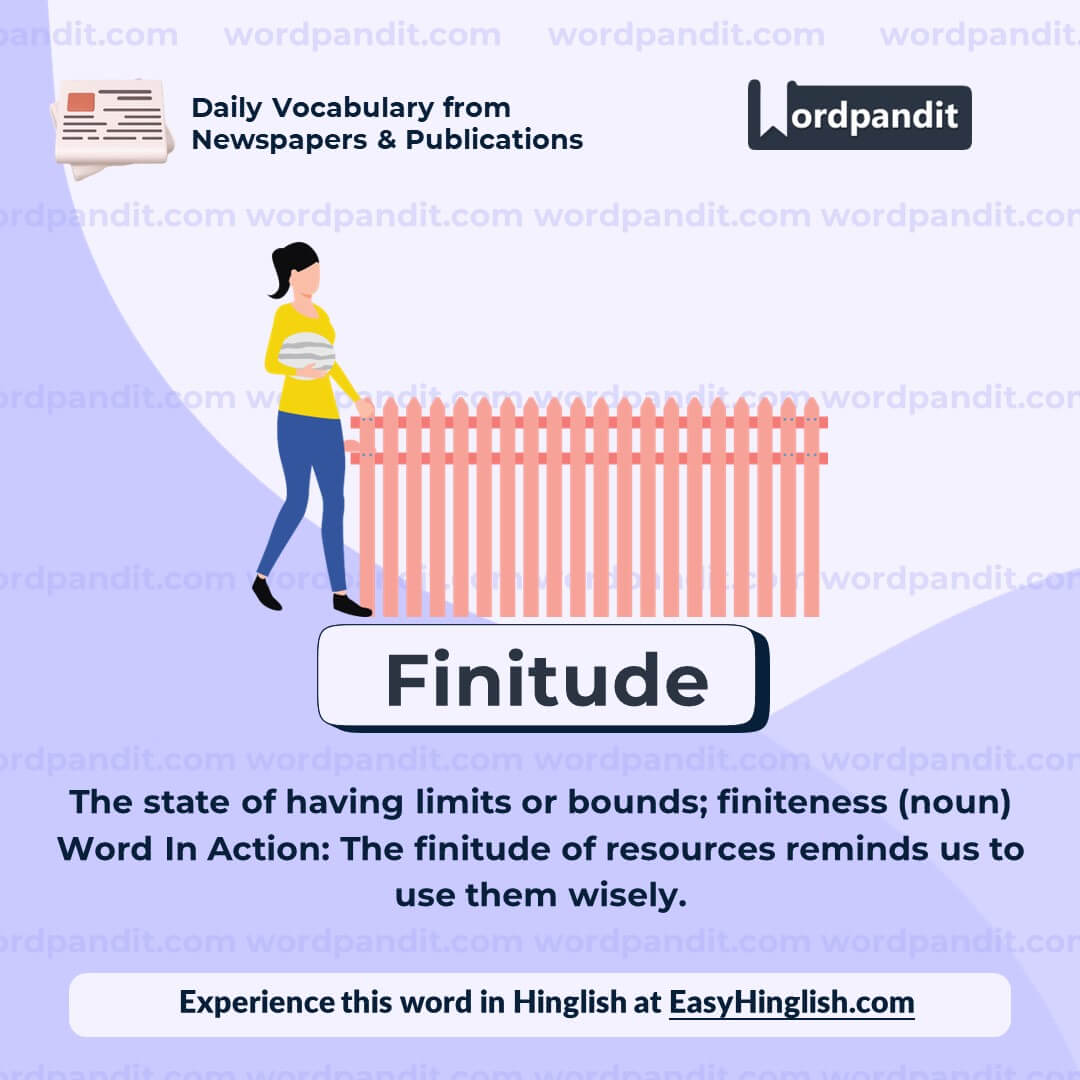
WORD-5: Finitude
Context:
"The Commonwealth of Oceana (1656) was the design of an 'immortal' English commonwealth – again trying to escape corruption and finitude." - BBC
Explanatory Paragraph:
Finitude meaning in English is 'the state of having limits or being finite, especially in terms of time or existence.' This word is used when discussing the inevitable limitations of life, governments, resources, or human endeavors. How to use finitude effectively depends on the context—it appears commonly in philosophical discussions, academic writing, and competitive exam passages that explore themes of mortality, temporality, and human limitations.
Meaning: The state or quality of being limited in time, space, or extent; the condition of having boundaries or an end (Noun)
Pronunciation: FIN-ih-tood
Difficulty Level: ⭐⭐⭐⭐ Advanced
Etymology: Finitude comes from Latin 'finitus' meaning 'finished or bounded,' combined with the suffix '-tude' which denotes a state or condition. The word entered English in the 17th century during philosophical debates about human mortality and the nature of existence, carrying the weight of acknowledging that all things—empires, lives, resources—eventually come to an end.
Prashant Sir's Notes:
Students often ask: what is the difference between finitude and mortality? While mortality specifically refers to death and dying, finitude usage in academic writing encompasses all kinds of limitations—temporal, spatial, or quantitative. For UPSC and GRE aspirants, finitude frequently appears in philosophy passages and essays about sustainability, where it signals discussions about limited resources or the bounded nature of human achievement. In Indian English newspapers, you'll see phrases like "the finitude of natural resources" when discussing environmental challenges. Remember, finitude for CAT Reading Comprehension often appears in passages contrasting human ambition with natural limitations—recognizing this contrast helps you grasp the author's philosophical stance quickly.
Synonyms & Antonyms:
Synonyms: limitedness, boundedness, mortality, transience, impermanence, temporality, ephemerality, perishability
Antonyms: infinitude, endlessness, immortality, permanence, eternity, boundlessness
Usage Examples:
- The finitude of fossil fuels has forced India to invest heavily in renewable energy sources like solar and wind power.
- Ramesh's meditation practice helped him accept the finitude of human existence rather than constantly fearing death and aging.
- The author's essay explored the finitude of political power, arguing that even mighty empires eventually crumble under their own weight.
- Understanding the finitude of our attention span, Priya divided her study schedule into focused forty-five-minute blocks with regular breaks.
Cultural Reference:
"In our pursuit of endless growth, we forget the fundamental finitude that defines our planet and our lives." - Common theme in environmental literature and sustainability discussions
Think About It:
How does acknowledging the finitude of resources, time, and life itself change the way we make decisions about careers, relationships, and environmental conservation?
Quick Activity:
List three areas in your life where recognizing finitude could lead to better decisions—perhaps in how you spend time, use resources, or plan for the future.
Memory Tip:
Think of 'Finitude' as 'FINISH-attitude'—the attitude that accepts everything has a FINISH line or endpoint. Just like a cricket match has a finite number of overs, life and resources have their finitude.
Real-World Application:
Finitude is commonly used in academic essays, environmental reports, and philosophical discussions to acknowledge natural limitations. In business writing, it appears when discussing resource constraints or project timelines. For competitive exam essays on topics like sustainability, climate change, or human achievement, using 'finitude' demonstrates sophisticated vocabulary and conceptual understanding of limits and boundaries.


