

Daily Vocabulary from International Newspapers and Publications
Expand Your Vocabulary with Wordpandit’s Global Vocabulary Hub
At Wordpandit, we are committed to helping you develop a truly global vocabulary by drawing from some of the most respected international publications. This section is designed to keep you ahead of the curve by introducing you to words that define global conversations and trends.
The Power of Global Sources
To help you think and communicate on a global scale, we curate vocabulary from renowned international sources, such as:
- The New York Times
- The Washington Post
- BBC
- The Guardian
- The Economist
- Scientific American
- Psychology Today
- And many more...
Stay Global, Stay Competitive
Our daily updates from international publications ensure you are consistently exposed to new words that reflect global news and developments, making sure your vocabulary is not only current but also globally relevant.
Enhance Your Global Perspective
Whether you’re preparing for international exams, aiming to excel in global business communication, or want to enhance your language skills for personal growth, Wordpandit offers the resources you need to thrive in a global context.
Effective Learning, Global Reach
Our learning methodology combines global examples, memory aids, and interactive activities, allowing you to internalize new words effectively and apply them in real-world scenarios.
Begin Your Global Vocabulary Journey Now!

Why Choose Wordpandit?
Practical Learning: Focus on words you'll actually encounter in real-world reading, enhancing your comprehension and communication skills.
Diverse Content: From current affairs to scientific breakthroughs, our varied sources expose you to vocabulary across multiple domains.
Effortless Integration: Make Wordpandit a part of your daily routine. Just a few minutes each day can significantly boost your lexicon over time.
Your Path to Vocabulary Mastery
- Visit our Daily Vocabulary section regularly
- Explore new words and their usage in context
- Practice incorporating these words into your own writing and speech
- Track your progress as your vocabulary expands
Start Your Journey Today
Embark on your vocabulary enhancement journey with Wordpandit. By consistently engaging with our daily posts, you'll build a robust vocabulary that serves you well in academic, professional, and personal contexts.
Remember, a word a day keeps linguistic limitations at bay. Make Wordpandit your daily companion in the quest for vocabulary excellence!
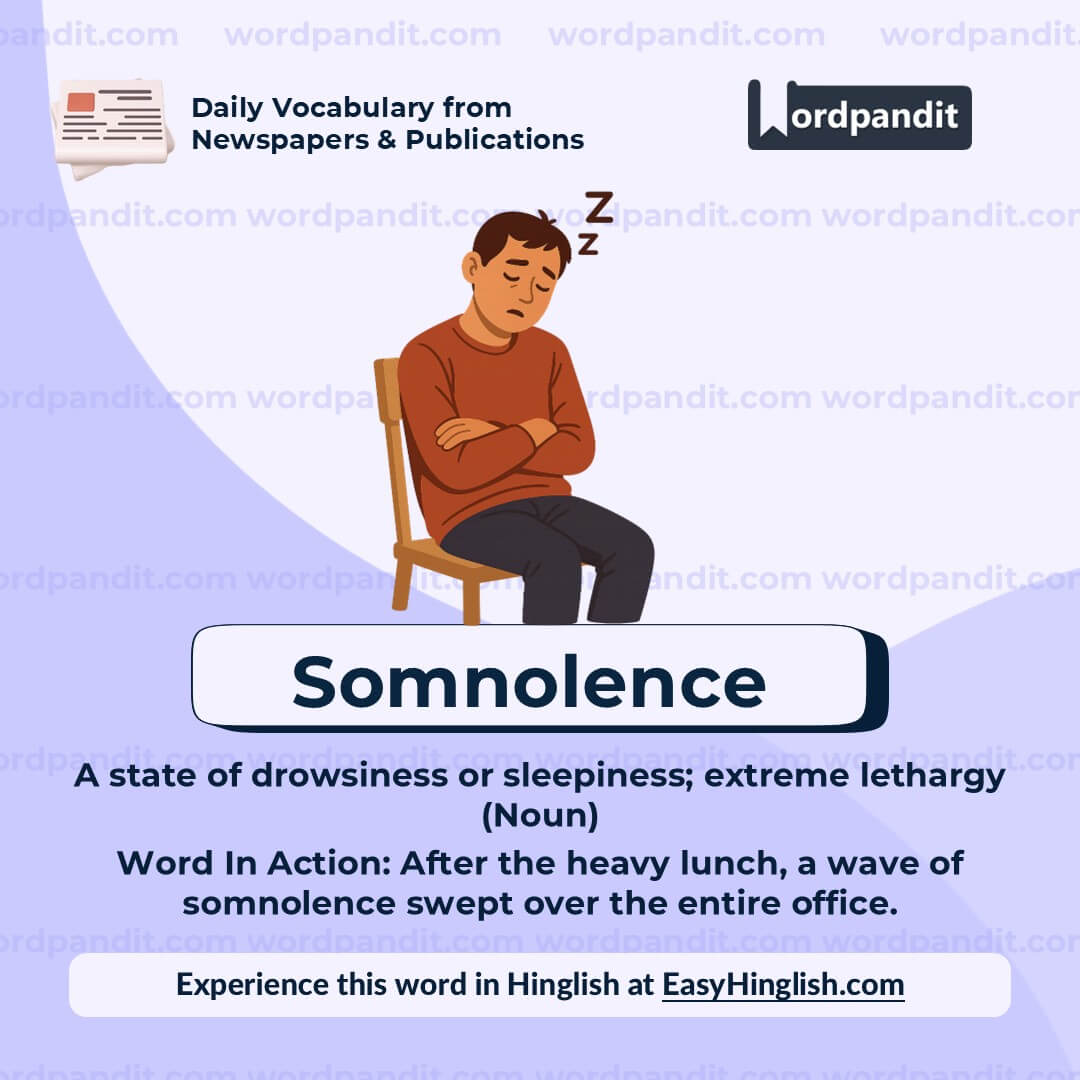
WORD-1: Somnolence
Context:
"The celebrated game of glorious uncertainties is for me a tiresome tedium of inglorious certainty wherein bouts of catatonic somnolence, both on the field and in the spectator stands, are interspersed at periodic intervals with volcanic upheavals, as missiles are flung about hither and thither with much brandishing of wooden cudgels, the entire exercise punctuated by war whoops, fist pumping, chest thumping, and similar gladiatorial gesticulations." - BBC
Explanatory Paragraph:
Somnolence meaning in English is a state of drowsiness or sleepiness, where someone feels extremely lethargic and ready to doze off. This word is used when describing situations or environments that induce a heavy, sleep-like lethargy in people. How to use somnolence effectively appears frequently in formal writing, medical contexts, literary descriptions, and competitive exam passages where authors describe dull, monotonous situations that cause extreme drowsiness or lack of alertness.
Meaning: A state of drowsiness or sleepiness; extreme lethargy (Noun)
Pronunciation: SOM-nuh-lense
Difficulty Level: ⭐⭐⭐ Advanced
Etymology: Somnolence comes from Latin 'somnus' meaning 'sleep,' combined with the suffix '-olence' indicating a state or condition. The word entered English through Middle French 'somnolence' and has retained its connection to sleep and drowsiness. Over time, it evolved from simply meaning sleepiness to describing that heavy, almost irresistible pull toward sleep that overcomes someone in dull or unstimulating situations.
Prashant Sir's Notes:
Many students confuse somnolence with insomnia, but they're actually opposites—the difference between somnolence and drowsiness is subtle, as drowsiness is temporary tiredness while somnolence suggests a deeper, more persistent sleepy state. For CAT and GRE aspirants, somnolence frequently appears in Reading Comprehension passages describing monotonous situations or medical contexts. In competitive exam vocabulary, understanding somnolence usage in sentences helps you identify tone—when authors use it, they're often being critical or sarcastic about something boring. Indian English newspapers use somnolence particularly in political commentary about dull parliamentary sessions or in sports writing about one-sided matches that put spectators to sleep.
Synonyms & Antonyms:
Synonyms: drowsiness, sleepiness, lethargy, sluggishness, torpor, languor, lassitude, stupor, heaviness, doziness
Antonyms: alertness, wakefulness, vigilance, energy, liveliness, vitality
Usage Examples:
- The afternoon meeting induced such somnolence among employees that even the manager struggled to keep his eyes open.
- Priya fought against the somnolence creeping over her during the three-hour lecture on tax regulations and accounting principles.
- The humid Chennai weather combined with the professor's monotonous voice created an atmosphere of complete somnolence in the classroom.
- Rahul's somnolence after lunch became so predictable that his colleagues scheduled important discussions only during morning hours.
Cultural Reference:
"The endless Test match sessions in scorching heat often induce somnolence among spectators, broken only by occasional boundaries or wickets." - Common observation in cricket commentary
Think About It:
Why do certain environments or activities trigger somnolence even when we've had adequate sleep? What does this tell us about how our brains respond to monotony versus stimulation?
Quick Activity:
Think of three situations from your daily life that induce somnolence. Write one sentence describing each situation using the word naturally and effectively.
Memory Tip:
Think of 'Somnolence' as 'SOM-NO-LENS'—imagine your eyes have NO LENS to see clearly because you're so sleepy and drowsy. Or connect it to 'som' sounding like 'slumber'—somnolence is that heavy slumber-like feeling pulling you toward sleep.
Real-World Application:
Somnolence is commonly used in medical writing to describe patient symptoms, in literary criticism when analyzing an author's pacing or atmosphere, and in formal reviews of performances or events. Journalists use it to critique boring speeches, tedious meetings, or one-sided sports matches. In academic writing for competitive exams, using somnolence demonstrates sophisticated vocabulary when describing monotonous conditions or analyzing how writers create atmosphere in their narratives.
WORD-2: Spellbinding
Context:
"It's as spellbinding a spectacle as watching a traffic light change from red to amber to green, and back again." - BBC
Explanatory Paragraph:
Spellbinding meaning in English is something so fascinating and captivating that it holds your complete attention, as if you were under a magic spell. This word is used when describing performances, stories, visuals, or experiences that are utterly mesmerizing and impossible to look away from. How to use spellbinding appears frequently in reviews, literary criticism, entertainment writing, and competitive exam passages where writers need to convey intense fascination or describe something remarkably captivating.
Meaning: Holding one's attention completely as if by magic; fascinating (Adjective)
Pronunciation: SPELL-bine-ding
Difficulty Level: ⭐⭐ Basic to Intermediate
Etymology: Spellbinding combines 'spell' from Old English 'spel' meaning 'story or discourse' (later associated with magical incantations) and 'binding' meaning 'to tie or hold fast.' The word emerged in the early 20th century to describe something that figuratively binds someone's attention as completely as a magical spell would. It evolved from literal references to magic into a common metaphor for anything utterly captivating.
Prashant Sir's Notes:
Students often ask: what is the difference between spellbinding and mesmerizing? While both mean captivating, spellbinding usage in sentences emphasizes the magical quality of holding attention, while mesmerizing focuses more on hypnotic repetition. For GRE and CAT aspirants, notice that spellbinding can be used ironically—in the context sentence above, the writer sarcastically calls watching a traffic light "spellbinding" to mean exactly the opposite, showing it's boring. In Indian English newspapers and film reviews, you'll see spellbinding most often describing performances, cinematography, or narratives: "Shah Rukh Khan's spellbinding performance" or "the spellbinding visuals of Kashmir." Understanding both literal and ironic usage helps you tackle tricky RC passages.
Synonyms & Antonyms:
Synonyms: captivating, mesmerizing, enchanting, enthralling, fascinating, riveting, gripping, bewitching, hypnotic, absorbing
Antonyms: boring, dull, tedious, uninteresting, mundane, monotonous
Usage Examples:
- Aishwarya's spellbinding kathak performance at the Mumbai cultural festival left the audience in complete silence, mesmerized by every movement.
- The documentary on India's space program presented such spellbinding footage of the Mars mission that even non-science students watched intently.
- Amitabh Bachchan's spellbinding narration in the nature series kept viewers glued to their screens for all eight episodes.
- The lawyer's spellbinding arguments in court held the jury's attention for three straight hours without a single distraction.
Cultural Reference:
"Sanjay Leela Bhansali's films are known for their spellbinding visuals that transport audiences into lavish, dreamlike worlds of color and grandeur." - Common observation in Bollywood film criticism
Think About It:
What makes certain performances or experiences spellbinding while others fail to hold our attention? Is it the content itself, the delivery, or our own mindset as viewers?
Quick Activity:
Recall the most spellbinding movie, book, or performance you've experienced recently. Write two sentences explaining what made it so captivating using the word spellbinding naturally.
Memory Tip:
Think of 'Spellbinding' as literally being BOUND by a magical SPELL—imagine a magician casting a spell that binds your eyes to the stage, making it impossible to look away. Or picture yourself "spell-bound" like being tied up by words or visuals that won't let you go.
Real-World Application:
Spellbinding is extensively used in entertainment journalism, book and film reviews, travel writing, and performance critiques. Writers use it to convey exceptional quality in artistic or visual experiences. In business presentations and marketing, the word describes compelling content that holds audience attention. For competitive exam essays, using spellbinding demonstrates your ability to convey strong positive impressions while adding sophistication to descriptive writing about cultural experiences, performances, or memorable events.
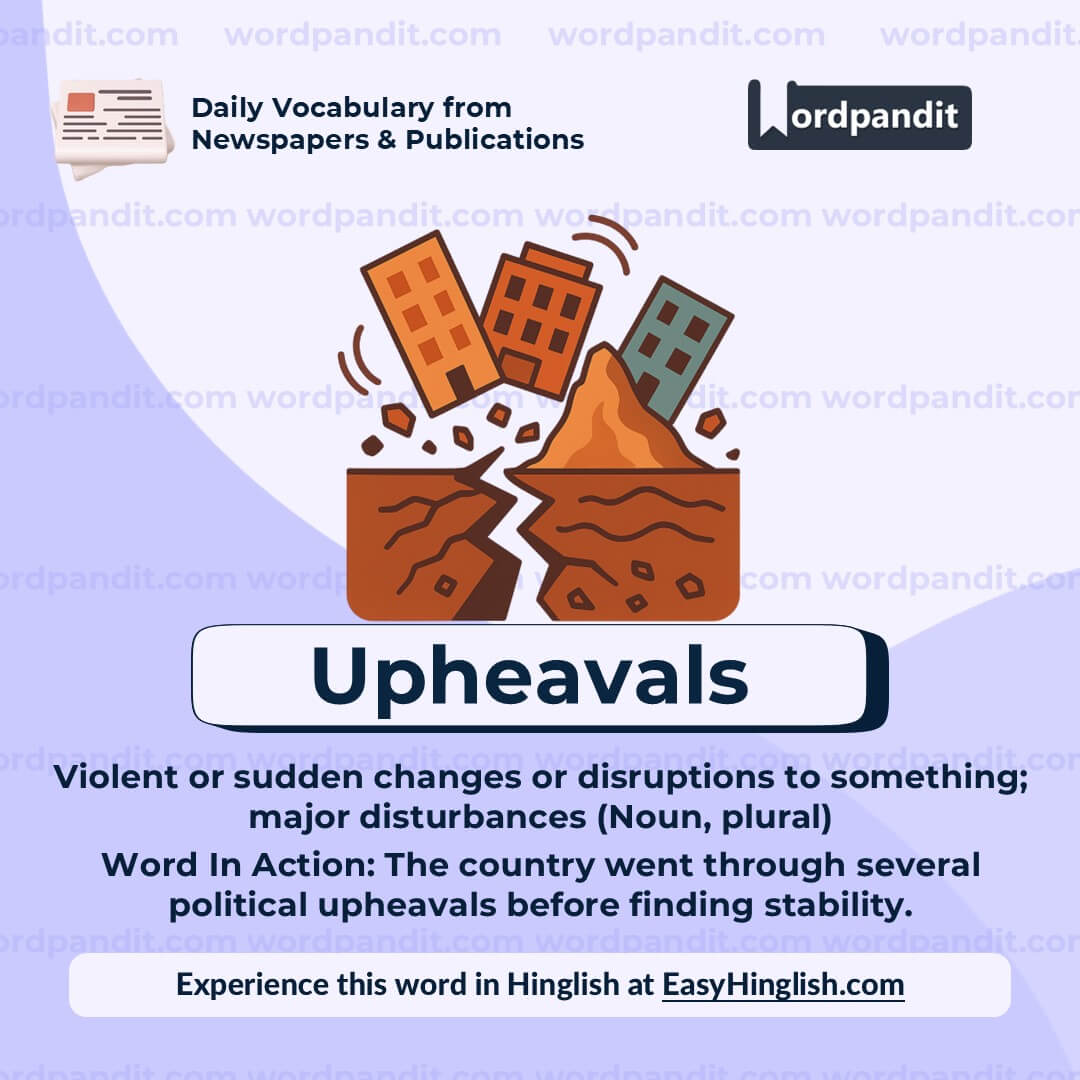
WORD-3: Upheavals
Context:
"The global economy is facing major upheavals due to ongoing conflicts, rising fuel prices, and rapid technological changes." - BBC
Explanatory Paragraph:
Upheavals meaning in English is a sudden and violent disruption or major change that overturns existing structures, systems, or situations. This word is used when describing dramatic transformations in politics, society, economics, or personal life that shake up the status quo. How to use upheavals correctly appears frequently in news analysis, historical writing, economic reports, and competitive exam passages where authors discuss revolutionary changes, crises, or fundamental shifts in established orders.
Meaning: Violent or sudden changes or disruptions to something; major disturbances (Noun, plural)
Pronunciation: up-HEE-vuls
Difficulty Level: ⭐⭐⭐ Intermediate
Etymology: Upheaval comes from the verb 'upheave,' combining 'up' and 'heave' (to lift with effort). Originally used in geology during the 18th century to describe the upward movement of Earth's crust, the word soon expanded metaphorically to describe any situation where existing structures are violently lifted up and overturned. The geological origin still influences how we understand the word today—upheavals suggest forces powerful enough to literally overturn the ground beneath our feet.
Prashant Sir's Notes:
Many students confuse upheavals with simple changes or transitions, but the difference between upheavals and changes is crucial—upheavals are always dramatic, disruptive, and often violent or chaotic, while changes can be gradual and peaceful. For UPSC and CAT aspirants, upheavals frequently appears in passages about historical events, economic crises, or social revolutions. Students often ask: what is the difference between upheaval and turmoil? Upheaval emphasizes the overturning of existing systems, while turmoil focuses on the confusion and disorder itself. In Indian English newspapers, you'll see upheavals used particularly when discussing political crises like government collapses, economic shocks like demonetization, or social movements that challenge traditional structures—"the upheavals of the Emergency period" or "technological upheavals transforming Indian agriculture."
Synonyms & Antonyms:
Synonyms: disruptions, turmoil, chaos, revolutions, disturbances, convulsions, turbulence, cataclysms, upheaval, shake-ups, transformations (dramatic)
Antonyms: stability, calm, peace, order, continuity, tranquility, equilibrium
Usage Examples:
- The partition of India in 1947 caused massive social upheavals, displacing millions of families and reshaping the entire subcontinent.
- Ravi's company faced major upheavals when three senior managers resigned simultaneously, leaving critical projects without leadership.
- The introduction of GST brought economic upheavals to small businesses across India, forcing them to completely restructure their accounting systems.
- Climate change is causing environmental upheavals in the Himalayan region, with glaciers melting and weather patterns becoming increasingly unpredictable.
Cultural Reference:
"The Emergency period of 1975-77 represents one of the greatest political upheavals in independent India's history, fundamentally challenging democratic institutions." - Common reference in Indian political history
Think About It:
Can major upheavals ever lead to positive long-term outcomes, or do they always leave lasting scars on societies and individuals? Think of historical examples from India's journey.
Quick Activity:
Identify two major upheavals that have occurred in India in the last decade (political, economic, or social). Write one sentence about each explaining the nature of the disruption using the word upheavals.
Memory Tip:
Break 'Upheavals' into 'UP-HEAVE-als'—imagine something being HEAVED UP violently from below, like an earthquake lifting the ground UP and overturning everything. Or think of a powerful wave in the ocean that heaves UP and disrupts everything in its path—that's an upheaval.
Real-World Application:
Upheavals is commonly used in journalism covering political crises, economic analysis discussing market disruptions, historical writing describing revolutionary periods, and corporate communications addressing organizational restructuring. News editors use it to convey the severity of changes affecting nations, industries, or societies. In competitive exam essays for UPSC, CAT, or GRE, using upheavals demonstrates sophisticated understanding when discussing transformative historical events, economic shifts, or social movements that fundamentally altered existing structures.
WORD-4: Subversive
Context:
"In a major security operation, officials claimed to have dismantled several subversive groups accused of spreading anti-government propaganda online." - Psyche
Explanatory Paragraph:
Subversive meaning in English is seeking to undermine or overthrow an established system, authority, or set of beliefs through deliberate actions or ideas. This word is used when describing activities, ideas, or people that challenge or attempt to destabilize existing power structures from within. How to use subversive appears frequently in political discourse, security reports, literary criticism, and competitive exam passages where authors discuss rebellion, resistance movements, or ideas that threaten the status quo.
Meaning: Seeking or intended to undermine or overthrow an established authority or system (Adjective)
Pronunciation: sub-VER-siv
Difficulty Level: ⭐⭐⭐ Intermediate to Advanced
Etymology: Subversive comes from Latin 'subvertere,' combining 'sub' meaning 'from below' and 'vertere' meaning 'to turn.' The word literally means 'to turn from below' or 'to overturn from underneath.' It entered English in the 17th century initially describing physical overturning, but quickly evolved to describe ideas or actions that work secretly from within to undermine established systems. The 'from below' aspect remains crucial—subversive activities typically work underneath the surface to destabilize authority.
Prashant Sir's Notes:
Many students confuse subversive with rebellious, but the difference between subversive and rebellious is important—rebellion is open and direct opposition, while subversive usage in sentences implies working secretly or indirectly from within to undermine authority. For UPSC aspirants studying political science and history, subversive appears frequently when discussing movements that challenged colonial rule or authoritarian regimes. Students often ask: is subversive always negative? Not necessarily—freedom fighters are often called subversive by those in power, but heroes by those seeking liberation. In Indian English newspapers, you'll see subversive used in security contexts ("subversive elements"), cultural criticism ("subversive cinema that questions social norms"), or discussing literature that challenges established thinking—"Premchand's stories were considered subversive to feudal systems." Understanding context tells you whether it's being used positively or negatively.
Synonyms & Antonyms:
Synonyms: seditious, revolutionary, insurgent, disruptive, undermining, destabilizing, treasonous, radical, insurrectionary, rebellious (with stealth)
Antonyms: supportive, loyal, obedient, conformist, orthodox, establishment-friendly, conservative
Usage Examples:
- The British colonial government labeled many Indian independence activists as subversive elements threatening law and order in the empire.
- Priya's seemingly innocent blog posts contained subversive messages questioning corporate culture and encouraging workers to demand better conditions.
- The documentary was banned for its subversive content that challenged official narratives about historical events through hidden interviews and leaked documents.
- In Mumbai's underground art scene, several artists create subversive works that critique political corruption using satire and symbolism.
Cultural Reference:
"Films like 'Rang De Basanti' can be seen as subversive, inspiring youth to question authority and challenge systemic injustice through their powerful narratives." - Common observation in Indian film analysis
Think About It:
When does subversive activity represent necessary resistance against injustice, and when does it threaten legitimate social order? Who decides where that line is drawn?
Quick Activity:
Think of a book, film, or social media movement that you consider subversive. Write two sentences explaining what established norms or systems it challenges and how it does so.
Memory Tip:
Break 'Subversive' into 'SUB-VERSE-ive'—think of going UNDER (sub) to REVERSE the system, like working beneath the surface to turn things upside down. Or imagine a submarine (sub) working underwater to overturn a ship from below—that's subversive action, hidden and from underneath.
Real-World Application:
Subversive is commonly used in political journalism covering security issues and dissent movements, literary and film criticism analyzing works that challenge social norms, intelligence reports discussing threats to state authority, and academic writing on revolutionary movements. Security analysts use it to describe activities threatening established governments, while cultural critics use it positively to describe art that questions oppressive systems. In UPSC essays on governance, freedom of expression, or social movements, using subversive demonstrates nuanced understanding of how change movements operate—whether describing historical freedom struggles or contemporary activism.
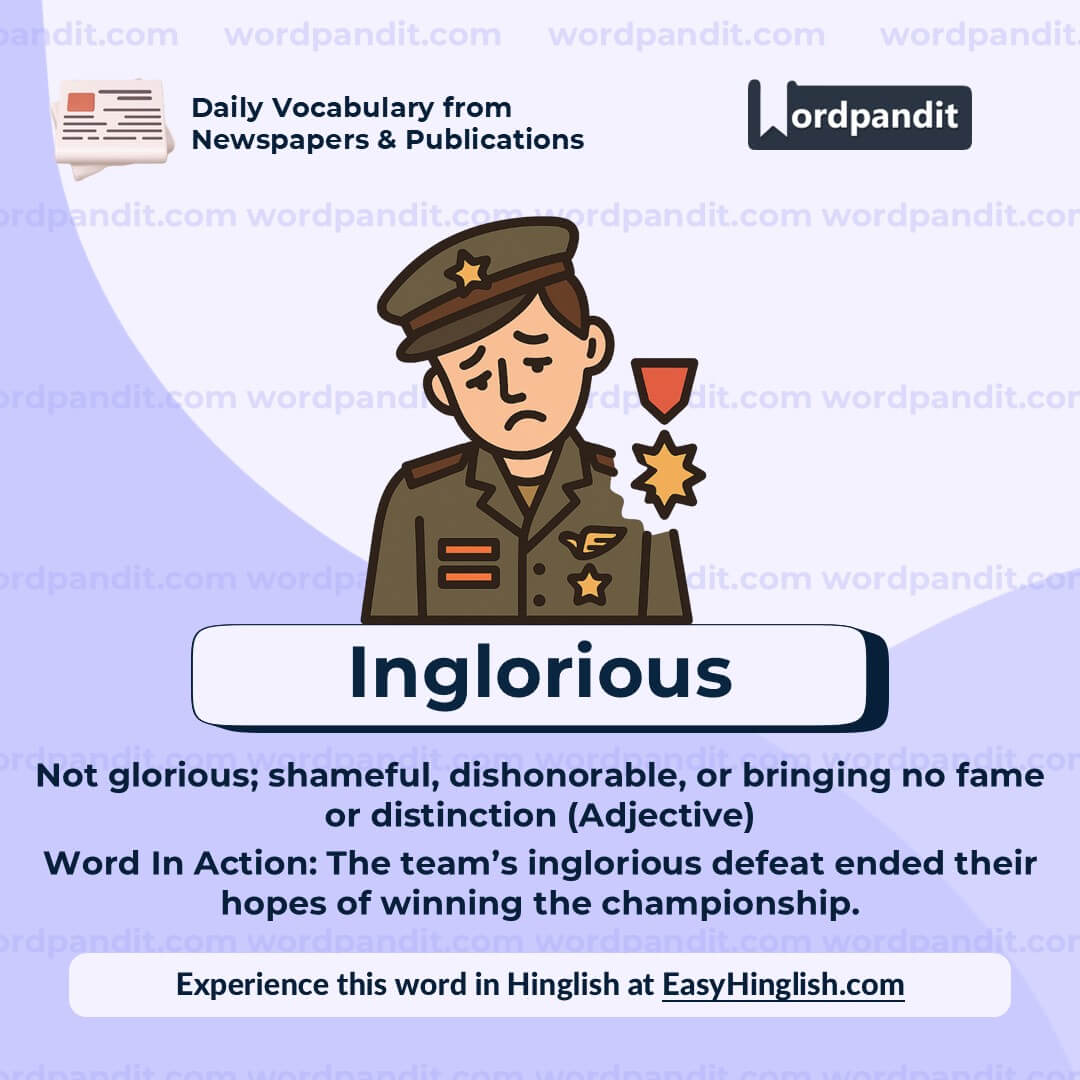
WORD-5: Inglorious
Context:
"The celebrated game of glorious uncertainties is for me a tiresome tedium of inglorious certainty wherein bouts of catatonic somnolence, both on the field and in the spectator stands, are interspersed at periodic intervals with volcanic upheavals, as missiles are flung about hither and thither with much brandishing of wooden cudgels, the entire exercise punctuated by war whoops, fist pumping, chest thumping, and similar gladiatorial gesticulations." - Psyche
Explanatory Paragraph:
Inglorious meaning in English is lacking fame, honor, or glory; shameful or bringing no credit or distinction. This word is used when describing events, defeats, performances, or endings that are disappointing, undignified, or even disgraceful. How to use inglorious effectively appears in literary writing, sports commentary, historical accounts, and competitive exam passages where authors need to convey failure, dishonor, or lack of distinction in situations where glory or honor was expected or desired.
Meaning: Not glorious; shameful, dishonorable, or bringing no fame or distinction (Adjective)
Pronunciation: in-GLOR-ee-us
Difficulty Level: ⭐⭐⭐ Intermediate to Advanced
Etymology: Inglorious combines the Latin prefix 'in-' meaning 'not' with 'gloriosus' meaning 'full of glory or fame.' The word entered English in the 16th century as a direct opposite to 'glorious,' used to describe actions, events, or people that lacked honor or brought shame instead of praise. While 'glorious' celebrates fame and honor, 'inglorious' condemns their absence or highlights situations where expected glory turned into disgrace or disappointment.
Prashant Sir's Notes:
Students often ask: what is the difference between inglorious and disgraceful? While both indicate lack of honor, inglorious emphasizes the absence of glory or fame, while disgraceful focuses on active shame. For CAT and GRE aspirants, inglorious frequently appears in passages about historical defeats, failed campaigns, or disappointing performances—understanding the context helps you grasp tone and authorial intent. In Indian English sports writing, you'll see inglorious used particularly for humiliating defeats: "India's inglorious exit from the tournament" or "the team's inglorious performance." The word carries strong negative connotations, so writers use it when they want to emphasize not just failure but failure that's particularly disappointing or shameful given expectations. Notice in the context sentence how the writer contrasts "glorious uncertainties" with "inglorious certainty"—this rhetorical contrast makes the criticism sharper.
Synonyms & Antonyms:
Synonyms: shameful, dishonorable, disgraceful, ignominious, undistinguished, disreputable, humiliating, ignoble, dishonored, discreditable
Antonyms: glorious, honorable, distinguished, renowned, celebrated, illustrious, triumphant, magnificent
Usage Examples:
- The company's inglorious collapse after the accounting scandal erased decades of reputation building and left thousands of employees jobless.
- After promising to revolutionize Indian agriculture, the startup met an inglorious end when investors discovered the technology didn't actually work.
- Vikram's political career came to an inglorious conclusion when corruption charges forced him to resign before completing even one year in office.
- The much-hyped film suffered an inglorious fate at the box office, closing within two weeks despite starring three major Bollywood celebrities.
Cultural Reference:
"India's 2007 ODI World Cup campaign ended in inglorious fashion with a first-round exit, shocking fans who had expected the team to dominate the tournament." - Common reference in Indian cricket history
Think About It:
Why do we find inglorious endings more memorable than quiet, unremarkable ones? What does our fascination with inglorious defeats reveal about human nature and expectations?
Quick Activity:
Think of a recent news event, sports match, or public incident that ended ingloriously. Write two sentences describing what happened and why it was particularly lacking in glory or honor.
Memory Tip:
Think of 'Inglorious' as 'IN-GLORIOUS'—imagine the word 'glorious' but with 'IN' blocking it, preventing any glory from shining through. Or remember the film "Inglourious Basterds"—though spelled differently, it captures the idea of something that's the opposite of glorious, lacking honor or proper dignity.
Real-World Application:
Inglorious is commonly used in sports journalism describing humiliating defeats, historical writing about failed military campaigns or fallen empires, business reporting on corporate collapses, and political commentary on disgraced leaders or failed policies. Writers use it when simple words like "unsuccessful" don't capture the depth of disappointment or shame involved. In competitive exam essays for UPSC or CAT, using inglorious demonstrates sophisticated vocabulary when analyzing historical events, leadership failures, or situations where high expectations met disappointing, shameful outcomes—particularly effective when contrasting expected glory with actual disgrace.


