

Daily Vocabulary from International Newspapers and Publications
Expand Your Vocabulary with Wordpandit’s Global Vocabulary Hub
At Wordpandit, we are committed to helping you develop a truly global vocabulary by drawing from some of the most respected international publications. This section is designed to keep you ahead of the curve by introducing you to words that define global conversations and trends.
The Power of Global Sources
To help you think and communicate on a global scale, we curate vocabulary from renowned international sources, such as:
- The New York Times
- The Washington Post
- BBC
- The Guardian
- The Economist
- Scientific American
- Psychology Today
- And many more...
Stay Global, Stay Competitive
Our daily updates from international publications ensure you are consistently exposed to new words that reflect global news and developments, making sure your vocabulary is not only current but also globally relevant.
Enhance Your Global Perspective
Whether you’re preparing for international exams, aiming to excel in global business communication, or want to enhance your language skills for personal growth, Wordpandit offers the resources you need to thrive in a global context.
Effective Learning, Global Reach
Our learning methodology combines global examples, memory aids, and interactive activities, allowing you to internalize new words effectively and apply them in real-world scenarios.
Begin Your Global Vocabulary Journey Now!

Why Choose Wordpandit?
Practical Learning: Focus on words you'll actually encounter in real-world reading, enhancing your comprehension and communication skills.
Diverse Content: From current affairs to scientific breakthroughs, our varied sources expose you to vocabulary across multiple domains.
Effortless Integration: Make Wordpandit a part of your daily routine. Just a few minutes each day can significantly boost your lexicon over time.
Your Path to Vocabulary Mastery
- Visit our Daily Vocabulary section regularly
- Explore new words and their usage in context
- Practice incorporating these words into your own writing and speech
- Track your progress as your vocabulary expands
Start Your Journey Today
Embark on your vocabulary enhancement journey with Wordpandit. By consistently engaging with our daily posts, you'll build a robust vocabulary that serves you well in academic, professional, and personal contexts.
Remember, a word a day keeps linguistic limitations at bay. Make Wordpandit your daily companion in the quest for vocabulary excellence!
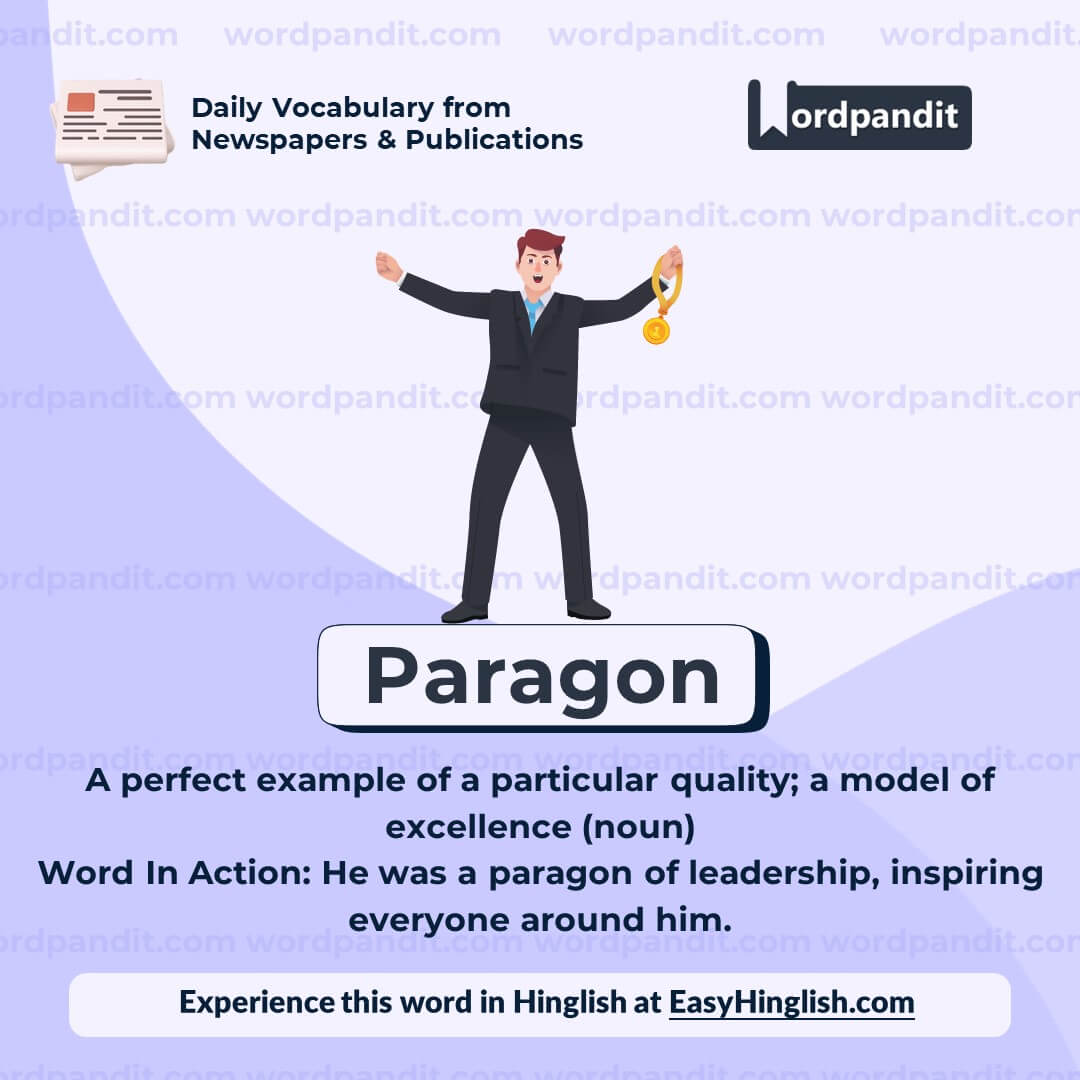
WORD-1: Paragon
Context:
"The world sees Japan as a paragon of minimalism. But its hidden clutter culture shows that 'more' can be as magical as 'less.'" - Aeon
Explanatory Paragraph:
Paragon meaning in English is 'a perfect example or model of excellence in a particular quality.' This word is used when describing someone or something that represents the highest standard or ideal in its category. How to use paragon effectively appears frequently in formal writing, competitive exam essays, and literary analysis where you need to highlight exceptional qualities or benchmark standards. Paragon is commonly used in CAT reading comprehension passages, newspaper editorials, and academic discussions to denote exemplary models.
Meaning: A perfect example or model of a particular quality; an ideal standard of excellence (Noun)
Pronunciation: PAIR-uh-gon
Difficulty Level: ⭐⭐⭐ Intermediate
Etymology: Paragon comes from the Italian word 'paragone' meaning 'touchstone' or 'comparison,' which itself derives from the Greek 'parakonan' meaning 'to sharpen against.' Originally used to describe a flawless diamond, the word evolved to represent any perfect model or standard of excellence against which others are measured.
Prashant Sir's Notes:
Many students confuse paragon with 'prototype'—the difference between paragon and prototype is crucial for exam vocabulary. A prototype is simply the first model of something, while paragon usage specifically means a perfect example of excellence. For GRE and CAT aspirants, paragon frequently appears in passages discussing ideal models or exceptional individuals. In Indian English newspapers, you'll often see phrases like "paragon of virtue" when describing respected leaders, or "paragon of efficiency" for benchmark institutions. Students often ask: what is the difference between paragon and epitome? While both mean perfect examples, epitome suggests a concentrated essence, whereas paragon emphasizes being an unmatched standard.
Synonyms & Antonyms:
Synonyms: epitome, exemplar, ideal, model, archetype, quintessence, standard, prototype (in modern usage), benchmark, embodiment
Antonyms: failure, disgrace, worst example, poor specimen, inferior model, flawed version
Usage Examples:
- Ratan Tata is often described as a paragon of ethical business leadership in Indian corporate history.
- The new teacher became a paragon of patience, handling even the most difficult students with remarkable composure and understanding.
- Switzerland has long been considered a paragon of political neutrality, maintaining its stance through numerous global conflicts.
- My grandmother was a paragon of traditional Indian hospitality, ensuring every guest felt welcomed and cherished in her home.
Cultural Reference:
"Sachin Tendulkar remains a paragon of dedication and sportsmanship, inspiring generations of cricketers across India and beyond." - Common cricket commentary
Think About It:
Can anyone truly be a paragon of all virtues, or does holding someone to such perfect standards set them up for inevitable disappointment?
Quick Activity:
Write two sentences describing someone you know personally who is a paragon of a specific quality—patience, honesty, creativity, or hard work. Be specific about what makes them exemplary.
Memory Tip:
Think of 'Paragon' as 'PAIR-A-GONE'—imagine a perfect pair where one has gone beyond and stands alone as the absolute best, like Virat Kohli among cricketers or A.R. Rahman among music composers.
Real-World Application:
Paragon is commonly used in business journalism, literary criticism, and competitive exam essays to describe ideal examples or benchmark standards. In corporate communications, professionals use it to highlight exemplary performance or model practices. For UPSC aspirants, understanding paragon helps in essay writing when discussing role models, institutional excellence, or setting policy benchmarks. In CAT reading comprehension, spotting "paragon" helps identify the author's tone when praising or criticizing by comparison to an ideal standard.
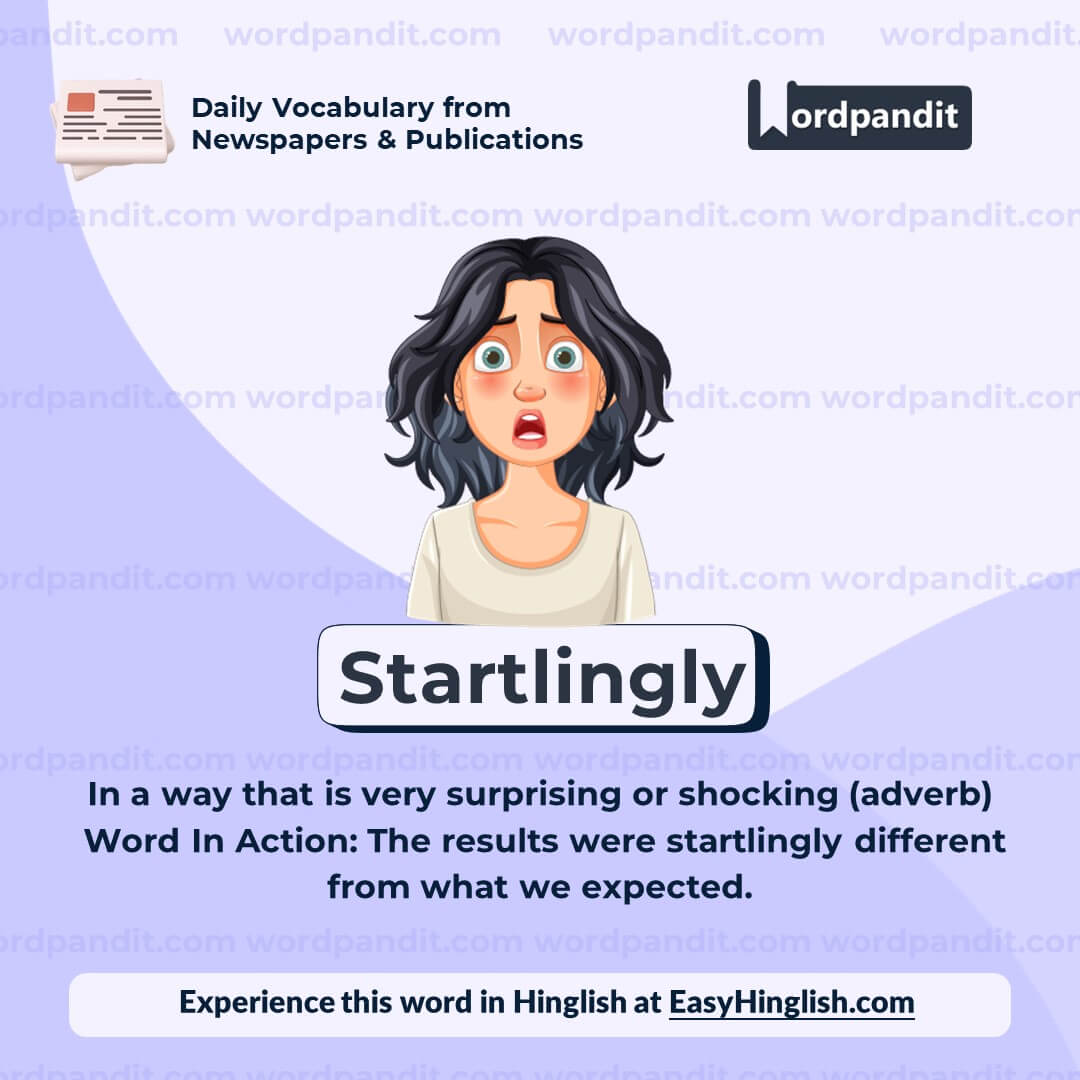
WORD-2: Startlingly
Context:
"looked startlingly unlike the rarefied minimalism that the world had come to expect from Japan. Tsuzuki's photos were a joyous declaration to the contrary, celebrating the vitality of living spaces filled with wall-to-wall clutter." - Aeon
Explanatory Paragraph:
Startlingly meaning in English is 'in a way that causes sudden surprise or shock due to being very unusual or unexpected.' This word is used when describing something that dramatically contradicts expectations or reveals an unexpected contrast. How to use startlingly appears frequently in descriptive writing, news analysis, and competitive exam passages where authors emphasize surprising differences or unexpected revelations. Startlingly is commonly used in GRE and CAT reading comprehension to signal important contrasts that readers should notice.
Meaning: In a surprising or shocking manner; to a degree that causes astonishment (Adverb)
Pronunciation: START-ling-lee
Difficulty Level: ⭐⭐ Basic to Intermediate
Etymology: Startlingly comes from the Old English word 'steartlian' meaning 'to stumble or kick,' which evolved through Middle English 'stertlen' to mean 'to leap or move suddenly.' The '-ingly' suffix was added to create the adverb form, emphasizing the manner in which something causes sudden surprise or shock, much like a physical startle response.
Prashant Sir's Notes:
Many students confuse startlingly with 'surprisingly'—the difference between startlingly and surprisingly is important for precise expression. While both indicate unexpectedness, startlingly usage carries a stronger emotional impact, suggesting shock or astonishment rather than mere surprise. For CAT and GRE aspirants, when you see 'startlingly' in RC passages, it's the author's signal that a major contrast or reversal is being presented. In Indian English newspapers, you'll often encounter phrases like "startlingly different" or "startlingly similar" to emphasize dramatic comparisons. Students often ask: how to use startlingly in formal writing? Place it before adjectives or adverbs to intensify the unexpected nature of what you're describing.
Synonyms & Antonyms:
Synonyms: surprisingly, shockingly, astonishingly, strikingly, remarkably, unexpectedly, amazingly, dramatically, stunningly, extraordinarily
Antonyms: predictably, expectedly, typically, ordinarily, normally, unsurprisingly
Usage Examples:
- The Mumbai slum area contained startlingly clean streets and well-organized community systems that defied common stereotypes about informal settlements.
- Priya's financial situation improved startlingly fast after she started her online business, doubling her income within just three months.
- The report revealed startlingly high pollution levels in the river, far exceeding what environmental activists had initially estimated.
- Despite being twins, Rohan and Sohan had startlingly different personalities—one outgoing and adventurous, the other quiet and contemplative.
Cultural Reference:
"India's space program achieved startlingly ambitious goals on remarkably modest budgets, proving that innovation doesn't always require massive funding." - Common media commentary on ISRO achievements
Think About It:
Why do we find certain contrasts startlingly memorable while others barely register in our minds? What makes something truly startling versus merely different?
Quick Activity:
Write two sentences describing something you recently discovered that was startlingly different from what you expected—perhaps about a person, place, or situation that surprised you.
Memory Tip:
Think of 'Startlingly' as 'START-LING'—imagine someone jumping at the START of a race because a LOUD bell rings, creating that startled, shocked reaction. Like when Dhoni's helicopter shot first appeared and startlingly changed cricket forever.
Real-World Application:
Startlingly is commonly used in journalism, research reports, and analytical essays to emphasize unexpected findings or dramatic contrasts. In business writing, professionals use it to highlight significant deviations from predictions or norms. For UPSC essay writing, startlingly helps create impact when presenting contradictory evidence or surprising statistics. In CAT and GRE reading comprehension, recognizing 'startlingly' signals important turning points where the author introduces contrasts or challenges assumptions, making it crucial for understanding passage structure and tone.
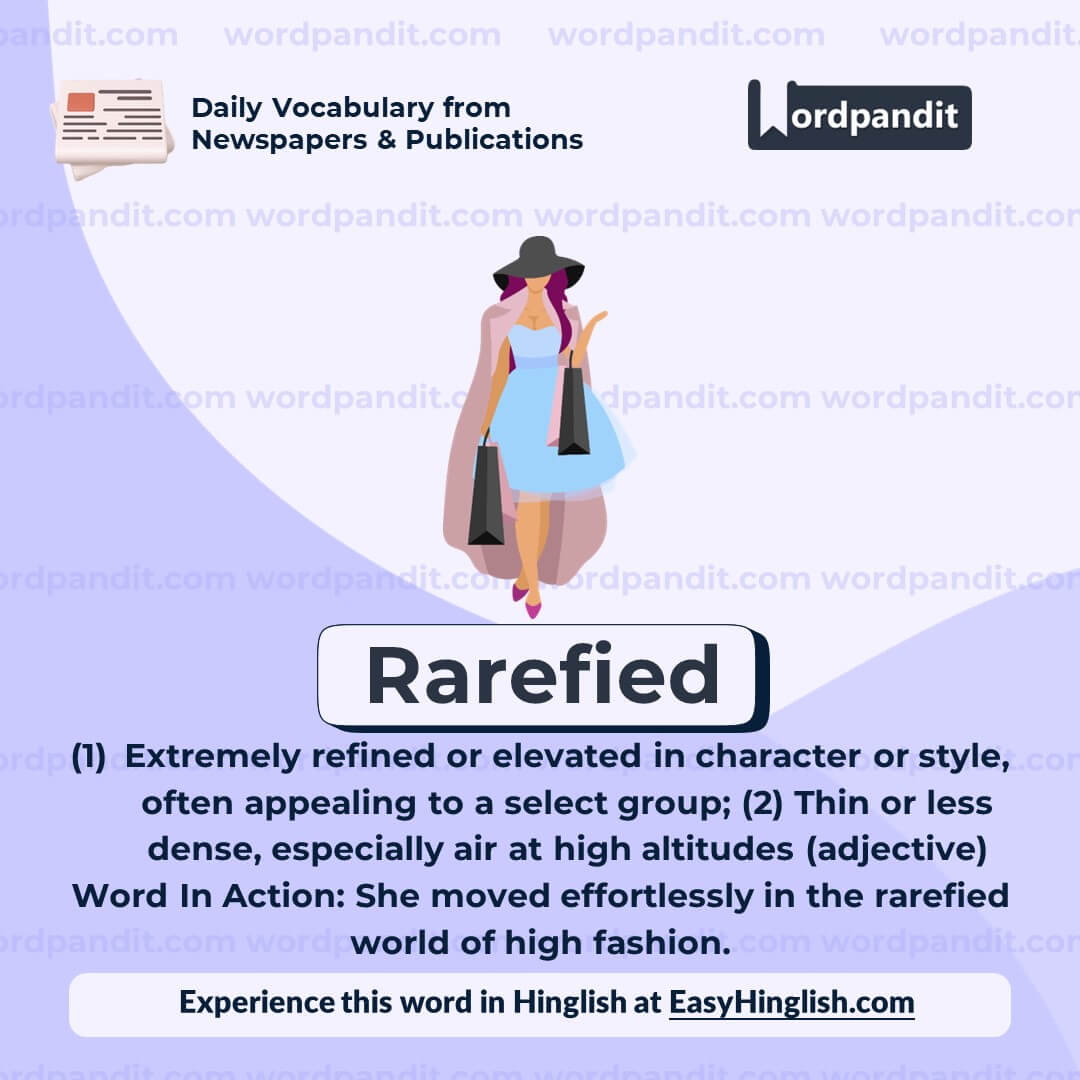
WORD-3: Rarefied
Context:
"looked startlingly unlike the rarefied minimalism that the world had come to expect from Japan. Tsuzuki's photos were a joyous declaration to the contrary, celebrating the vitality of living spaces filled with wall-to-wall clutter." - Aeon
Explanatory Paragraph:
Rarefied meaning in English is 'exclusive, elevated, or refined to a point where it is understood or accessible only to a select few; also literally meaning thin or less dense.' This word is used when describing elite or exclusive environments, high-level intellectual discussions, or anything that exists at a sophisticated level beyond ordinary experience. How to use rarefied effectively appears in formal writing, literary criticism, and competitive exam passages where authors discuss exclusive social circles, elevated artistic standards, or refined cultural practices. Rarefied is commonly seen in CAT and GRE reading comprehension when describing elite contexts or exclusive domains.
Meaning: Belonging to or characteristic of a select group; elevated and often inaccessible to ordinary people; made less dense or more refined (Adjective)
Pronunciation: RAIR-uh-fide
Difficulty Level: ⭐⭐⭐ Intermediate to Advanced
Etymology: Rarefied comes from the Latin word 'rarefacere,' combining 'rarus' meaning 'rare or sparse' and 'facere' meaning 'to make.' Originally used in physics to describe air becoming thinner at high altitudes, the word evolved metaphorically to describe anything refined, exclusive, or elevated beyond common reach—whether ideas, social circles, or cultural practices that exist in a refined, exclusive sphere.
Prashant Sir's Notes:
Students often ask: what is the difference between rarefied and refined? While both suggest elevation, rarefied usage specifically emphasizes exclusivity and inaccessibility, whereas refined simply means improved or cultured. For UPSC and CAT aspirants, rarefied frequently appears in passages discussing elite institutions, high art, or exclusive social contexts. The difference between rarefied and elite is subtle—elite describes the group itself, while rarefied describes the atmosphere or environment they inhabit. In Indian English newspapers, you'll see phrases like "rarefied world of classical music" or "rarefied circles of diplomacy" to signal exclusive domains. How to use rarefied correctly: pair it with abstract nouns like atmosphere, world, circles, or realm to convey exclusivity and elevation beyond ordinary experience.
Synonyms & Antonyms:
Synonyms: exclusive, elite, elevated, esoteric, refined, sophisticated, select, high-minded, lofty, exalted, rarified (alternate spelling)
Antonyms: common, ordinary, accessible, popular, widespread, down-to-earth, mainstream, inclusive
Usage Examples:
- The rarefied world of Indian classical dance remains largely inaccessible to those without years of dedicated training and cultural immersion.
- Amit struggled to adapt to the rarefied atmosphere of the IIT campus after growing up in a small town with limited educational resources.
- The art gallery curator moved effortlessly through rarefied circles of collectors, discussing million-rupee paintings with casual expertise.
- Her research existed in such a rarefied academic domain that even her colleagues in the same department struggled to understand her work.
Cultural Reference:
"The rarefied world of Test cricket, with its five-day format and nuanced strategies, appeals to purists who appreciate the game's complexity beyond the excitement of T20 matches." - Cricket commentary on format preferences
Think About It:
Does something become more valuable when it exists in rarefied circles, or does exclusivity sometimes prevent truly worthy ideas and art from reaching those who would benefit most?
Quick Activity:
Identify three domains or fields in Indian society that could be described as rarefied—perhaps in arts, sports, academics, or business. Write one sentence explaining why each feels exclusive or elevated.
Memory Tip:
Think of 'Rarefied' as 'RARE-IFIED'—imagine something so rare that it has been 'rarified' or made exclusive, like oxygen becoming rare at high altitudes. Just as only experienced mountaineers reach rarefied air at Everest's peak, only select few access rarefied social or intellectual circles.
Real-World Application:
Rarefied is commonly used in cultural criticism, sociology writing, and opinion pieces to describe exclusive domains or elite environments. In academic writing, scholars use it to discuss specialized knowledge areas or exclusive institutional contexts. For GRE and CAT aspirants, understanding rarefied helps decode passages about social hierarchies, cultural elitism, or specialized fields. In journalism, writers employ this word when discussing high society, elite institutions, or sophisticated artistic movements that remain inaccessible to mainstream audiences, making it essential vocabulary for analyzing social commentary.
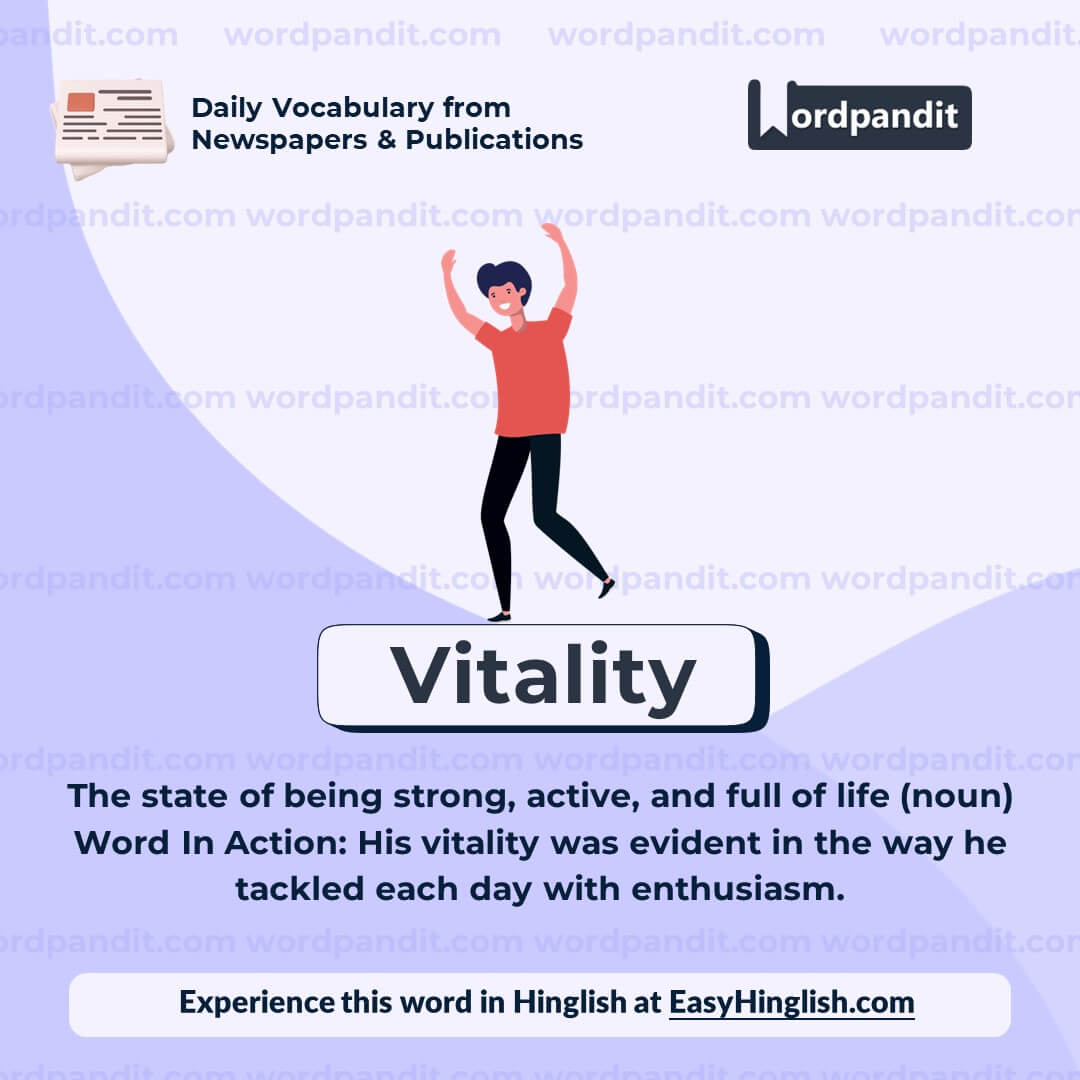
WORD-4: Vitality
Context:
"looked startlingly unlike the rarefied minimalism that the world had come to expect from Japan. Tsuzuki's photos were a joyous declaration to the contrary, celebrating the vitality of living spaces filled with wall-to-wall clutter." - Aeon
Explanatory Paragraph:
Vitality meaning in English is 'the state of being strong, active, and full of energy; the power giving continuance of life and vigor.' This word is used when describing energetic life force, dynamic activity, or robust health in people, places, or ideas. How to use vitality appears frequently in descriptive writing, health discussions, and competitive exam essays where authors emphasize energy, liveliness, and dynamic qualities. Vitality is commonly used in CAT reading comprehension passages, motivational writing, and cultural commentary to convey life, energy, and spirited existence.
Meaning: The state of being strong and active; energy and liveliness; the power to live and grow (Noun)
Pronunciation: vy-TAL-ih-tee
Difficulty Level: ⭐⭐ Basic to Intermediate
Etymology: Vitality comes from the Latin word 'vitalis' meaning 'of life,' derived from 'vita' meaning 'life.' Through Old French 'vitalité,' the word entered English in the late 16th century to describe the essential life force or energy that animates living beings. The concept evolved to encompass not just biological life but also the energetic, spirited quality that makes something vibrant and dynamic.
Prashant Sir's Notes:
Many students confuse vitality with 'energy'—the difference between vitality and energy is that vitality suggests an inherent life force or robust health, while energy is simply the capacity to do work. For GRE and CAT aspirants, vitality usage in passages often signals the author's positive evaluation of something dynamic or alive. In Indian English newspapers, you'll frequently see "economic vitality" describing thriving markets or "cultural vitality" for vibrant traditions. Students often ask: how to use vitality in essays? Use it when discussing health, vigor, economic dynamism, or cultural liveliness—it adds sophistication beyond simple words like 'energy' or 'liveliness.' The phrase "full of vitality" is particularly common in descriptive writing about people, cities, or movements that display remarkable energy and life.
Synonyms & Antonyms:
Synonyms: energy, vigor, liveliness, animation, spirit, dynamism, vibrancy, exuberance, zest, life force, robustness
Antonyms: lethargy, weakness, lifelessness, dullness, inertia, sluggishness, apathy, torpor
Usage Examples:
- The street markets of Old Delhi burst with vitality, filled with colorful vendors, aromatic food stalls, and energetic bargaining at every corner.
- After recovering from illness, Rajesh gradually regained his vitality through regular yoga practice and a balanced vegetarian diet.
- The startup ecosystem in Bangalore demonstrates remarkable vitality, with new companies launching every week and innovation driving constant growth.
- Despite being in her seventies, my grandmother's vitality amazes everyone—she wakes at five, manages household affairs, and still teaches neighborhood children.
Cultural Reference:
"Indian festivals like Holi and Diwali showcase the vitality of our cultural traditions, bringing communities together with unmatched energy and celebration year after year." - Common cultural commentary
Think About It:
What gives a city, culture, or individual true vitality—is it youth and newness, or can vitality come from deep roots and enduring traditions?
Quick Activity:
Write two sentences describing a place or person you know that radiates vitality. What specific behaviors, qualities, or characteristics make them seem so full of life and energy?
Memory Tip:
Think of 'Vitality' as 'VITAL-ity'—remember that VITAL means essential for life, so vitality is the quality of being full of life and energy. Like MS Dhoni's vitality on the cricket field even in his late thirties, showing that life force that keeps you dynamic and active.
Real-World Application:
Vitality is commonly used in health and wellness writing, urban planning discussions, economic reports, and cultural commentary to describe dynamic life force. In business journalism, analysts discuss "economic vitality" when evaluating market health. For UPSC essay writing, vitality helps articulate arguments about cultural preservation, urban development, or social movements. In CAT reading comprehension, recognizing vitality signals the author's appreciation for energy and liveliness in whatever subject they're discussing—whether describing neighborhoods, traditions, or individuals—making it essential for understanding positive evaluative tone.

WORD-5: Facade
Context:
"But Tsuzuki peeled away this façade to reveal a more complicated side to his nation. And Tokyo was the perfect setting for this exfoliation." - Aeon
Explanatory Paragraph:
Facade meaning in English is 'a false or superficial appearance that conceals the true nature of something; also literally, the front face of a building.' This word is used when describing deceptive outward appearances that hide underlying realities, whether in people's behavior, social institutions, or situations. How to use facade appears frequently in analytical writing, psychology discussions, and competitive exam passages where authors expose contradictions between appearance and reality. Facade is commonly seen in CAT and GRE reading comprehension when discussing social pretense, institutional hypocrisy, or deceptive presentations.
Meaning: A false, superficial, or artificial appearance or effect that conceals true feelings or reality; the front of a building (Noun)
Pronunciation: fuh-SAHD
Difficulty Level: ⭐⭐⭐ Intermediate
Etymology: Facade comes from the French word 'façade,' derived from Italian 'facciata,' which comes from 'faccia' meaning 'face,' ultimately from Latin 'facies.' Originally used in architecture in the 17th century to describe the front face of a building, the word evolved metaphorically to describe the false front people or institutions present to the world while hiding their true nature behind this deceptive exterior.
Prashant Sir's Notes:
Many students confuse facade with 'front' or 'appearance'—the difference between facade and appearance is crucial for exam vocabulary. While appearance is neutral, facade usage always carries negative connotations of deception or concealment. For CAT and UPSC aspirants, when you encounter facade in RC passages, it signals the author is about to expose contradictions or reveal hidden truths. Students often ask: what is the difference between facade and pretense? Pretense is the act of pretending, while facade is the false appearance created through that pretense. In Indian English newspapers, phrases like "maintaining a facade of unity" or "behind the facade of prosperity" indicate situations where surface appearances mask difficult realities. How to use facade correctly in formal writing: it typically appears with verbs like maintain, create, penetrate, or strip away, emphasizing the tension between surface and depth.
Synonyms & Antonyms:
Synonyms: front, pretense, veneer, mask, guise, show, appearance, semblance, exterior, cover, disguise, charade
Antonyms: reality, truth, authenticity, genuineness, substance, sincerity, actuality, core
Usage Examples:
- The politician maintained a facade of concern for farmers while his policies consistently favored large corporate interests over small agricultural communities.
- Behind the facade of a perfect marriage, Meera and Vikram struggled with communication issues that they carefully hid from family and friends.
- The company's facade of environmental responsibility crumbled when investigators discovered years of illegal waste dumping in nearby rivers.
- Rohan projected a confident facade during job interviews, though internally he battled severe anxiety about his technical skills and qualifications.
Cultural Reference:
"In the film 'Dil Chahta Hai,' Akash initially presents a facade of carefree indifference toward relationships, but gradually reveals deeper emotional vulnerabilities beneath this protective exterior." - Bollywood character analysis
Think About It:
Is maintaining some facade necessary for functioning in society, or does authenticity always serve us better in the long run? Where do we draw the line between privacy and deception?
Quick Activity:
Write two sentences about a situation where someone or something maintained a facade that eventually crumbled. What was hidden, and how was the truth revealed?
Memory Tip:
Think of 'Facade' as 'FACE-ADE'—like lemonade is a sweet drink that masks sourness, a facade is a false FACE that masks the real situation underneath. Imagine a beautiful building facade hiding a crumbling interior, just like people sometimes hide their true feelings behind a pleasant face.
Real-World Application:
Facade is commonly used in investigative journalism, psychological analysis, social commentary, and critical essays to expose contradictions between public image and private reality. In business writing, analysts use it when discussing corporate social responsibility that masks unethical practices. For GRE and CAT aspirants, recognizing facade in reading passages helps identify the author's critical stance toward subjects presenting false appearances. In UPSC essays on governance, society, or ethics, facade effectively articulates the gap between official claims and ground realities, making it powerful vocabulary for analytical and argumentative writing.


