

Daily Vocabulary from International Newspapers and Publications
Expand Your Vocabulary with Wordpandit’s Global Vocabulary Hub
At Wordpandit, we are committed to helping you develop a truly global vocabulary by drawing from some of the most respected international publications. This section is designed to keep you ahead of the curve by introducing you to words that define global conversations and trends.
The Power of Global Sources
To help you think and communicate on a global scale, we curate vocabulary from renowned international sources, such as:
- The New York Times
- The Washington Post
- BBC
- The Guardian
- The Economist
- Scientific American
- Psychology Today
- And many more...
Stay Global, Stay Competitive
Our daily updates from international publications ensure you are consistently exposed to new words that reflect global news and developments, making sure your vocabulary is not only current but also globally relevant.
Enhance Your Global Perspective
Whether you’re preparing for international exams, aiming to excel in global business communication, or want to enhance your language skills for personal growth, Wordpandit offers the resources you need to thrive in a global context.
Effective Learning, Global Reach
Our learning methodology combines global examples, memory aids, and interactive activities, allowing you to internalize new words effectively and apply them in real-world scenarios.
Begin Your Global Vocabulary Journey Now!

Why Choose Wordpandit?
Practical Learning: Focus on words you'll actually encounter in real-world reading, enhancing your comprehension and communication skills.
Diverse Content: From current affairs to scientific breakthroughs, our varied sources expose you to vocabulary across multiple domains.
Effortless Integration: Make Wordpandit a part of your daily routine. Just a few minutes each day can significantly boost your lexicon over time.
Your Path to Vocabulary Mastery
- Visit our Daily Vocabulary section regularly
- Explore new words and their usage in context
- Practice incorporating these words into your own writing and speech
- Track your progress as your vocabulary expands
Start Your Journey Today
Embark on your vocabulary enhancement journey with Wordpandit. By consistently engaging with our daily posts, you'll build a robust vocabulary that serves you well in academic, professional, and personal contexts.
Remember, a word a day keeps linguistic limitations at bay. Make Wordpandit your daily companion in the quest for vocabulary excellence!
WORD-1: Enshrined
Context:
"In the US, UK and Australia, this criminalising language, once the preserve of the right-wing press, is now echoed by politicians across the political spectrum and enshrined in legislation." - The Conversation
Explanatory Paragraph:
Enshrined meaning in English is 'to preserve or protect something sacred or valued by placing it in a position of respect and permanence.' This word is used when principles, rights, or important values are formally established and protected, often in laws, constitutions, or institutional frameworks. Enshrined is commonly used in formal writing, legal documents, news articles about constitutional matters, and competitive exam passages discussing governance, rights, and institutional structures.
Meaning: To preserve or cherish something as sacred or very important. (Verb)
Pronunciation: en-SHRYNED
Difficulty Level: ⭐⭐⭐ Intermediate
Etymology: Enshrined comes from the word 'shrine,' which refers to a sacred or holy place. The prefix 'en-' means 'to put into or onto,' so literally it meant to place something in a shrine. Over time, the word evolved beyond religious contexts to mean protecting any valued principle or right by giving it permanent, respected status in laws or institutions.
Prashant Sir's Notes:
Many students confuse 'enshrined' with 'inscribed'—while inscribed simply means 'written,' enshrined specifically carries the weight of protection and reverence. For UPSC and CAT aspirants, enshrined frequently appears in passages about constitutional rights and governance, signaling that something isn't just written down but formally protected. The difference between enshrined and embedded is crucial: enshrined usage in legal contexts always suggests deliberate protection and respect, while embedded is more neutral. In Indian English newspapers, you'll constantly see phrases like "rights enshrined in the Constitution"—this combination signals fundamental protections that cannot be easily removed. How to use enshrined correctly: it always implies both permanence and protection, never just casual inclusion.
Synonyms & Antonyms:
Synonyms: consecrate, preserve, protect, cherish, immortalize, sanctify, entrench, embed (in formal contexts), codify, establish permanently
Antonyms: abolish, remove, discard, abandon, neglect, violate
Usage Examples:
- The Right to Education is enshrined in Article 21A of the Indian Constitution, making free education a fundamental right for children.
- Priya argued that workplace gender equality should be enshrined in company policy rather than left to individual managers' discretion.
- The principle of secularism, enshrined in the Preamble, remains a cornerstone of India's democratic identity despite ongoing political debates.
- My grandfather's values of honesty and hard work are enshrined in our family traditions, passed down through four generations now.
Cultural Reference:
"The values enshrined in our Constitution—justice, liberty, equality, and fraternity—must guide every decision we make as a nation." - Common refrain in Indian political and judicial discourse
Think About It:
If a right is enshrined in the Constitution but not effectively implemented in practice, does the enshrinement hold real meaning, or is it merely symbolic?
Quick Activity:
List three fundamental rights enshrined in the Indian Constitution and write one sentence explaining why each deserves this protected status.
Memory Tip:
Think of 'enshrined' as 'in-SHRINE-d'—imagine placing something precious inside a protective shrine at a temple. Just as devotees protect sacred objects in shrines, important principles are enshrined in constitutions and laws to keep them safe and respected.
Real-World Application:
In legal writing, journalism about constitutional matters, and policy documents, 'enshrined' is the precise term for describing rights, principles, or values that have been formally protected in foundational documents. It appears frequently in Supreme Court judgments, editorials discussing fundamental rights, UPSC essays on governance, and news analysis of legislative changes. Understanding this word helps you recognize when writers are emphasizing the protected, permanent nature of certain principles rather than just their existence.
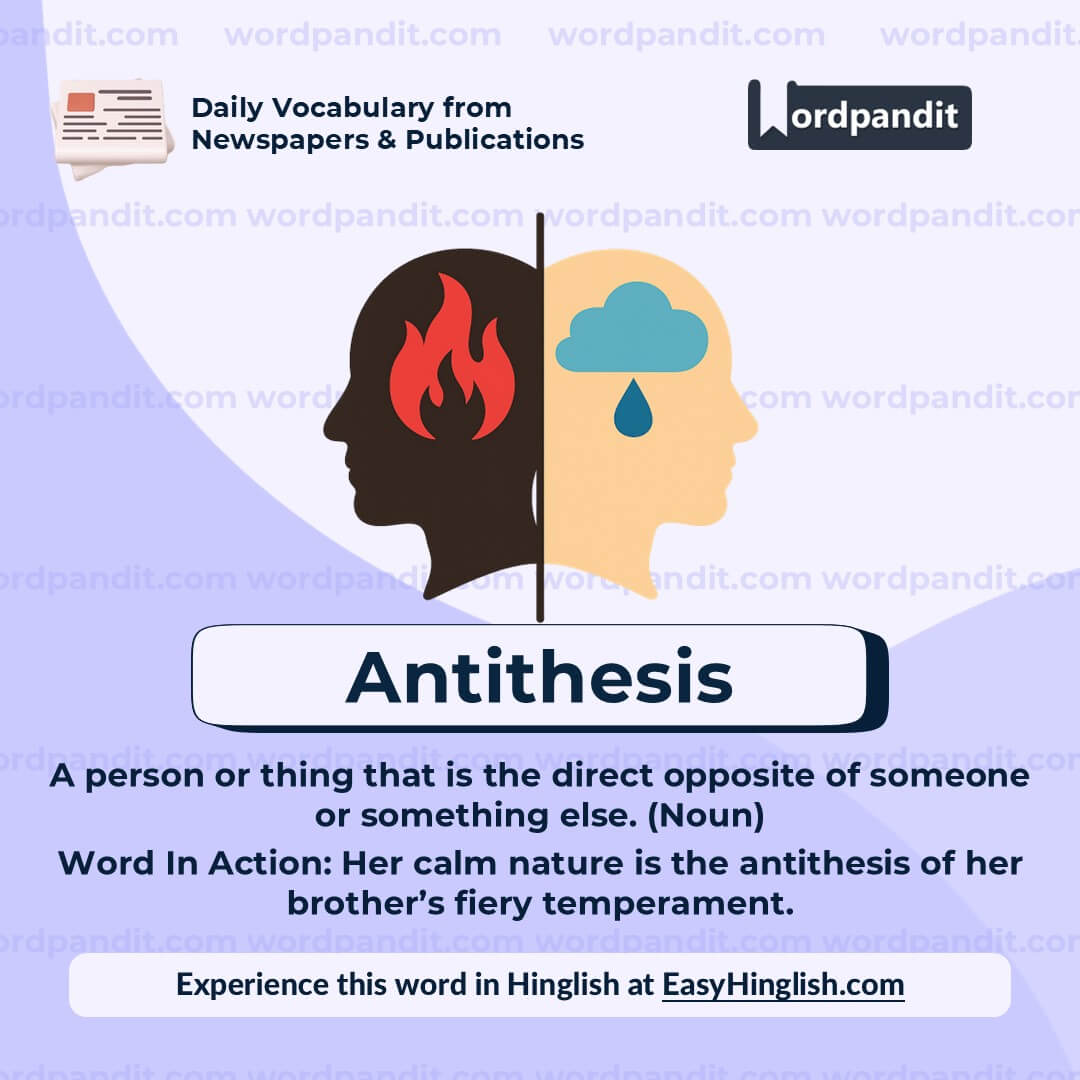
WORD-2: Antithesis
Context:
"It is used as a term of abuse or contempt. Because peasants themselves are seen as an embarrassing vestige, the antithesis of 'progress'." - Aeon
Explanatory Paragraph:
Antithesis meaning in English is 'the direct or exact opposite of something, or a person or thing that is the complete reverse of another.' This word is used when you want to emphasize a sharp contrast between two completely opposing ideas, concepts, or entities. Antithesis is commonly used in formal writing, literary analysis, debate, philosophical discussions, and competitive exam passages to highlight stark contrasts and opposing viewpoints.
Meaning: A person or thing that is the direct opposite of someone or something else. (Noun)
Pronunciation: an-TIH-thuh-sis
Difficulty Level: ⭐⭐⭐ Intermediate to Advanced
Etymology: Antithesis comes from Greek 'antitithenai' meaning 'to set against,' formed from 'anti-' (against) and 'tithenai' (to place). Originally used in rhetoric to describe the juxtaposition of contrasting ideas in balanced phrases, the word evolved to mean any direct opposite. The rhetorical device was popular in classical Greek and Roman oratory, and the term entered English through Latin in the 15th century to describe both the literary technique and the concept of complete opposition.
Prashant Sir's Notes:
Students often ask: what is the difference between antithesis and opposite? While 'opposite' is a simple, everyday word, antithesis usage in academic writing carries more weight and drama—it emphasizes the sharpest, most complete form of opposition. For CAT and GRE aspirants, antithesis frequently appears in Reading Comprehension passages where authors contrast ideologies or concepts. How to use antithesis correctly: it's typically followed by 'of' (antithesis of progress) or 'to' (antithesis to everything we value). In Indian English newspapers, you'll see phrases like "this policy is the antithesis of inclusive development"—signaling fundamental opposition, not just disagreement. Many students confuse antithesis with 'paradox,' but remember: antithesis is about opposites, while paradox is about seeming contradictions that might actually be true.
Synonyms & Antonyms:
Synonyms: opposite, contrary, reverse, converse, inverse, negation, contrast, polar opposite, direct opposite, complete reverse
Antonyms: same, similarity, equivalent, match, parallel, correspondence
Usage Examples:
- Rohit's luxurious lifestyle in South Mumbai was the antithesis of the simple, frugal existence his grandfather had led in their village.
- The company's claim of environmental responsibility is the antithesis of its actual practice of dumping untreated waste into the river.
- Gandhi's philosophy of non-violence represented the antithesis of the colonial government's approach of suppression through force and intimidation.
- Priya found her new boss's micromanagement style to be the antithesis of the trust-based leadership she had experienced at her previous startup.
Cultural Reference:
"Love and hate are not opposites; indifference is the antithesis of love." - A concept explored in various Bollywood films where the strongest emotions coexist, but apathy represents true opposition.
Think About It:
In modern India, is rapid urbanization truly the antithesis of rural development, or can both exist as complementary paths to progress?
Quick Activity:
Write two sentences describing something you value and then describe its antithesis. For example: "Honesty is the foundation of trust. Its antithesis, deception, destroys relationships permanently."
Memory Tip:
Break 'antithesis' into 'ANTI-THESIS'—'anti' means against, and 'thesis' is your main argument. So antithesis is literally the argument AGAINST your thesis. Think of a debate: if your thesis is "technology improves education," the antithesis would be "technology harms education"—complete opposites facing each other.
Real-World Application:
In academic essays, opinion pieces, and analytical writing, 'antithesis' is essential for presenting strong contrasts and opposing viewpoints. It appears frequently in UPSC mains answers when comparing contrasting policies, in CAT Reading Comprehension passages discussing conflicting ideologies, and in newspaper editorials highlighting contradictions between stated values and actions. Legal arguments often use antithesis to contrast competing interpretations. Mastering this word helps you articulate sharp distinctions and recognize when writers are emphasizing fundamental oppositions rather than minor differences.
WORD-3: Monopolised
Context:
"It has been taken for granted that agriculture will eventually be monopolised by large capital and machinery, and cities will absorb the majority of the human population." - Aeon
Explanatory Paragraph:
Monopolised meaning in English is 'to have exclusive control or possession of something, preventing others from participating or competing.' This word is used when describing situations where one entity dominates an entire market, resource, conversation, or activity, excluding others from access or involvement. Monopolised is commonly used in business journalism, economics discussions, competitive exam passages about market structures, and formal writing about power dynamics and resource control.
Meaning: To take complete control or possession of something, preventing others from sharing it. (Verb)
Pronunciation: muh-NAH-puh-lyzed
Difficulty Level: ⭐⭐⭐ Intermediate
Etymology: Monopolised comes from Greek 'monopolion,' combining 'monos' (single, alone) and 'polein' (to sell). The term originally referred to exclusive trading rights granted by governments in ancient Greece and Rome. It entered English through Latin 'monopolium' in the 16th century, initially describing exclusive commercial privileges. Over time, the meaning expanded beyond commerce to include dominating any resource, conversation, or activity. The British spelling uses 's' (monopolised) while American English uses 'z' (monopolized).
Prashant Sir's Notes:
Many students confuse 'monopolised' with 'dominated'—while dominated means having control, monopolised specifically means having EXCLUSIVE control where competition is eliminated. The difference between monopolised and controlled is crucial for CAT and UPSC economics questions: monopolised usage always implies that others are actively prevented from participating. In Indian English newspapers, you'll frequently see "monopolised by a few players" or "monopolised the market"—this signals complete market capture, not just leadership. For GRE Reading Comprehension, when you see monopolised in a passage, it's often criticizing concentration of power or resources. How to use monopolised correctly: it can apply to markets (monopolised the telecom sector), resources (monopolised water supply), or even social situations (monopolised the conversation at dinner). Students preparing for banking exams should note that monopoly and monopolisation are key concepts in questions about market structures and competition law.
Synonyms & Antonyms:
Synonyms: dominate completely, control exclusively, corner the market, take over entirely, appropriate, commandeer, engross, absorb completely, have exclusive rights to, capture entirely
Antonyms: share, distribute, decentralize, divide, democratize, open up, liberalize, compete
Usage Examples:
- For decades, Indian Railways monopolised long-distance passenger transport until budget airlines emerged and transformed the travel landscape in the 2000s.
- Amit's uncle monopolised the family business for twenty years, refusing to give his siblings or their children any decision-making authority.
- Critics argue that a few large e-commerce platforms have monopolised online retail in India, making it difficult for small sellers to compete.
- During the meeting, Sharma ji monopolised the discussion for forty minutes, leaving no time for other team members to present their ideas.
Cultural Reference:
"Before economic liberalization in 1991, the government had monopolised key sectors like telecommunications, airlines, and banking—the reforms broke these monopolies and opened markets to competition." - Common reference in discussions about India's economic transformation
Think About It:
When big tech companies monopolise digital spaces and personal data, should governments intervene to protect competition and consumer rights, or does innovation require allowing successful companies to dominate?
Quick Activity:
Identify two sectors in India that you think are monopolised or nearly monopolised by one or two major players. Write one sentence explaining the impact of this monopolisation on consumers.
Memory Tip:
Think of 'MONO-POLY' like a board game where one player owns everything—'mono' means one/single, and 'poly' relates to selling/market. When someone has monopolised something, they're the ONLY player left in the game, owning all the properties. Imagine Ambani or Adani owning every business in town—that's monopolisation!
Real-World Application:
In business journalism, economic analysis, and policy discussions, 'monopolised' is the precise term for describing markets or resources under exclusive control. It appears regularly in Competition Commission reports, business newspaper articles about market concentration, UPSC essays on economic reforms, and CAT passages discussing corporate power. Understanding this word is essential for analyzing market structures in banking exams, recognizing anti-competitive practices in case studies, and interpreting government policies on market regulation. The term signals not just dominance but the problematic exclusion of competition.
WORD-4: Relinquish
Context:
"States grudgingly relinquish their resource-raising capacity and resent any loss of agency over expenditure." - Economic Times
Explanatory Paragraph:
Relinquish meaning in English is 'to voluntarily give up, surrender, or let go of something such as power, rights, possession, or control.' This word is used when someone releases their hold on something they previously controlled or owned, often reluctantly or under pressure. Relinquish is commonly used in legal documents, political journalism, business contexts, and competitive exam passages discussing power transitions, territorial disputes, and organizational changes.
Meaning: To voluntarily give up or surrender something such as power, a right, or possession (Verb)
Pronunciation: rih-LING-kwish
Difficulty Level: ⭐⭐⭐ Intermediate
Etymology: Relinquish comes from Latin 'relinquere,' formed from 're-' (back, away) and 'linquere' (to leave). The word literally means 'to leave behind' or 'to abandon.' It entered English through Old French 'relinquiss-' in the 15th century, originally used in legal contexts to describe formally giving up claims or rights. Over centuries, the meaning expanded to include voluntarily surrendering any form of control, possession, or authority, though it often retains the sense of reluctance or difficulty in letting go.
Prashant Sir's Notes:
Students often ask: what is the difference between relinquish and abandon? While abandon suggests leaving something carelessly or permanently, relinquish specifically means voluntarily giving up control, often formally or under circumstances. For UPSC aspirants, relinquish frequently appears in passages about federal structures, power-sharing, and constitutional amendments. How to use relinquish correctly: it's typically followed by a noun representing power, control, rights, or possession—you relinquish control, relinquish power, relinquish your claim. In Indian English newspapers, particularly Economic Times and Hindu editorials, you'll see "reluctant to relinquish" or "forced to relinquish"—these phrases signal unwilling surrender. Many students confuse relinquish with 'renounce,' but the difference is subtle: renounce often implies a moral or ideological rejection, while relinquish is more neutral, focusing on the act of giving up. For CAT Reading Comprehension, when authors use relinquish, they're often discussing power dynamics where someone must let go despite not wanting to.
Synonyms & Antonyms:
Synonyms: surrender, give up, yield, cede, renounce, abandon, forgo, waive, hand over, release, resign, abdicate (for positions)
Antonyms: retain, keep, maintain, hold onto, claim, seize, acquire, grasp, possess
Usage Examples:
- After forty years as chairman, Mr. Patel finally agreed to relinquish control of the family business to his daughter Anjali.
- The Karnataka government was reluctant to relinquish its authority over water distribution to the interstate tribunal, citing state autonomy concerns.
- Sunita had to relinquish her dream of becoming a classical dancer when a knee injury ended her training at age seventeen.
- Under the new GST framework, states were asked to relinquish their independent taxation powers in exchange for revenue-sharing guarantees from the Centre.
Cultural Reference:
"When Baahubali asked Bhallaladeva to relinquish the throne that rightfully belonged to him, the refusal set off the epic conflict." - A reference to power struggles and the unwillingness to surrender control, common in Indian epics and cinema
Think About It:
Why is it so difficult for leaders in politics, business, and even families to relinquish power gracefully, even when it's time for new leadership?
Quick Activity:
Write two sentences about a situation where someone should relinquish control but refuses to do so. Explain the consequences of not letting go.
Memory Tip:
Break 'relinquish' into 'RE-LINK-wish'—imagine you WISH to RE-LINK (reconnect) with something, but you must let it go. Or think of Dhoni relinquishing the captaincy—he had to RELIEVE himself of LEADERSHIP, letting someone else take charge despite his success.
Real-World Application:
In legal documents, corporate governance discussions, political analysis, and policy debates, 'relinquish' is the formal term for voluntarily giving up rights, powers, or possessions. It appears frequently in Supreme Court judgments about territorial disputes, business journalism covering leadership transitions, UPSC essays on federalism and Centre-State relations, and CAT passages discussing organizational change. Understanding this word helps you recognize when writers are discussing voluntary surrender versus forced removal, and identifies the often-reluctant nature of power transfers in various contexts.
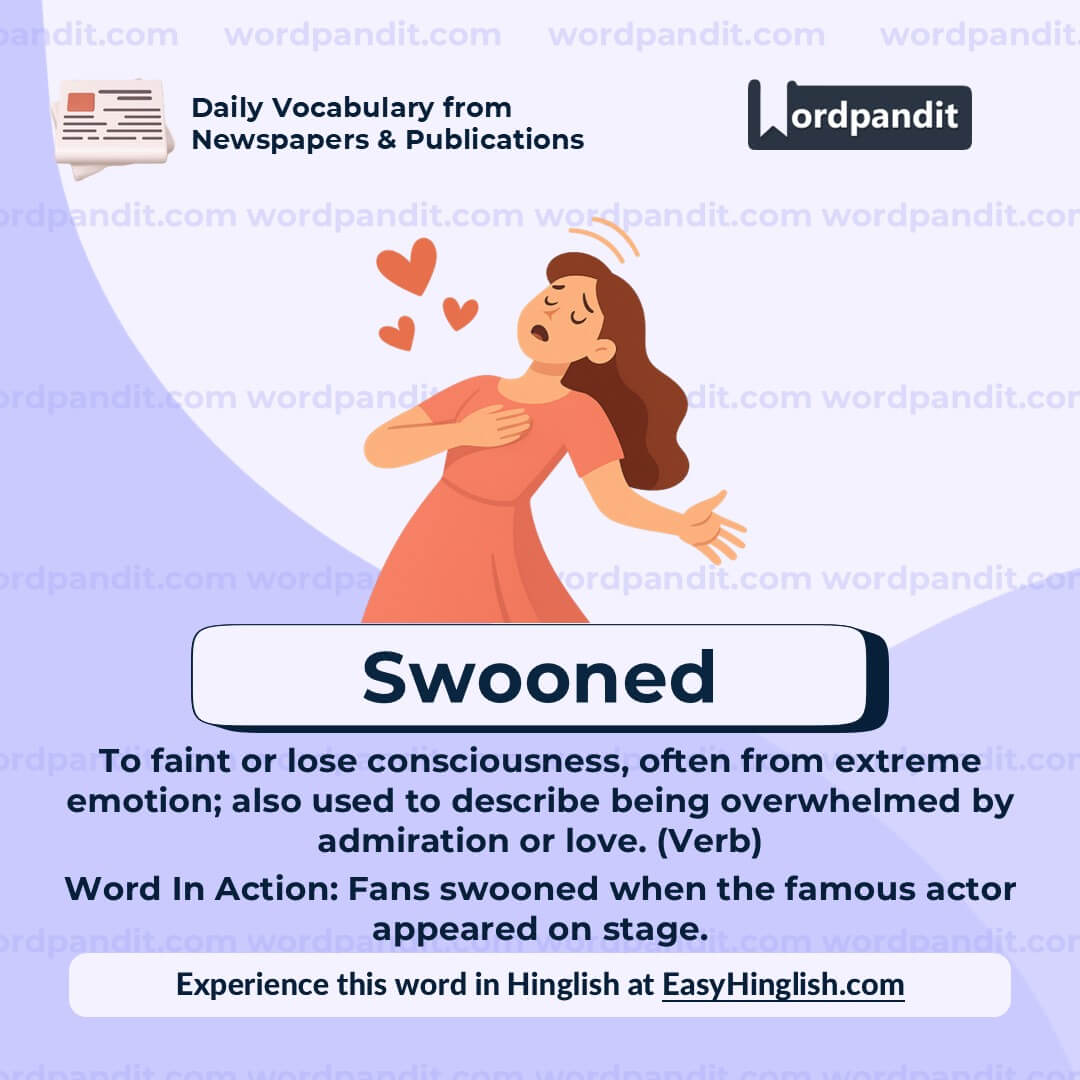
WORD-5: Swooned
Context:
"In 2015 and 2016, as he was becoming the Republican nominee the first time, Mr. Trump quickly transformed into an all-encompassing, central figure, in an evolving, building story that started like a dark joke that Mr. Trump was in on, then swooned into a reality." - The New York Times
Explanatory Paragraph:
Swooned meaning in English has two primary uses: 'to faint or lose consciousness from extreme emotion, weakness, or excitement,' and metaphorically, 'to be overwhelmed with admiration, delight, or romantic feelings.' In modern usage, it also describes a gradual transformation or shift into a different state. Swooned is commonly used in literary writing, entertainment journalism, romantic contexts, and occasionally in political or social commentary to describe dramatic emotional reactions or transitions.
Meaning: To faint or lose consciousness, often from extreme emotion; also used to describe being overwhelmed by admiration or love. (Verb)
Pronunciation: SWOOND
Difficulty Level: ⭐⭐ Basic to Intermediate
Etymology: Swooned comes from Middle English 'swonen' or 'swounen,' meaning to faint or lose consciousness. The word has Old English roots in 'geswogen' (in a faint, unconscious). Originally used literally to describe fainting from physical causes like heat or weakness, by the 18th and 19th centuries it gained romantic associations, frequently appearing in Victorian literature to describe women fainting from emotion. In contemporary usage, it's often used figuratively or humorously to describe being overwhelmed with admiration or delight, and occasionally as a poetic way to describe gradual transitions or transformations.
Prashant Sir's Notes:
Many students know swooned only from romantic contexts—"girls swooning over Bollywood heroes"—but in advanced reading passages for CAT and GRE, you'll encounter its metaphorical use describing transitions or transformations, as in the NYT context above. The difference between swooned and fainted is important: fainted is clinical and literal, while swooned carries emotional or poetic weight. How to use swooned correctly: in modern writing, it's often ironic or exaggerated when describing admiration ("fans swooned over his performance"), but in literary contexts it can describe gradual, almost dreamlike transitions ("the evening swooned into night"). In Indian English journalism, you'll occasionally see "swooned over" in entertainment coverage or political commentary describing excessive public admiration. For competitive exams, recognize that swooned can signal the author is using elevated, poetic language to describe either overwhelming emotion or a gentle transformation.
Synonyms & Antonyms:
Synonyms: faint, pass out, lose consciousness, collapse, be overcome, be enraptured, be overwhelmed, be captivated, transform gradually, drift into
Antonyms: revive, awaken, remain conscious, stay alert, be unimpressed, resist, remain unmoved
Usage Examples:
- When Shah Rukh Khan appeared on stage at the Mumbai concert, thousands of fans literally swooned, with several needing medical attention from the excitement.
- The peaceful afternoon swooned into a chaotic evening as news of the company's bankruptcy spread through the office floors.
- Priya's grandmother swooned from the heat during the outdoor wedding ceremony, requiring immediate assistance from the family doctor present.
- Critics swooned over the cinematography in the new Malayalam film, calling it a visual masterpiece that redefined Indian cinema aesthetics.
Cultural Reference:
"Remember the scene in DDLJ where girls swooned over Raj's charm? That's the classic Bollywood depiction of overwhelming romantic attraction that became iconic in the 90s." - Common reference to how swooning represented idealized romance in Indian cinema
Think About It:
In the age of social media, do people still swoon over celebrities and public figures with the same intensity, or has constant digital access made admiration more casual and less overwhelming?
Quick Activity:
Write one sentence using swooned literally (fainting) and another using it figuratively (being overwhelmed with admiration). Notice how the context changes the word's impact.
Memory Tip:
Think of 'swooned' as 'SWOON-ed into a SWOON'—imagine someone so overwhelmed they make a "swooooon" sound as they faint dramatically like in old movies. Or remember the cricket stadium scene: when Virat Kohli hits a century, fans don't just cheer—they SWOON over his performance!
Real-World Application:
In entertainment journalism, lifestyle magazines, literary writing, and occasionally in political commentary, 'swooned' adds dramatic or romantic flair to descriptions of overwhelming reactions. It appears in film reviews describing audience reactions, celebrity profiles discussing fan devotion, and creative writing depicting intense emotions or gradual transitions. For competitive exams, recognizing swooned helps you identify when authors are using elevated, poetic language versus straightforward description. Understanding both its literal meaning (fainting) and figurative uses (overwhelming admiration or gradual transformation) is essential for interpreting tone and intent in advanced reading passages.


