

Daily Vocabulary from Indian Newspapers and Publications
Welcome to Wordpandit’s Indian Vocabulary Hub
At Wordpandit, we understand the importance of staying rooted in the local context while expanding your language skills. This section focuses on enriching your vocabulary with words and phrases drawn from India’s leading newspapers and publications, ensuring you're learning vocabulary that is practical, relevant, and uniquely Indian.
Why Indian Sources Matter
We believe that the best way to master any language is by immersing yourself in local content. That’s why we carefully curate vocabulary from top Indian publications, including:
- The Hindu
- The Times of India
- The Economic Times
- Hindustan Times
- Live Mint
- The Indian Express
- And many others...
Stay Updated, Stay Relevant
With daily updates from Indian news sources, you’ll be consistently learning words that reflect the trends and shifts in Indian society and culture. Our focus is to provide vocabulary that enhances your understanding of the language in an Indian context.
How Wordpandit Supports Your Goals
Whether you’re preparing for exams, aiming to improve your professional communication, or simply want to stay connected with the latest Indian vocabulary, Wordpandit is here to guide you every step of the way.
Learn with a Practical Approach
Our interactive learning methodology includes real-world examples, engaging activities, and context-specific usage to ensure that every word becomes part of your active vocabulary.
Dive into Indian Vocabulary Today!

Why Choose Wordpandit?
Practical Learning: Focus on words you'll actually encounter in real-world reading, enhancing your comprehension and communication skills.
Diverse Content: From current affairs to scientific breakthroughs, our varied sources expose you to vocabulary across multiple domains.
Effortless Integration: Make Wordpandit a part of your daily routine. Just a few minutes each day can significantly boost your lexicon over time.
Your Path to Vocabulary Mastery
- Visit our Daily Vocabulary section regularly
- Explore new words and their usage in context
- Practice incorporating these words into your own writing and speech
- Track your progress as your vocabulary expands
Start Your Journey Today
Embark on your vocabulary enhancement journey with Wordpandit. By consistently engaging with our daily posts, you'll build a robust vocabulary that serves you well in academic, professional, and personal contexts.
Remember, a word a day keeps linguistic limitations at bay. Make Wordpandit your daily companion in the quest for vocabulary excellence!
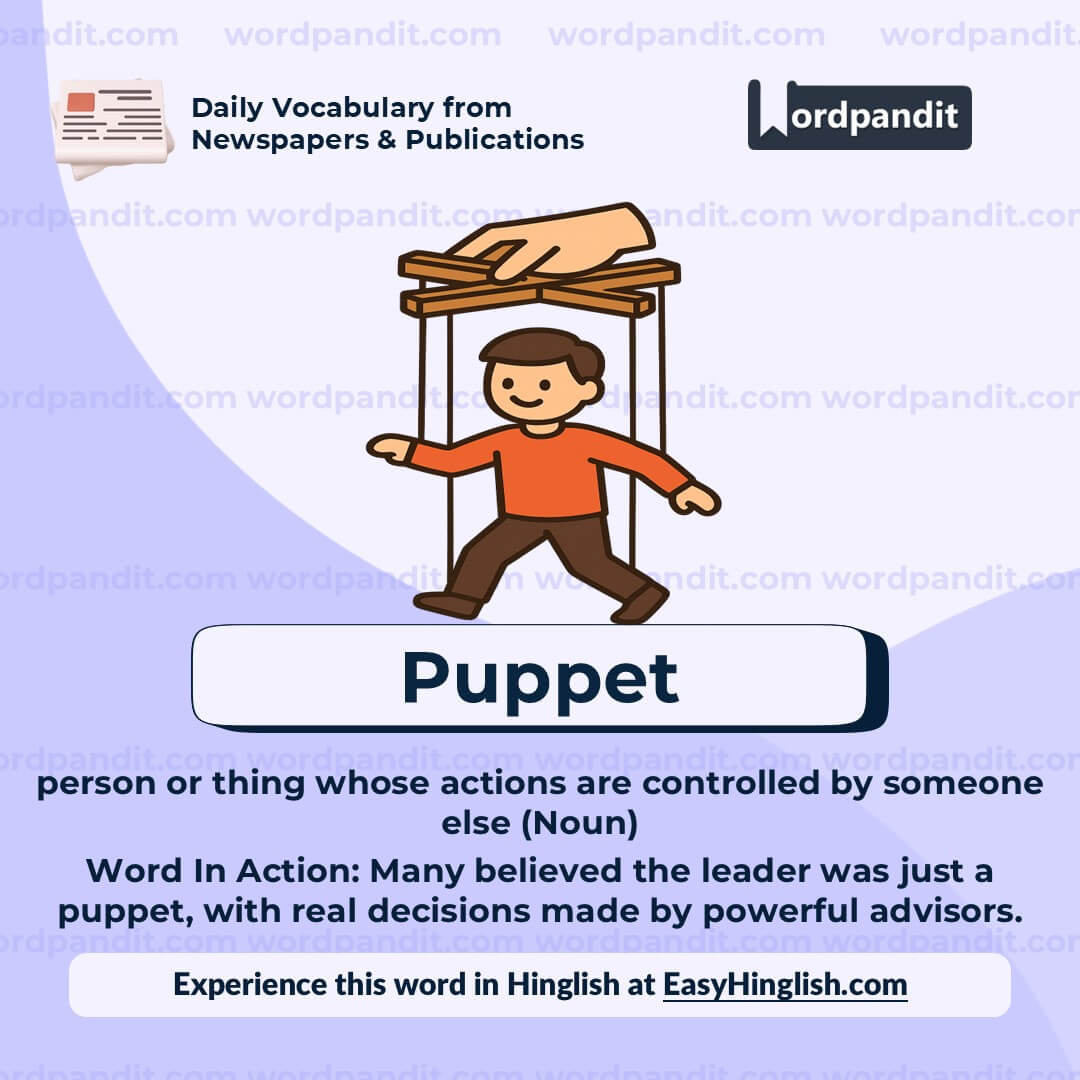
WORD-1: Puppet
Context:
"The choreographed rallies, puppet rivals and Potemkin village polling stations are not subtle counterfeits designed to be mistaken for the genuine article." - The Guardian
Explanatory Paragraph:
The word puppet usually refers to a small figure controlled by strings or hands in performances. However, in a figurative sense, it describes a person or entity that is controlled or manipulated by someone else, without real independence or power. In politics or organizations, calling someone a "puppet" means they are acting under someone else’s control rather than making their own decisions.
Meaning: A person or thing whose actions are controlled by someone else (Noun)
Pronunciation: Puh-pet
Difficulty Level: ⭐⭐ Basic to Intermediate
Etymology: From Middle French poupette, meaning "small doll," from Latin pupa, meaning "girl" or "doll."
Prashant Sir's Notes:
Puppet can mean both an innocent plaything (a doll for entertainment) and a dangerous metaphor (a powerless person being controlled). In exams, it is often used in a metaphorical or political sense.
Synonyms & Antonyms:
Synonyms: pawn, tool, stooge, figurehead, marionette
Antonyms: leader, independent thinker, master, controller
Usage Examples:
- The dictator kept a puppet government in place to give the illusion of democracy.
- As children, we loved watching puppet shows at the fair.
- Critics claimed the manager was just a puppet for the board of directors.
- He refused to be anyone’s puppet and insisted on making his own choices.
Cultural Reference:
"The Godfather" movies often show how some politicians and businessmen act like puppets under the influence of the Mafia, reflecting the word’s metaphorical use in popular culture.
Think About It:
Can someone truly be considered powerful if they are secretly being controlled like a puppet?
Quick Activity:
Write two sentences using the word puppet: one in the literal sense (toy/show) and one in the metaphorical sense (controlled person).
Memory Tip:
Think of "puppet" as "puppy + pet" — like a pet being controlled by its owner, a puppet is controlled by someone else.
Real-World Application:
The word "puppet" is widely used in political commentary to describe leaders or officials who appear to serve but are actually manipulated by more powerful figures behind the scenes.
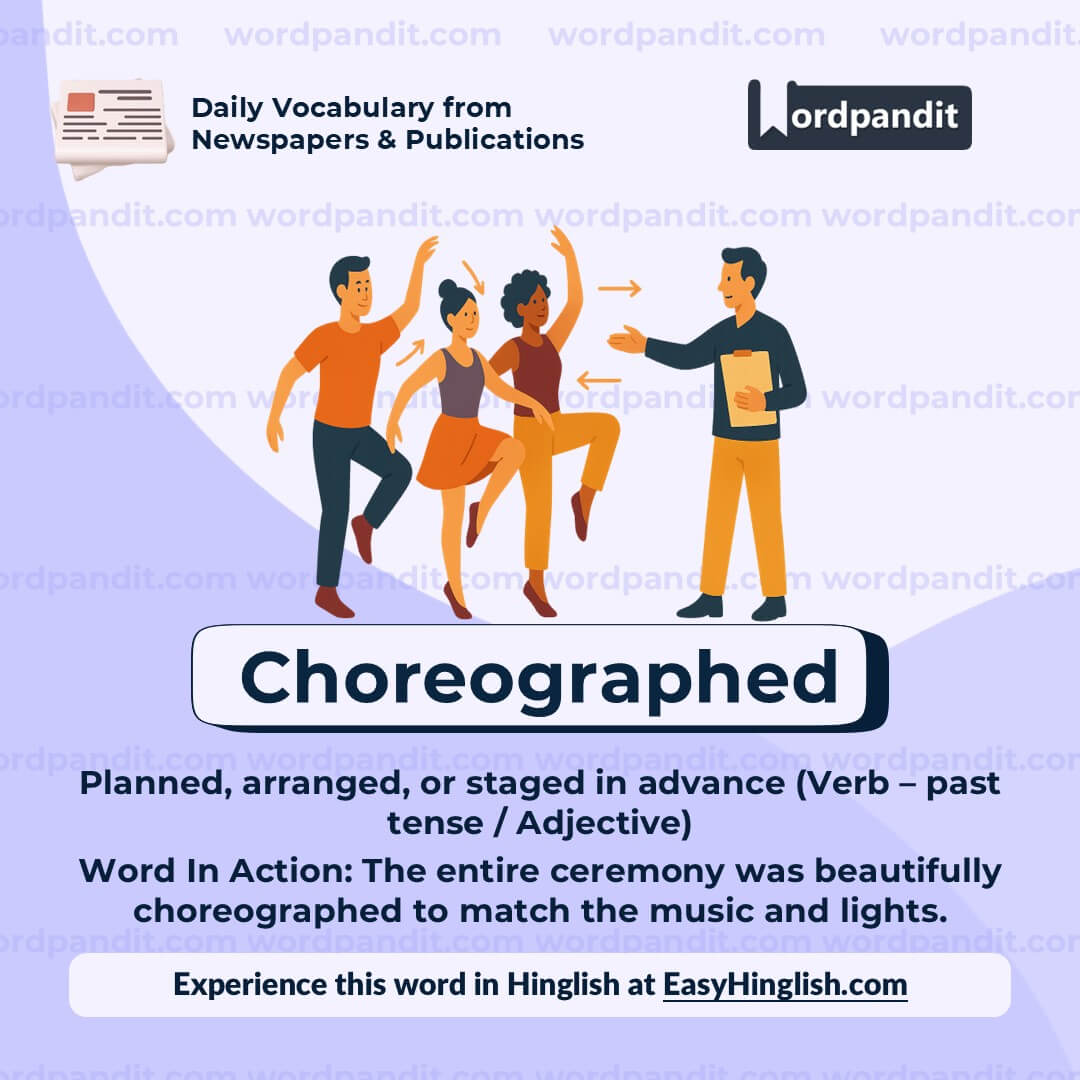
WORD-2: Choreographed
Context:
"The choreographed rallies, puppet rivals and Potemkin village polling stations are not subtle counterfeits designed to be mistaken for the genuine article." - The Guardian
Explanatory Paragraph:
The word choreographed comes from the world of dance, where it means designing and arranging movements in a planned sequence. Outside dance, it is often used metaphorically to describe events or actions that appear carefully controlled, staged, or planned in advance, often to create a certain impression. In politics or media, calling something “choreographed” suggests that spontaneity is missing—it is more like a performance than reality.
Meaning: Planned, arranged, or staged in advance (Verb – past tense / Adjective)
Pronunciation: Ko-ree-uh-graft
Difficulty Level: ⭐⭐⭐ Intermediate
Etymology: From Greek khoros (dance) + graphein (to write). Originally used for designing dances, later extended to describe any planned or staged action.
Prashant Sir's Notes:
While “choreographed” literally means designed dance movements, in exams it usually appears in the figurative sense: events, speeches, or rallies that are pre-planned and lack spontaneity.
Synonyms & Antonyms:
Synonyms: staged, arranged, orchestrated, planned, premeditated
Antonyms: spontaneous, improvised, unplanned, natural
Usage Examples:
- The flash mob was carefully choreographed to surprise the audience at the mall.
- Many critics argued that the leader’s “impromptu” walk among the crowd was actually choreographed for the cameras.
- The ceremony was beautifully choreographed, with each participant knowing their exact role.
- She choreographed the play so that every movement matched the rhythm of the music.
Cultural Reference:
Opening ceremonies of the Olympics are often described as “choreographed spectacles,” blending dance, theater, and national symbolism into a carefully staged performance.
Think About It:
If an event is “choreographed,” does it automatically lose authenticity, or can careful planning still feel genuine?
Quick Activity:
Write one sentence describing a literal use of “choreographed” (related to dance) and another showing its metaphorical use (related to politics or media).
Memory Tip:
Think of “choreo” (dance) + “graph” (write). To choreograph is to “write the dance” — and by extension, to pre-plan any sequence of actions.
Real-World Application:
In journalism, “choreographed” is often used to critique staged media events, while in performing arts it describes the actual design of dance and theater performances.
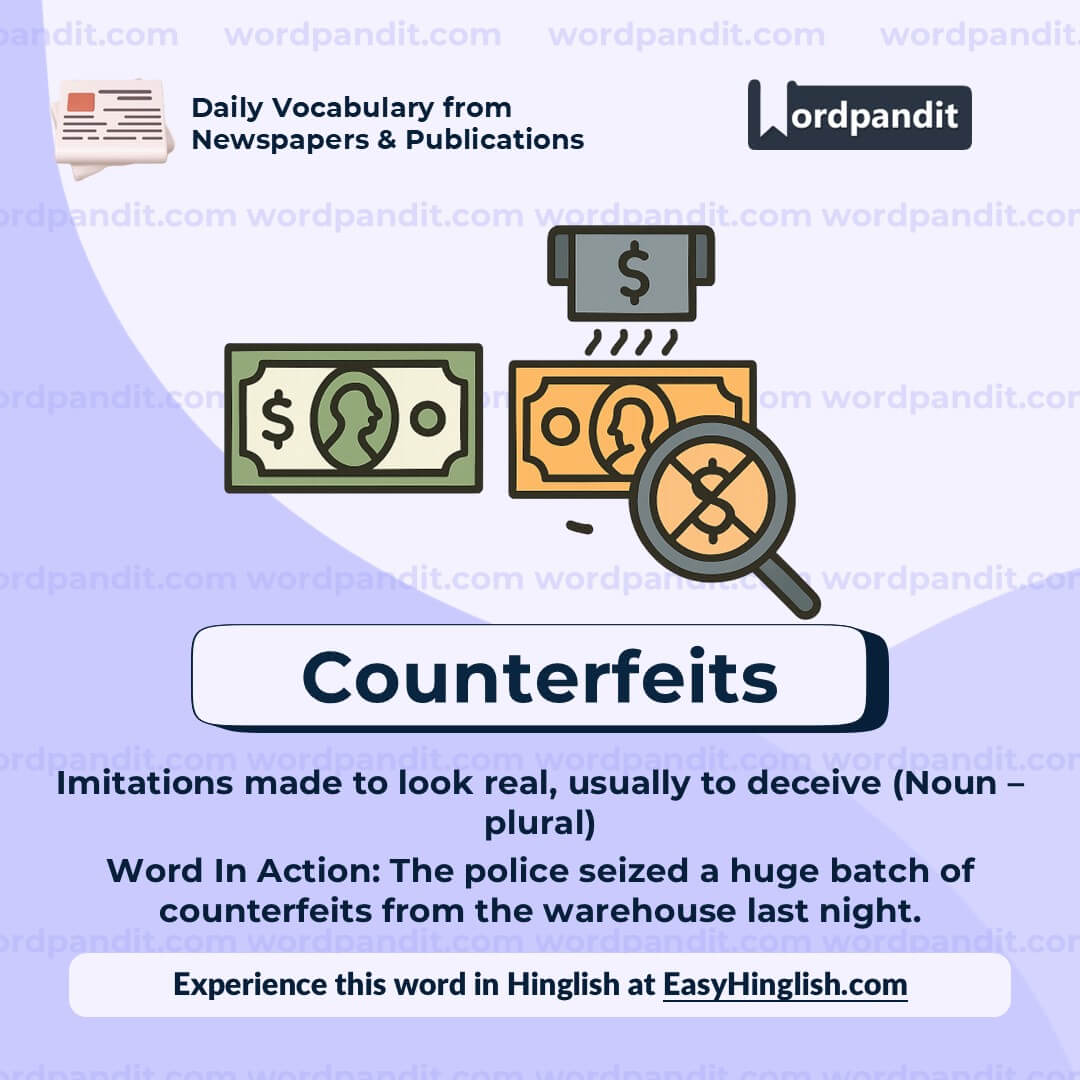
WORD-3: Counterfeits
Context:
"The choreographed rallies, puppet rivals and Potemkin village polling stations are not subtle counterfeits designed to be mistaken for the genuine article." - The Guardian
Explanatory Paragraph:
The word counterfeits refers to imitations made to look like the real thing, often with the intent to deceive. It is commonly used for fake money, documents, or products, but can also apply to actions or events that are staged to give a false impression of authenticity. In the given context, “counterfeits” suggests that the rallies and polling stations are not genuine democratic practices but staged imitations meant to mislead.
Meaning: Imitations made to look real, usually to deceive (Noun – plural)
Pronunciation: Kown-ter-fayts
Difficulty Level: ⭐⭐⭐ Intermediate
Etymology: From Old French contrefaire, meaning "to imitate," from Latin contra (against) + facere (to make).
Prashant Sir's Notes:
Counterfeit does not only apply to money—it can be used for fake emotions, fake leaders, or staged events. In exams, look for figurative use beyond just financial fraud.
Synonyms & Antonyms:
Synonyms: fake, forgery, imitation, sham, fraud
Antonyms: genuine, authentic, original, legitimate
Usage Examples:
- The police seized thousands of counterfeit banknotes from the warehouse.
- Her smile looked like a counterfeit, masking her true feelings.
- The brand is taking strict action against counterfeit goods being sold online.
- The event was dismissed as a counterfeit attempt at democracy.
Cultural Reference:
Counterfeit money has been a recurring theme in crime novels and films, such as the movie “Catch Me If You Can,” where fake identities and forgeries drive the plot.
Think About It:
Is a counterfeit always harmful, or can some imitations (like art reproductions or costume jewelry) serve a useful purpose?
Quick Activity:
Create two sentences: one where “counterfeit” refers to an object (like money or goods) and another where it refers to something abstract (like emotions or values).
Memory Tip:
Break it as “counter” (against) + “feit” (from Latin facere, to make) → something “made against the real,” i.e., a fake copy.
Real-World Application:
Counterfeiting is a global issue in finance, fashion, and technology. Beyond products, the term is also used in politics and media to expose fake appearances of truth or legitimacy.
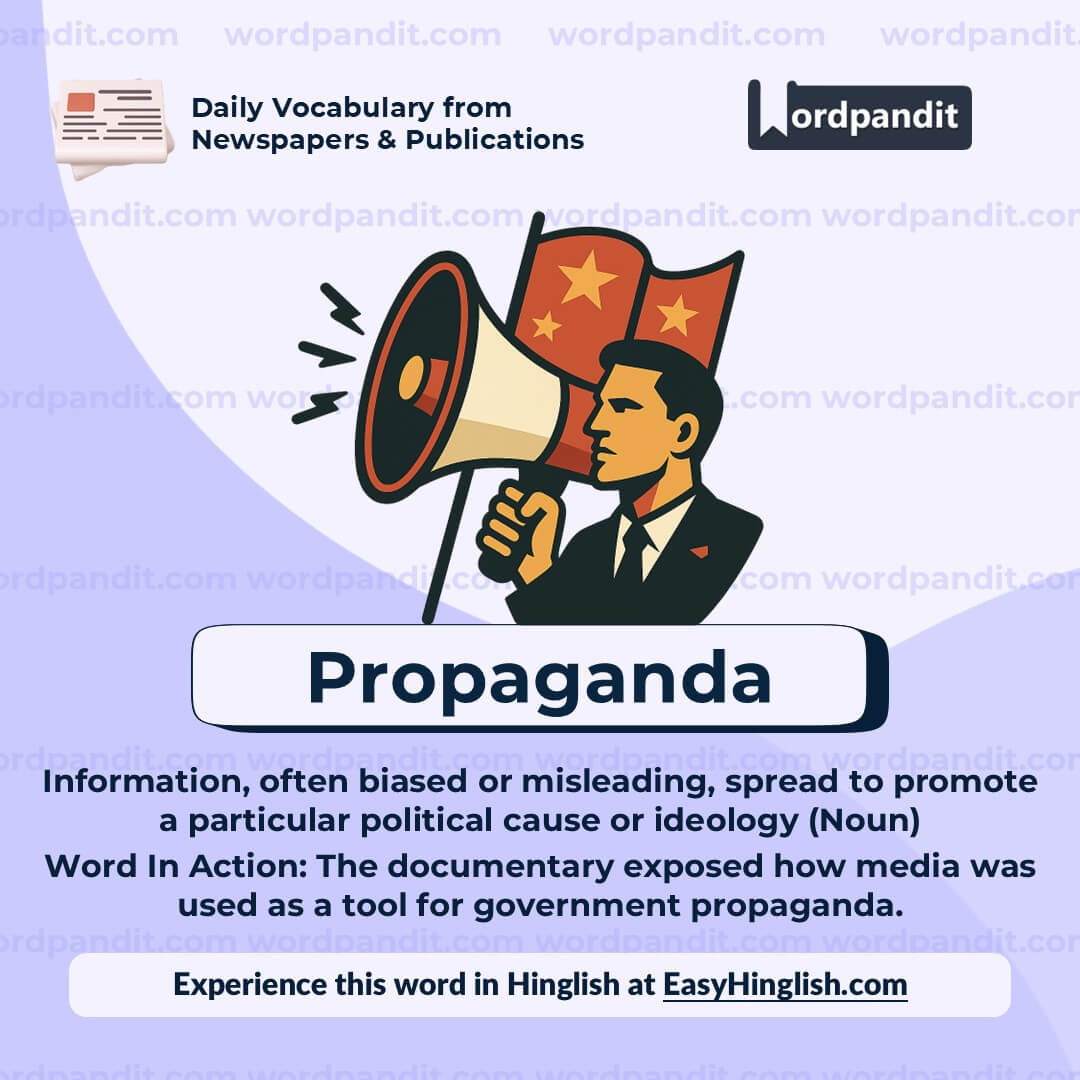
WORD-4: Propaganda
Context:
"Cultivating contempt for democracy is one of the most powerful propaganda weapons in a despot’s arsenal." - The Guardian
Explanatory Paragraph:
Propaganda refers to information that is spread with the purpose of influencing opinions, often in a biased or misleading way. It is usually associated with governments, political groups, or organizations that want to shape public perception in their favor. While propaganda can be used to spread positive ideas, the word generally carries a negative sense—suggesting manipulation, distortion of truth, or the deliberate hiding of facts.
Meaning: Information, often biased or misleading, spread to promote a particular political cause or ideology (Noun)
Pronunciation: Pro-puh-gan-duh
Difficulty Level: ⭐⭐⭐ Intermediate
Etymology: From modern Latin Congregatio de Propaganda Fide ("Congregation for Propagating the Faith"), a committee of cardinals established in 1622 by the Catholic Church to spread religious teachings. Over time, the term came to mean the spread of ideas—often with manipulation.
Prashant Sir's Notes:
Remember: propaganda is not always lies—it can be truth exaggerated, twisted, or presented selectively to shape opinions. In exams, it usually means manipulative messaging by leaders, governments, or groups.
Synonyms & Antonyms:
Synonyms: misinformation, disinformation, spin, indoctrination, brainwashing
Antonyms: truth, facts, objectivity, impartiality
Usage Examples:
- The regime used propaganda posters to glorify its leader and suppress dissent.
- During wartime, both sides relied heavily on propaganda to boost morale and demonize the enemy.
- Social media has become a modern tool for spreading propaganda quickly and widely.
- The documentary exposed how advertising can sometimes act as subtle propaganda.
Cultural Reference:
George Orwell’s novel 1984 illustrates how propaganda can control entire societies, with slogans like “War is Peace” and constant manipulation of truth by the state.
Think About It:
In today’s digital age, where news spreads instantly, how can we distinguish between genuine information and propaganda?
Quick Activity:
Write a short headline or slogan that could be used as propaganda—then rewrite it in a neutral, factual way.
Memory Tip:
Think of “propaganda” as “propagate + agenda” → spreading an agenda, often with manipulation.
Real-World Application:
Propaganda is not just found in politics—advertising, marketing campaigns, and even social media influencers sometimes use propaganda techniques to sway public opinion.
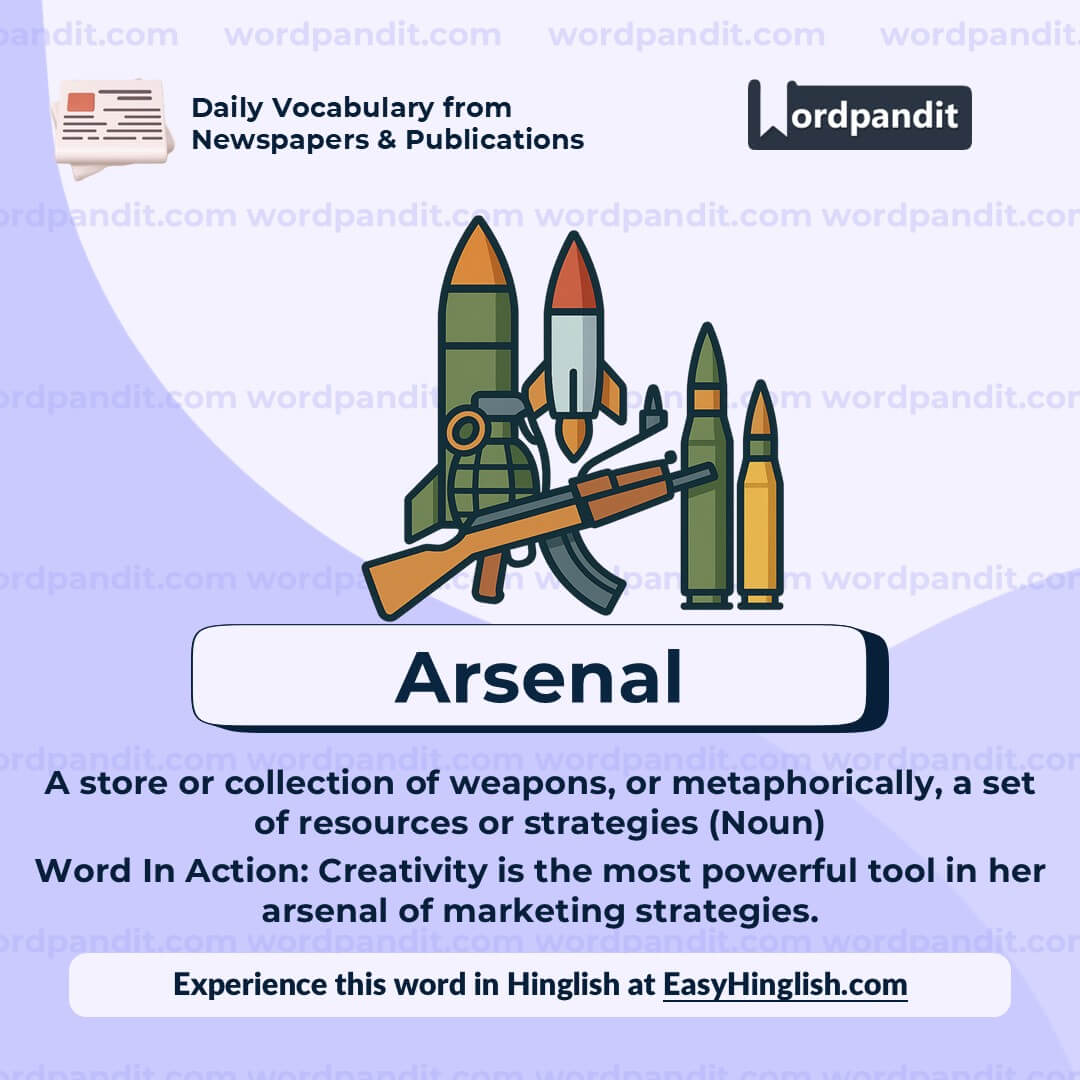
WORD-5: Arsenal
Context:
"Cultivating contempt for democracy is one of the most powerful propaganda weapons in a despot’s arsenal." - The Guardian
Explanatory Paragraph:
The word arsenal originally means a place where weapons and military equipment are stored. Over time, it has also come to mean a collection or supply of tools, resources, or strategies that someone can use to achieve their goals. In the given context, it is used metaphorically: a despot’s “arsenal” refers not to literal weapons but to manipulative strategies (like propaganda) used to maintain power.
Meaning: A store or collection of weapons, or metaphorically, a set of resources or strategies (Noun)
Pronunciation: Ahr-suh-nuhl
Difficulty Level: ⭐⭐ Basic to Intermediate
Etymology: From Italian arsenale, from Arabic dār aṣ-ṣināʿa meaning “house of manufacture.” Originally referred to shipyards or places making weapons.
Prashant Sir's Notes:
“Arsenal” is often used metaphorically in exams: not just weapons, but also a set of skills, strategies, or tools one can use. Pay attention to context—literal (military) vs. figurative (resources).
Synonyms & Antonyms:
Synonyms: armory, storehouse, repository, reserve, stockpile
Antonyms: scarcity, deficiency, shortage, lack
Usage Examples:
- The city hosts one of the largest military arsenals in the region.
- A good vocabulary is a powerful arsenal for effective communication.
- The scientist used an arsenal of advanced tools to conduct her research.
- Humor was his secret weapon in the arsenal of leadership skills.
Cultural Reference:
The football club “Arsenal FC” in London takes its name from the Royal Arsenal, a historic weapons factory in Woolwich, linking the word to strength and firepower.
Think About It:
When we describe knowledge, skills, or even propaganda as an “arsenal,” does it suggest that ideas can be as powerful as physical weapons?
Quick Activity:
Write one sentence using “arsenal” in the literal sense (weapons) and another in the metaphorical sense (skills/resources).
Memory Tip:
Think of “arsenal” as a “storehouse of arms.” Extend this idea to any “storehouse of resources.”
Real-World Application:
In business, education, and politics, “arsenal” is frequently used metaphorically to describe strategies, tools, or talents available to someone, beyond its military meaning.


