

Daily Vocabulary from International Newspapers and Publications
Expand Your Vocabulary with Wordpandit’s Global Vocabulary Hub
At Wordpandit, we are committed to helping you develop a truly global vocabulary by drawing from some of the most respected international publications. This section is designed to keep you ahead of the curve by introducing you to words that define global conversations and trends.
The Power of Global Sources
To help you think and communicate on a global scale, we curate vocabulary from renowned international sources, such as:
- The New York Times
- The Washington Post
- BBC
- The Guardian
- The Economist
- Scientific American
- Psychology Today
- And many more...
Stay Global, Stay Competitive
Our daily updates from international publications ensure you are consistently exposed to new words that reflect global news and developments, making sure your vocabulary is not only current but also globally relevant.
Enhance Your Global Perspective
Whether you’re preparing for international exams, aiming to excel in global business communication, or want to enhance your language skills for personal growth, Wordpandit offers the resources you need to thrive in a global context.
Effective Learning, Global Reach
Our learning methodology combines global examples, memory aids, and interactive activities, allowing you to internalize new words effectively and apply them in real-world scenarios.
Begin Your Global Vocabulary Journey Now!

Why Choose Wordpandit?
Practical Learning: Focus on words you'll actually encounter in real-world reading, enhancing your comprehension and communication skills.
Diverse Content: From current affairs to scientific breakthroughs, our varied sources expose you to vocabulary across multiple domains.
Effortless Integration: Make Wordpandit a part of your daily routine. Just a few minutes each day can significantly boost your lexicon over time.
Your Path to Vocabulary Mastery
- Visit our Daily Vocabulary section regularly
- Explore new words and their usage in context
- Practice incorporating these words into your own writing and speech
- Track your progress as your vocabulary expands
Start Your Journey Today
Embark on your vocabulary enhancement journey with Wordpandit. By consistently engaging with our daily posts, you'll build a robust vocabulary that serves you well in academic, professional, and personal contexts.
Remember, a word a day keeps linguistic limitations at bay. Make Wordpandit your daily companion in the quest for vocabulary excellence!
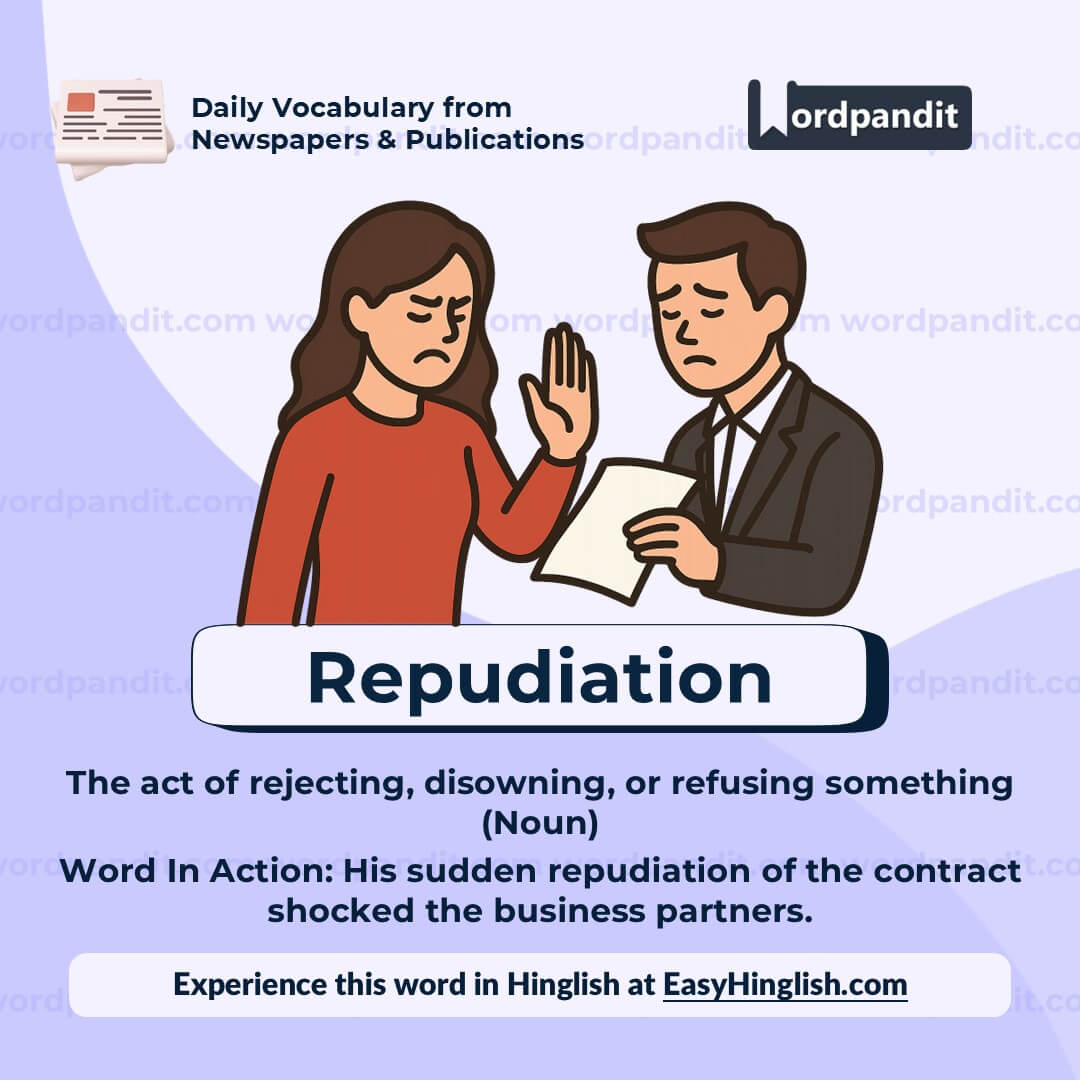
WORD-1: Repudiation
Context:
"That doesn’t make his method infallible, but its repudiation has proved to be a reliable route to defeat." - Guardian
Explanatory Paragraph:
Repudiation means the act of rejecting, refusing to accept, or denying the validity of something. It often carries a formal or strong sense of rejection, such as denying an idea, refusing to acknowledge responsibility, or officially declaring something void. In politics, law, and everyday life, repudiation signals a clear break from something previously suggested, believed, or agreed upon.
Meaning: The act of rejecting, disowning, or refusing something (Noun)
Pronunciation: reh-pyoo-dee-AY-shun
Difficulty Level: ⭐⭐⭐ Intermediate
Etymology: From Latin repudiare meaning "to reject, cast off," derived from pudere (to cause shame). Entered English in the late 16th century with the sense of formal rejection or denial.
Prashant Sir's Notes:
Think of repudiation as a very strong "NO." It’s not just ignoring something; it’s actively rejecting it. You often see this word in legal, political, and intellectual contexts where ideas, agreements, or responsibilities are denied.
Synonyms & Antonyms:
Synonyms: rejection, denial, disavowal, renunciation, refusal
Antonyms: acceptance, affirmation, approval, acknowledgment, embrace
Usage Examples:
- The company’s repudiation of the contract led to a long legal battle.
- Her public repudiation of the rumor silenced the critics.
- The leader’s repudiation of violence was welcomed by the international community.
- His repudiation of outdated traditions made him a controversial figure.
Cultural Reference:
"In law, repudiation is often used to describe the refusal to honor a contract or agreement, a concept that has shaped countless historical disputes." - Adapted from legal studies context
Think About It:
When does rejecting an idea or tradition become an act of courage, and when does it become an act of irresponsibility?
Quick Activity:
Write two sentences: one where you use "repudiation" in a political context, and another in a personal context.
Memory Tip:
Think of "repudiate" as "re-PUsh away" → to push away or reject strongly. Repudiation is the noun form of this action.
Real-World Application:
Repudiation is often used in international relations when a country rejects a treaty, in business when a contract is denied, or in personal life when someone distances themselves from an accusation or false claim.
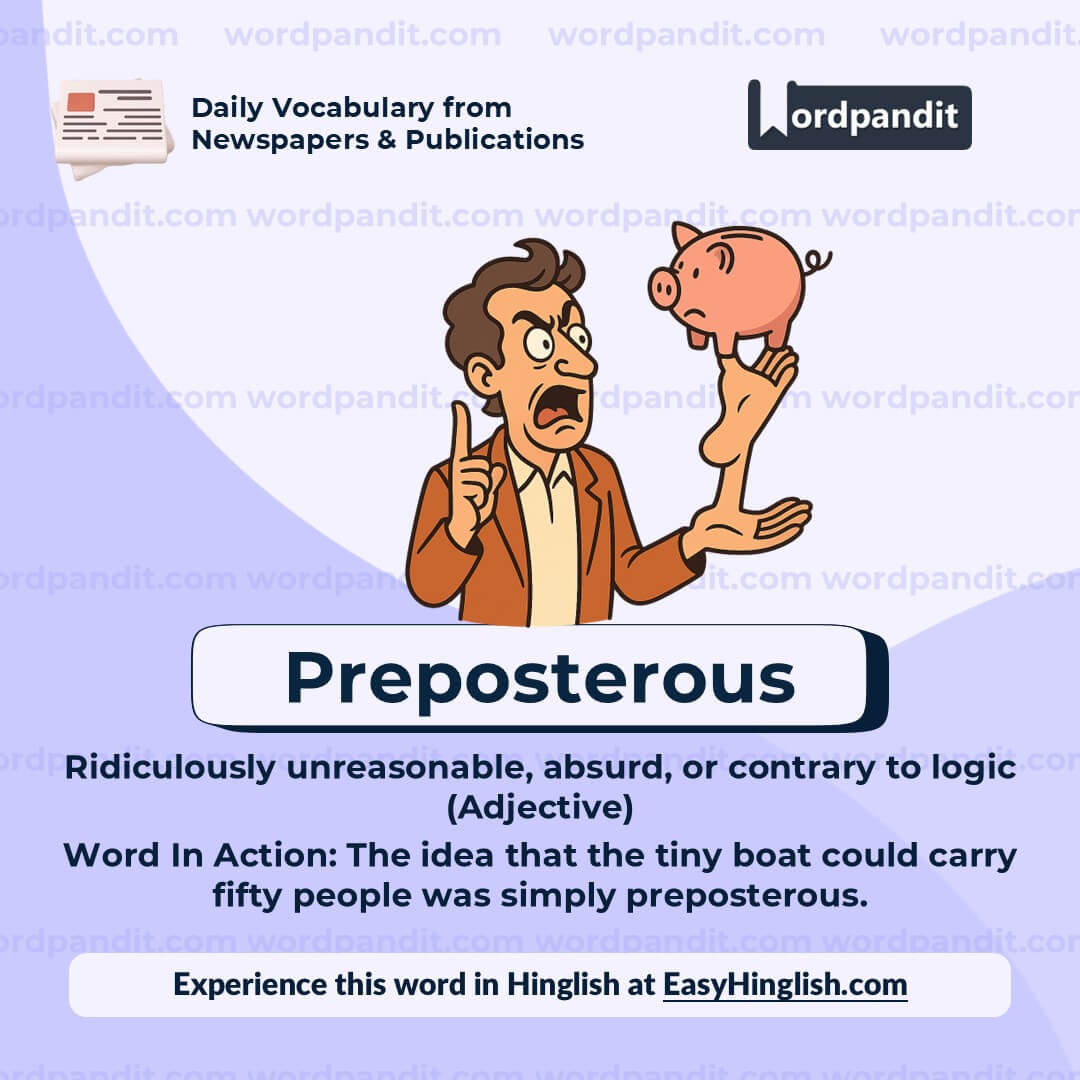
WORD-2: Preposterous
Context:
"Pleading for continuity in volatile times is probably the best campaign available to Sunak, which is to say the only one that isn’t preposterous given that his party has been in power for the past 14 years." - Guardian
Explanatory Paragraph:
Preposterous describes something that is completely absurd, ridiculous, or contrary to common sense. It conveys disbelief that something could even be considered reasonable. When an idea, plan, or statement is called preposterous, it suggests that it is laughably unreasonable or irrational.
Meaning: Ridiculously unreasonable, absurd, or contrary to logic (Adjective)
Pronunciation: preh-POS-ter-us
Difficulty Level: ⭐⭐ Basic-Intermediate
Etymology: From Latin praeposterus, meaning “the wrong way round,” literally “before-behind” (prae = before, posterus = coming after). The idea is of things being in absurd or illogical order.
Prashant Sir's Notes:
Think of preposterous as something so unreasonable that it flips logic upside down. If someone says, “Let’s ban sleeping to increase productivity,” that would be preposterous! Use it for strong emphasis when something defies common sense.
Synonyms & Antonyms:
Synonyms: absurd, ludicrous, ridiculous, nonsensical, outrageous
Antonyms: reasonable, sensible, logical, rational, realistic
Usage Examples:
- It’s preposterous to think you can run a marathon without any training.
- The idea of building a snowman in the middle of summer sounded preposterous to the children.
- He made a preposterous claim that he could finish the project in one hour.
- The teacher laughed at the preposterous excuse for missing homework.
Cultural Reference:
In classic British comedy shows, the word "preposterous" is often used as a sharp retort to highlight absurdity in political debates or daily life, giving it a dramatic and humorous effect.
Think About It:
Why do we often laugh at preposterous ideas instead of considering whether they might inspire unconventional creativity?
Quick Activity:
Write down three "preposterous" inventions or ideas (e.g., a bicycle that floats in the air) and then explain why they would never work.
Memory Tip:
Break it into "pre" (before) + "posterous" (after) = “before-after” → when things are upside down or illogical, they are preposterous.
Real-World Application:
Preposterous is often used in debates, media commentary, and everyday conversations to dismiss an argument, proposal, or statement as absurd. It’s a powerful word to quickly highlight the illogical nature of something.
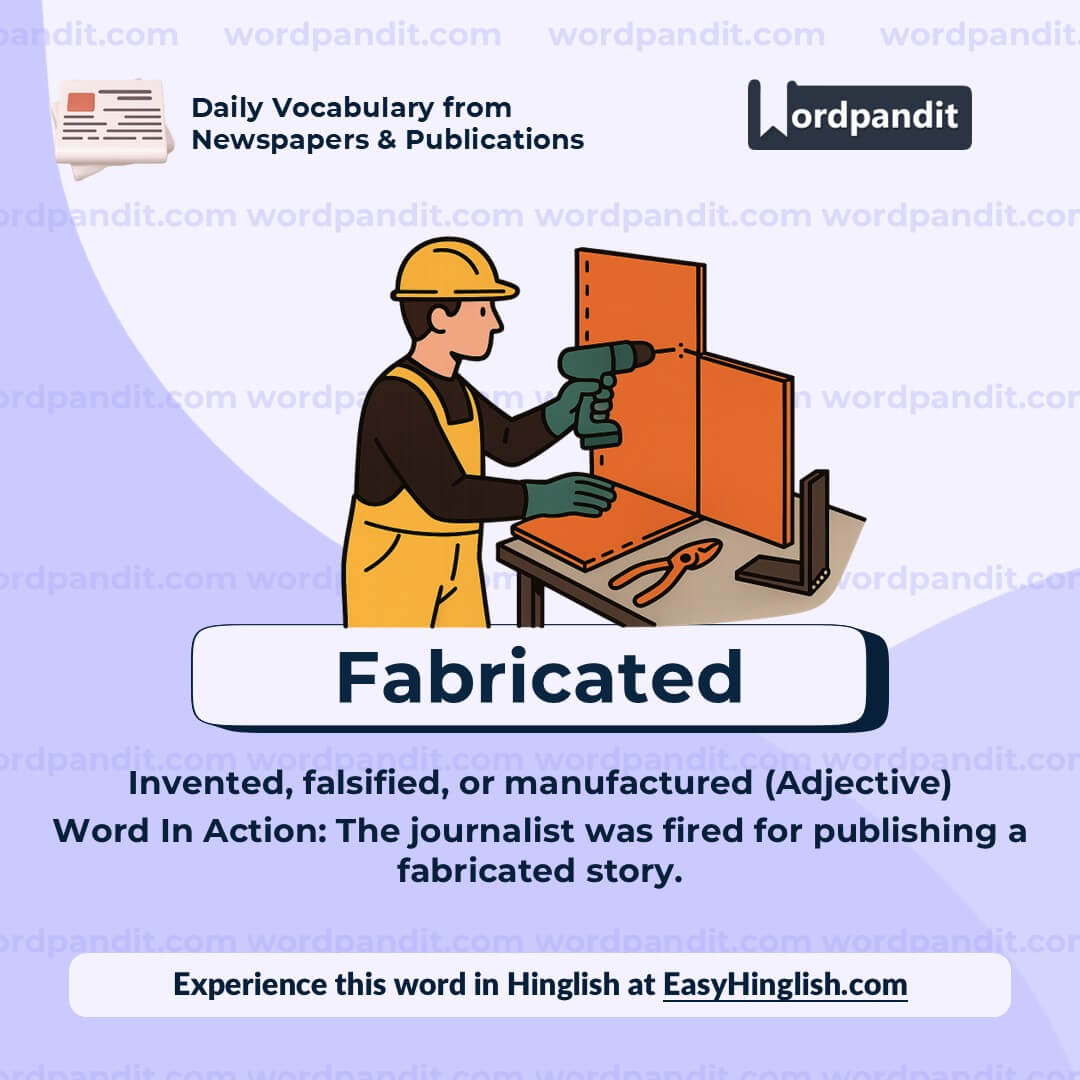
WORD-3: Fabricated
Context:
"The relevance to today’s circumstances is tenuous but not entirely fabricated." - Guardian
Explanatory Paragraph:
Fabricated means something that has been made up, invented, or constructed—often with the implication of being false or fake. While it can also mean “manufactured” in a neutral sense (like fabricated steel), in common usage it often suggests dishonesty, such as a fabricated excuse, story, or evidence.
Meaning: Invented, falsified, or manufactured (Adjective)
Pronunciation: FAB-ri-kay-ted
Difficulty Level: ⭐⭐ Basic-Intermediate
Etymology: From Latin fabricatus (“to make, build, construct”), past participle of fabricare. Originally meant “constructed” but later took on the meaning of “constructed falsely.”
Prashant Sir's Notes:
Remember: fabrication is not just about building; it can be about “building lies.” When you hear “fabricated,” ask yourself—was it genuinely built, or was it falsely invented?
Synonyms & Antonyms:
Synonyms: falsified, concocted, manufactured, forged, invented
Antonyms: genuine, authentic, real, truthful, valid
Usage Examples:
- The journalist was accused of publishing a fabricated story to attract attention.
- He offered a fabricated excuse for being late, but no one believed him.
- The evidence turned out to be fabricated, undermining the entire case.
- The company fabricated steel beams for the new bridge.
Cultural Reference:
In many famous legal scandals, from forged documents to staged reports, the exposure of fabricated evidence has dramatically changed the outcomes of trials and public opinion.
Think About It:
Why do people often prefer to believe fabricated stories, even when they seem too good—or too bad—to be true?
Quick Activity:
Write one fabricated excuse for missing school or work, and then rewrite it as a truthful version. Compare the two.
Memory Tip:
Think of "fabricated" as "fabric" + "created" → like weaving fabric, a false story is “woven together” piece by piece.
Real-World Application:
The word “fabricated” is widely used in journalism, politics, and law to expose false claims, evidence, or narratives. It is also used in engineering and industry in the literal sense of constructing or manufacturing something.
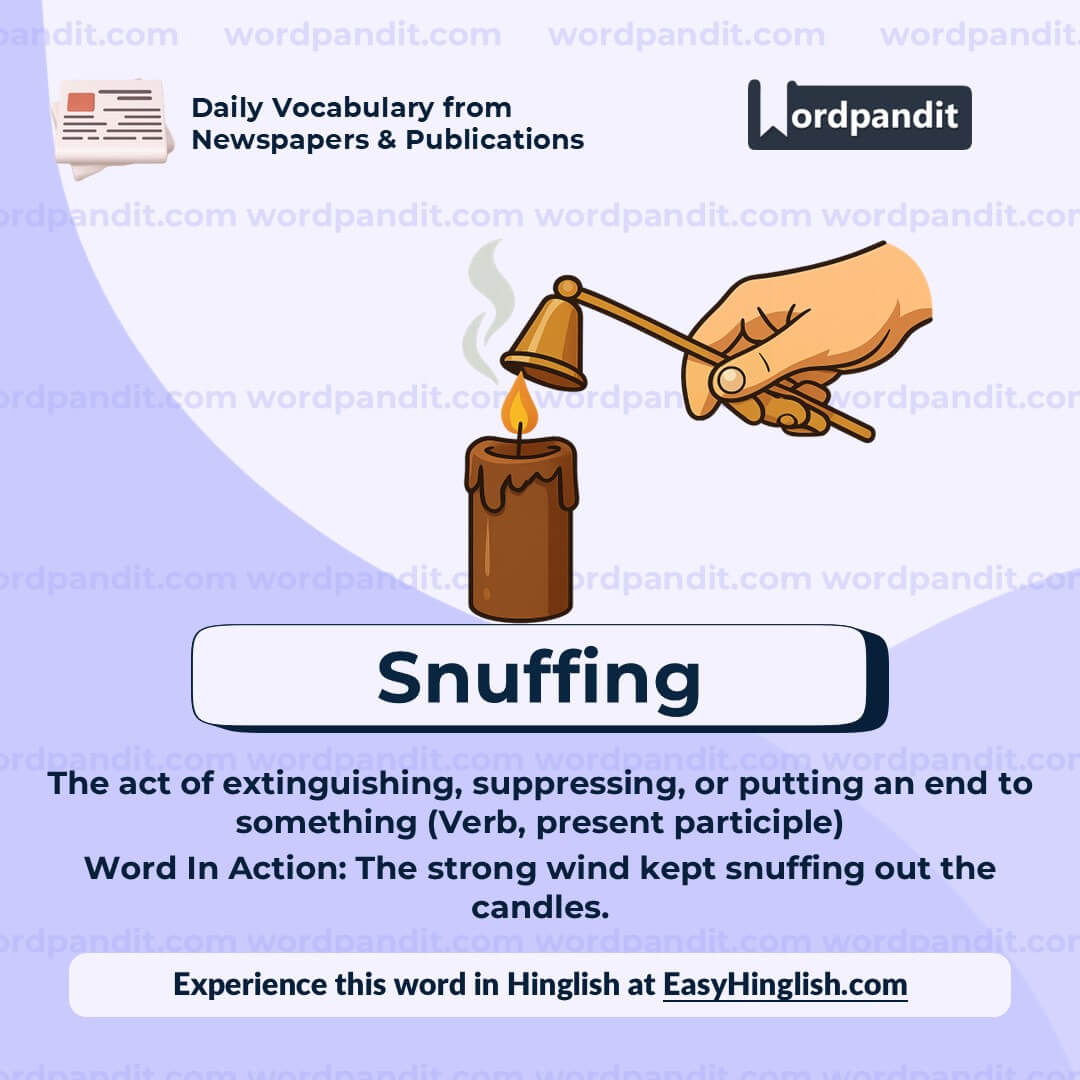
WORD-4: Snuffing
Context:
"There will be no premature victory rally like the one that Kinnock addressed in Sheffield the week before polling, which has entered Westminster folklore as a parable of vote-snuffing hubristic grandiosity." - Guardian
Explanatory Paragraph:
Snuffing usually means extinguishing or putting out something, such as a flame or a candle. By extension, it can also mean putting an end to something—killing an idea, suppressing enthusiasm, or even ending life in darker contexts. In the political example above, "vote-snuffing" suggests actions or attitudes that extinguished electoral support.
Meaning: The act of extinguishing, suppressing, or putting an end to something (Verb, present participle)
Pronunciation: snuhf-ing
Difficulty Level: ⭐⭐ Basic-Intermediate
Etymology: From Middle English snuffen, meaning "to snuff out a candle," possibly of Scandinavian origin. The figurative sense of "to end or suppress" developed later.
Prashant Sir's Notes:
Picture blowing out a candle—when you snuff a flame, it dies instantly. Apply this image to ideas, votes, or chances: snuffing means ending them suddenly and completely. The metaphor makes the word vivid.
Synonyms & Antonyms:
Synonyms: extinguishing, quenching, suppressing, dousing, smothering
Antonyms: igniting, sparking, kindling, fueling, stimulating
Usage Examples:
- She was snuffing out the candles one by one after the dinner party.
- The scandal ended up snuffing his chances of becoming president.
- Fear has a way of snuffing ambition before it can take root.
- The firefighters worked hard at snuffing the last embers of the blaze.
Cultural Reference:
In Victorian households, "candle-snuffers" were common tools for extinguishing candles without producing smoke. Today, the word often survives metaphorically in politics, literature, and film to describe killing off ideas or hopes.
Think About It:
Why does our language often compare the end of ideas or opportunities to the extinguishing of a flame?
Quick Activity:
Write one sentence where "snuffing" is used literally (like with a candle) and another where it’s used figuratively (like in politics or sports).
Memory Tip:
Imagine the sound “snuff” as the little puff of air you use to blow out a candle. That sound-image link makes it easy to remember the meaning.
Real-World Application:
"Snuffing" is often used in journalism, politics, and literature to describe how enthusiasm, chances, or movements are abruptly ended. In everyday life, it still applies to candles, flames, or even habits we try to end.
WORD-5: Retreading
Context:
"Wariness of retreading old errors gives Starmer’s approach to the election a ponderous gait, which critics interpret as morbid timidity and supporters identify as judicious pace." - Guardian
Explanatory Paragraph:
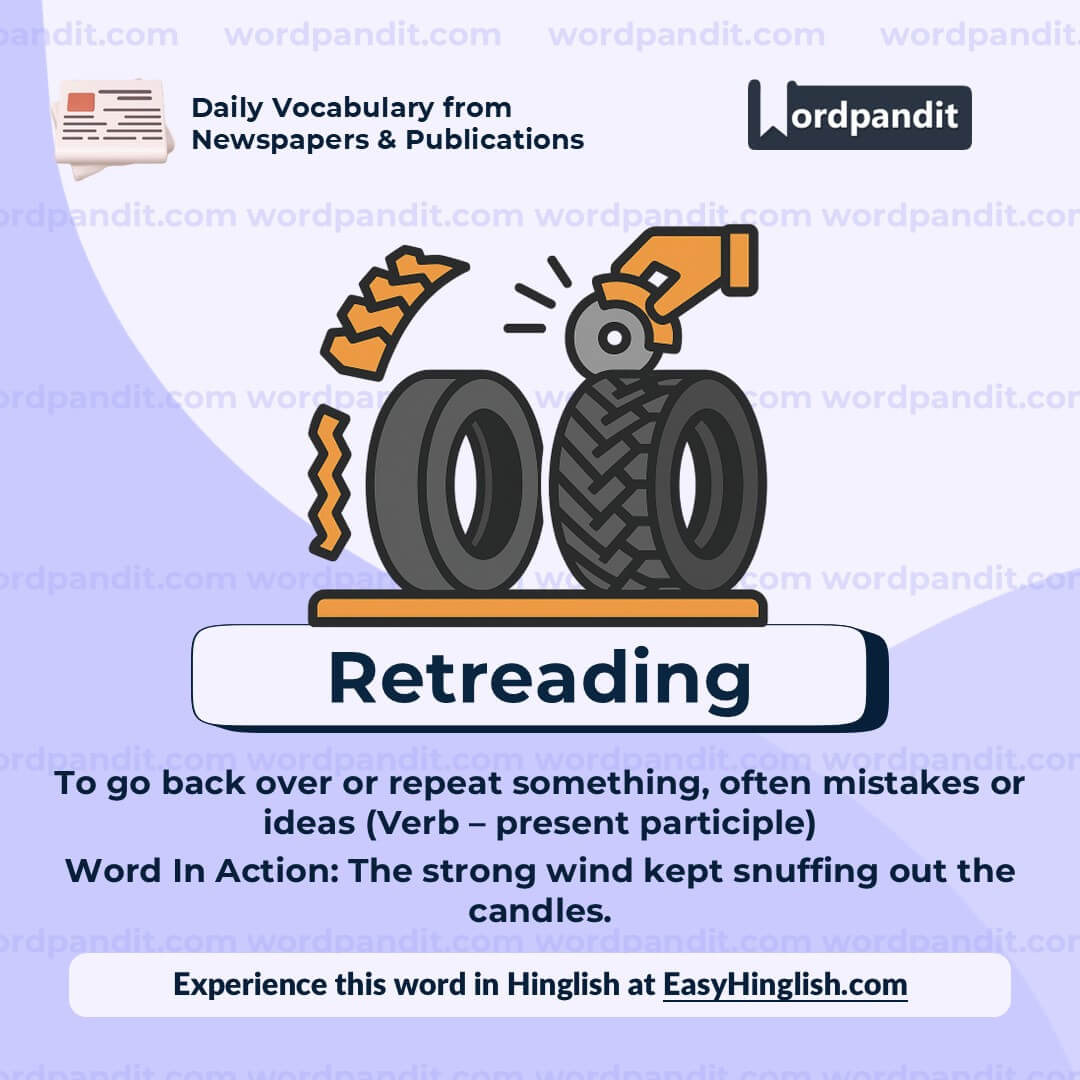
Retreading literally refers to replacing the worn surface of a tire with new material so it can be used again. Figuratively, it means going back over old ground—repeating past mistakes, revisiting familiar ideas, or recycling old approaches. In the political example above, "retreading old errors" means repeating mistakes that have already been made before.
Meaning: To go back over or repeat something, often mistakes or ideas (Verb – present participle)
Pronunciation: ree-TRED-ing
Difficulty Level: ⭐⭐ Basic-Intermediate
Etymology: From "re-" (again) + "tread" (to step or walk). Originally used in the 1600s to mean “to walk again,” later extended to tires in the automotive era, and figuratively to “repeating actions or mistakes.”
Prashant Sir's Notes:
Visualize walking the same path again and again—that’s retreading. In political or professional language, it suggests going back to old ways (often unsuccessfully). In practical usage, it’s also tied to tires being given a new surface for reuse.
Synonyms & Antonyms:
Synonyms: repeating, reusing, recycling, revisiting, rehashing
Antonyms: innovating, creating, originating, pioneering, advancing
Usage Examples:
- The director was criticized for retreading old themes instead of exploring new ideas.
- He avoided retreading past mistakes by carefully planning his campaign.
- The mechanic recommended retreading the tire to save money instead of buying a new one.
- Retreading outdated policies can make a leader seem unimaginative.
Cultural Reference:
In Hollywood, “retreading” is often used to describe movies that recycle old plots or reboot franchises instead of bringing something fresh—sometimes successful, often criticized.
Think About It:
Is retreading always a negative thing? Can revisiting old paths sometimes be wise and help us learn from history?
Quick Activity:
Write two sentences: one where “retreading” shows a negative idea (like repeating mistakes), and one where it shows a positive idea (like wisely reviewing lessons).
Memory Tip:
Think of “tread” as walking. Retread = walking the same path again → repeating what was already done.
Real-World Application:
“Retreading” appears in politics, business, and art to describe repetition of past ideas or strategies. It also has a very practical meaning in the automobile industry, where old tires are retreaded to extend their life and save costs.


