

Daily Vocabulary from International Newspapers and Publications
Expand Your Vocabulary with Wordpandit’s Global Vocabulary Hub
At Wordpandit, we are committed to helping you develop a truly global vocabulary by drawing from some of the most respected international publications. This section is designed to keep you ahead of the curve by introducing you to words that define global conversations and trends.
The Power of Global Sources
To help you think and communicate on a global scale, we curate vocabulary from renowned international sources, such as:
- The New York Times
- The Washington Post
- BBC
- The Guardian
- The Economist
- Scientific American
- Psychology Today
- And many more...
Stay Global, Stay Competitive
Our daily updates from international publications ensure you are consistently exposed to new words that reflect global news and developments, making sure your vocabulary is not only current but also globally relevant.
Enhance Your Global Perspective
Whether you’re preparing for international exams, aiming to excel in global business communication, or want to enhance your language skills for personal growth, Wordpandit offers the resources you need to thrive in a global context.
Effective Learning, Global Reach
Our learning methodology combines global examples, memory aids, and interactive activities, allowing you to internalize new words effectively and apply them in real-world scenarios.
Begin Your Global Vocabulary Journey Now!

Why Choose Wordpandit?
Practical Learning: Focus on words you'll actually encounter in real-world reading, enhancing your comprehension and communication skills.
Diverse Content: From current affairs to scientific breakthroughs, our varied sources expose you to vocabulary across multiple domains.
Effortless Integration: Make Wordpandit a part of your daily routine. Just a few minutes each day can significantly boost your lexicon over time.
Your Path to Vocabulary Mastery
- Visit our Daily Vocabulary section regularly
- Explore new words and their usage in context
- Practice incorporating these words into your own writing and speech
- Track your progress as your vocabulary expands
Start Your Journey Today
Embark on your vocabulary enhancement journey with Wordpandit. By consistently engaging with our daily posts, you'll build a robust vocabulary that serves you well in academic, professional, and personal contexts.
Remember, a word a day keeps linguistic limitations at bay. Make Wordpandit your daily companion in the quest for vocabulary excellence!
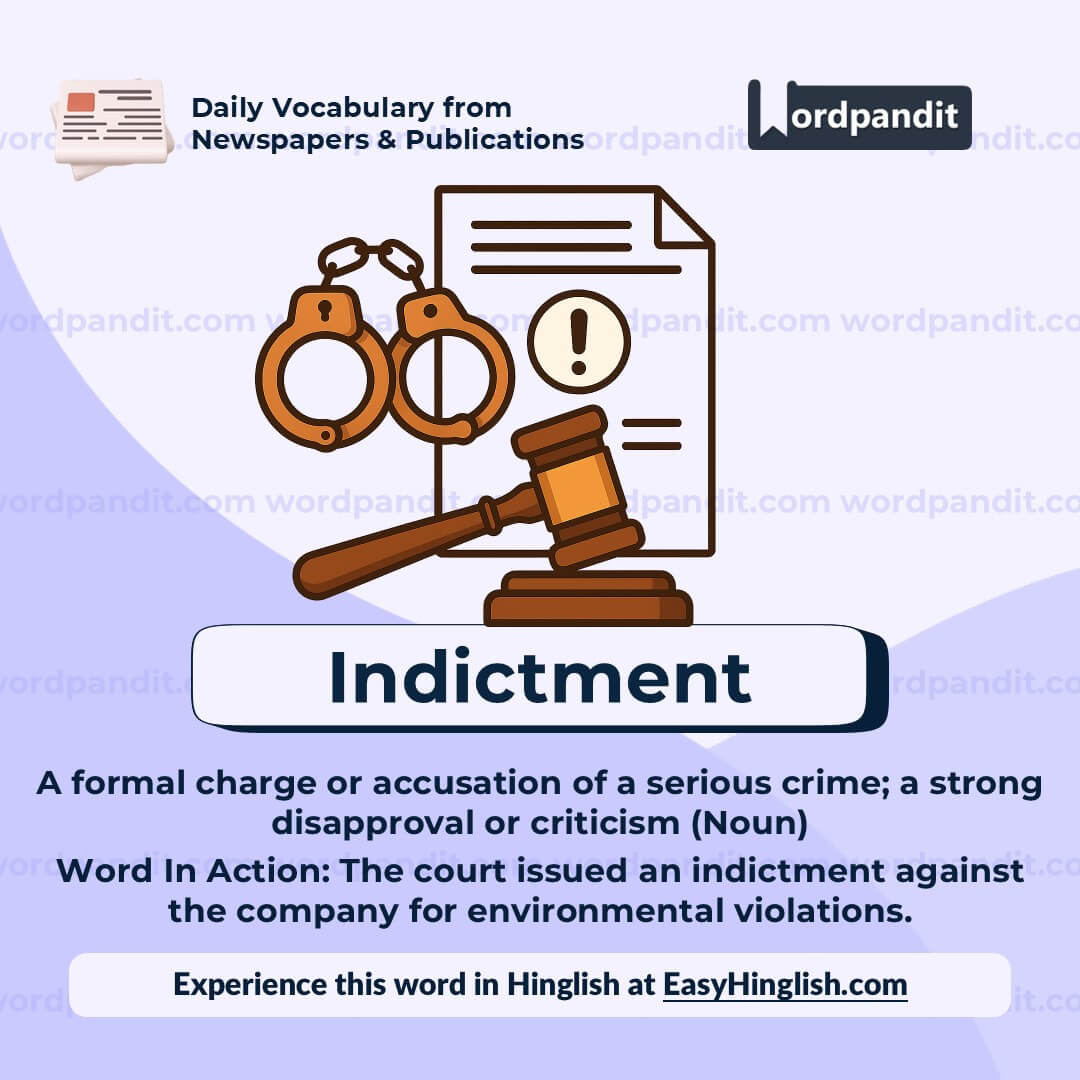
WORD-1: Indictment
Context:
"The impeachment clause of the Constitution provides that 'the Party convicted shall nevertheless be liable and subject to Indictment, Trial, Judgment and Punishment, according to Law.'" - Washington Post
Explanatory Paragraph:
The word indictment refers to a formal accusation or charge that someone has committed a crime. It is typically issued by a grand jury in legal systems like that of the United States. An indictment does not mean the person is guilty, but it formally begins the process of bringing the accused individual to trial. Outside the legal sense, the word can also be used figuratively to mean strong criticism of someone or something.
Meaning: A formal charge or accusation of a serious crime; a strong disapproval or criticism (Noun)
Pronunciation: in-DITE-ment
Difficulty Level: ⭐⭐⭐ Intermediate
Etymology: From Middle English enditement, derived from Anglo-French enditer (to accuse, indict), from Latin indictare meaning "to proclaim or declare."
Prashant Sir's Notes:
This word is very important in legal and political contexts. Remember: indictment = formal charge, not the final judgment. Many students confuse it with 'conviction,' but conviction is after proof; indictment is just the formal accusation.
Synonyms & Antonyms:
Synonyms: accusation, charge, allegation, prosecution
Antonyms: acquittal, exoneration, absolution
Usage Examples:
- The grand jury issued an indictment against the company for fraud.
- His career ended after the indictment on corruption charges.
- The report was seen as an indictment of the government's failure to act quickly.
- Being indicted does not mean being guilty—it only begins the legal process.
Cultural Reference:
"In U.S. history, many high-profile figures have faced indictments, highlighting the principle that no one is above the law." - American Legal History Discussions
Think About It:
Why do you think societies place importance on the process of indictment before trial, rather than going straight to judgment?
Quick Activity:
Fill in the blank: The report on the factory’s unsafe conditions was seen as a strong __________ of the company’s practices.
Memory Tip:
Think of "indictment" as "in-dite-ment" → “in writing a charge.” It reminds you that an indictment is a formal written charge against someone.
Real-World Application:
The word "indictment" is often heard in news reports, especially in stories involving political scandals, corporate crimes, or high-profile criminal cases. Knowing this term helps you better understand discussions about law and justice in society.
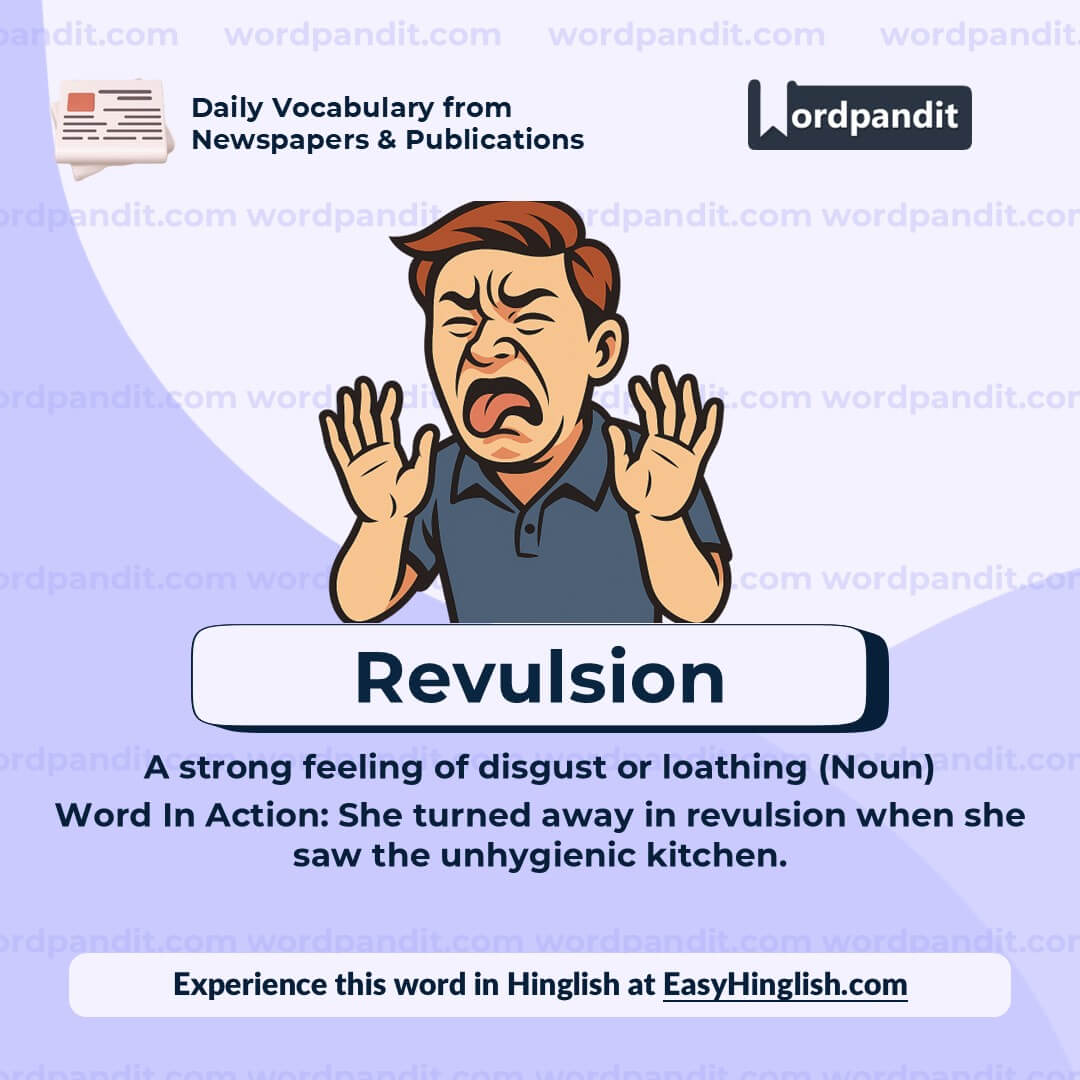
WORD-2: Revulsion
Context:
"Mr. Biden’s address performed a crucial civic service not only by channeling the public’s revulsion at a flagrant narcissist who won’t take no for an answer but also by forthrightly stating just what could happen to the United States if that narcissist wins again." - New York Times
Explanatory Paragraph:
The word revulsion describes a strong feeling of disgust, shock, or intense dislike toward something. It usually arises as a reaction to something morally offensive, repulsive, or deeply unpleasant. It goes beyond simple dislike—revulsion implies an instinctive emotional recoil or rejection of something detestable.
Meaning: A strong feeling of disgust or loathing (Noun)
Pronunciation: reh-VUL-shun
Difficulty Level: ⭐⭐ Beginner-Intermediate
Etymology: From Latin revulsio, meaning "a pulling back," from revellere (to pluck away, tear back). Over time, it came to describe an emotional pulling away caused by disgust.
Prashant Sir's Notes:
Revulsion is an emotional word—use it when describing very strong negative reactions. Remember: dislike is mild, revulsion is extreme. Also, it often pairs with reactions to moral wrongdoing or shocking events.
Synonyms & Antonyms:
Synonyms: disgust, loathing, abhorrence, repugnance, nausea
Antonyms: attraction, delight, admiration, affection
Usage Examples:
- She turned away in revulsion when she saw the cruelty of the act.
- The corruption scandal provoked widespread revulsion among the public.
- He spoke with revulsion about the injustice he had witnessed.
- The smell of spoiled food filled her with revulsion.
Cultural Reference:
"The global revulsion at apartheid in South Africa was a driving force behind international sanctions and boycotts." - Historical Human Rights Movements
Think About It:
Why do you think revulsion is such a powerful emotion in shaping moral and social movements?
Quick Activity:
Fill in the blank: The citizens expressed their __________ at the government's decision to cover up the scandal.
Memory Tip:
Think of "revulsion" as “re-volt + shun” → you shun or avoid something with revolt and disgust.
Real-World Application:
The term "revulsion" is widely used in journalism, politics, and literature to describe public outrage or moral disgust, especially in contexts like corruption, violence, or social injustice.
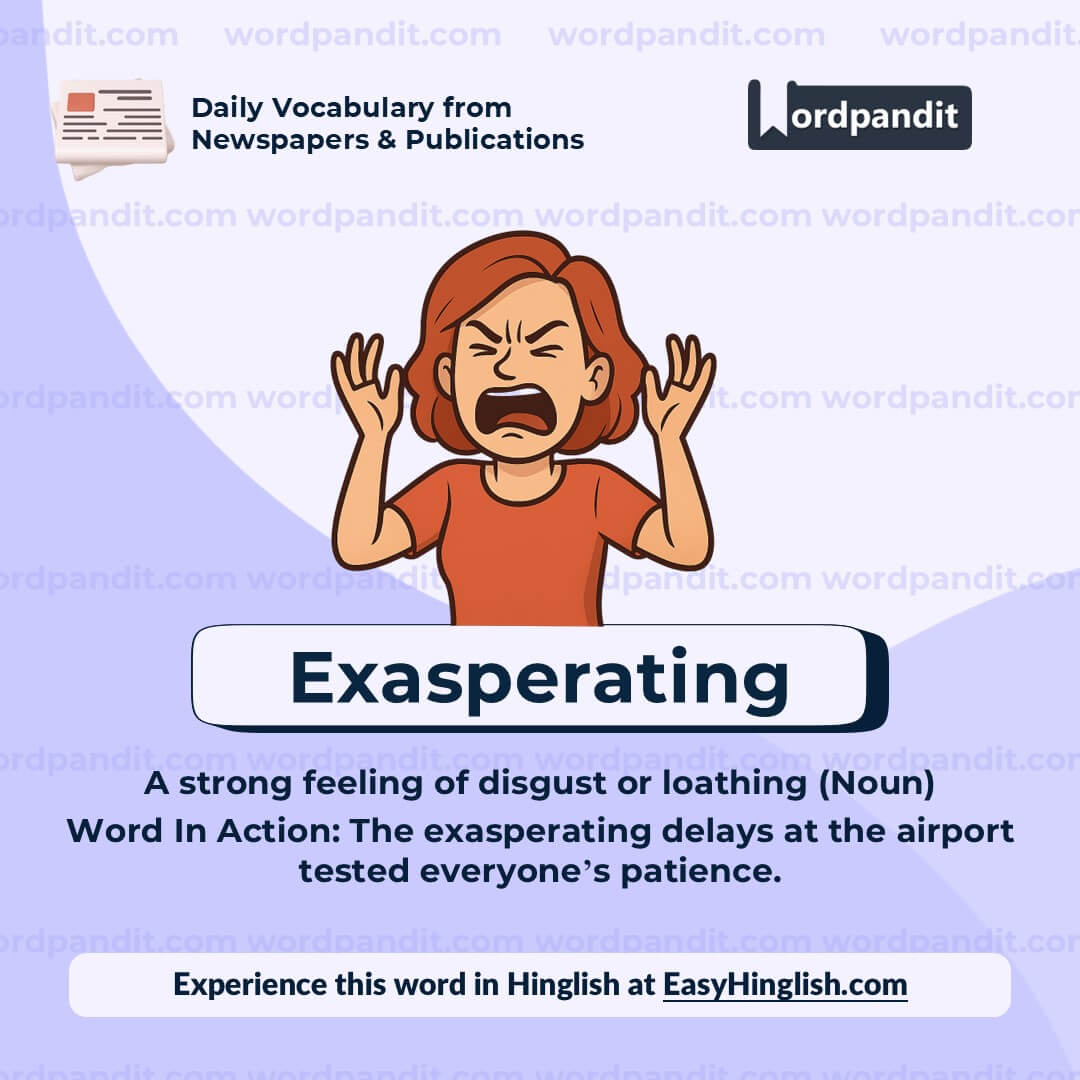
WORD-3: Exasperating
Context:
"The exasperating reality along with a majority of the country, struggles to cope with as we enter an election year unlike any in American history." - New York Times
Explanatory Paragraph:
The word exasperating describes something that is extremely annoying, frustrating, or irritating. It refers to situations, people, or problems that push someone’s patience to the limit. While “annoying” can be mild, “exasperating” suggests a deeper, almost overwhelming sense of irritation.
Meaning: Intensely irritating or frustrating (Adjective)
Pronunciation: ig-ZAS-puh-ray-ting
Difficulty Level: ⭐⭐ Beginner-Intermediate
Etymology: From Latin exasperare, meaning "to make rough, irritate," formed by combining ex- (thoroughly) + asper (rough). The sense evolved into provoking annoyance or frustration.
Prashant Sir's Notes:
Exasperating = beyond irritating. Think of that one situation that makes you clench your teeth—slow internet, endless bureaucracy, or people not listening. It’s more intense than “annoying.”
Synonyms & Antonyms:
Synonyms: infuriating, irritating, aggravating, maddening, vexing
Antonyms: calming, soothing, relieving, pleasing
Usage Examples:
- The exasperating delays at the airport tested everyone’s patience.
- It is exasperating to repeat the same instructions over and over again.
- The exasperating puzzle kept him awake all night.
- Her exasperating habit of interrupting made conversations difficult.
Cultural Reference:
"For many viewers, waiting week after week for cliffhangers in classic TV series was exasperating, yet it kept the excitement alive." - Media Studies Reflection
Think About It:
Do exasperating situations always harm us, or can they sometimes push us to grow in patience and problem-solving?
Quick Activity:
Make a list of three exasperating situations in daily life. Then, rewrite each as a positive challenge to build patience.
Memory Tip:
Think “ex-as-perating” → “extra irritating.” The “ex” at the beginning signals that the annoyance is pushed to the extreme.
Real-World Application:
"Exasperating" is commonly used in conversations, media, and literature to describe frustrating realities—whether it’s politics, technology, or everyday inconveniences. Knowing this word helps capture emotions more precisely.
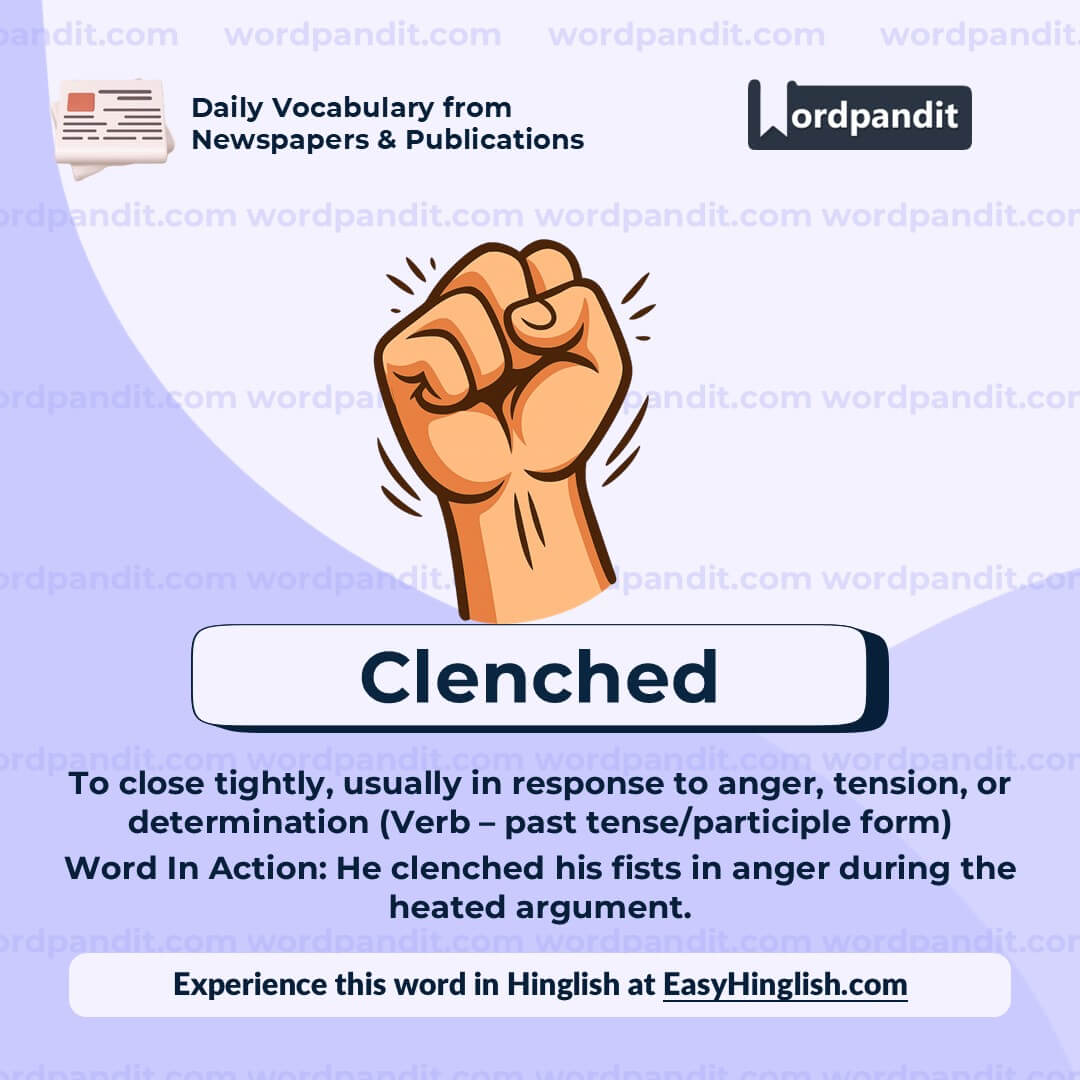
WORD-4: Clenched
Context:
"It was this brief, unfinished aside — off-script, sandwiched around an extended silence during which the president clenched his fists in an effort to resist uttering the curse behind his teeth." - New York Times
Explanatory Paragraph:
The word clenched refers to the action of closing something tightly, usually the hands, teeth, or jaw, often as a physical sign of strong emotion such as anger, determination, fear, or pain. For example, when someone clenches their fists, it usually shows they are trying to control or express intense feelings.
Meaning: To close tightly, usually in response to anger, tension, or determination (Verb – past tense/participle form)
Pronunciation: klensht
Difficulty Level: ⭐ Beginner
Etymology: From Middle English clenchen or clench, meaning "to grasp or clutch," likely imitative of the sound of teeth snapping shut. The sense of emotional intensity developed later.
Prashant Sir's Notes:
Clenched is a very physical word—it shows emotion without words. Fists clenched = anger or control; teeth clenched = suppressed anger or determination. It’s a great descriptive tool in writing.
Synonyms & Antonyms:
Synonyms: gripped, tightened, compressed, grasped
Antonyms: released, loosened, relaxed, opened
Usage Examples:
- He clenched his fists to stop himself from shouting.
- She clenched her teeth as the dentist worked on her tooth.
- The player clenched the trophy with pride and relief.
- His jaw was clenched, a sign of hidden anger.
Cultural Reference:
"The iconic image of an athlete standing on the podium with clenched fists raised became a symbol of resistance and strength." - Olympic History Archives
Think About It:
Why do physical actions like clenching often reveal emotions more clearly than words?
Quick Activity:
Act it out: Clench your fists for a few seconds. What emotions come to your mind? Write them down.
Memory Tip:
Remember “clenched” as “closed tight.” Both words start with “cl,” making it easy to link the action with the sound.
Real-World Application:
"Clenched" is often used in news reports, literature, and everyday speech to describe body language that reflects strong emotions—helping readers or listeners visualize intensity in a situation.
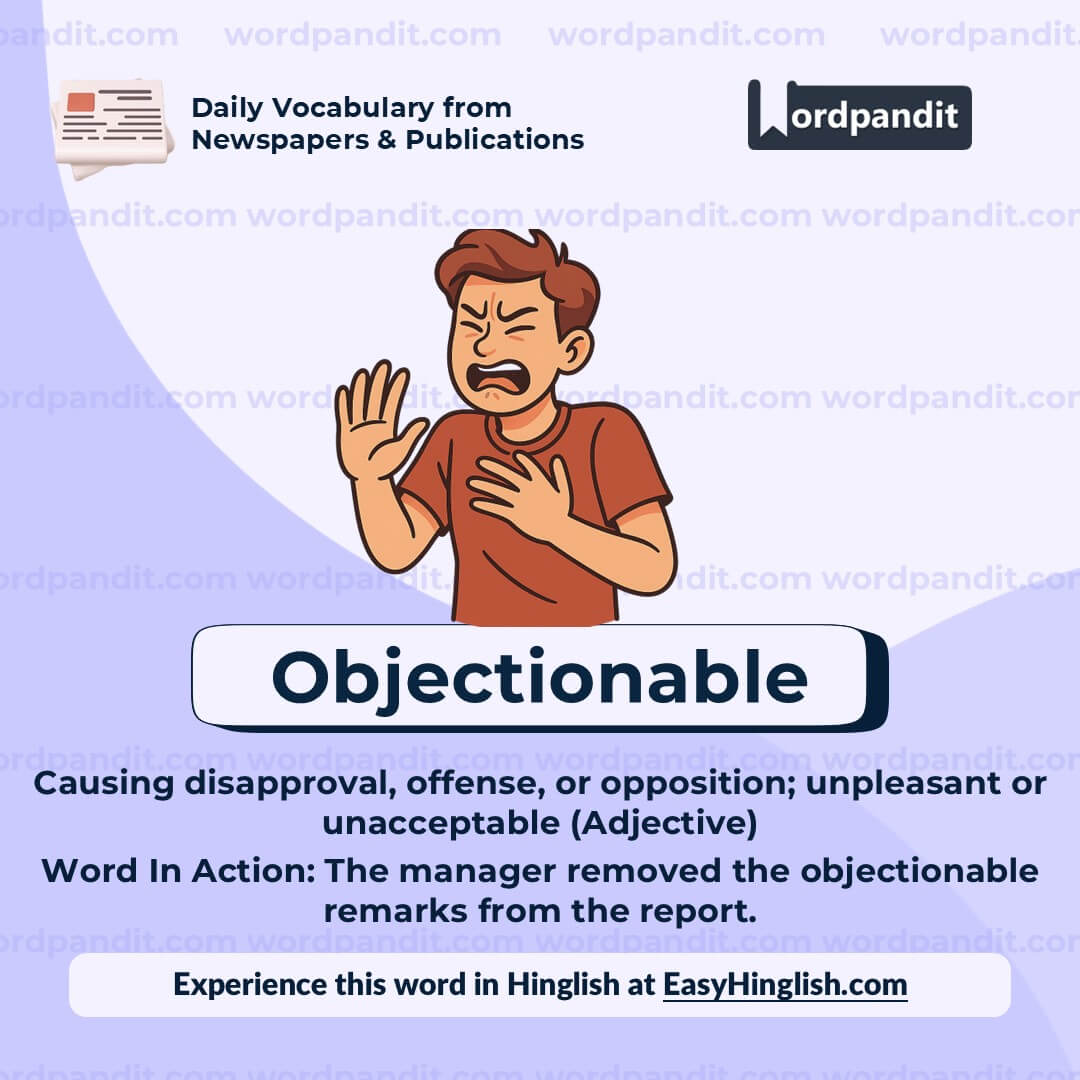
WORD-5: Objectionable
Context:
"No official who maintained the president’s support has ever been impeached for carrying out policy in ways the House found objectionable." - Washington Post
Explanatory Paragraph:
The word objectionable describes something that causes disapproval, dislike, or offense. If an action, idea, or behavior is objectionable, it is considered unpleasant, inappropriate, or morally or socially unacceptable to others. The strength of the objection can vary—from mild disapproval to strong condemnation—depending on context.
Meaning: Causing disapproval, offense, or opposition; unpleasant or unacceptable (Adjective)
Pronunciation: ub-JEK-shuh-nuh-bul
Difficulty Level: ⭐⭐ Beginner-Intermediate
Etymology: Derived from Latin objectus (to throw against, oppose) → Old French objection → Middle English objection + suffix -able (capable of). Literally, “capable of being opposed.”
Prashant Sir's Notes:
Think of “objectionable” as anything people would raise an “objection” against. It could be policies, language, behavior, or even jokes. Always remember: objectionable = unacceptable to others’ standards.
Synonyms & Antonyms:
Synonyms: offensive, unacceptable, improper, distasteful, disagreeable
Antonyms: acceptable, agreeable, pleasant, appropriate
Usage Examples:
- The committee found the advertisement objectionable and demanded its removal.
- Many parents consider violent video games objectionable for children.
- His objectionable remarks caused the audience to walk out in protest.
- The policy may be legal, but it is morally objectionable to many citizens.
Cultural Reference:
"Books have often been labeled ‘objectionable’ and banned in different societies, sparking debates about censorship and free expression." - Literature and Society Studies
Think About It:
Who decides what is objectionable in a society—and should that power lie with governments, communities, or individuals?
Quick Activity:
Write down three behaviors you personally find objectionable. Then, reflect: would everyone agree with you, or is it subjective?
Memory Tip:
Break it into: “objection” + “able” → “able to cause objections.” If something is objectionable, people will object to it.
Real-World Application:
The word "objectionable" is common in law, politics, education, and media when discussing policies, remarks, or actions that provoke criticism or resistance. It is especially useful in formal debates and discussions.


