

Daily Vocabulary from International Newspapers and Publications
Expand Your Vocabulary with Wordpandit’s Global Vocabulary Hub
At Wordpandit, we are committed to helping you develop a truly global vocabulary by drawing from some of the most respected international publications. This section is designed to keep you ahead of the curve by introducing you to words that define global conversations and trends.
The Power of Global Sources
To help you think and communicate on a global scale, we curate vocabulary from renowned international sources, such as:
- The New York Times
- The Washington Post
- BBC
- The Guardian
- The Economist
- Scientific American
- Psychology Today
- And many more...
Stay Global, Stay Competitive
Our daily updates from international publications ensure you are consistently exposed to new words that reflect global news and developments, making sure your vocabulary is not only current but also globally relevant.
Enhance Your Global Perspective
Whether you’re preparing for international exams, aiming to excel in global business communication, or want to enhance your language skills for personal growth, Wordpandit offers the resources you need to thrive in a global context.
Effective Learning, Global Reach
Our learning methodology combines global examples, memory aids, and interactive activities, allowing you to internalize new words effectively and apply them in real-world scenarios.
Begin Your Global Vocabulary Journey Now!

Why Choose Wordpandit?
Practical Learning: Focus on words you'll actually encounter in real-world reading, enhancing your comprehension and communication skills.
Diverse Content: From current affairs to scientific breakthroughs, our varied sources expose you to vocabulary across multiple domains.
Effortless Integration: Make Wordpandit a part of your daily routine. Just a few minutes each day can significantly boost your lexicon over time.
Your Path to Vocabulary Mastery
- Visit our Daily Vocabulary section regularly
- Explore new words and their usage in context
- Practice incorporating these words into your own writing and speech
- Track your progress as your vocabulary expands
Start Your Journey Today
Embark on your vocabulary enhancement journey with Wordpandit. By consistently engaging with our daily posts, you'll build a robust vocabulary that serves you well in academic, professional, and personal contexts.
Remember, a word a day keeps linguistic limitations at bay. Make Wordpandit your daily companion in the quest for vocabulary excellence!
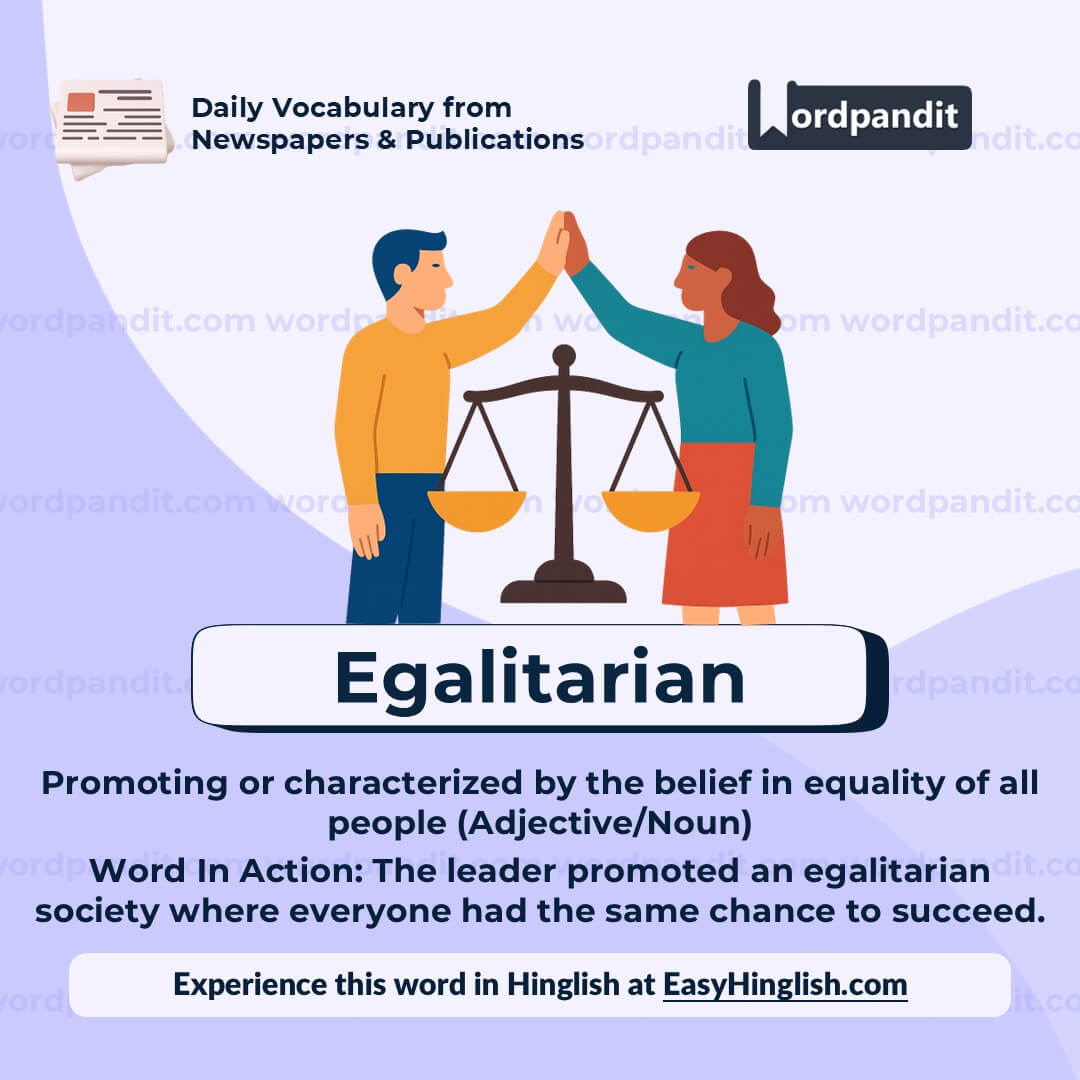
WORD-1: Egalitarian
Context:
"Jaishankar has made the case that India’s rise is not only ushering in a multipolar distribution of economic and military power but also a more egalitarian world where alternative civilisations and ideas have influence." - Hindustan Times
Explanatory Paragraph:
The word egalitarian refers to the belief in or promotion of equality, especially regarding rights, opportunities, and status. When something is described as egalitarian, it emphasizes fairness and rejects unjust hierarchies or privileges. For example, an egalitarian society ensures that people have equal access to resources, power, and opportunities regardless of their background.
Meaning: Promoting or characterized by the belief in equality of all people (Adjective/Noun)
Pronunciation: ih-gal-uh-TAIR-ee-uhn
Difficulty Level: ⭐⭐⭐ Intermediate
Etymology: From French égalitaire ("equal"), derived from Latin aequalis meaning "equal".
Prashant Sir's Notes:
This is an important socio-political word. Whenever you encounter discussions about fairness, equality, or justice, "egalitarian" becomes a keyword. Always link it with the idea of fairness in society.
Synonyms & Antonyms:
Synonyms: equal, democratic, fair, impartial, just
Antonyms: elitist, hierarchical, unequal, discriminatory
Usage Examples:
- The new policy is seen as a step toward creating a more egalitarian education system.
- Her egalitarian views made her popular among people from all walks of life.
- Many philosophers argue that an egalitarian society is the foundation of true democracy.
- The company’s egalitarian work culture ensures that everyone’s ideas are valued equally.
Cultural Reference:
"The concept of egalitarianism is central to the French Revolution's motto: 'Liberty, Equality, Fraternity'." - History Texts
Think About It:
Do you think true egalitarianism can exist in societies that still value wealth and status?
Quick Activity:
Write two sentences: one describing an egalitarian classroom and another describing a non-egalitarian classroom.
Memory Tip:
Think of "equal" inside "egalitarian" → it’s about equality and fairness.
Real-World Application:
The term "egalitarian" is often used in discussions about politics, economics, gender rights, and education policies, where fairness and equal opportunity are key issues.
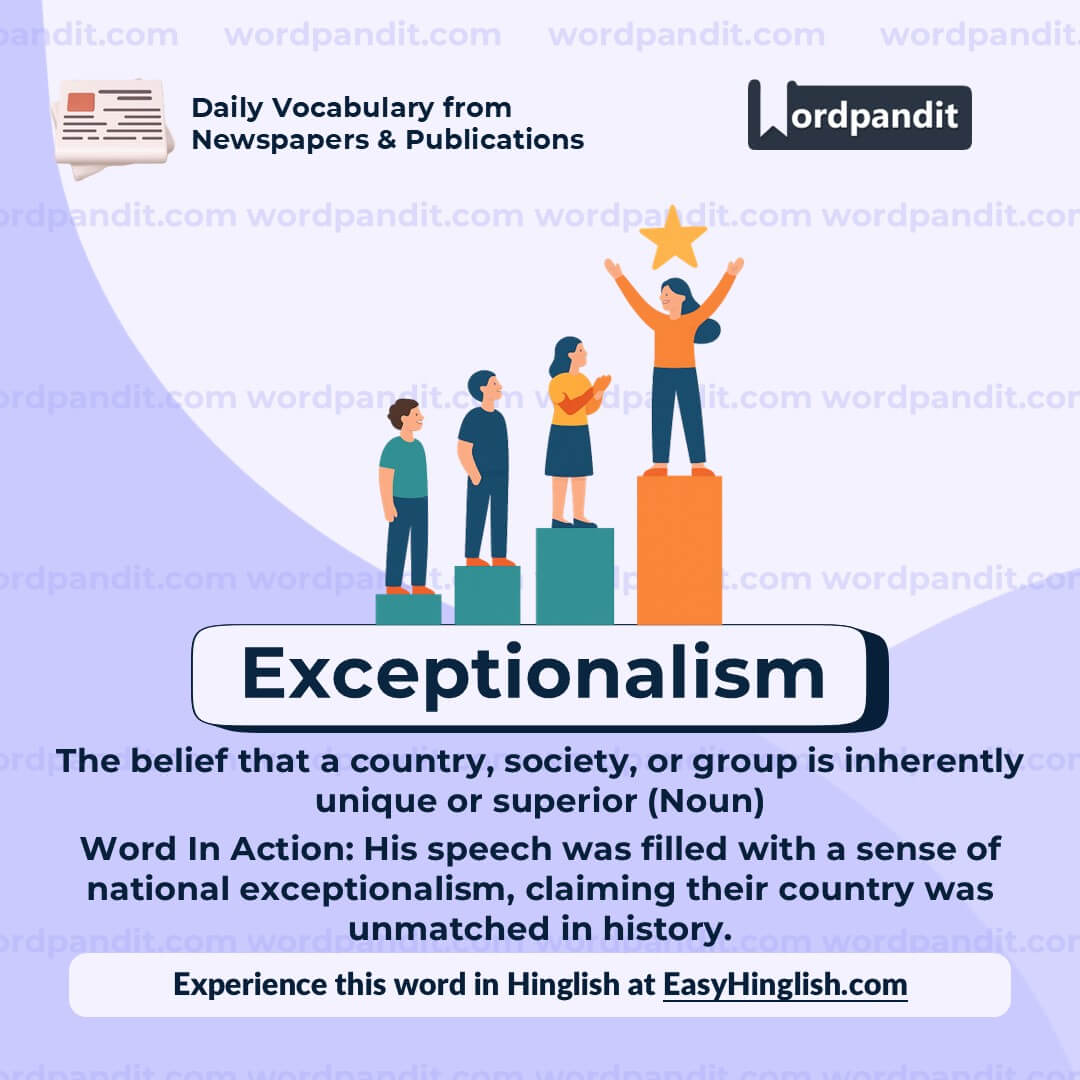
WORD-2: Exceptionalism
Context:
"He talks of an Indian exceptionalism with ‘a different level of culture and heritage, with accompanying attitudes and mindset’ that sets Bharat apart from the United States and China." - Hindustan Times
Explanatory Paragraph:
The word exceptionalism refers to the belief that a nation, culture, or group is unique and fundamentally different from others, often implying superiority or a special role in history. It can be applied positively, as in valuing uniqueness, or critically, when it suggests arrogance or a sense of being above others. For example, "American exceptionalism" is the idea that the United States has a distinct mission and place in the world.
Meaning: The belief that a country, society, or group is inherently unique or superior (Noun)
Pronunciation: ek-SEP-shuh-nuh-liz-uhm
Difficulty Level: ⭐⭐⭐⭐ Advanced
Etymology: Derived from "exceptional" (meaning unusual or extraordinary) + "-ism" (denoting a belief or doctrine). Usage dates back to political and cultural discourses in the 19th century.
Prashant Sir's Notes:
This word often appears in international relations and cultural studies. It helps us understand how countries see themselves in comparison to others. Link it to the idea of "self-identity" on a national scale.
Synonyms & Antonyms:
Synonyms: uniqueness, distinctiveness, peculiarity, specialness
Antonyms: universality, commonness, ordinariness
Usage Examples:
- The idea of American exceptionalism has shaped the country’s foreign policy for decades.
- Indian exceptionalism is often tied to its cultural depth and civilizational continuity.
- Critics argue that national exceptionalism can lead to arrogance and isolationism.
- Exceptionalism can inspire pride but also blind societies to their flaws.
Cultural Reference:
"American exceptionalism" is a recurring theme in U.S. political rhetoric, suggesting the nation has a unique destiny compared to others. - Political Studies
Think About It:
Is exceptionalism a strength that preserves identity, or a weakness that prevents cooperation with others?
Quick Activity:
Write down two examples of exceptionalism: one from your own culture or nation, and one from another country you know about.
Memory Tip:
Think of "exception" in "exceptionalism" → it means being an exception to the rule, standing apart from others.
Real-World Application:
The word "exceptionalism" is often used in debates about nationalism, global politics, and cultural identity. It is key to understanding how countries justify their actions on the world stage.
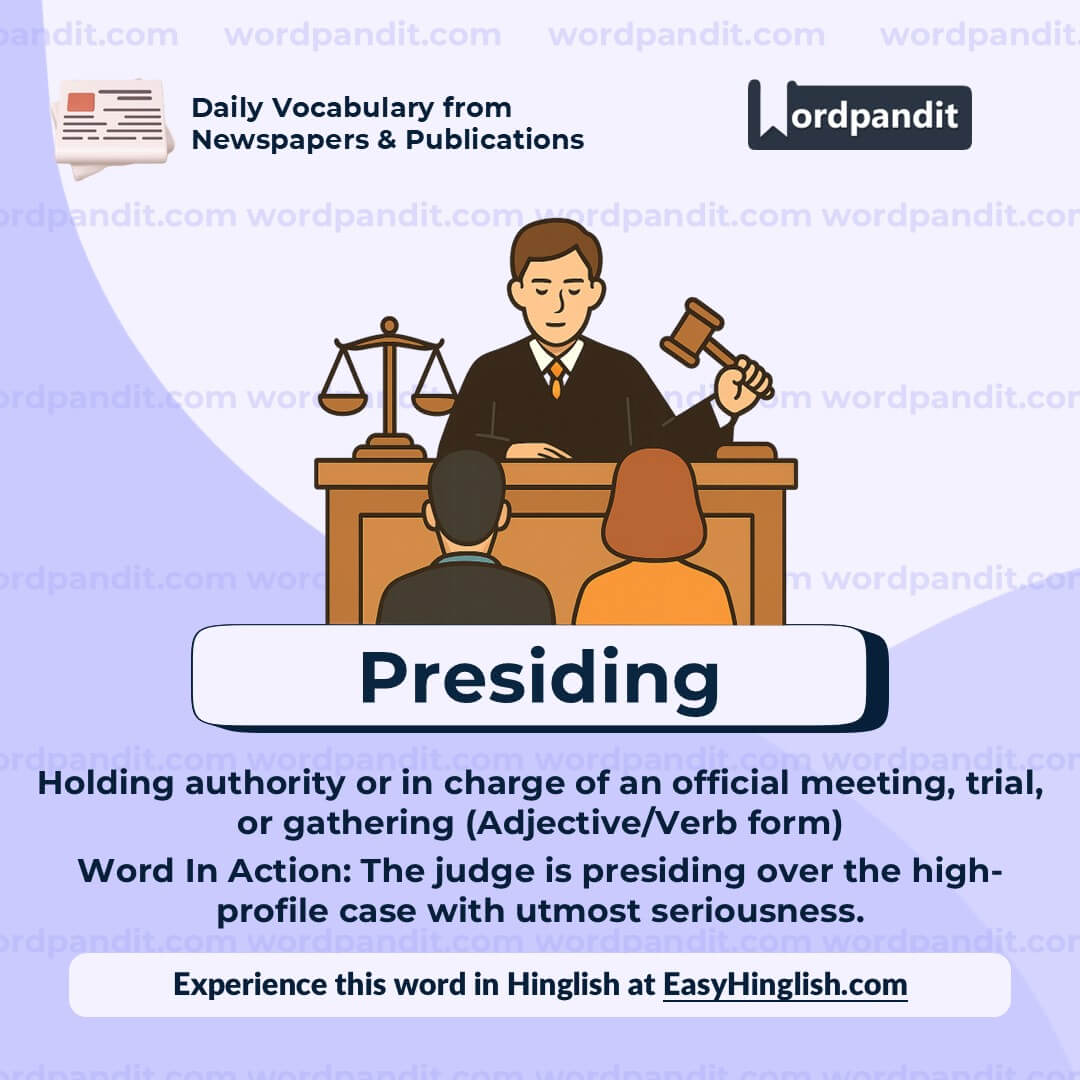
WORD-3: Presiding
Context:
"It has also given due importance to the opinion of the presiding judge of the trial court as 'an independent authority which must be consulted'." - Hindustan Times
Explanatory Paragraph:
The word presiding describes someone who holds authority in a formal setting and is in charge of conducting or overseeing proceedings. Most often, it is used in legal, political, or official contexts, such as a presiding judge in a courtroom, a presiding officer in parliament, or a presiding chairperson in a meeting. The presiding figure ensures rules are followed and decisions are carried out fairly.
Meaning: Holding authority or in charge of an official meeting, trial, or gathering (Adjective/Verb form)
Pronunciation: preh-ZAI-ding
Difficulty Level: ⭐⭐ Basic to Intermediate
Etymology: From Latin praesidere, meaning "to sit before" or "to supervise," formed from prae (before) + sedere (to sit).
Prashant Sir's Notes:
Remember this word in connection with authority and responsibility. A presiding person is not just "present" but actively directing and supervising. It is widely used in courtrooms, legislatures, and formal meetings.
Synonyms & Antonyms:
Synonyms: overseeing, supervising, chairing, directing, leading
Antonyms: following, obeying, assisting, participating (without authority)
Usage Examples:
- The presiding officer maintained order during the heated debate in parliament.
- The presiding judge carefully considered the evidence before announcing the verdict.
- At the ceremony, the presiding minister delivered the opening address.
- She is presiding over the committee that will decide the company’s next expansion strategy.
Cultural Reference:
"The term 'Presiding Officer' is often used in the British Parliament to describe the individual responsible for maintaining order in debates." - Parliamentary Studies
Think About It:
What qualities should a presiding figure have to ensure fairness and respect in an official setting?
Quick Activity:
Imagine you are presiding over a student council meeting. Write two sentences on how you would handle a disagreement between members.
Memory Tip:
Break it as "pre-" (before) + "side" (sit) → the one who sits in front, leading the proceedings.
Real-World Application:
The word "presiding" is common in courts, parliaments, corporate meetings, and ceremonies—wherever someone with authority directs the flow of events.
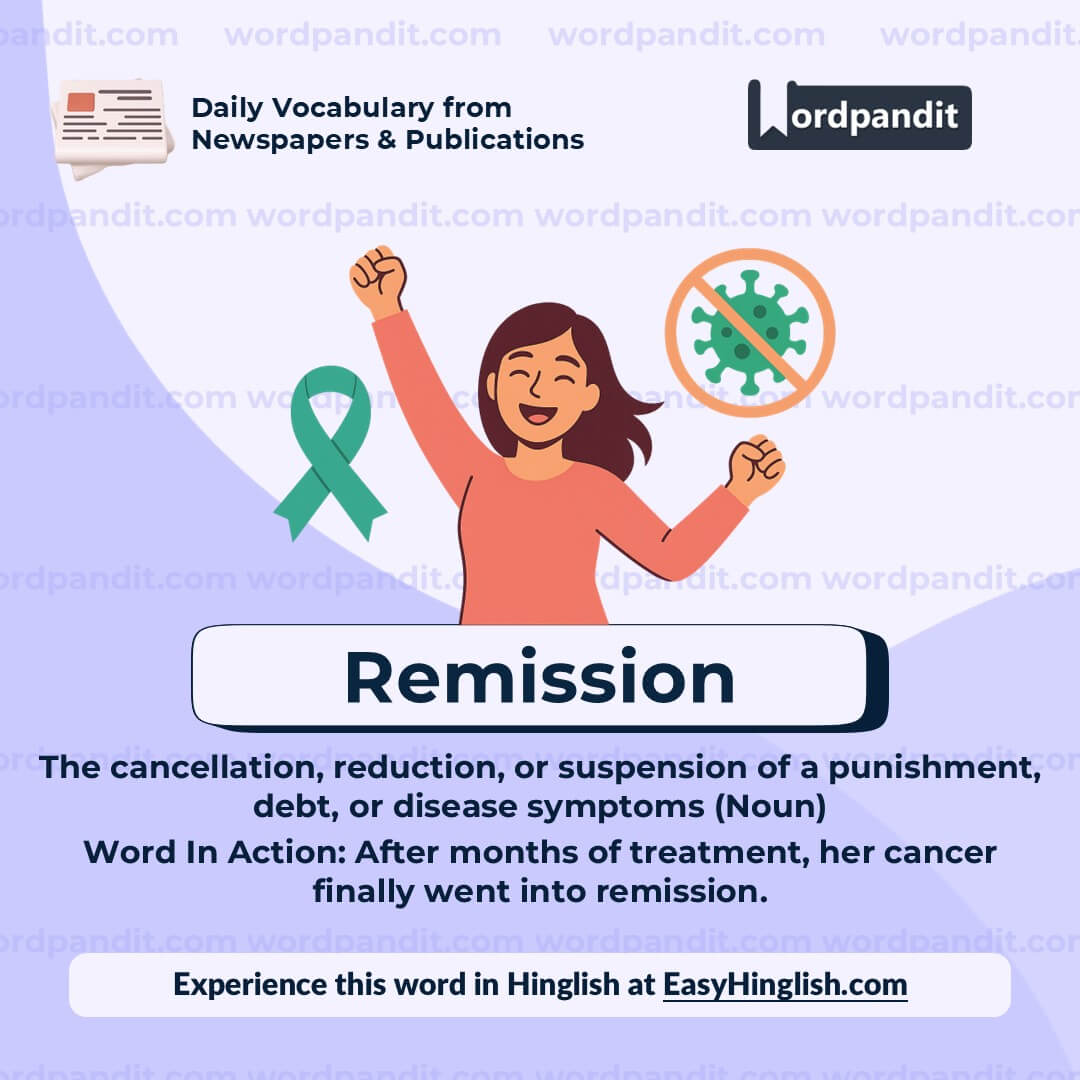
WORD-4: Remission
Context:
"Having completed 14 years of imprisonment, the convicts applied for remission and the state of Gujarat vide its orders dated August 10, 2022, prematurely released them." - Hindustan Times
Explanatory Paragraph:
The word remission refers to the act of reducing, canceling, or pardoning a penalty, punishment, or debt. In a legal sense, it usually means a reduction of a prison sentence or the early release of a convict based on good behavior, special circumstances, or government orders. In medicine, however, the term also refers to a decrease or temporary disappearance of the symptoms of a disease. The core idea is "lessening" or "relief from" something burdensome.
Meaning: The cancellation, reduction, or suspension of a punishment, debt, or disease symptoms (Noun)
Pronunciation: ri-MISH-uhn
Difficulty Level: ⭐⭐⭐ Intermediate
Etymology: From Latin remissio ("sending back, relaxation"), from remittere meaning "to send back" or "relax".
Prashant Sir's Notes:
This word has dual usage: (1) Legal – sentence reduction; (2) Medical – reduction in disease symptoms. Always connect it with the idea of "release" or "relief".
Synonyms & Antonyms:
Synonyms: pardon, reduction, forgiveness, alleviation, release
Antonyms: penalty, punishment, enforcement, continuation
Usage Examples:
- The convict’s lawyer filed an appeal for remission of the sentence after ten years of good behavior.
- During remission, the patient showed no signs of cancer.
- The governor granted remission to several prisoners on Independence Day.
- Remission of debt was announced to support struggling farmers.
Cultural Reference:
"In India, remission of sentences is often granted on occasions like Republic Day or Independence Day as part of state pardoning powers." - Legal Studies
Think About It:
Should remission be based only on good behavior, or should the severity of the crime always override the possibility of early release?
Quick Activity:
Write two sentences: one using "remission" in a legal sense and another in a medical sense.
Memory Tip:
Think of "remission" as "re-mission" → sending back or reducing something unwanted, like punishment or illness.
Real-World Application:
The term is frequently used in law for sentence reduction and in healthcare for diseases like cancer, where patients can go into remission when symptoms subside.
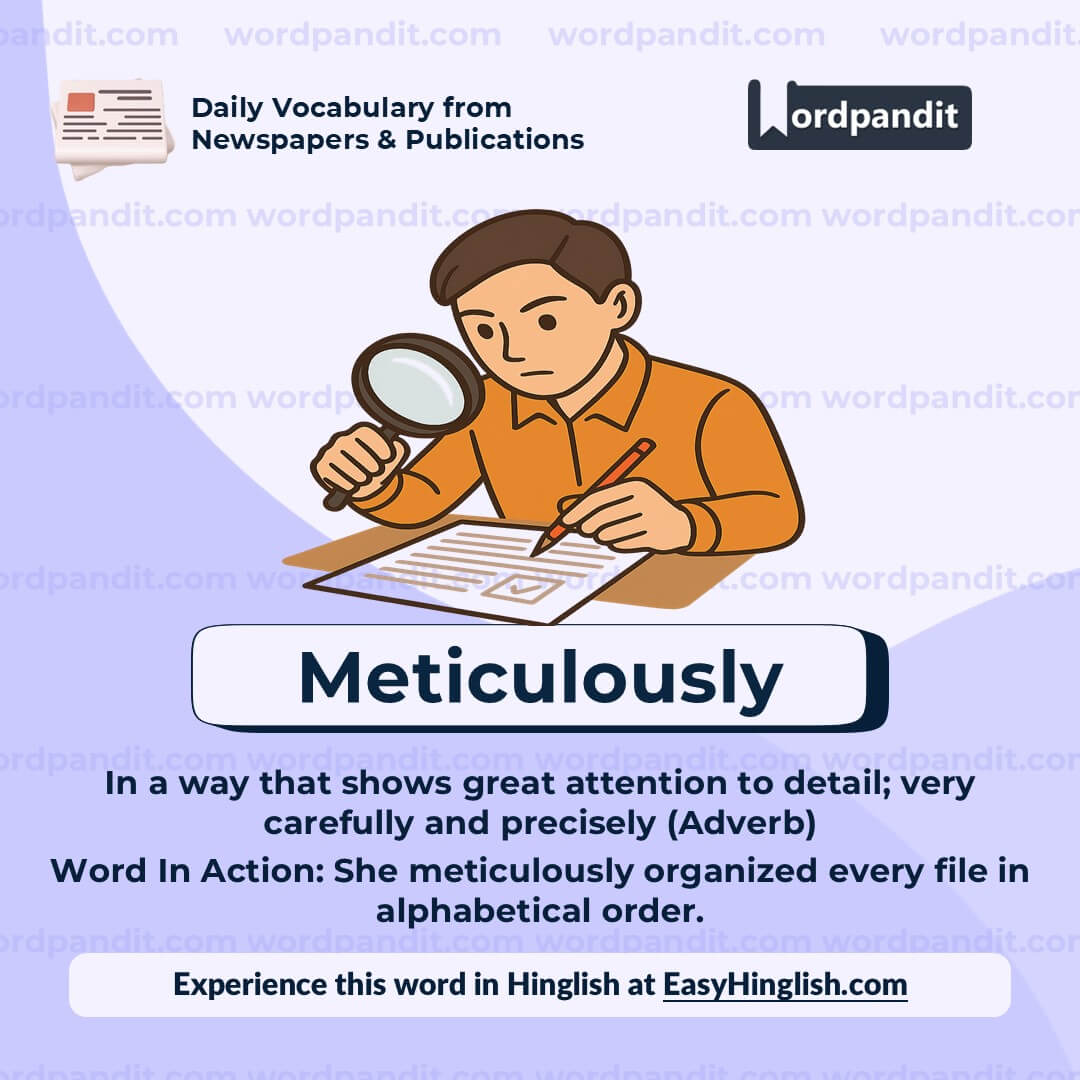
WORD-5: Meticulously
Context:
"Advocate Vrinda Grover and her team took it up pro bono and followed it meticulously through the legal labyrinth." - Hindustan Times
Explanatory Paragraph:
The word meticulously means doing something with great care, precision, and attention to detail. A person who works meticulously ensures that no aspect, however small, is overlooked. It often suggests patience, accuracy, and thoroughness in completing tasks, whether in law, science, art, or daily life.
Meaning: In a way that shows great attention to detail; very carefully and precisely (Adverb)
Pronunciation: meh-TIK-yuh-lus-lee
Difficulty Level: ⭐⭐⭐ Intermediate
Etymology: From Latin meticulosus ("fearful, overly careful"), from metus ("fear"). Over time, the meaning shifted to emphasize extreme carefulness and precision rather than fear.
Prashant Sir's Notes:
This is a classic “exam-friendly” word. Whenever you see meticulous/meticulously, think of perfectionists who pay attention to every tiny detail. Connect it with professions that demand precision—lawyers, doctors, scientists, architects.
Synonyms & Antonyms:
Synonyms: carefully, precisely, thoroughly, diligently, painstakingly
Antonyms: carelessly, hastily, roughly, negligently
Usage Examples:
- The scientist meticulously recorded every observation during the experiment.
- She planned the wedding meticulously, ensuring that nothing was left to chance.
- The artist meticulously painted each detail of the landscape.
- He meticulously checked the contract before signing it.
Cultural Reference:
"Leonardo da Vinci is often admired for his meticulously detailed sketches and notes, which combined art and science." - Art History Studies
Think About It:
Is being meticulous always an advantage, or can too much attention to detail sometimes slow down progress?
Quick Activity:
Pick a daily task (like cooking, studying, or cleaning). Write a sentence showing how someone might do it carelessly and another sentence showing how someone might do it meticulously.
Memory Tip:
Link "meticulously" with "micro details" → it’s about focusing on the tiniest parts of a task.
Real-World Application:
The word is commonly used in professional contexts where precision is vital—such as legal arguments, medical diagnoses, financial auditing, or engineering designs.


