

Daily Vocabulary from International Newspapers and Publications
Expand Your Vocabulary with Wordpandit’s Global Vocabulary Hub
At Wordpandit, we are committed to helping you develop a truly global vocabulary by drawing from some of the most respected international publications. This section is designed to keep you ahead of the curve by introducing you to words that define global conversations and trends.
The Power of Global Sources
To help you think and communicate on a global scale, we curate vocabulary from renowned international sources, such as:
- The New York Times
- The Washington Post
- BBC
- The Guardian
- The Economist
- Scientific American
- Psychology Today
- And many more...
Stay Global, Stay Competitive
Our daily updates from international publications ensure you are consistently exposed to new words that reflect global news and developments, making sure your vocabulary is not only current but also globally relevant.
Enhance Your Global Perspective
Whether you’re preparing for international exams, aiming to excel in global business communication, or want to enhance your language skills for personal growth, Wordpandit offers the resources you need to thrive in a global context.
Effective Learning, Global Reach
Our learning methodology combines global examples, memory aids, and interactive activities, allowing you to internalize new words effectively and apply them in real-world scenarios.
Begin Your Global Vocabulary Journey Now!

Why Choose Wordpandit?
Practical Learning: Focus on words you'll actually encounter in real-world reading, enhancing your comprehension and communication skills.
Diverse Content: From current affairs to scientific breakthroughs, our varied sources expose you to vocabulary across multiple domains.
Effortless Integration: Make Wordpandit a part of your daily routine. Just a few minutes each day can significantly boost your lexicon over time.
Your Path to Vocabulary Mastery
- Visit our Daily Vocabulary section regularly
- Explore new words and their usage in context
- Practice incorporating these words into your own writing and speech
- Track your progress as your vocabulary expands
Start Your Journey Today
Embark on your vocabulary enhancement journey with Wordpandit. By consistently engaging with our daily posts, you'll build a robust vocabulary that serves you well in academic, professional, and personal contexts.
Remember, a word a day keeps linguistic limitations at bay. Make Wordpandit your daily companion in the quest for vocabulary excellence!
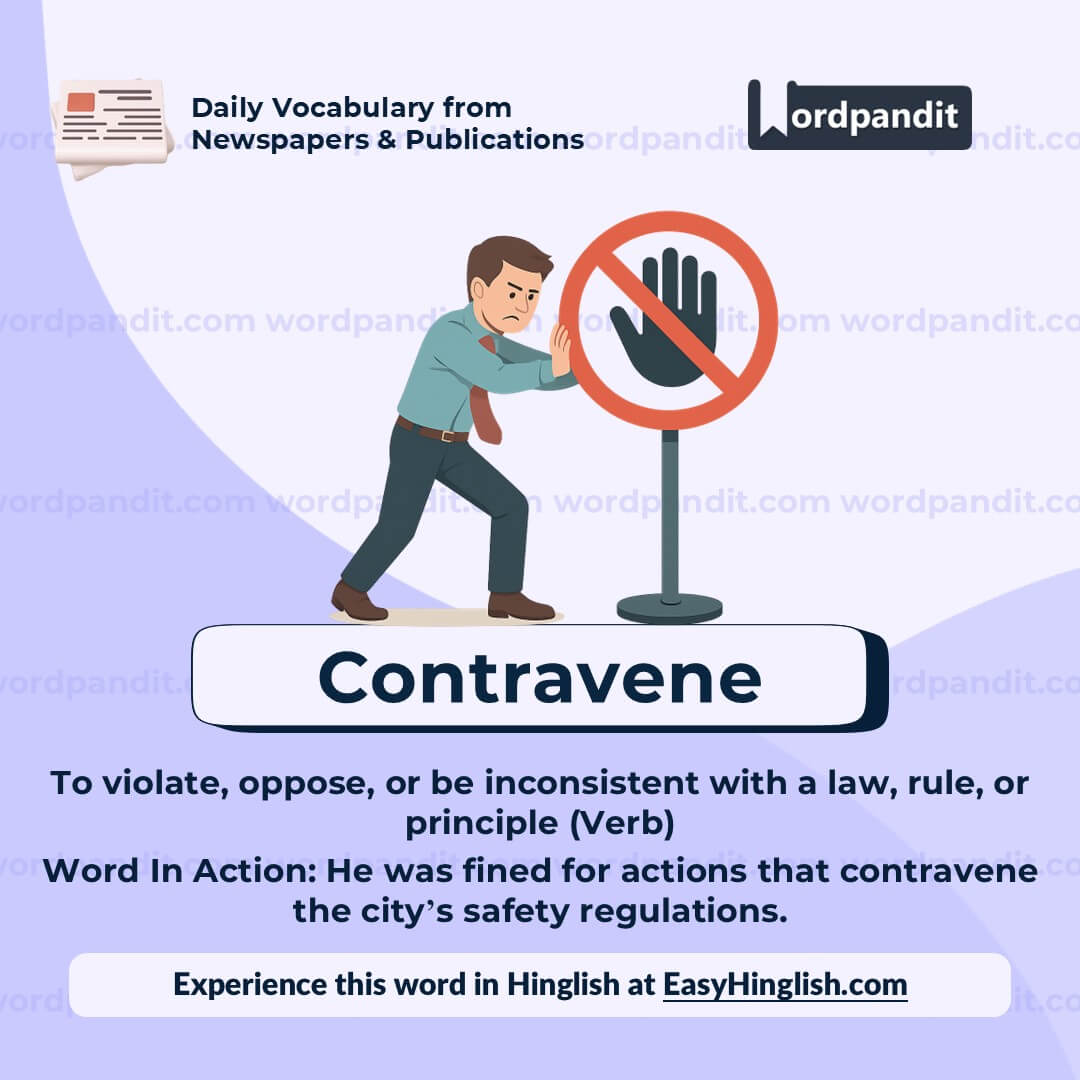
WORD-1: Contravene
Context:
"By applying the laws of war to organised criminals as if they were terrorists or insurgents, the move may contravene international law, Human Rights Watch’s deputy Americas director, Juan Pappier, told the Washington Post." - Guardian
Explanatory Paragraph:
The word contravene means to go against, break, or act in conflict with a law, rule, or agreement. It is most often used in legal, formal, or official contexts where someone’s action is directly opposed to established rules or principles. For example, ignoring safety regulations at work can be said to contravene workplace law.
Meaning: To violate, oppose, or be inconsistent with a law, rule, or principle (Verb)
Pronunciation: kon-truh-veen
Difficulty Level: ⭐⭐⭐⭐ Advanced
Etymology: From Latin contravenire, meaning "to come against" (contra = against + venire = to come).
Prashant Sir's Notes:
Think of contravene as "coming against" the rule. It is frequently used in legal or formal documents, making it a power word in law, governance, and policy writing.
Synonyms & Antonyms:
Synonyms: violate, breach, infringe, transgress, oppose
Antonyms: comply, obey, adhere, conform
Usage Examples:
- The company was fined for contravening environmental protection laws.
- Speaking without permission would contravene the strict rules of the debate.
- The policy changes were criticized as contravening basic human rights.
- Any action that contravenes the constitution will be declared invalid.
Cultural Reference:
"In many legal systems, actions that contravene international treaties are considered violations of global norms." - International Law Commentary
Think About It:
Do you think breaking a rule for a higher moral reason still counts as contravening it, or does intent matter more than the act?
Quick Activity:
Fill in the blank: "The new regulation clearly __________ the previous agreement signed by both parties." (Hint: Use the correct form of *contravene*.)
Memory Tip:
Think of contra = against and vene = come. When you contravene, you "come against" the law or rule.
Real-World Application:
In law, business, and international relations, "contravene" is often used to describe policies or actions that break formal agreements, contracts, or laws. Knowing this word helps in understanding news reports, legal debates, and compliance issues.
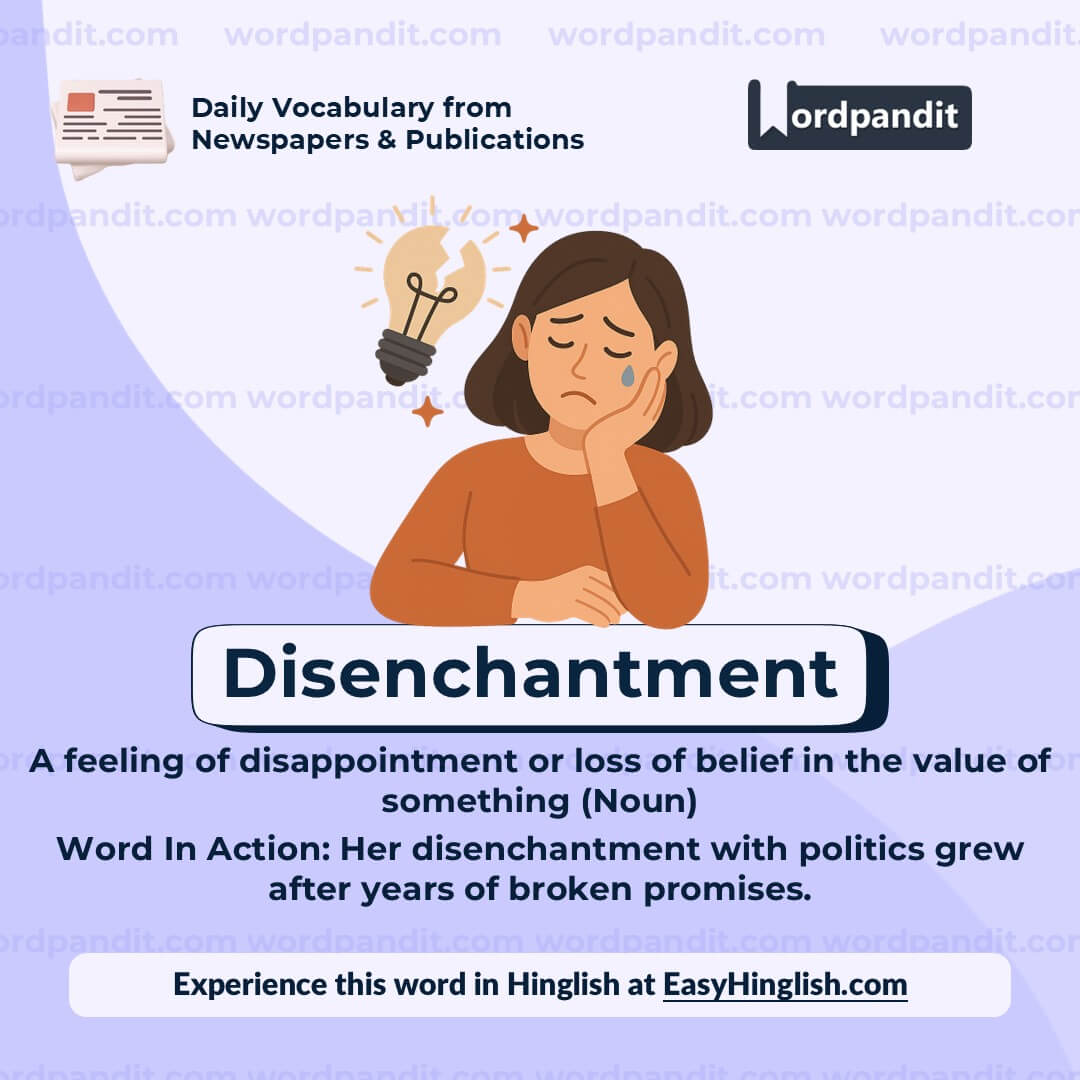
WORD-2: Disenchantment
Context:
"Burgeoning security issues are a significant factor in Latin America’s growing disenchantment with democracy." - Guardian
Explanatory Paragraph:
The word disenchantment refers to the feeling of disappointment, loss of trust, or disillusionment after realizing that something is not as good, fair, or effective as expected. It often describes a shift from initial hope or excitement to frustration or dissatisfaction, especially with institutions, leaders, or beliefs.
Meaning: A feeling of disappointment or loss of belief in the value of something (Noun)
Pronunciation: dis-en-chant-ment
Difficulty Level: ⭐⭐⭐ Intermediate
Etymology: From Old French enchanter (“to enchant, to charm”), with the prefix dis- indicating reversal, meaning “the undoing of enchantment” or “loss of magic.”
Prashant Sir's Notes:
Think of it as the opposite of being "enchanted." When the magic fades, hope turns to disappointment—this is disenchantment. Very useful in politics, sociology, and psychology.
Synonyms & Antonyms:
Synonyms: disillusionment, disappointment, dissatisfaction, discontent
Antonyms: enthusiasm, optimism, enchantment, faith
Usage Examples:
- Her disenchantment with the corporate world led her to start her own business.
- Disenchantment among young voters is weakening public trust in elections.
- The workers’ disenchantment grew as promises of better wages went unfulfilled.
- Travelers often feel disenchantment when tourist destinations fail to match their glamorous online images.
Cultural Reference:
"The disenchantment of the world" was famously discussed by sociologist Max Weber to describe how modern society loses its mystical or spiritual sense under rationalization and bureaucracy.
Think About It:
Is disenchantment always negative, or can it sometimes be the first step toward realistic change and improvement?
Quick Activity:
Complete the sentence: "The student’s __________ with the education system grew after repeated failures of reform." (Hint: Use the noun form from *enchant*.)
Memory Tip:
Think of dis- (removal) + enchantment (magic, charm). Disenchantment = when the magic or charm disappears, leaving you disappointed.
Real-World Application:
The word is commonly used in political science, journalism, and social commentary to describe public frustration with governments, leaders, or institutions. It helps explain voter apathy, social movements, and loss of faith in systems.
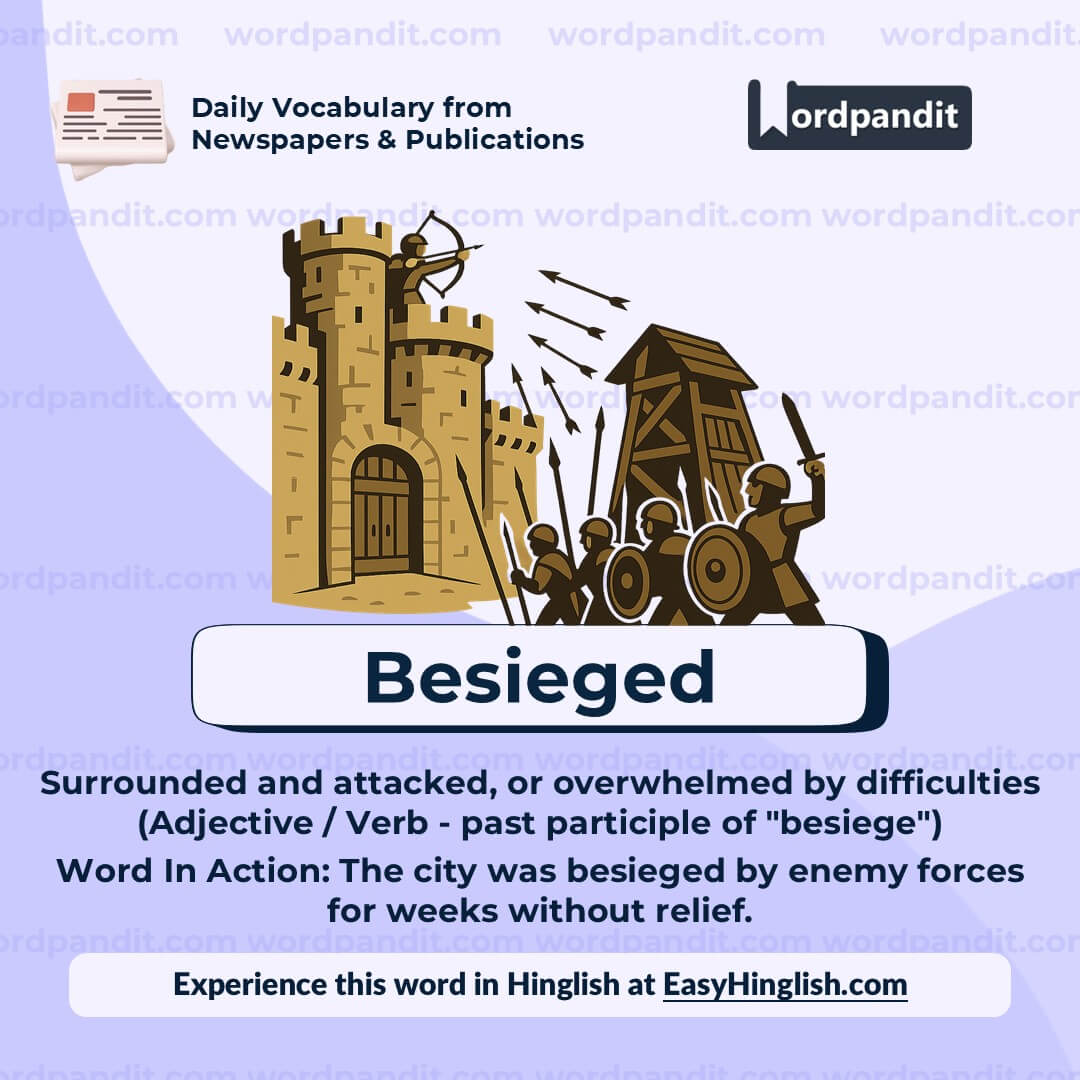
WORD-3: Besieged
Context:
"It is understandable that human rights are an intangible concern for people besieged by criminal groups." - Guardian
Explanatory Paragraph:
The word besieged refers to being surrounded or under attack, either physically by an enemy or metaphorically by problems, pressures, or demands. Historically, it described cities surrounded by armies, but today it is also used figuratively—for example, when someone feels overwhelmed by stress or criticism.
Meaning: Surrounded and attacked, or overwhelmed by difficulties (Adjective / Verb - past participle of "besiege")
Pronunciation: bih-seejd
Difficulty Level: ⭐⭐⭐ Intermediate
Etymology: From Old French besiegier, meaning "to surround with an army," from siege (seat or blockade).
Prashant Sir's Notes:
Besieged works both literally (armies surrounding a city) and figuratively (people or groups overwhelmed by constant attack, problems, or demands). A vivid word with strong imagery.
Synonyms & Antonyms:
Synonyms: surrounded, encircled, attacked, overwhelmed, harassed
Antonyms: free, protected, liberated, secure
Usage Examples:
- The medieval town was besieged for months before surrendering.
- She felt besieged by endless deadlines at work.
- The politician was besieged by reporters demanding answers.
- Villages besieged by violence often lose faith in government promises.
Cultural Reference:
During the famous Siege of Troy in Greek mythology, the city was besieged by Greek forces for ten years, giving rise to the epic story of the Trojan War.
Think About It:
Do modern uses of "besieged" in describing stress or criticism dilute the original power of the word rooted in warfare?
Quick Activity:
Fill in the blank: "The customer service team was __________ by complaints after the product recall." (Hint: Use the past participle form of *besiege*.)
Memory Tip:
Think of a "siege" as being trapped inside with enemies outside. To be besieged is to be stuck in the middle of unending attacks or pressures.
Real-World Application:
The term is widely used in news reporting to describe towns, communities, or even individuals under pressure—whether by military forces, criminal groups, or overwhelming stress. It adds emotional weight to descriptions of conflict and crisis.
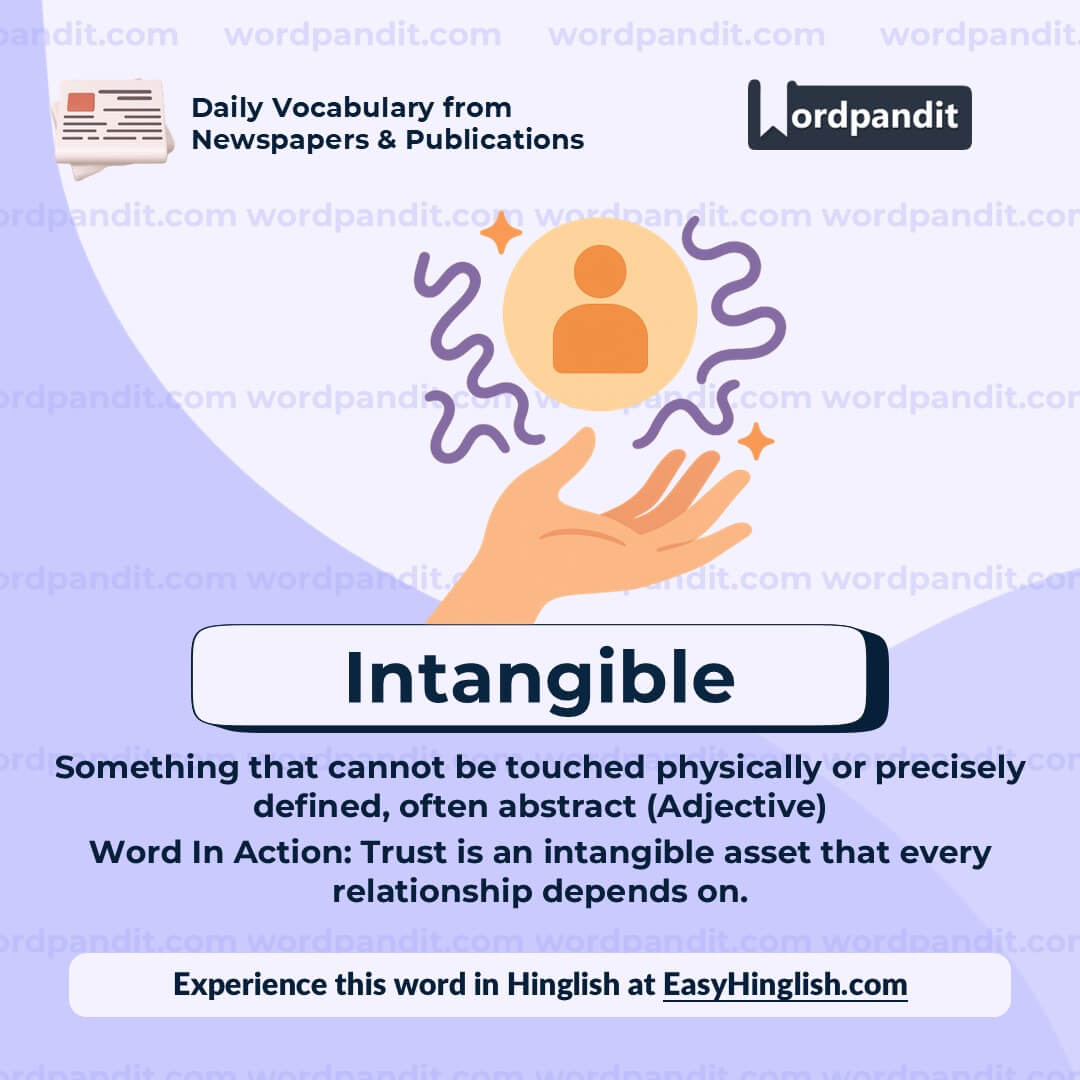
WORD-4: Intangible
Context:
"It is understandable that human rights are an intangible concern for people besieged by criminal groups." - Guardian
Explanatory Paragraph:
The word intangible refers to something that cannot be physically touched or easily measured, but still exists and carries value or importance. It is often used for abstract qualities such as hope, trust, reputation, or human rights—things you cannot hold in your hands but that deeply influence people’s lives and decisions.
Meaning: Something that cannot be touched physically or precisely defined, often abstract (Adjective)
Pronunciation: in-tan-juh-buhl
Difficulty Level: ⭐⭐ Basic-Intermediate
Etymology: From Latin tangere meaning "to touch," with prefix in- (not), hence "not touchable."
Prashant Sir's Notes:
Think of "intangible" as something you cannot literally touch but can still feel—like emotions, rights, or even business assets such as goodwill. Very useful for both philosophical and business contexts.
Synonyms & Antonyms:
Synonyms: abstract, immaterial, impalpable, invisible, untouchable
Antonyms: tangible, concrete, physical, visible, material
Usage Examples:
- Trust is an intangible quality that strengthens relationships.
- Many companies invest in intangible assets such as brand value and reputation.
- The artist tried to capture the intangible feeling of nostalgia in her painting.
- Justice is often seen as an intangible ideal that societies strive to achieve.
Cultural Reference:
In business, "intangible assets" like goodwill, intellectual property, and brand reputation are valued alongside physical assets, highlighting their invisible but significant impact on success.
Think About It:
Are intangible qualities like trust or freedom more powerful than tangible resources like money and weapons?
Quick Activity:
Choose the correct option: "Love, unlike a diamond ring, is an __________ asset." (a) tangible (b) intangible
Memory Tip:
Break it down: "in-" = not + "tangible" = touchable → not touchable = intangible.
Real-World Application:
From human rights discussions to corporate finance, "intangible" is a versatile word used to describe abstract yet powerful forces that shape society, relationships, and economies.
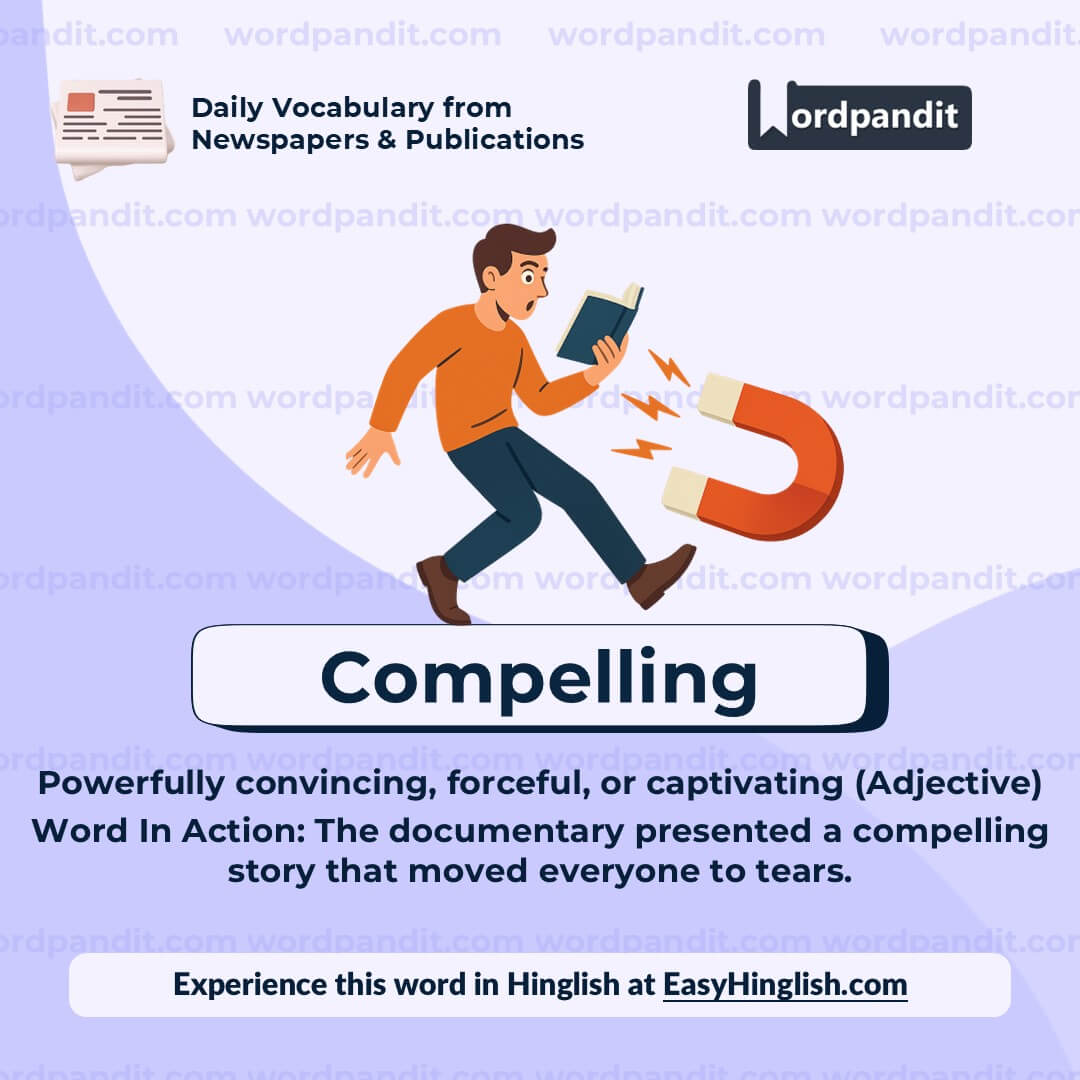
WORD-5: Compelling
Context:
"If you are likely to be killed by a stray bullet, or kidnapped by a criminal group, due process is not compelling." - Guardian
Explanatory Paragraph:
The word compelling describes something that is forceful, convincing, or irresistibly interesting. It can be used for arguments that are persuasive, stories that captivate attention, or even situations that demand action because they are urgent and unavoidable. In the given context, it means that due process does not seem convincing or powerful enough when basic survival is at stake.
Meaning: Powerfully convincing, forceful, or captivating (Adjective)
Pronunciation: kom-pel-ing
Difficulty Level: ⭐⭐ Basic-Intermediate
Etymology: From Latin compellere ("to drive together, to force"), through Middle English "compellen" meaning "to force or oblige."
Prashant Sir's Notes:
Think of "compelling" as something that forces your attention—whether it’s an argument, a story, or a need. It can be positive (a compelling novel) or negative (a compelling reason to leave immediately).
Synonyms & Antonyms:
Synonyms: convincing, forceful, persuasive, captivating, irresistible
Antonyms: weak, unconvincing, unpersuasive, dull
Usage Examples:
- The lawyer presented a compelling case that won over the jury.
- The novel was so compelling that I couldn’t put it down until the last page.
- She gave a compelling reason for her sudden resignation.
- There is compelling evidence linking climate change to extreme weather events.
Cultural Reference:
In film and literature reviews, critics often describe stories as "compelling" when they hold the audience’s attention and evoke strong emotional responses.
Think About It:
What makes an argument or story truly compelling—its content, the way it’s delivered, or the emotions it stirs?
Quick Activity:
Fill in the blank: "The scientist provided __________ data that convinced the committee to fund her research." (Hint: Use the adjective form of *compel*.)
Memory Tip:
Think of "compel" = to force. Something "compelling" forces your mind or heart to pay attention.
Real-World Application:
"Compelling" is frequently used in everyday conversations, academic writing, marketing, and media to describe arguments, evidence, or narratives that strongly influence people’s thoughts and actions.


