

Daily Vocabulary from International Newspapers and Publications
Expand Your Vocabulary with Wordpandit’s Global Vocabulary Hub
At Wordpandit, we are committed to helping you develop a truly global vocabulary by drawing from some of the most respected international publications. This section is designed to keep you ahead of the curve by introducing you to words that define global conversations and trends.
The Power of Global Sources
To help you think and communicate on a global scale, we curate vocabulary from renowned international sources, such as:
- The New York Times
- The Washington Post
- BBC
- The Guardian
- The Economist
- Scientific American
- Psychology Today
- And many more...
Stay Global, Stay Competitive
Our daily updates from international publications ensure you are consistently exposed to new words that reflect global news and developments, making sure your vocabulary is not only current but also globally relevant.
Enhance Your Global Perspective
Whether you’re preparing for international exams, aiming to excel in global business communication, or want to enhance your language skills for personal growth, Wordpandit offers the resources you need to thrive in a global context.
Effective Learning, Global Reach
Our learning methodology combines global examples, memory aids, and interactive activities, allowing you to internalize new words effectively and apply them in real-world scenarios.
Begin Your Global Vocabulary Journey Now!

Why Choose Wordpandit?
Practical Learning: Focus on words you'll actually encounter in real-world reading, enhancing your comprehension and communication skills.
Diverse Content: From current affairs to scientific breakthroughs, our varied sources expose you to vocabulary across multiple domains.
Effortless Integration: Make Wordpandit a part of your daily routine. Just a few minutes each day can significantly boost your lexicon over time.
Your Path to Vocabulary Mastery
- Visit our Daily Vocabulary section regularly
- Explore new words and their usage in context
- Practice incorporating these words into your own writing and speech
- Track your progress as your vocabulary expands
Start Your Journey Today
Embark on your vocabulary enhancement journey with Wordpandit. By consistently engaging with our daily posts, you'll build a robust vocabulary that serves you well in academic, professional, and personal contexts.
Remember, a word a day keeps linguistic limitations at bay. Make Wordpandit your daily companion in the quest for vocabulary excellence!
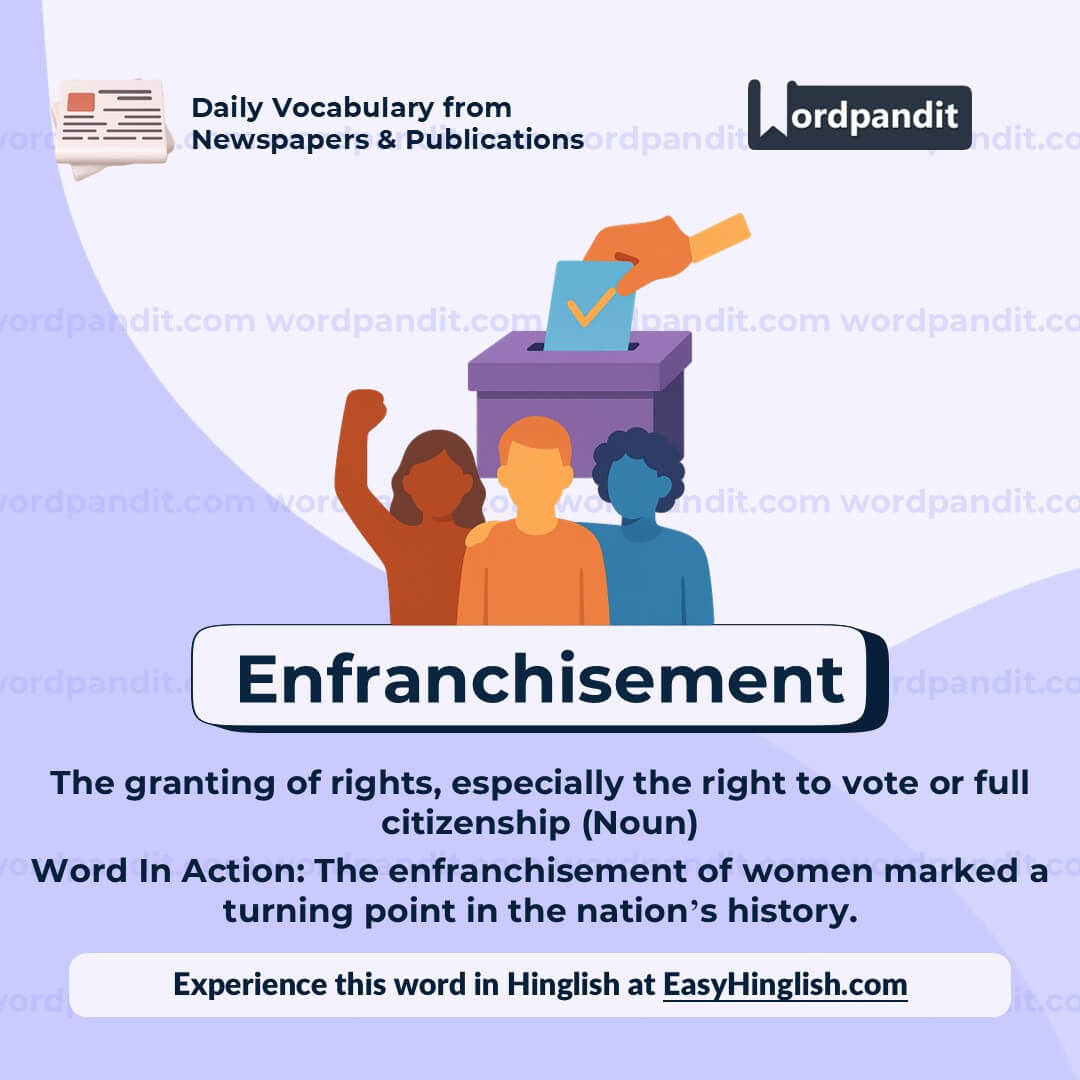
WORD-1: Enfranchisement
Context:
"The overall effect is of an emphatic enfranchisement of the rights of people in Gaza." - Guardian
Explanatory Paragraph:
The word enfranchisement refers to the granting of rights or privileges, particularly the right to vote or the acknowledgment of a group's freedom and autonomy. In the context of the sentence, it suggests a powerful recognition or restoration of the rights of people in Gaza—implying empowerment, liberation, and participation in decisions affecting their lives. The term is often used in historical or political discussions where access to civil liberties or social equality is being expanded.
Meaning: The granting of rights, especially the right to vote or full citizenship (Noun)
Pronunciation: en-FRAN-chise-ment
Difficulty Level: ⭐⭐⭐ Intermediate
Etymology: From Old French enfranchir meaning "to set free," derived from Latin francus meaning "free."
Prashant Sir's Notes:
Think of enfranchisement as the opposite of oppression or exclusion. Historically, it has been used in the context of giving marginalized groups a voice—most notably in civil rights and suffrage movements. In exams, it's a great word to use in essays or discussions around democracy, rights, and governance.
Synonyms & Antonyms:
Synonyms: empowerment, liberation, emancipation, suffrage, civic inclusion
Antonyms: disenfranchisement, exclusion, oppression, subjugation
Usage Examples:
- The civil rights movement led to the enfranchisement of millions of African Americans in the United States.
- Women's enfranchisement in the early 20th century marked a major shift in global democratic progress.
- Activists are calling for the enfranchisement of marginalized communities in digital decision-making spaces.
- The new constitution ensured the enfranchisement of all citizens, regardless of race or gender.
Cultural Reference:
"The history of women's enfranchisement in New Zealand marks a global first in gender equality." - Encyclopedia Britannica
Think About It:
In what ways does enfranchisement extend beyond the right to vote and influence other areas of life?
Quick Activity:
Write a short paragraph (3–4 lines) about a historical moment of enfranchisement. Use the word “enfranchisement” at least once.
Memory Tip:
Think: "En-FREE-chisement" → sounds like "freedom" being granted. When someone is enfranchised, they are being set free or empowered.
Real-World Application:
The concept of enfranchisement is central to discussions on voting rights, minority representation, and inclusive policy-making in democracies worldwide. Understanding this term helps in analyzing news articles, civic education, and social justice movements.
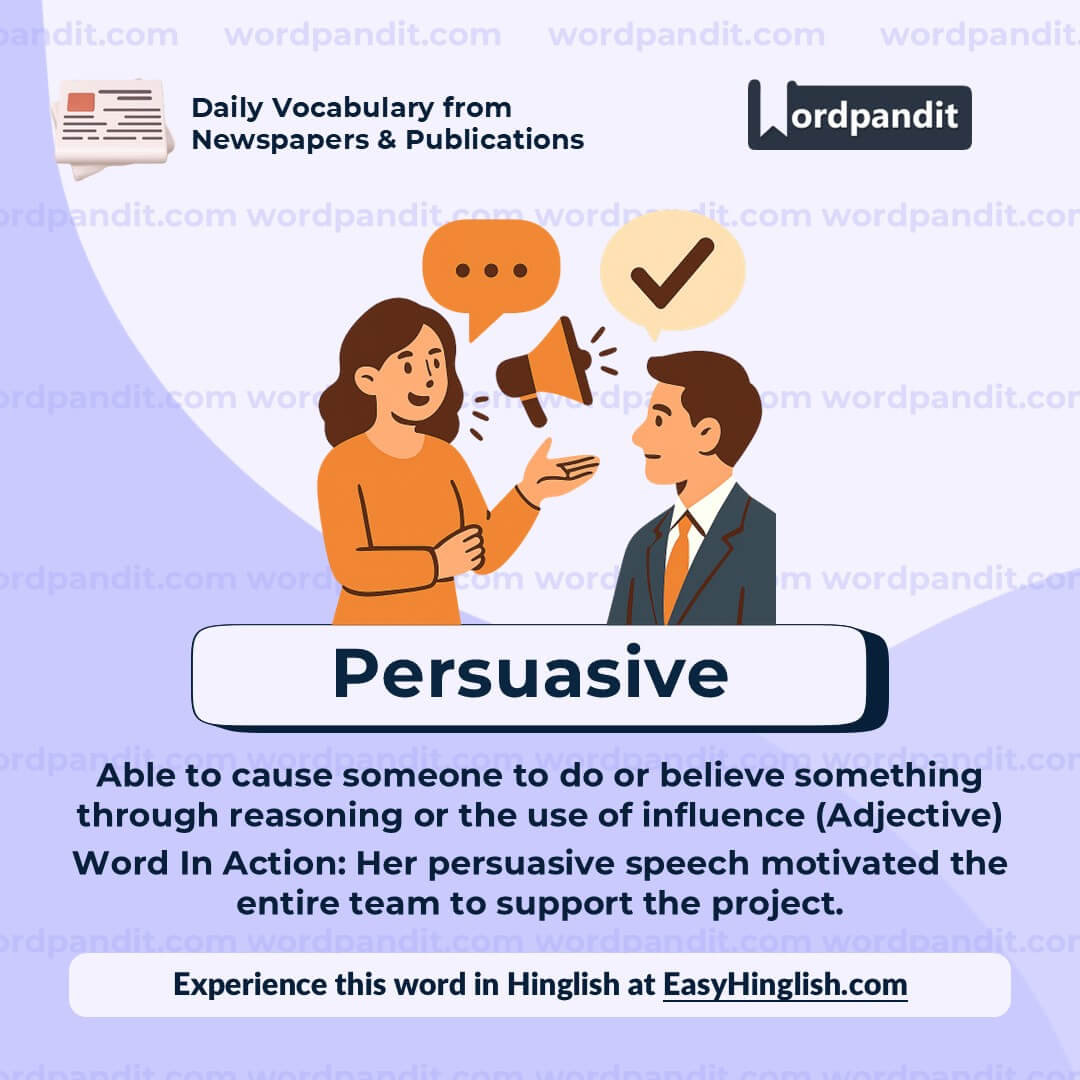
WORD-2: Persuasive
Context:
"The ICJ case shows how western logic is wearing thin and its persuasive power waning in a multipolar world." - Guardian
Explanatory Paragraph:
The word persuasive describes the ability to convince someone to believe or do something through reasoning, appeal, or influence. In the sentence above, it refers to the declining influence or convincing power of Western logic or narratives in an increasingly diverse and multipolar world, where multiple centers of power challenge old dominant perspectives. The word often applies to speech, writing, or argumentation that effectively changes minds or behavior.
Meaning: Able to cause someone to do or believe something through reasoning or the use of influence (Adjective)
Pronunciation: per-SWAY-siv
Difficulty Level: ⭐⭐ Beginner
Etymology: From Latin persuasivus, from persuadere meaning "to convince or urge."
Prashant Sir's Notes:
This is a high-utility word, often used in essay writing, speeches, and interviews. A persuasive argument doesn't just state facts—it appeals to logic, emotion, or credibility. This is also a critical word in marketing and legal studies.
Synonyms & Antonyms:
Synonyms: convincing, compelling, influential, forceful, eloquent
Antonyms: unconvincing, ineffective, weak, unpersuasive
Usage Examples:
- The lawyer delivered a persuasive argument that swayed the jury in her favor.
- Her persuasive writing style makes complex topics easy to understand.
- Good marketing relies heavily on persuasive messaging to drive consumer behavior.
- Even though he was calm, his tone was firm and persuasive enough to change their minds.
Cultural Reference:
"The art of rhetoric—especially persuasive speech—was central to Greek education and politics." - History of Rhetoric
Think About It:
What makes an argument truly persuasive—facts, emotions, or the speaker’s credibility?
Quick Activity:
Pick a topic you care about. Write two persuasive sentences trying to convince someone to support your view.
Memory Tip:
Think: "Per-SWAY-sive" — if someone can sway your opinion, they are persuasive.
Real-World Application:
Being persuasive is a key soft skill in sales, leadership, teaching, and everyday communication. Whether you're pitching an idea or writing an essay, persuasive language helps you make an impact.

WORD-3: Obstructing
Context:
"By creating such a focal point for that shift, the case brought by South Africa has illustrated that perhaps it is those who are obstructing attempts to end the severe distress in Gaza who hold the fringe position." - Guardian
Explanatory Paragraph:
The word obstructing refers to the act of blocking, delaying, or hindering progress, movement, or an action. In this context, it implies that certain actors are actively preventing or interfering with efforts to alleviate suffering and resolve the humanitarian crisis in Gaza. The term often carries a negative connotation, suggesting purposeful resistance or uncooperative behavior, especially in situations where progress or resolution is urgently needed.
Meaning: Actively hindering or blocking progress, movement, or a process (Verb – present participle)
Pronunciation: uhb-STRUHK-ting
Difficulty Level: ⭐⭐ Beginner
Etymology: From Latin obstruere, meaning "to build against, block up," from ob- (against) + struere (to build)
Prashant Sir's Notes:
“Obstructing” is frequently used in legal, political, and social contexts to point out who or what is causing delays or preventing change. In exams, it's a precise verb to describe resistance or barriers in any kind of process—physical, social, or ideological.
Synonyms & Antonyms:
Synonyms: blocking, hindering, impeding, interfering, stalling
Antonyms: facilitating, aiding, helping, promoting, advancing
Usage Examples:
- The protesters were accused of obstructing traffic during the demonstration.
- He was arrested for obstructing justice by hiding key evidence from the police.
- Political infighting is obstructing the passage of critical climate legislation.
- She apologized for obstructing the meeting and promised to be more constructive.
Cultural Reference:
"Obstruction of justice" is a legal term commonly used in court cases involving interference with investigations or legal processes—seen in high-profile cases such as Watergate and others involving political figures.
Think About It:
When does obstruction become a form of protest, and when is it simply a barrier to progress?
Quick Activity:
Identify a current issue (e.g., climate change, education reform) and write one sentence using “obstructing” to describe a challenge or barrier to its solution.
Memory Tip:
Think: "Obstruct = OBSTACLE" → Both start with “ob” and deal with blocking the way. If you’re obstructing, you're putting up obstacles.
Real-World Application:
“Obstructing” is often used in legal documents, political commentary, and activism to identify who is slowing or blocking progress. Understanding its nuance is crucial in debates, journalism, and legal reasoning.
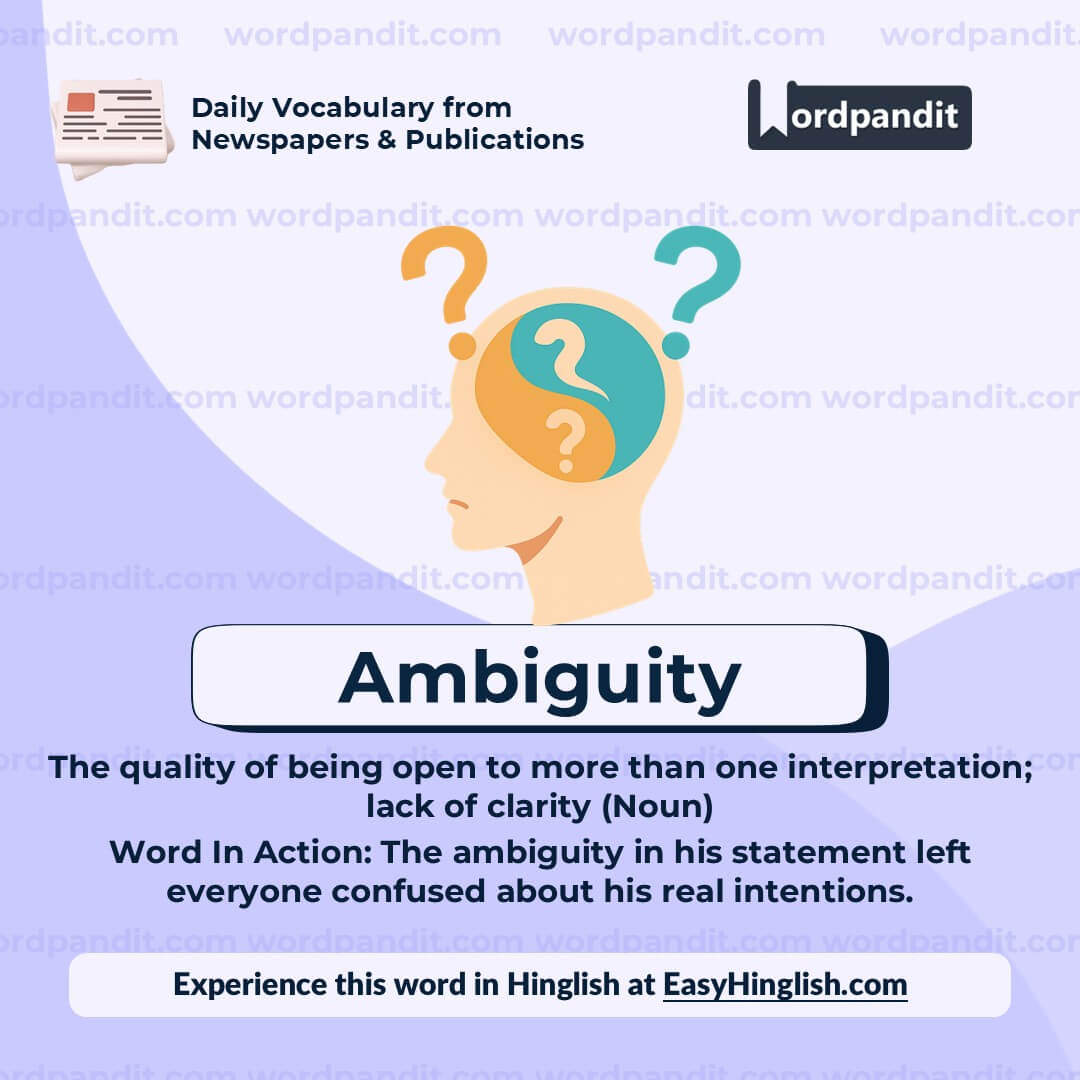
WORD-4: Ambiguity
Context:
"...the absence of moral ambiguity. Few moral issues are entirely uncontroversial, and where there is disagreement, there cannot be the kind of groundswell of public opinion that has finally brought the Post Office scandal to the top of the political agenda." - Guardian
Explanatory Paragraph:
The word ambiguity refers to a situation, statement, or concept that is unclear, open to multiple interpretations, or lacking in certainty. In the context of “moral ambiguity,” it means that the morality of a situation isn’t clearly right or wrong—it exists in a grey area. The sentence from the article emphasizes how rare it is to find moral issues without some ambiguity, as most situations involve conflicting views, values, or interpretations.
Meaning: The quality of being open to more than one interpretation; lack of clarity (Noun)
Pronunciation: am-bih-GYOO-ih-tee
Difficulty Level: ⭐⭐⭐ Intermediate
Etymology: From Latin ambiguus meaning "doubtful, uncertain" and ambigere meaning "to wander" or "to hesitate between two paths"
Prashant Sir's Notes:
Ambiguity is a favorite term in both literature and philosophy. It reflects life’s complexity—rarely is anything purely black or white. In exams, using this word can add depth to arguments where you acknowledge the presence of doubt or differing interpretations.
Synonyms & Antonyms:
Synonyms: vagueness, uncertainty, obscurity, equivocation, doubt
Antonyms: clarity, certainty, precision, transparency, lucidity
Usage Examples:
- The ambiguity in his statement left everyone confused about his real intentions.
- Good writers sometimes use ambiguity to provoke thought and multiple interpretations.
- Legal documents are often criticized for their ambiguity, which can lead to disputes.
- The character in the novel lives in moral ambiguity, making readers question their own values.
Cultural Reference:
"The ending of Christopher Nolan’s film Inception is famous for its ambiguity—was it a dream or reality?" - Film Criticism Journal
Think About It:
Is ambiguity always a weakness, or can it sometimes create space for creativity, empathy, or deeper understanding?
Quick Activity:
Think of a sentence that could be interpreted in two different ways. Write it down, then explain both interpretations.
Memory Tip:
Remember: “Ambi-” means both or two. Ambiguity = two meanings → double meaning or unclear.
Real-World Application:
Understanding ambiguity is essential in law, literature, politics, and media analysis. It helps individuals recognize bias, question assumptions, and engage critically with complex issues.
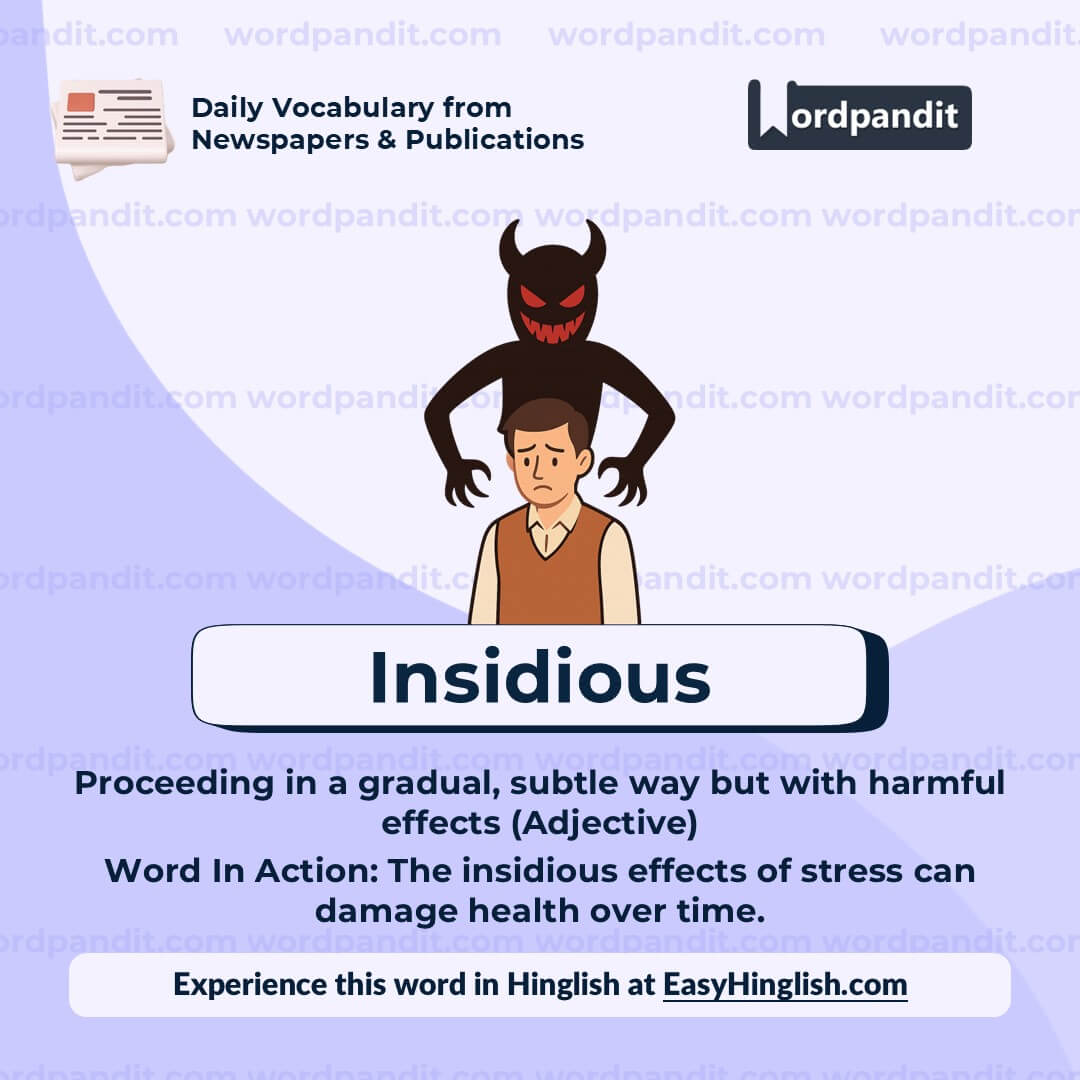
WORD-5: Insidious
Context:
"The Conservatives have masterfully used immigration, for instance, to tell an insidious and divisive story about Britain and who belongs here." - Guardian
Explanatory Paragraph:
The word insidious describes something harmful that spreads subtly and gradually, often without being noticed at first. In this context, it refers to a narrative about immigration that may appear reasonable or harmless on the surface but subtly promotes division, prejudice, or exclusion. “Insidious” implies danger that creeps in quietly, gaining power before its full effects are recognized. It's commonly used to describe deceptive ideologies, illnesses, or strategies that cause long-term harm.
Meaning: Proceeding in a gradual, subtle way but with harmful effects (Adjective)
Pronunciation: in-SID-ee-us
Difficulty Level: ⭐⭐⭐ Intermediate
Etymology: From Latin insidiosus, meaning “deceitful,” from insidiae (ambush, plot)
Prashant Sir's Notes:
“Insidious” is one of those powerful words often used in social and political writing. It adds depth when describing hidden dangers, systemic biases, or slow-acting threats. Use it in essays to highlight issues that grow unnoticed until the damage is done—like misinformation, prejudice, or addiction.
Synonyms & Antonyms:
Synonyms: subtle, stealthy, sneaky, devious, deceitful, treacherous
Antonyms: obvious, direct, honest, transparent, overt
Usage Examples:
- The insidious spread of misinformation on social media can destabilize societies.
- Some illnesses, like hypertension, are insidious because they show no symptoms until it's too late.
- Racism can be insidious, embedding itself in systems and language in ways people don’t immediately notice.
- The company’s advertising used insidious messaging to create insecurities among young consumers.
Cultural Reference:
"The 2010 horror film Insidious plays on the word’s meaning, focusing on a hidden supernatural threat that creeps into a family’s life undetected." - Horror Film Analysis
Think About It:
What are some modern examples of insidious ideas or trends that appear harmless at first but carry long-term consequences?
Quick Activity:
List two social or personal habits that might be described as insidious. Explain why.
Memory Tip:
Think: “In-sneaky” → Insidious sounds like “sneaky inside” — something dangerous sneaking in without warning.
Real-World Application:
“Insidious” is often used in news, policy discussions, and mental health contexts to highlight threats that grow silently—like disinformation, discrimination, or toxic workplace culture. Recognizing such threats helps in early intervention and awareness.


