

Daily Vocabulary from International Newspapers and Publications
Expand Your Vocabulary with Wordpandit’s Global Vocabulary Hub
At Wordpandit, we are committed to helping you develop a truly global vocabulary by drawing from some of the most respected international publications. This section is designed to keep you ahead of the curve by introducing you to words that define global conversations and trends.
The Power of Global Sources
To help you think and communicate on a global scale, we curate vocabulary from renowned international sources, such as:
- The New York Times
- The Washington Post
- BBC
- The Guardian
- The Economist
- Scientific American
- Psychology Today
- And many more...
Stay Global, Stay Competitive
Our daily updates from international publications ensure you are consistently exposed to new words that reflect global news and developments, making sure your vocabulary is not only current but also globally relevant.
Enhance Your Global Perspective
Whether you’re preparing for international exams, aiming to excel in global business communication, or want to enhance your language skills for personal growth, Wordpandit offers the resources you need to thrive in a global context.
Effective Learning, Global Reach
Our learning methodology combines global examples, memory aids, and interactive activities, allowing you to internalize new words effectively and apply them in real-world scenarios.
Begin Your Global Vocabulary Journey Now!

Why Choose Wordpandit?
Practical Learning: Focus on words you'll actually encounter in real-world reading, enhancing your comprehension and communication skills.
Diverse Content: From current affairs to scientific breakthroughs, our varied sources expose you to vocabulary across multiple domains.
Effortless Integration: Make Wordpandit a part of your daily routine. Just a few minutes each day can significantly boost your lexicon over time.
Your Path to Vocabulary Mastery
- Visit our Daily Vocabulary section regularly
- Explore new words and their usage in context
- Practice incorporating these words into your own writing and speech
- Track your progress as your vocabulary expands
Start Your Journey Today
Embark on your vocabulary enhancement journey with Wordpandit. By consistently engaging with our daily posts, you'll build a robust vocabulary that serves you well in academic, professional, and personal contexts.
Remember, a word a day keeps linguistic limitations at bay. Make Wordpandit your daily companion in the quest for vocabulary excellence!
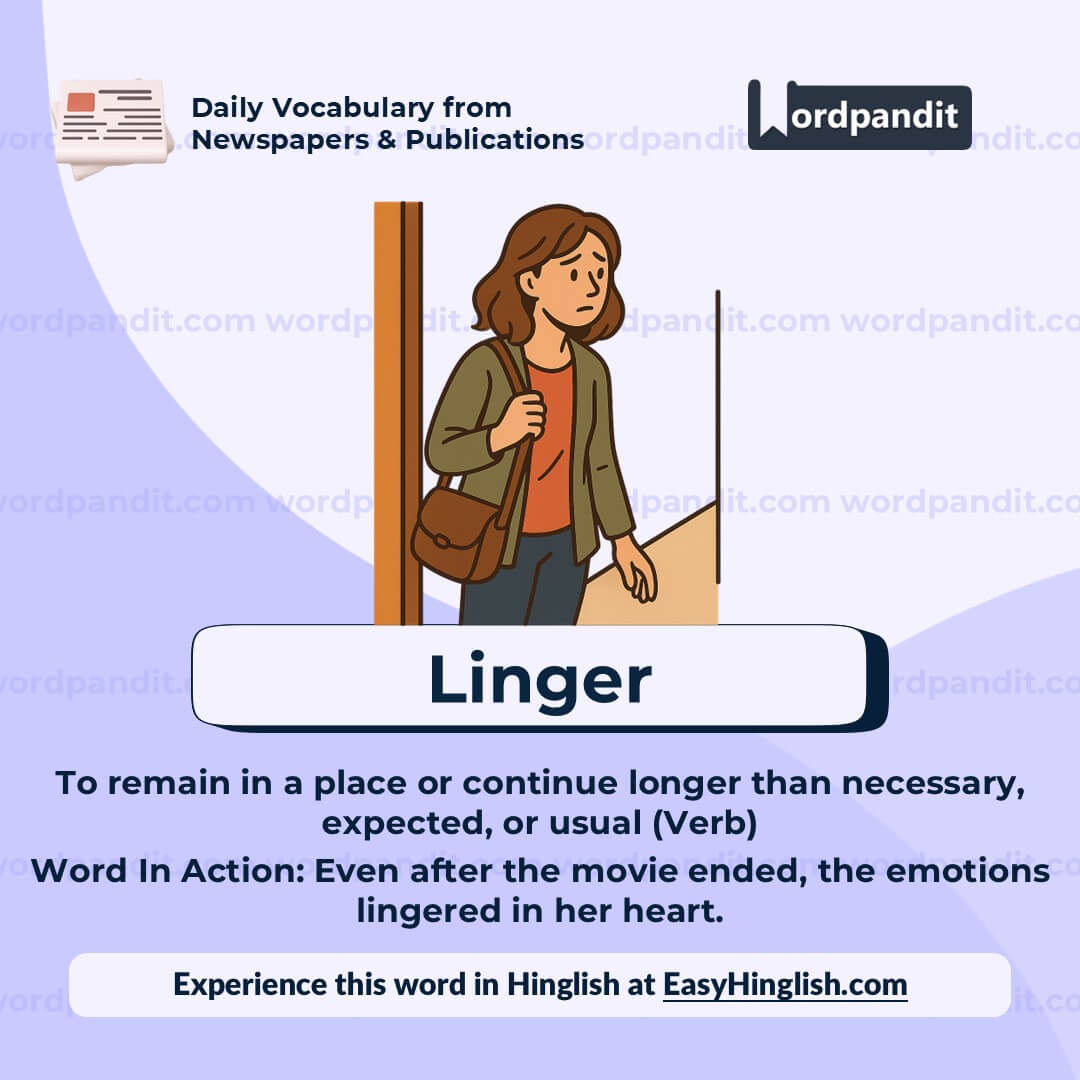
WORD-1: Linger
Context:
"The great thing about philosophy is that we can all do it. Anyone can ask philosophical questions about reality, truth, right and wrong, and the point of it all, and we often do, at least for brief moments throughout the day. The best books, TV shows, and movies all come dyed in philosophy, and they plant ideas that linger long after you close the book or the screen fades to black." - Big Think
Explanatory Paragraph:
The word linger means to stay in a place or in someone's mind for longer than expected, often because leaving or fading away feels difficult. It can describe people staying behind after an event, a smell or taste remaining in the air, or even emotions and ideas staying with us long after the moment has passed. It often carries a sense of slowness, hesitation, or lasting presence.
Meaning: To remain in a place or continue longer than necessary, expected, or usual (Verb)
Pronunciation: LIN-gur
Difficulty Level: ⭐⭐ Beginner to Intermediate
Etymology: From Old English lengan (to prolong), related to Old Norse lengja, meaning "to make long."
Prashant Sir's Notes:
Linger is often connected with emotions, memories, or experiences that don’t fade quickly. It can have both positive and negative tones depending on context — joy can linger, but so can sorrow.
Synonyms & Antonyms:
Synonyms: remain, stay, persist, loiter, hover
Antonyms: depart, vanish, disappear, fade, leave
Usage Examples:
- The sweet aroma of fresh flowers lingered in the room long after she had left.
- He lingered at the doorway, hesitant to say goodbye.
- The memory of that summer vacation still lingers in my mind.
- A sense of unease lingered even after the problem seemed solved.
Cultural Reference:
"Memories linger the longest when tied to strong emotions." – A common theme in psychology and literature.
Think About It:
What emotions or ideas from your past continue to linger with you today, and why do you think they have stayed?
Quick Activity:
Write two sentences — one where something pleasant lingers (like a taste or memory) and one where something unpleasant lingers (like a doubt or smell).
Memory Tip:
Think of a guest who lingers at your house — they stay longer than expected. That’s exactly what the word means: something that doesn’t leave quickly.
Real-World Application:
The word linger is often used in everyday life to describe perfumes, tastes, music, or conversations that stay with us long after the original moment is gone. It is also used in psychology, literature, and art to describe emotions or memories that endure.
WORD-2: Optimised
Context:
"The optimised morning routine has become a near-mythical ideal for young people, sold by fitness influencers posting obsessively about their 5.30am starts, claiming to finish their weight training, macronutrient-rich meals and emails before our first alarm – promising that everything in your life would be better if you, too, had the discipline to just get up early." - The Guardian
Explanatory Paragraph:
The word optimised means improved or adjusted in the best possible way to achieve maximum effectiveness or efficiency. When something is optimised, it has been carefully refined so that it works at its highest potential. This can apply to routines, systems, machines, or even strategies — anything that can be improved to deliver the best results.
Meaning: Made as effective, perfect, or functional as possible (Verb – past tense)
Pronunciation: OP-tih-mized
Difficulty Level: ⭐⭐⭐ Intermediate
Etymology: From Latin optimus meaning "best" → via French and later English "optimize" (to make the best of).
Prashant Sir's Notes:
Optimised is usually linked with productivity, efficiency, or performance. It reflects the idea of continuous improvement — cutting waste, saving time, or increasing effectiveness. Be careful: "optimised" doesn’t always mean "perfect," but rather "improved towards the best possible version."
Synonyms & Antonyms:
Synonyms: enhanced, refined, improved, streamlined, perfected
Antonyms: neglected, worsened, degraded, weakened, inefficient
Usage Examples:
- The company optimised its website so that it loads faster on mobile devices.
- Her study schedule was optimised to balance rest, focus, and review sessions.
- The hospital optimised patient flow to reduce waiting times.
- With a few changes, the app was optimised to consume less battery power.
Cultural Reference:
In modern self-help and productivity culture, "optimised living" has become a trend — where people seek to fine-tune every detail of their day to achieve maximum output.
Think About It:
Do you think optimising every part of life makes us more effective, or does it sometimes create unnecessary pressure?
Quick Activity:
Pick one aspect of your daily routine (like studying, exercising, or sleeping). Write down two ways you could optimise it to make it more effective.
Memory Tip:
Think of "optimised" as aiming for the "optimum" — the very best condition possible. Both words share the root optimus, meaning "best."
Real-World Application:
The word optimised is commonly used in business, technology, health, and education to describe systems, routines, or tools that are improved for better performance. For example, an optimised diet improves health, while an optimised algorithm makes software run more smoothly.
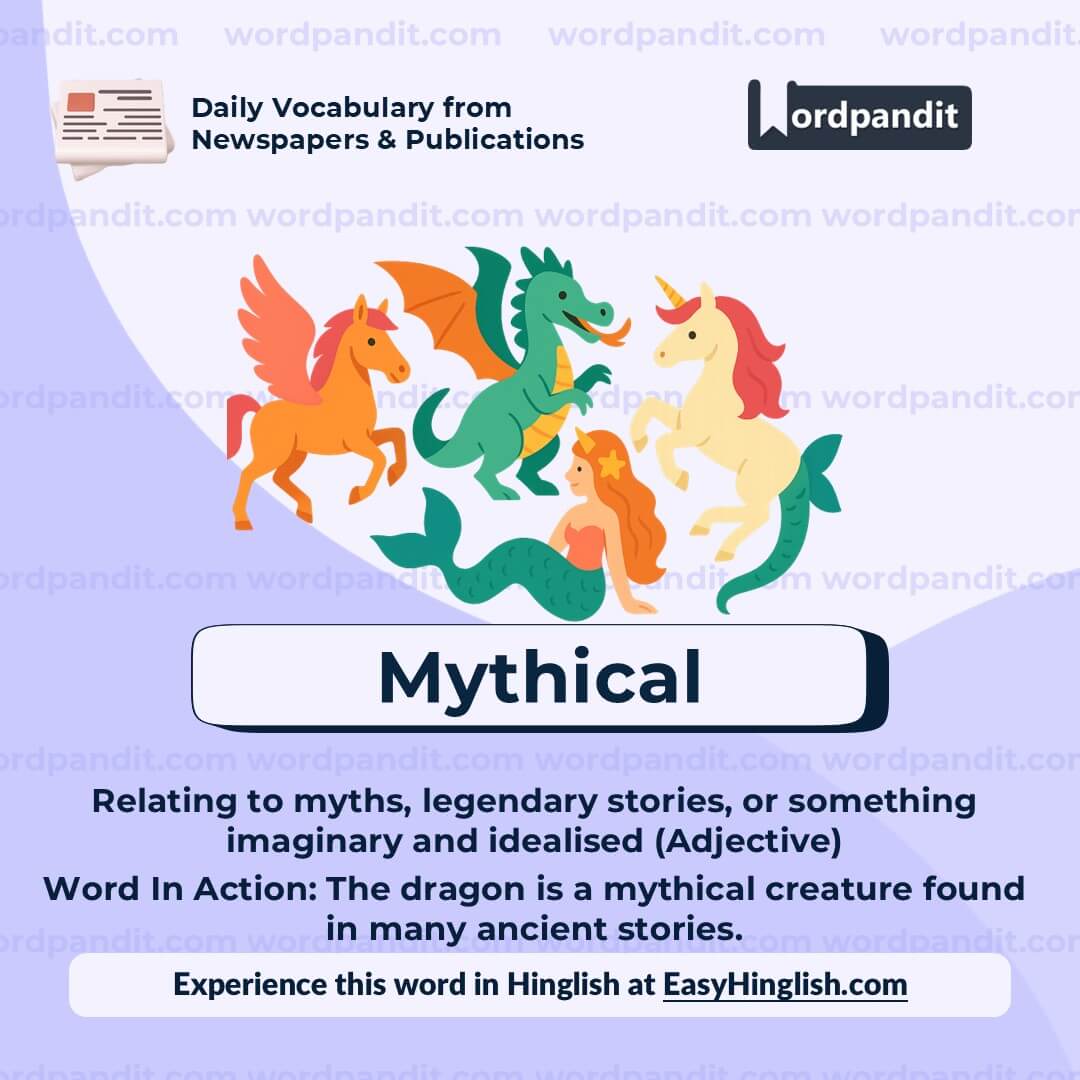
WORD-3: Mythical
Context:
"The optimised morning routine has become a near-mythical ideal for young people, sold by fitness influencers posting obsessively about their 5.30am starts, claiming to finish their weight training, macronutrient-rich meals and emails before our first alarm – promising that everything in your life would be better if you, too, had the discipline to just get up early." - The Guardian
Explanatory Paragraph:
The word mythical has two shades of meaning. Literally, it relates to myths, legends, or stories involving gods, heroes, and magical creatures. Figuratively, it describes something imagined, unreal, or idealised — often too perfect to be true. In modern contexts, it is used for ideals or goals that people talk about but are difficult to actually achieve, much like legends that exist more in stories than in reality.
Meaning: Relating to myths, legendary stories, or something imaginary and idealised (Adjective)
Pronunciation: MITH-ih-kuhl
Difficulty Level: ⭐⭐ Beginner to Intermediate
Etymology: From Greek mythos meaning "story, tale," later becoming "mythicus" in Latin, and eventually "mythical" in English.
Prashant Sir's Notes:
Mythical often conveys exaggeration or unattainability in modern speech. While originally tied to ancient stories, in today’s usage it often describes something so rare, perfect, or extraordinary that it feels almost unreal.
Synonyms & Antonyms:
Synonyms: legendary, imaginary, fabulous, fabled, unreal
Antonyms: real, factual, actual, authentic, true
Usage Examples:
- Dragons and unicorns are creatures of mythical origin.
- He chased the mythical dream of perfection in every aspect of his life.
- The castle stood on the hill like something out of a mythical tale.
- In modern culture, the idea of "work-life balance" sometimes feels mythical.
Cultural Reference:
Mythical creatures such as the phoenix, minotaur, and mermaids have shaped stories across civilizations, from Greek mythology to modern fantasy novels.
Think About It:
Why do humans create mythical stories — do they serve as entertainment, moral guidance, or a way to explain the unknown?
Quick Activity:
Write down one modern "mythical" idea (e.g., the perfect job, flawless beauty, or an ideal routine) and explain why it feels difficult or impossible to achieve.
Memory Tip:
Connect "mythical" with "myth" — both relate to stories or ideas that are not entirely real but are widely spoken of.
Real-World Application:
In everyday life, mythical is used beyond legends to describe things like mythical wealth, mythical status, or mythical routines — ideals that are often exaggerated and rarely attainable in reality.
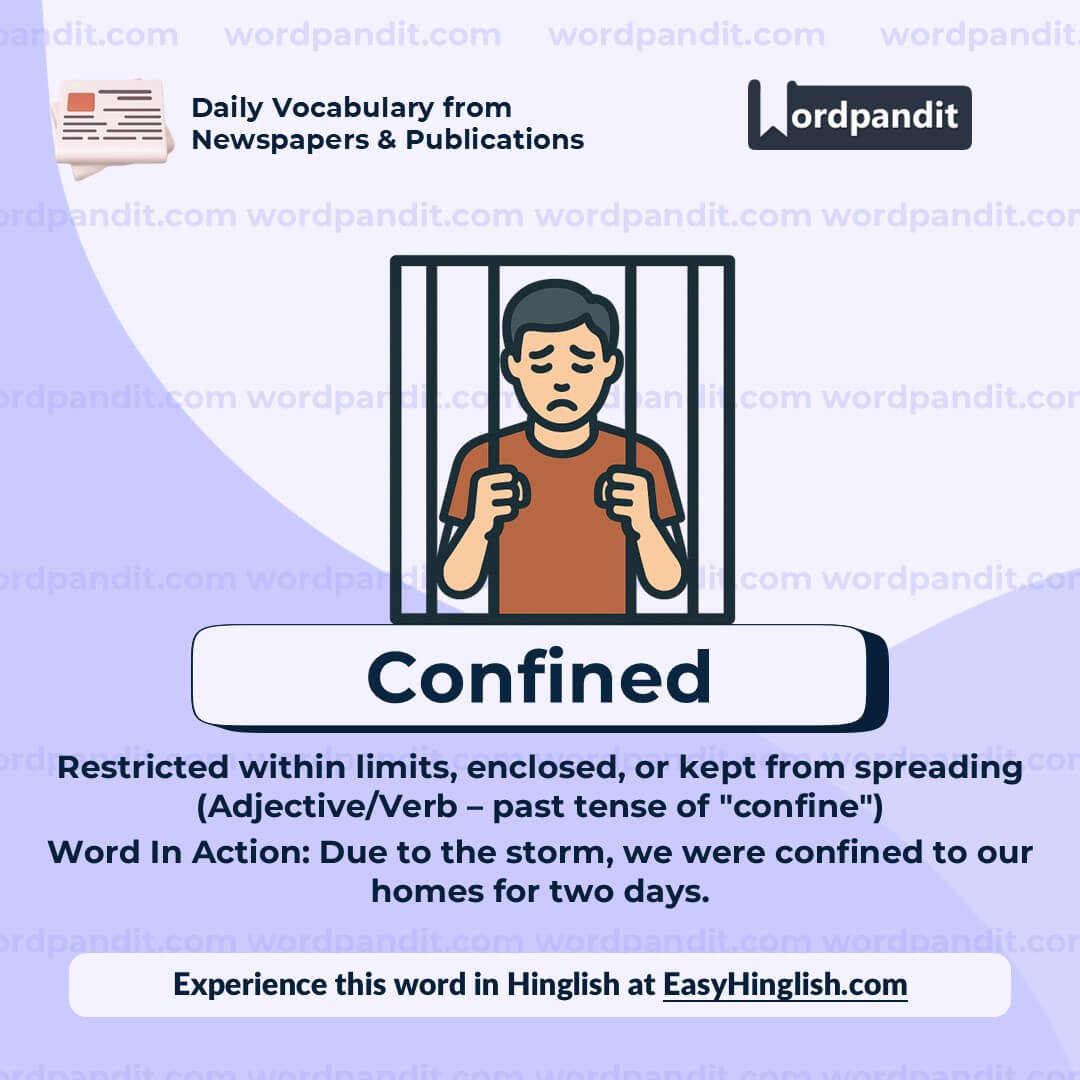
WORD-4: Confined
Context:
"We used to think of measles outbreaks in the United States as isolated events: short-lived and confined to close-knit communities with low vaccination rates. A flare here, a bubble there. But as those bubbles grow and converge, the United States could be at risk for tens of thousands of cases." - The New York Times
Explanatory Paragraph:
The word confined refers to being restricted, limited, or kept within certain boundaries. It can describe physical spaces, like a person being confined to a room, or abstract limits, like an idea or event being confined to a small group. It often carries a sense of restriction, enclosure, or lack of freedom.
Meaning: Restricted within limits, enclosed, or kept from spreading (Adjective/Verb – past tense of "confine")
Pronunciation: kun-FIND
Difficulty Level: ⭐⭐ Beginner to Intermediate
Etymology: From Latin confinare, meaning "to border, limit, or restrict," derived from con- (together) + finis (boundary, end).
Prashant Sir's Notes:
Confined often implies limitation, either physically (like a confined space) or socially (confined to a community). It can also mean restricted in scope, movement, or influence.
Synonyms & Antonyms:
Synonyms: restricted, limited, enclosed, restrained, contained
Antonyms: free, open, unrestricted, unbounded, limitless
Usage Examples:
- The patient was confined to bed for two weeks after surgery.
- The fire was quickly confined to one section of the building.
- Her creativity could not be confined by strict rules.
- The discussion was confined to financial issues only.
Cultural Reference:
The idea of "confinement" is often used in literature and films to symbolize restriction, such as in prison dramas or dystopian stories where freedom is tightly confined by authority.
Think About It:
Do restrictions always limit growth, or can being confined to certain boundaries sometimes spark creativity?
Quick Activity:
Think of a situation in your own life where you felt confined. Write one sentence describing how that limitation affected you positively or negatively.
Memory Tip:
Break it down: "con-" (together) + "fine" (boundary). Something confined is kept together within boundaries.
Real-World Application:
In everyday life, confined is used in health (patients confined to bed), safety (fire confined to an area), and law (confined spaces regulations). It’s also common in metaphorical contexts — for example, someone feeling confined by tradition or routine.
WORD-5: Converge
Context:
"We used to think of measles outbreaks in the United States as isolated events: short-lived and confined to close-knit communities with low vaccination rates. A flare here, a bubble there. But as those bubbles grow and converge, the United States could be at risk for tens of thousands of cases." - The New York Times
Explanatory Paragraph:
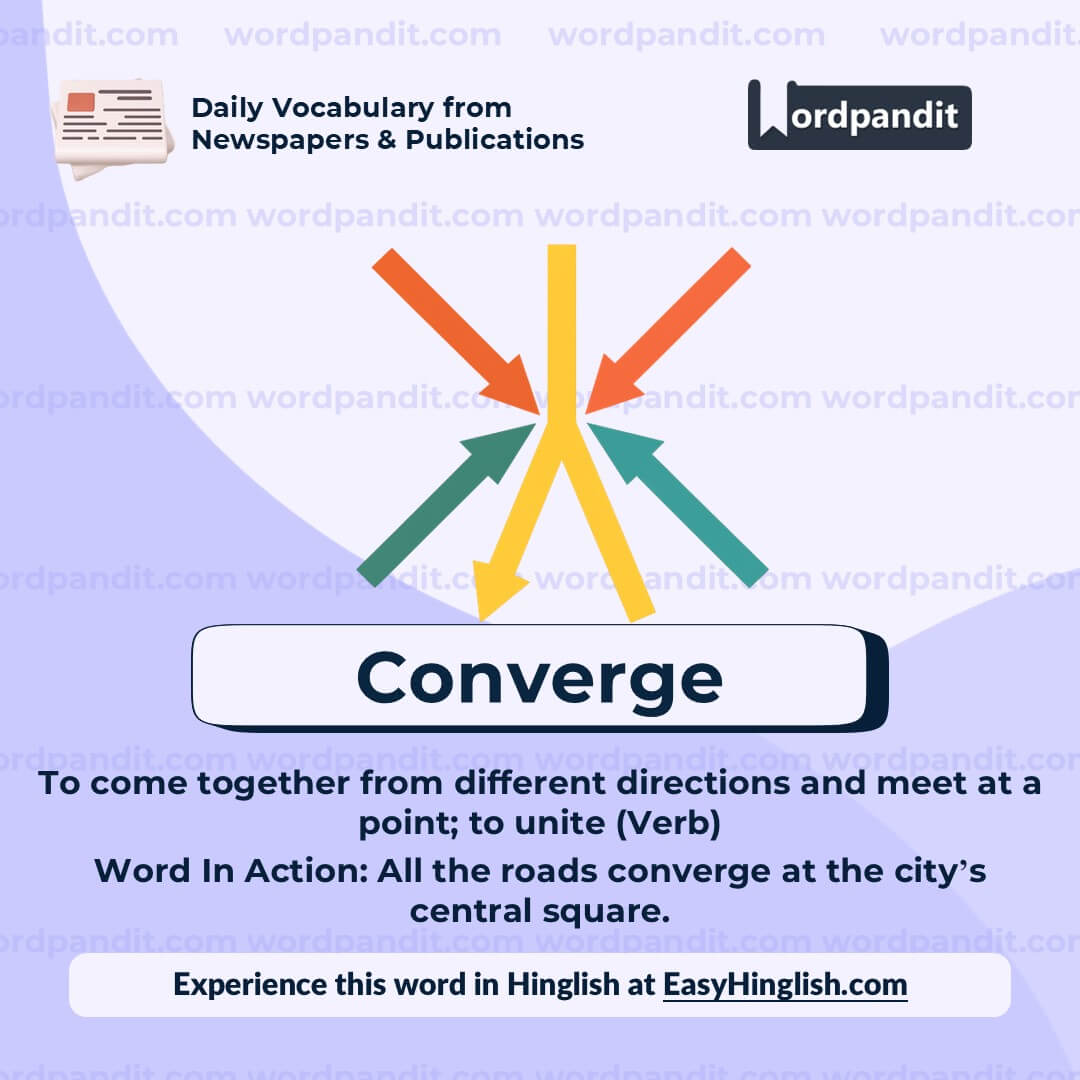
The word converge means to come together from different directions and meet at a point. It can be used for physical movement, like roads converging at a junction, or for abstract ideas and events, like trends, thoughts, or communities converging. It often suggests unity, joining, or merging into a common outcome.
Meaning: To come together from different directions and meet at a point; to unite (Verb)
Pronunciation: kun-VERJ
Difficulty Level: ⭐⭐⭐ Intermediate
Etymology: From Latin convergere, from con- (together) + vergere (to bend, incline).
Prashant Sir's Notes:
Converge highlights the idea of different streams, whether of thought, action, or people, moving towards one shared point. It is the opposite of divergence (moving apart).
Synonyms & Antonyms:
Synonyms: meet, unite, merge, join, intersect
Antonyms: diverge, separate, split, disperse, branch
Usage Examples:
- All the protestors converged at the city square by evening.
- The two rivers converge to form a larger waterway.
- Scientists from different fields converged to solve the climate crisis.
- As ideas from art and science converge, new innovations are born.
Cultural Reference:
The phrase "converging technologies" is used in discussions about AI, biotechnology, and nanotechnology, where different fields come together to create powerful advancements.
Think About It:
When people with diverse perspectives converge on a problem, do they always find stronger solutions, or can too many views sometimes create conflict?
Quick Activity:
Think of two different interests or hobbies you have. Write one sentence on how they could converge to create something new.
Memory Tip:
Remember: "con-" = together, and "verge" = to move or bend. So, converge = to move together toward one point.
Real-World Application:
The word converge is widely used in science, technology, and social discussions — for example, roads converge at an intersection, trends converge in fashion, and people converge at events or rallies.


