

Daily Vocabulary from International Newspapers and Publications
Expand Your Vocabulary with Wordpandit’s Global Vocabulary Hub
At Wordpandit, we are committed to helping you develop a truly global vocabulary by drawing from some of the most respected international publications. This section is designed to keep you ahead of the curve by introducing you to words that define global conversations and trends.
The Power of Global Sources
To help you think and communicate on a global scale, we curate vocabulary from renowned international sources, such as:
- The New York Times
- The Washington Post
- BBC
- The Guardian
- The Economist
- Scientific American
- Psychology Today
- And many more...
Stay Global, Stay Competitive
Our daily updates from international publications ensure you are consistently exposed to new words that reflect global news and developments, making sure your vocabulary is not only current but also globally relevant.
Enhance Your Global Perspective
Whether you’re preparing for international exams, aiming to excel in global business communication, or want to enhance your language skills for personal growth, Wordpandit offers the resources you need to thrive in a global context.
Effective Learning, Global Reach
Our learning methodology combines global examples, memory aids, and interactive activities, allowing you to internalize new words effectively and apply them in real-world scenarios.
Begin Your Global Vocabulary Journey Now!

Why Choose Wordpandit?
Practical Learning: Focus on words you'll actually encounter in real-world reading, enhancing your comprehension and communication skills.
Diverse Content: From current affairs to scientific breakthroughs, our varied sources expose you to vocabulary across multiple domains.
Effortless Integration: Make Wordpandit a part of your daily routine. Just a few minutes each day can significantly boost your lexicon over time.
Your Path to Vocabulary Mastery
- Visit our Daily Vocabulary section regularly
- Explore new words and their usage in context
- Practice incorporating these words into your own writing and speech
- Track your progress as your vocabulary expands
Start Your Journey Today
Embark on your vocabulary enhancement journey with Wordpandit. By consistently engaging with our daily posts, you'll build a robust vocabulary that serves you well in academic, professional, and personal contexts.
Remember, a word a day keeps linguistic limitations at bay. Make Wordpandit your daily companion in the quest for vocabulary excellence!
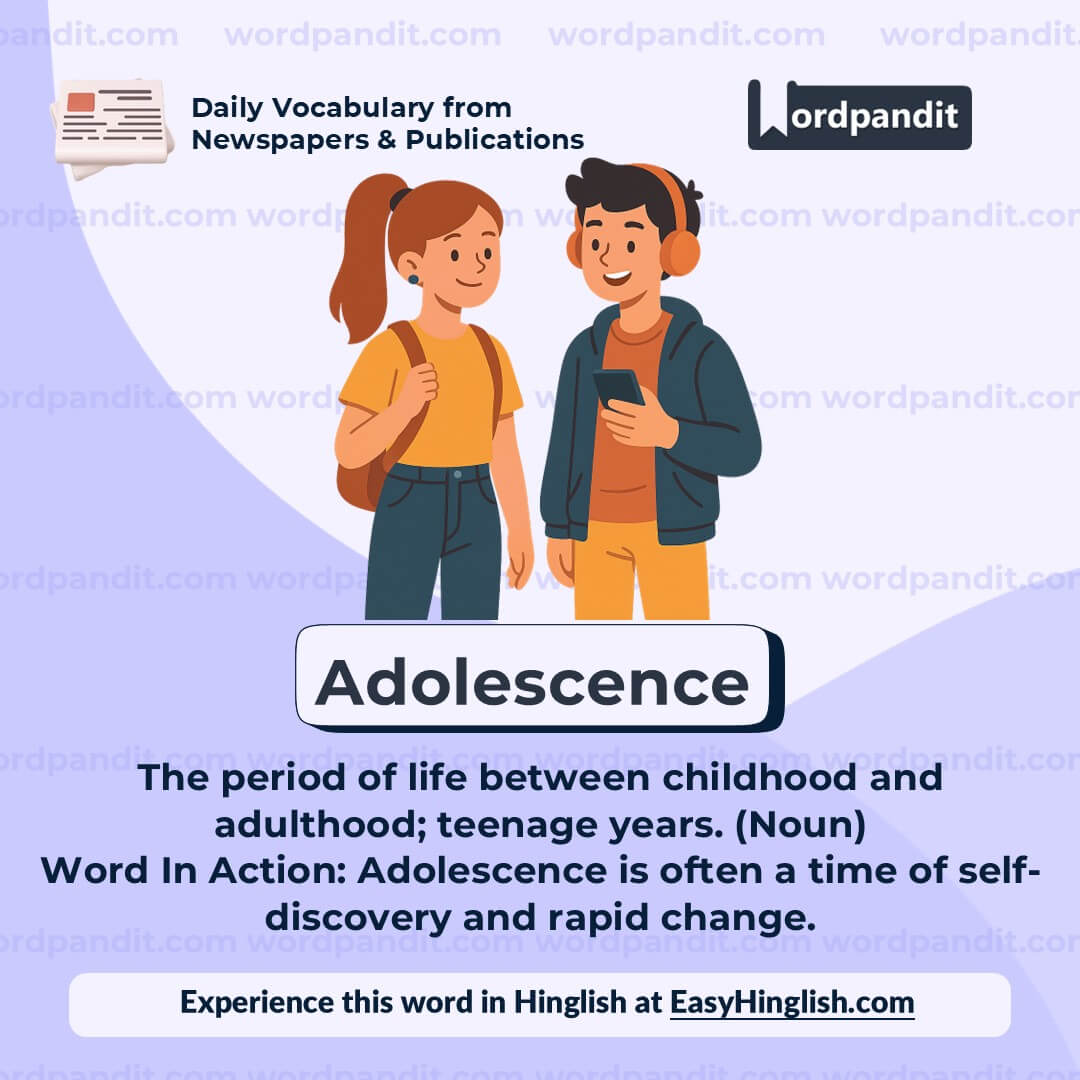
WORD-1: Adolescence
Context:
"Early in the first episode of the four-part Netflix series “Adolescence,” a father and son sit in a room at a police station because the son has been accused of murder." - The New York Times
Explanatory Paragraph:
Adolescence is the transitional stage of life between childhood and adulthood, usually marked by rapid physical, emotional, and psychological changes. It is a time when individuals begin to develop a stronger sense of identity, independence, and responsibility, but it is also often accompanied by confusion, experimentation, and challenges in decision-making.
Meaning: The period of life between childhood and adulthood, typically during the teenage years (Noun)
Pronunciation: ad-oh-LESS-ens
Difficulty Level: ⭐⭐ Beginner–Intermediate
Etymology: Derived from the Latin word adolescentia, from adolescere meaning "to grow up" or "to mature."
Prashant Sir's Notes:
Think of adolescence as the "growing bridge" between childhood innocence and adult responsibility. It is not only about age but also about transformation, exploration, and identity-building.
Synonyms & Antonyms:
Synonyms: teenage years, youth, puberty, growing-up period
Antonyms: childhood, adulthood, maturity
Usage Examples:
- Adolescence is often a confusing stage filled with questions about identity and purpose.
- Many lifelong habits are formed during adolescence, making it a critical developmental phase.
- She wrote a memoir reflecting on her struggles during adolescence.
- Modern psychology places great importance on understanding the challenges of adolescence.
Cultural Reference:
"Adolescence is just one big walking pimple." - J.D. Salinger, often quoted in discussions about teenage struggles and awkwardness.
Think About It:
How does adolescence shape a person’s values, choices, and identity in adulthood?
Quick Activity:
Write down three major changes (physical, emotional, or social) that typically occur during adolescence. Then reflect on which one has the most lasting impact.
Memory Tip:
Remember: "Adolescence = Adding lessons." This phase of life is about learning lessons that prepare you for adulthood.
Real-World Application:
Teachers, psychologists, and parents often study adolescence to better understand the struggles and behaviors of teenagers, helping them guide young people toward healthier decisions and future success.
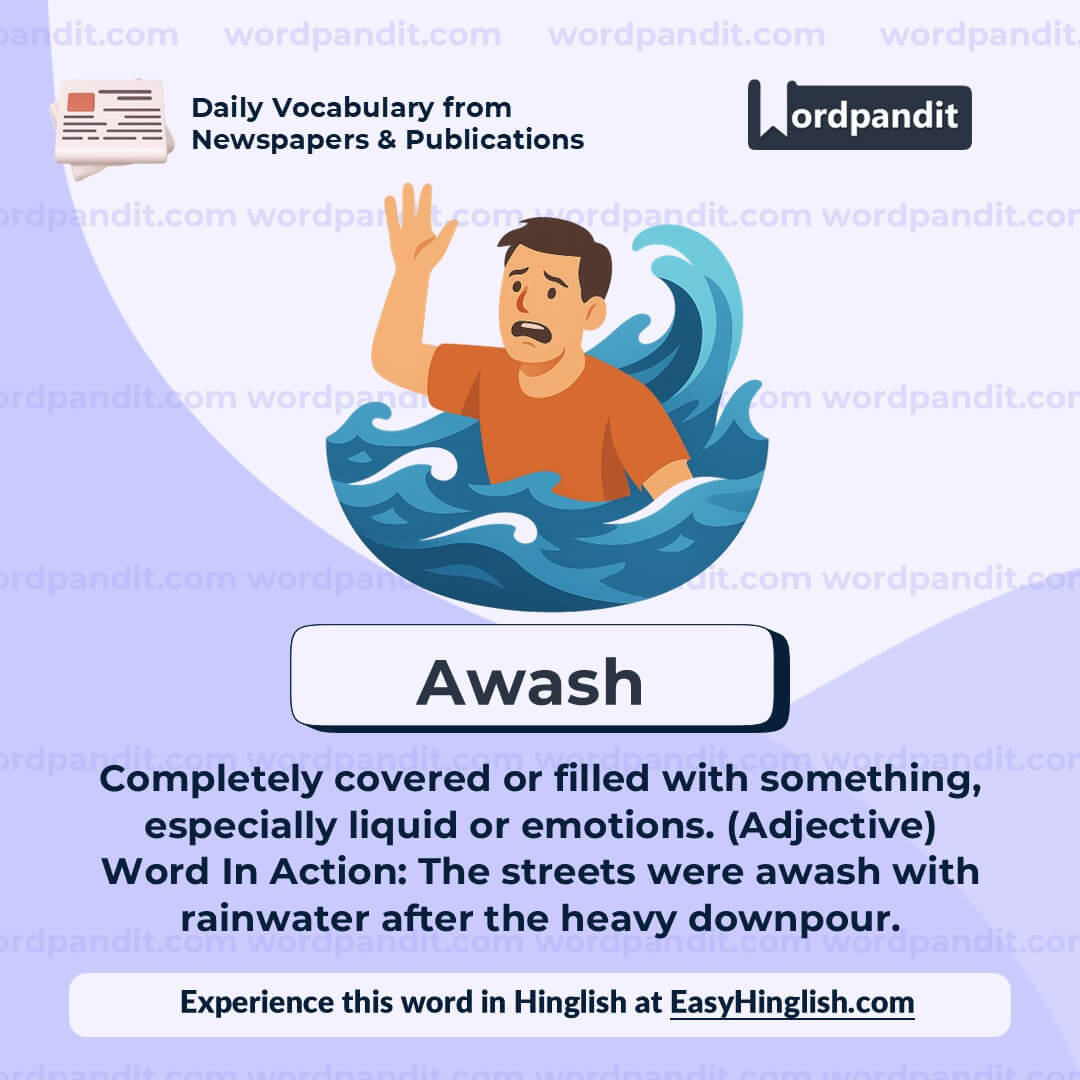
WORD-2: Awash
Context:
"The problem is that the internet is awash with half-read and mostly misunderstood philosophy. It is made up of a series of quotations — often from Nietzsche, Rumi, or Camus — ripped from a single line of a very complicated book. It’s wisdom, but out of context and stripped of nuance. The million-follower accounts on social media tear out pithy aphorisms from huge, well-argued tomes to broadcast the philosophical equivalent of “live, laugh, love.”" - Big Think
Explanatory Paragraph:
Awash means to be completely covered, filled, or overwhelmed with something. Originally used to describe being covered with water, it is now commonly applied in a figurative sense, such as being awash with emotions, ideas, or even information. It suggests an overflowing abundance—sometimes positive, but often overwhelming.
Meaning: Completely covered or filled with something, often in excess (Adjective)
Pronunciation: uh-WOSH
Difficulty Level: ⭐⭐ Beginner–Intermediate
Etymology: Comes from the phrase “a wash,” originally a nautical term describing a ship that is flooded or washed over with water.
Prashant Sir's Notes:
Visualize "awash" as standing on a beach when the waves suddenly wash over your feet. Similarly, when used figuratively, it means being flooded or overwhelmed by something—be it emotions, information, or physical objects.
Synonyms & Antonyms:
Synonyms: flooded, overflowing, saturated, inundated, brimming
Antonyms: dry, empty, barren, scarce
Usage Examples:
- The town was awash with tourists during the summer festival.
- After the announcement, she felt awash with relief.
- The market is awash with cheap, low-quality imitations of branded products.
- His desk was awash with papers, making it nearly impossible to find anything.
Cultural Reference:
Journalists often use "awash" when describing information overload in the digital age—for example, "We live in a world awash with data but starved for wisdom." - Inspired by modern media commentary.
Think About It:
Is being “awash” with information a sign of progress, or does it make true wisdom harder to find?
Quick Activity:
Fill in the blank: "The city was awash with __________ during the celebrations." Try using emotions, objects, or even sounds to complete the sentence creatively.
Memory Tip:
Think: "A wave washes over you." If something is awash, it’s like being covered by waves of abundance.
Real-World Application:
The word "awash" is commonly used in journalism and everyday conversation to describe situations of excess—such as a market awash with goods, a city awash with lights, or a mind awash with emotions.
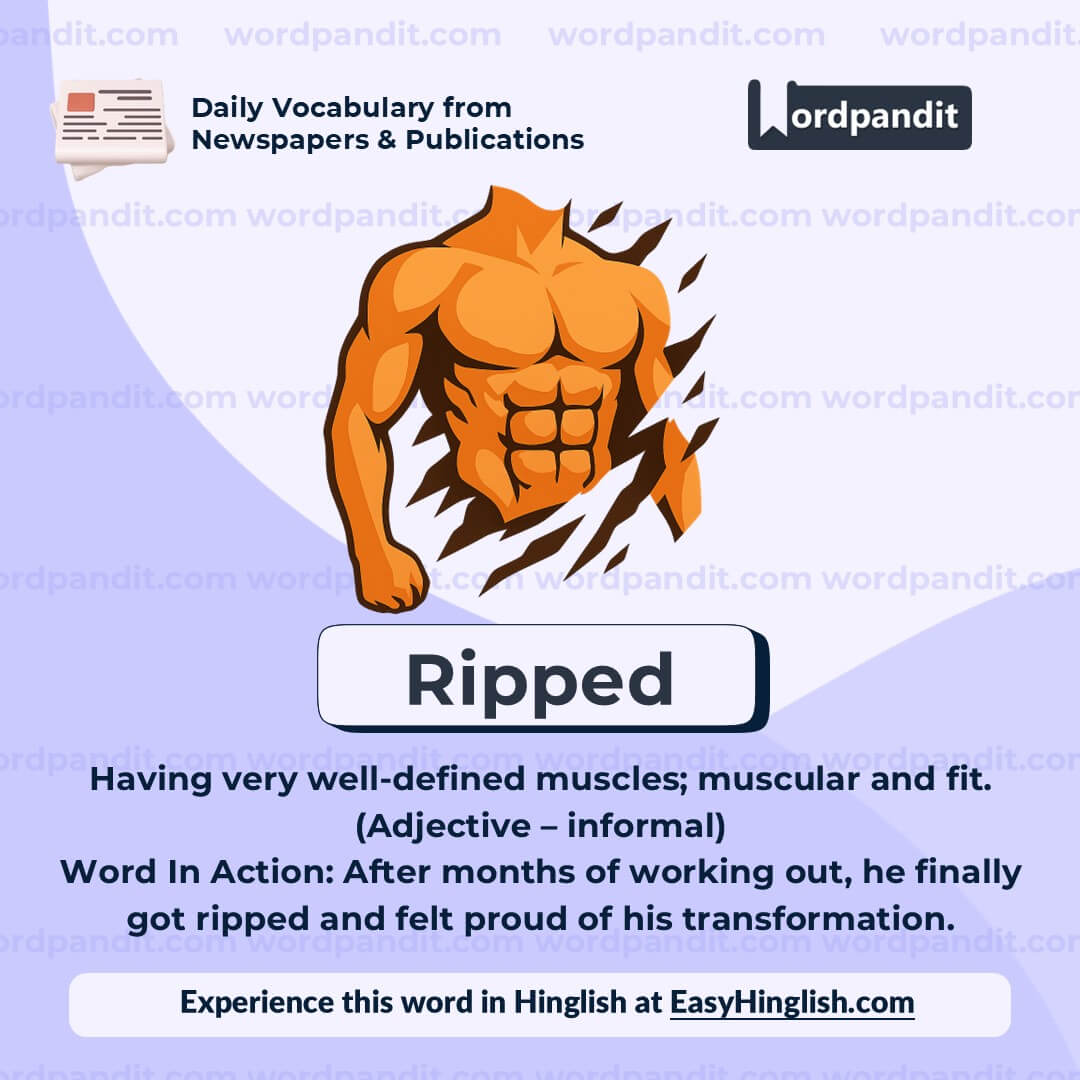
WORD-3: Ripped
Context:
"The problem is that the internet is awash with half-read and mostly misunderstood philosophy. It is made up of a series of quotations — often from Nietzsche, Rumi, or Camus — ripped from a single line of a very complicated book. It’s wisdom, but out of context and stripped of nuance. The million-follower accounts on social media tear out pithy aphorisms from huge, well-argued tomes to broadcast the philosophical equivalent of “live, laugh, love.”" - Big Think
Explanatory Paragraph:
Ripped generally means "torn apart quickly or forcefully." In a literal sense, it refers to tearing fabric or paper. In a figurative sense, as used here, it means taking something out of its original context or separating it abruptly from its full meaning. The word can also have informal meanings, such as describing someone with well-defined muscles, but in this context, it emphasizes distortion by removal.
Meaning: Torn apart or taken abruptly and forcefully (Verb, past participle)
Pronunciation: ript
Difficulty Level: ⭐ Beginner
Etymology: From Middle English rippen (to tear or cut open), related to Old Norse ripa, meaning "to tear or scratch."
Prashant Sir's Notes:
Always notice context. "Ripped" can mean "torn physically," "taken out of context," or even "muscular." In the Big Think example, it clearly refers to quotes being "ripped" or torn away from their larger philosophical framework.
Synonyms & Antonyms:
Synonyms: torn, shredded, pulled apart, extracted, detached
Antonyms: intact, whole, attached, preserved
Usage Examples:
- He accidentally ripped his shirt while climbing the fence.
- The speech was ripped out of context, changing its meaning entirely.
- She ripped the envelope open with excitement.
- The storm ripped the roof off several houses in the village.
Cultural Reference:
In media, people often say a politician’s words are "ripped from context," meaning the words are presented in a misleading way to change their intent.
Think About It:
When information is ripped from its original context, can it ever truly convey truth—or is it always a distortion?
Quick Activity:
Write a sentence using "ripped" in both a physical sense (something torn) and a figurative sense (something taken out of context).
Memory Tip:
Think of "rip = rip apart." Whether it’s a shirt, paper, or meaning, something is being broken away forcefully.
Real-World Application:
Ripped is commonly used in news, social media, and everyday life to describe both physical damage (a ripped cloth) and figurative misuse (ripped quotations, ripped-off ideas).
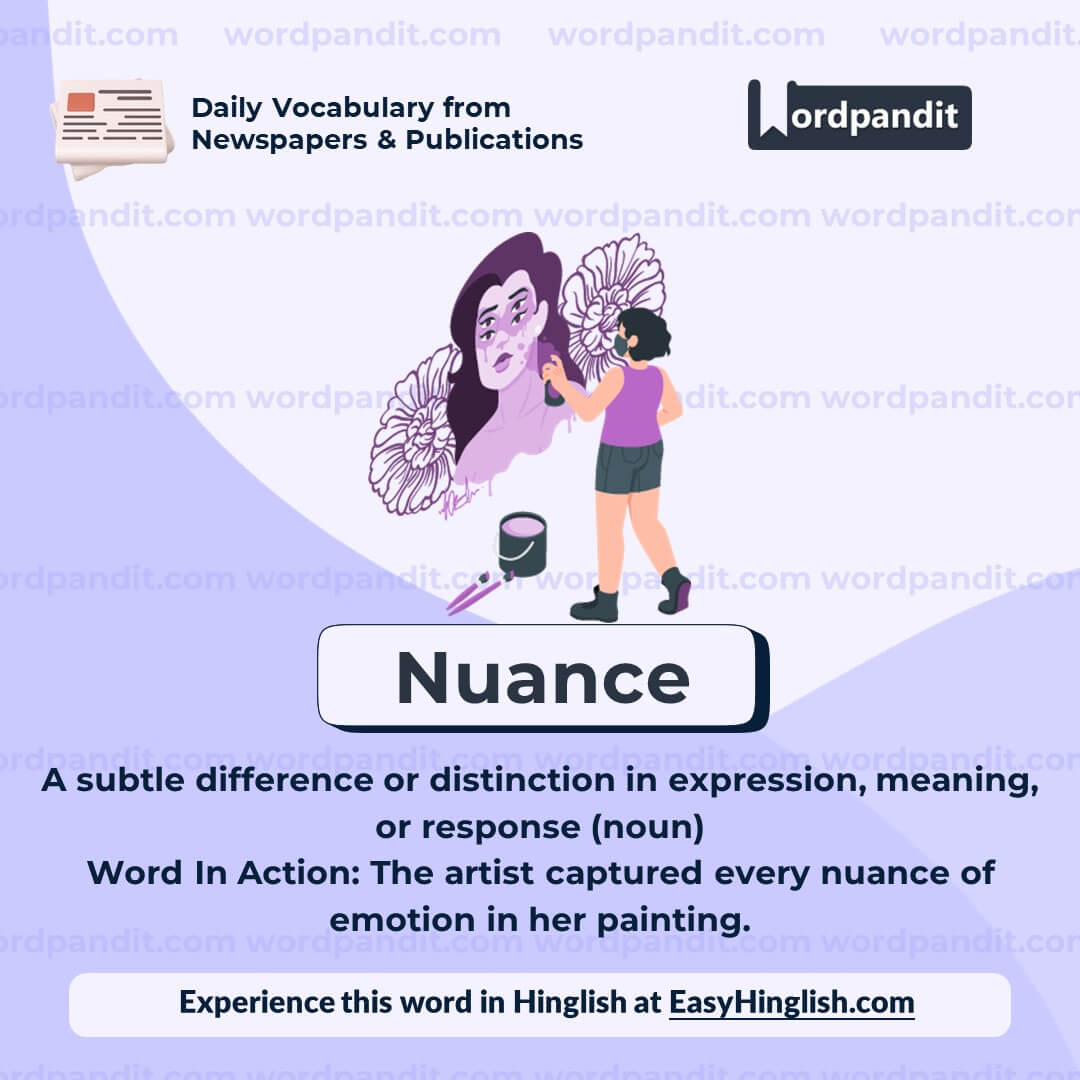
WORD-4: Nuance
Context:
"The problem is that the internet is awash with half-read and mostly misunderstood philosophy. It is made up of a series of quotations — often from Nietzsche, Rumi, or Camus — ripped from a single line of a very complicated book. It’s wisdom, but out of context and stripped of nuance. The million-follower accounts on social media tear out pithy aphorisms from huge, well-argued tomes to broadcast the philosophical equivalent of “live, laugh, love.”" - Big Think
Explanatory Paragraph:
Nuance refers to a subtle difference in meaning, expression, tone, or feeling. It highlights the fine distinctions that make ideas, arguments, or emotions richer and more complex. When nuance is lost, things appear oversimplified, and the depth of thought or feeling is diminished. Appreciating nuance often requires careful listening, observation, or analysis.
Meaning: A subtle or slight distinction, variation, or shade of meaning, expression, or tone (Noun)
Pronunciation: NEW-ahnss
Difficulty Level: ⭐⭐⭐ Intermediate
Etymology: From French nuance, meaning "shade" or "subtle difference," from Latin nubes, meaning "cloud." Originally linked to subtle variations like shades of color.
Prashant Sir's Notes:
Nuance is about the "grey areas" in communication and thought. It's what makes language, art, or ideas layered instead of black and white. Remember: missing nuance often leads to misunderstanding or oversimplification.
Synonyms & Antonyms:
Synonyms: subtlety, refinement, distinction, shade, gradation
Antonyms: bluntness, obviousness, simplicity, plainness
Usage Examples:
- The actor’s performance was full of nuance, capturing emotions that words alone couldn’t express.
- A nuanced understanding of history helps us avoid oversimplified conclusions.
- The artist used slight changes in color to add nuance to the painting.
- Without nuance, the debate quickly turned into extreme positions instead of meaningful discussion.
Cultural Reference:
In modern journalism and social media, people often complain that “nuance is dead” because complex ideas are reduced to short, catchy statements that ignore subtle distinctions.
Think About It:
Why do you think nuance is often lost in social media conversations, and what effect does this have on public understanding?
Quick Activity:
Pick a topic you know well (e.g., sports, movies, politics). Write one oversimplified statement about it, then rewrite the same idea with nuance to show deeper understanding.
Memory Tip:
Think of “nuance” as “new-angles.” Nuance is about spotting the small, new angles in meaning or expression that others might miss.
Real-World Application:
Nuance is essential in communication, art, literature, and diplomacy. A nuanced explanation in negotiations or debates can prevent conflicts, while lack of nuance can lead to misinterpretation or polarization.
WORD-5: Equivalent
Context:
"The problem is that the internet is awash with half-read and mostly misunderstood philosophy. It is made up of a series of quotations — often from Nietzsche, Rumi, or Camus — ripped from a single line of a very complicated book. It’s wisdom, but out of context and stripped of nuance. The million-follower accounts on social media tear out pithy aphorisms from huge, well-argued tomes to broadcast the philosophical equivalent of “live, laugh, love.”" - Big Think
Explanatory Paragraph:
Equivalent refers to something that is equal in value, meaning, function, or effect, even if it appears different in form. It highlights a balance or sameness between two things. In this context, “philosophical equivalent” means something that plays the same role or holds the same effect in philosophy as “live, laugh, love” does in popular culture—simple, catchy, but shallow.
Meaning: Something that is equal in value, function, or meaning to another (Noun/Adjective)
Pronunciation: ih-KWIV-uh-luhnt
Difficulty Level: ⭐⭐ Beginner–Intermediate
Etymology: From Latin aequivalens (present participle of aequivalere), meaning “to be equal in strength or worth,” combining aequi (equal) + valere (to be strong, to be worth).
Prashant Sir's Notes:
Think of “equivalent” as a balance scale: two different things that weigh the same. In reasoning, equivalence is about fairness or sameness in effect, even if the forms differ.
Synonyms & Antonyms:
Synonyms: equal, counterpart, parallel, comparable, match
Antonyms: opposite, unequal, contrast, difference
Usage Examples:
- The dollar is not always the exact equivalent of other currencies in value.
- Her silence was the equivalent of agreement in that situation.
- The teacher asked for a modern equivalent of an ancient proverb.
- Physical exercise can be seen as the equivalent of meditation for some people.
Cultural Reference:
In mathematics and logic, “equivalent statements” mean two expressions that are different in form but carry the same truth. This idea often extends into philosophy, law, and even literature.
Think About It:
Can two things ever truly be equivalent in meaning, or does context always create differences?
Quick Activity:
Think of a common proverb in your language. Now try to write its closest equivalent in English or another language you know.
Memory Tip:
Break it down: “equi-” = equal, “-valent” = value. Equivalent = equal in value or worth.
Real-World Application:
The word “equivalent” is widely used in mathematics, science, translation, and everyday life—for example, saying 1 kilometer is equivalent to 1000 meters, or that a gesture is equivalent to a spoken word.


