

Daily Vocabulary from International Newspapers and Publications
Expand Your Vocabulary with Wordpandit’s Global Vocabulary Hub
At Wordpandit, we are committed to helping you develop a truly global vocabulary by drawing from some of the most respected international publications. This section is designed to keep you ahead of the curve by introducing you to words that define global conversations and trends.
The Power of Global Sources
To help you think and communicate on a global scale, we curate vocabulary from renowned international sources, such as:
- The New York Times
- The Washington Post
- BBC
- The Guardian
- The Economist
- Scientific American
- Psychology Today
- And many more...
Stay Global, Stay Competitive
Our daily updates from international publications ensure you are consistently exposed to new words that reflect global news and developments, making sure your vocabulary is not only current but also globally relevant.
Enhance Your Global Perspective
Whether you’re preparing for international exams, aiming to excel in global business communication, or want to enhance your language skills for personal growth, Wordpandit offers the resources you need to thrive in a global context.
Effective Learning, Global Reach
Our learning methodology combines global examples, memory aids, and interactive activities, allowing you to internalize new words effectively and apply them in real-world scenarios.
Begin Your Global Vocabulary Journey Now!

Why Choose Wordpandit?
Practical Learning: Focus on words you'll actually encounter in real-world reading, enhancing your comprehension and communication skills.
Diverse Content: From current affairs to scientific breakthroughs, our varied sources expose you to vocabulary across multiple domains.
Effortless Integration: Make Wordpandit a part of your daily routine. Just a few minutes each day can significantly boost your lexicon over time.
Your Path to Vocabulary Mastery
- Visit our Daily Vocabulary section regularly
- Explore new words and their usage in context
- Practice incorporating these words into your own writing and speech
- Track your progress as your vocabulary expands
Start Your Journey Today
Embark on your vocabulary enhancement journey with Wordpandit. By consistently engaging with our daily posts, you'll build a robust vocabulary that serves you well in academic, professional, and personal contexts.
Remember, a word a day keeps linguistic limitations at bay. Make Wordpandit your daily companion in the quest for vocabulary excellence!
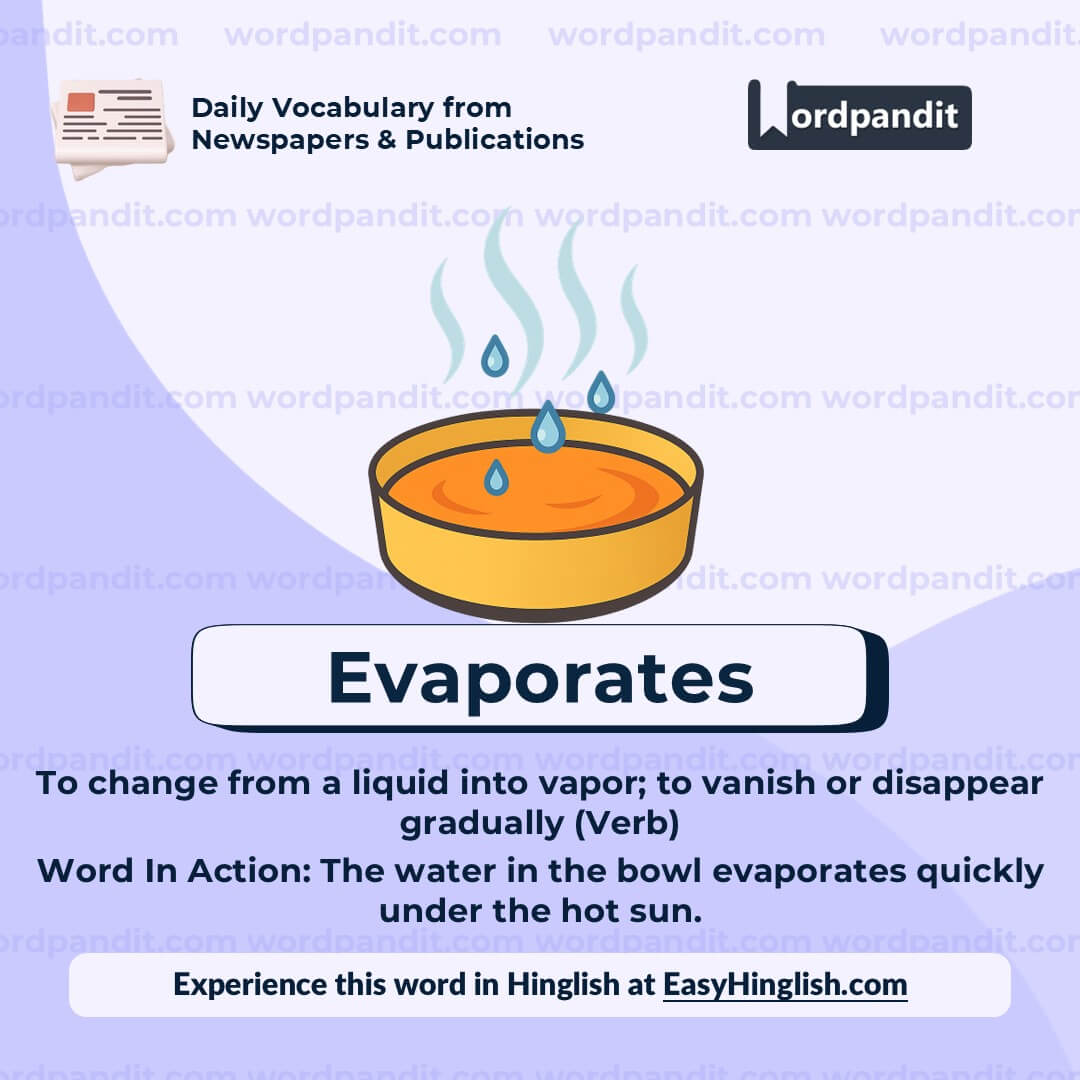
WORD-1: Evaporates
Context:
"Pumped to evaporation ponds, the brine evaporates to leave behind a mixture rich in lithium and other salts." - Scientific American
Explanatory Paragraph:
The word evaporates refers to the process in which a liquid slowly changes into vapor or gas, usually because of heat. For example, water left in the sun evaporates and disappears into the air. In scientific and industrial settings, evaporation is often used to separate substances by removing water or other solvents.
Meaning: To change from a liquid into vapor; to vanish or disappear gradually (Verb)
Pronunciation: ih-VAP-uh-rayts
Difficulty Level: ⭐⭐ Basic-Intermediate
Etymology: From Latin evaporare, meaning "to disperse as vapor," formed from e- (out) + vapor (steam, vapor).
Prashant Sir's Notes:
The word helps us understand natural processes and scientific phenomena. It can be used literally (water evaporates) and figuratively (hopes evaporate). Always connect it with the idea of something fading away.
Synonyms & Antonyms:
Synonyms: vaporizes, dissipates, vanishes, dries up, fades
Antonyms: condenses, solidifies, accumulates, persists
Usage Examples:
- The morning dew evaporates quickly once the sun rises.
- Her excitement evaporates whenever she faces criticism.
- The perfume evaporates if left uncovered for too long.
- In the desert, water evaporates faster due to intense heat.
Cultural Reference:
"Money, like water, evaporates if not carefully managed." - Common proverb adaptation
Think About It:
Why do you think "evaporates" is often used figuratively to describe emotions or opportunities, rather than just physical liquids?
Quick Activity:
Write two sentences using "evaporates" — one about a physical process and one about a feeling or situation.
Memory Tip:
Think of “evaporates” as “vanishes into air.” The word has "vapor" inside it, which reminds you of steam or mist disappearing.
Real-World Application:
In industries, evaporation is used to extract useful minerals like salt or lithium. In daily life, it explains why wet clothes dry when left outside.
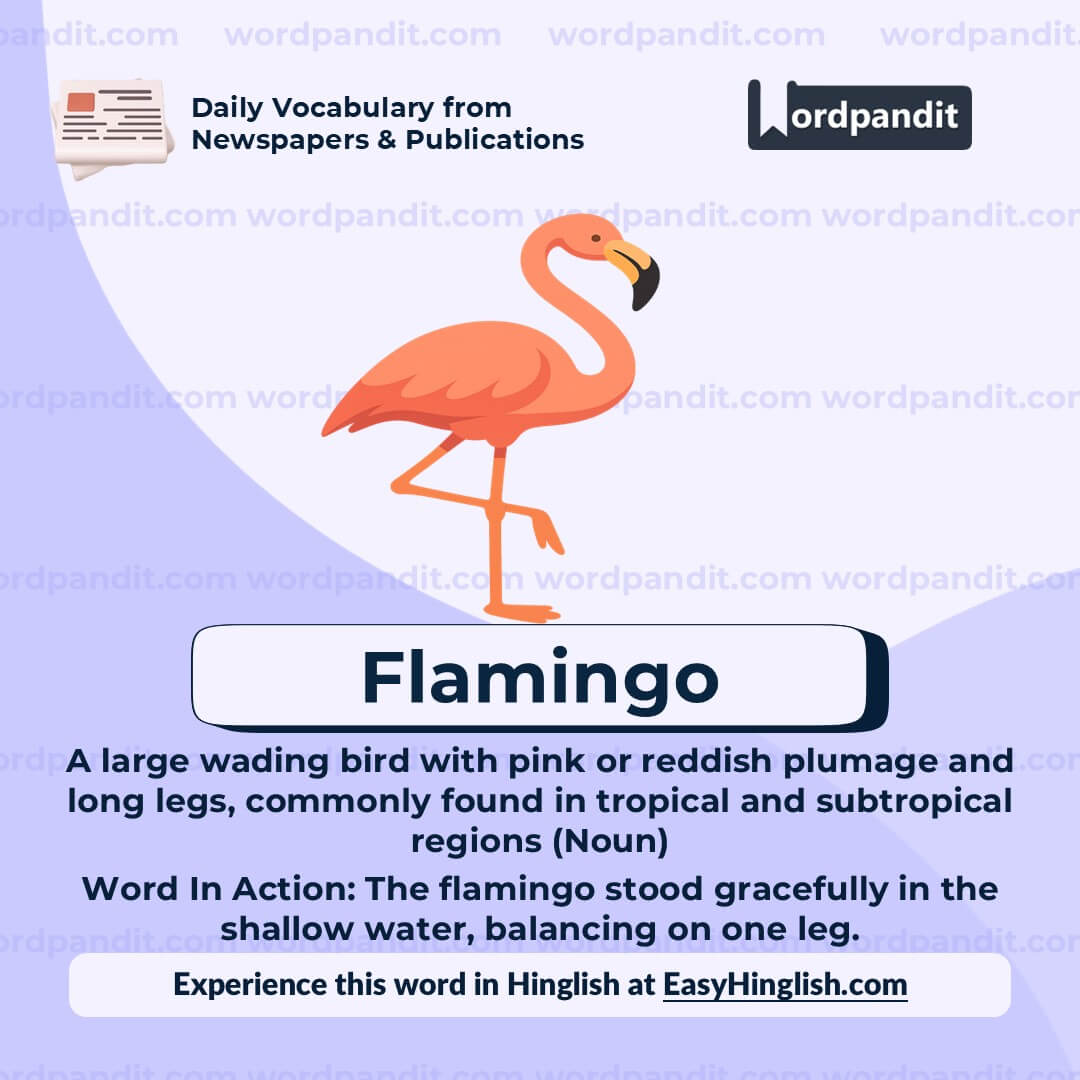
WORD-2: Flamingo
Context:
"Brine mining has the potential to exacerbate drought conditions for local communities and affect local wildlife: the Atacama mine puts water supplies for nearby Indigenous communities at risk and has contributed to dramatic declines in flamingo populations." - Scientific American
Explanatory Paragraph:
A flamingo is a tall wading bird known for its striking pink or reddish feathers, long legs, and curved beak. These birds are often found in large colonies near lagoons, lakes, or salt flats, where they feed on algae, shrimp, and other small organisms. Their pink color comes from the pigments in their diet. Flamingos are also a cultural symbol of elegance, balance, and tropical beauty.
Meaning: A large wading bird with pink or reddish plumage and long legs, commonly found in tropical and subtropical regions (Noun)
Pronunciation: fluh-MING-go
Difficulty Level: ⭐ Basic
Etymology: From Spanish flamenco (“flame-colored”), referring to the bird’s bright red or pink feathers; related to Latin flamma (“flame”).
Prashant Sir's Notes:
Think of the flamingo as a perfect example of how language, nature, and symbolism connect. It’s not just a bird — it’s also a metaphor for beauty, balance, and sometimes even extravagance in popular culture.
Synonyms & Antonyms:
Synonyms: wading bird, tropical bird, long-legged bird
Antonyms: (No direct antonyms, but contrasting birds could include flightless birds like penguins or ostriches)
Usage Examples:
- The flamingo stood gracefully in the shallow water, balancing on one leg.
- Flamingo populations are sensitive to changes in water levels and pollution.
- The hotel’s garden had a playful design with pink flamingo statues by the pool.
- She wore a dress the same vibrant shade as a flamingo’s feathers.
Cultural Reference:
Plastic pink flamingos became a symbol of American pop culture in the 1950s, often associated with kitsch and suburban lawn décor.
Think About It:
Why do you think the flamingo, more than many other birds, has become a cultural symbol of beauty and style worldwide?
Quick Activity:
Draw or visualize a flamingo and write three adjectives that describe its appearance or symbolism.
Memory Tip:
Remember: “Flamingo” comes from “flame” — its feathers look like flames, which makes it easy to connect to its bright pink color.
Real-World Application:
Flamingos are important indicators of environmental health in wetlands. Their decline often signals problems like droughts, habitat loss, or pollution, making them significant for ecological studies.
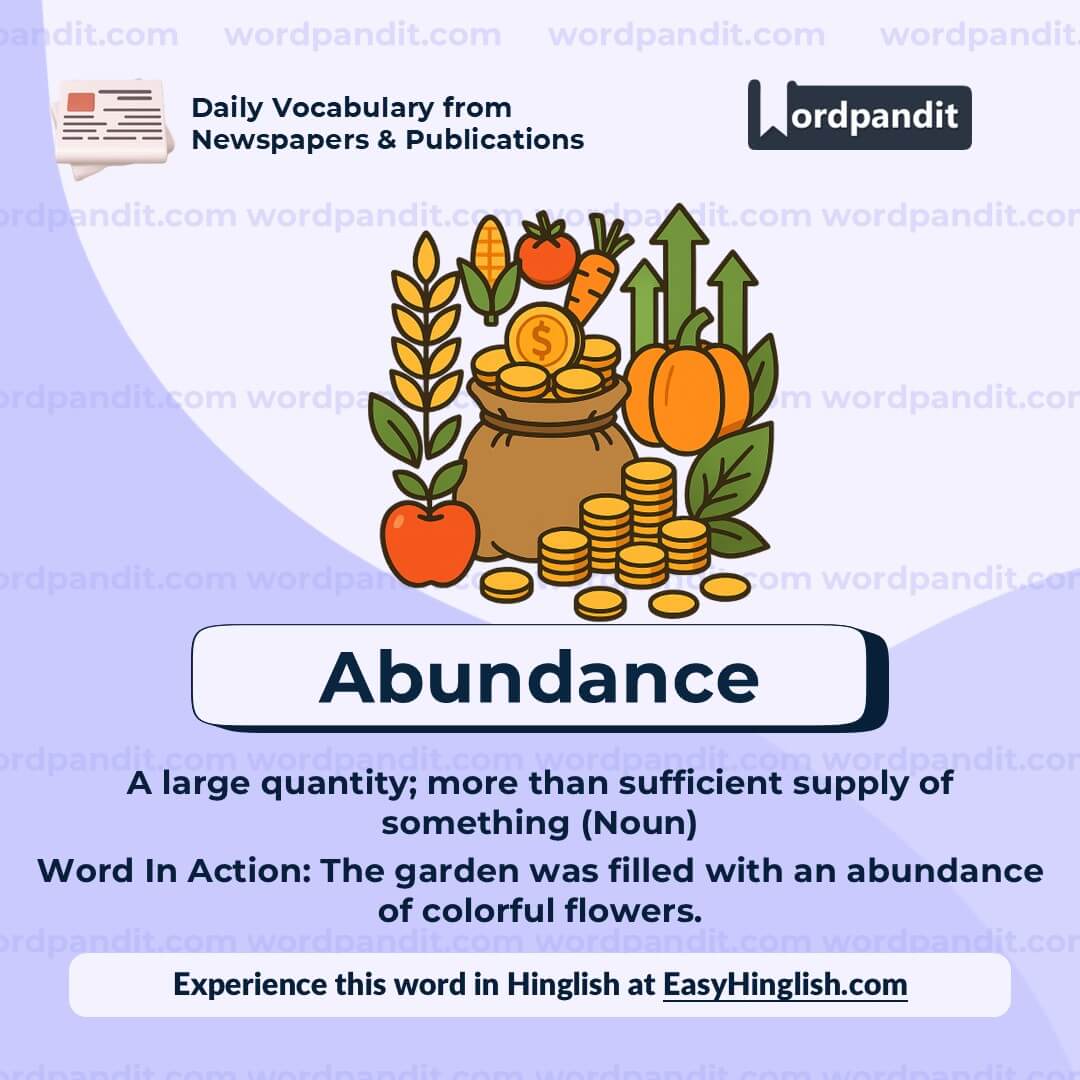
WORD-3: Abundance
Context:
"The ocean floor presents another promising alternative. There, an abundance of small rocks rich in minerals could be extracted for processing into critical minerals." - Scientific American
Explanatory Paragraph:
The word abundance refers to a very large quantity of something — more than enough. It conveys the idea of plenty, richness, or overflow. While it often describes natural resources, food, or opportunities, it can also apply to intangible things such as love, joy, or creativity.
Meaning: A large quantity; more than sufficient supply of something (Noun)
Pronunciation: uh-BUN-duns
Difficulty Level: ⭐⭐ Basic-Intermediate
Etymology: From Latin abundantia meaning "overflowing," derived from abundare ("to overflow").
Prashant Sir's Notes:
Abundance is about overflowing quantities, both literal and metaphorical. Always link it with the image of “more than enough” — whether it’s food, resources, or emotions.
Synonyms & Antonyms:
Synonyms: plenty, profusion, wealth, overflow, copiousness
Antonyms: scarcity, shortage, lack, deficiency, dearth
Usage Examples:
- The garden produced an abundance of fresh vegetables this year.
- She was admired for the abundance of kindness she showed to others.
- The festival featured an abundance of colors, music, and joy.
- The library provided an abundance of resources for research students.
Cultural Reference:
The "Cornucopia" or "Horn of Plenty" from Greek mythology is a classic symbol of abundance, representing endless nourishment and prosperity.
Think About It:
Do you think having an abundance of something always leads to happiness, or can too much sometimes create problems?
Quick Activity:
Write down three things in your life that you have in abundance — they can be tangible (like books) or intangible (like love, ideas).
Memory Tip:
Think of “abundance” as “a-bun-dance” — imagine so many buns that they’re dancing around you because there’s more than enough!
Real-World Application:
In economics and environmental studies, abundance highlights resource-rich areas and helps distinguish between places of plenty and those suffering from scarcity.
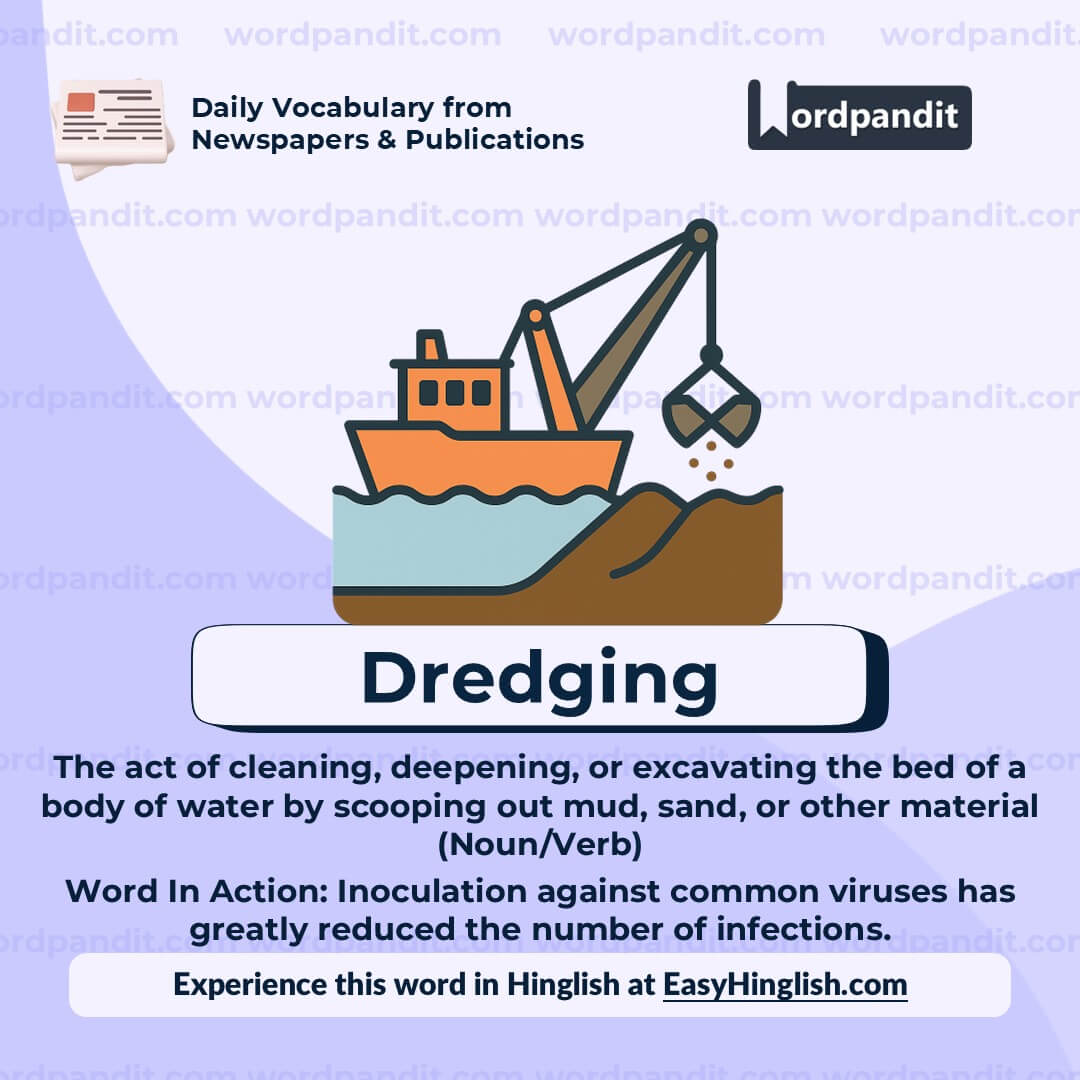
WORD-4: Dredging
Context:
"While traditional seabed mining relies on dredging, which can destroy the seabed, new innovative techniques that avoid these damages are being developed." - Scientific American
Explanatory Paragraph:
Dredging refers to the process of scooping, digging, or removing sediments, sand, or debris from the bottom of rivers, lakes, harbors, or seabeds. It is often done to deepen waterways, extract minerals, or maintain shipping routes. However, dredging can have harmful environmental effects, such as disturbing marine life and damaging seabeds.
Meaning: The act of cleaning, deepening, or excavating the bed of a body of water by scooping out mud, sand, or other material (Noun/Verb)
Pronunciation: DREJ-ing
Difficulty Level: ⭐⭐⭐ Intermediate
Etymology: From Middle Dutch dregghe (dragnet), linked to the idea of dragging material up from water beds.
Prashant Sir's Notes:
Think of dredging as “dragging out” material from underwater. It’s a useful image: pulling things up from beneath the surface — whether in rivers or in conversations (“dredging up old memories”).
Synonyms & Antonyms:
Synonyms: excavating, scooping, clearing, deepening
Antonyms: filling, depositing, covering
Usage Examples:
- The port required constant dredging to allow large ships to enter safely.
- The fisherman used a small dredge for catching shellfish on the seabed.
- The company faced criticism for dredging up toxic sediments from the river.
- She regretted dredging up painful memories from her childhood during the conversation.
Cultural Reference:
The phrase "dredging up old memories" is commonly used in literature and conversation to describe recalling unpleasant or forgotten events.
Think About It:
Why do you think the word “dredging” is used both for physical excavation and for bringing up old memories in conversations?
Quick Activity:
Create two sentences with "dredging": one describing a physical process (water/mining) and one describing a figurative use (memories/emotions).
Memory Tip:
Remember: “Dredging” sounds like “dragging.” Think of dragging things up from under the water or dragging up old stories from the past.
Real-World Application:
Dredging is vital for shipping, port maintenance, and resource extraction, but it is also a major environmental concern because it can harm marine ecosystems and release buried pollutants.
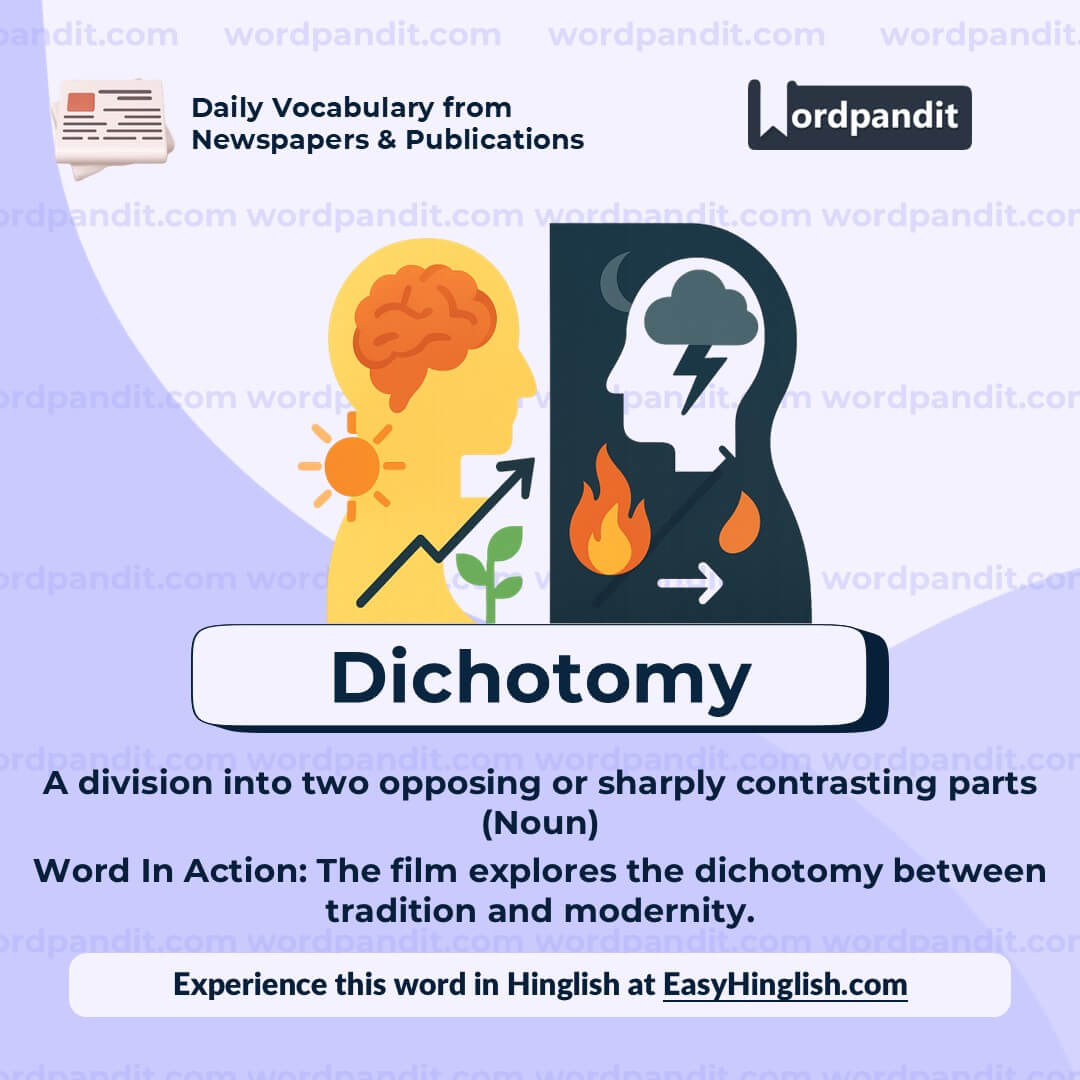
WORD-5: Dichotomy
Context:
"But the apparent trade-off between either sticking with gasoline vehicles or damaging the environment through unsustainable mining practices is a false dichotomy." - Scientific American
Explanatory Paragraph:
A dichotomy is a clear division or contrast between two things that are presented as completely opposite or mutually exclusive. It is often used in discussions where people reduce complex issues to an either/or choice, even though reality may be more nuanced. For example, saying "you’re either with us or against us" presents a false dichotomy, because in reality, multiple positions can exist between those extremes.
Meaning: A division into two opposing or sharply contrasting parts (Noun)
Pronunciation: dye-KOT-uh-mee
Difficulty Level: ⭐⭐⭐⭐ Advanced
Etymology: From Greek dichotomia, meaning "cutting in two," formed from dicha (in two, apart) + temnein (to cut).
Prashant Sir's Notes:
Always remember: dichotomy is about splitting the world into two halves. In exams, it is often used to discuss false choices, contrasts, or philosophical debates. Link it to "division into two."
Synonyms & Antonyms:
Synonyms: division, split, contrast, polarity, dualism
Antonyms: unity, harmony, integration, wholeness
Usage Examples:
- The novel explores the dichotomy between tradition and modernity.
- It is a false dichotomy to suggest that science and religion cannot coexist.
- The artist highlighted the dichotomy of light and shadow in his paintings.
- Politics often reduces complex issues into simple dichotomies of left versus right.
Cultural Reference:
Philosophers often discuss the dichotomy between good and evil, a theme that appears in countless myths, religions, and literary works worldwide.
Think About It:
Why do you think people often frame debates in terms of dichotomies, even when reality is more complex?
Quick Activity:
List two examples of dichotomies you have come across in daily life (e.g., success vs. failure, work vs. leisure). Then reflect: are these true dichotomies or false ones?
Memory Tip:
Break the word into "di-" (two) + "chotomy" (cut). Dichotomy = cut into two parts.
Real-World Application:
In debates, media, and politics, recognizing a false dichotomy helps avoid oversimplification and encourages more nuanced thinking.


