

Daily Vocabulary from International Newspapers and Publications
Expand Your Vocabulary with Wordpandit’s Global Vocabulary Hub
At Wordpandit, we are committed to helping you develop a truly global vocabulary by drawing from some of the most respected international publications. This section is designed to keep you ahead of the curve by introducing you to words that define global conversations and trends.
The Power of Global Sources
To help you think and communicate on a global scale, we curate vocabulary from renowned international sources, such as:
- The New York Times
- The Washington Post
- BBC
- The Guardian
- The Economist
- Scientific American
- Psychology Today
- And many more...
Stay Global, Stay Competitive
Our daily updates from international publications ensure you are consistently exposed to new words that reflect global news and developments, making sure your vocabulary is not only current but also globally relevant.
Enhance Your Global Perspective
Whether you’re preparing for international exams, aiming to excel in global business communication, or want to enhance your language skills for personal growth, Wordpandit offers the resources you need to thrive in a global context.
Effective Learning, Global Reach
Our learning methodology combines global examples, memory aids, and interactive activities, allowing you to internalize new words effectively and apply them in real-world scenarios.
Begin Your Global Vocabulary Journey Now!

Why Choose Wordpandit?
Practical Learning: Focus on words you'll actually encounter in real-world reading, enhancing your comprehension and communication skills.
Diverse Content: From current affairs to scientific breakthroughs, our varied sources expose you to vocabulary across multiple domains.
Effortless Integration: Make Wordpandit a part of your daily routine. Just a few minutes each day can significantly boost your lexicon over time.
Your Path to Vocabulary Mastery
- Visit our Daily Vocabulary section regularly
- Explore new words and their usage in context
- Practice incorporating these words into your own writing and speech
- Track your progress as your vocabulary expands
Start Your Journey Today
Embark on your vocabulary enhancement journey with Wordpandit. By consistently engaging with our daily posts, you'll build a robust vocabulary that serves you well in academic, professional, and personal contexts.
Remember, a word a day keeps linguistic limitations at bay. Make Wordpandit your daily companion in the quest for vocabulary excellence!
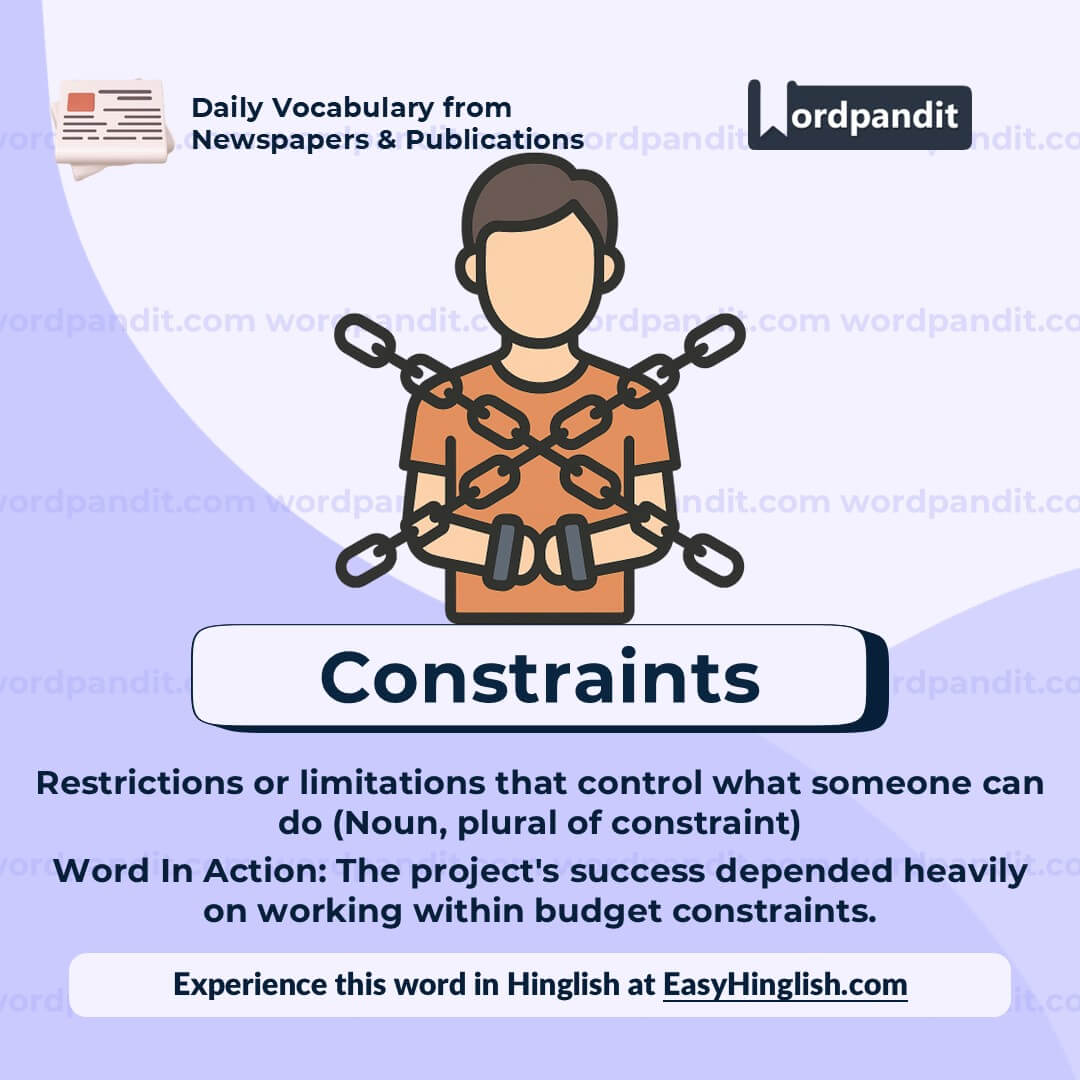
WORD-1: Constraints
Context:
"Once those informal, unwritten constraints are off, there is little that will stand in his way." - Guardian
Explanatory Paragraph:
The word constraints refers to the limits, restrictions, or controls that prevent someone from acting freely or fully. Constraints can be external, like laws, rules, or social expectations, or internal, like personal limitations. In simple terms, constraints are the boundaries that hold back actions or choices.
Meaning: Restrictions or limitations that control what someone can do (Noun, plural of constraint)
Pronunciation: kun-STRAYNTS
Difficulty Level: ⭐⭐ (Basic-Intermediate)
Etymology: From Old French constraindre meaning “to force, compel,” derived from Latin constringere meaning “to bind tightly.”
Prashant Sir's Notes:
Think of "constraints" as anything that restricts movement or freedom. They can be physical (like chains), mental (like fears), or social (like rules). Understanding contexts where constraints are lifted often signals freedom or danger depending on who is being unconstrained.
Synonyms & Antonyms:
Synonyms: restrictions, limitations, boundaries, controls, checks
Antonyms: freedom, liberty, openness, allowance, permission
Usage Examples:
- The project faced severe budgetary constraints, forcing the team to cut back on features.
- Social constraints often dictate how people behave in public.
- Without time constraints, the artist could work freely and explore new styles.
- Legal constraints ensure that companies do not exploit their workers.
Cultural Reference:
"Art lives from constraints and dies from freedom." – Leonardo da Vinci
Think About It:
Are constraints always negative, or can they sometimes encourage creativity and innovation?
Quick Activity:
Write down three constraints you face in daily life and think of one positive outcome each has produced for you.
Memory Tip:
Think of "con-STRAIN-ts" as things that "strain" or tighten your freedom, holding you back.
Real-World Application:
In business, constraints such as budget, time, or regulations shape decision-making. In personal life, constraints like social norms or family responsibilities guide behavior. Understanding them helps people plan realistically and act wisely.
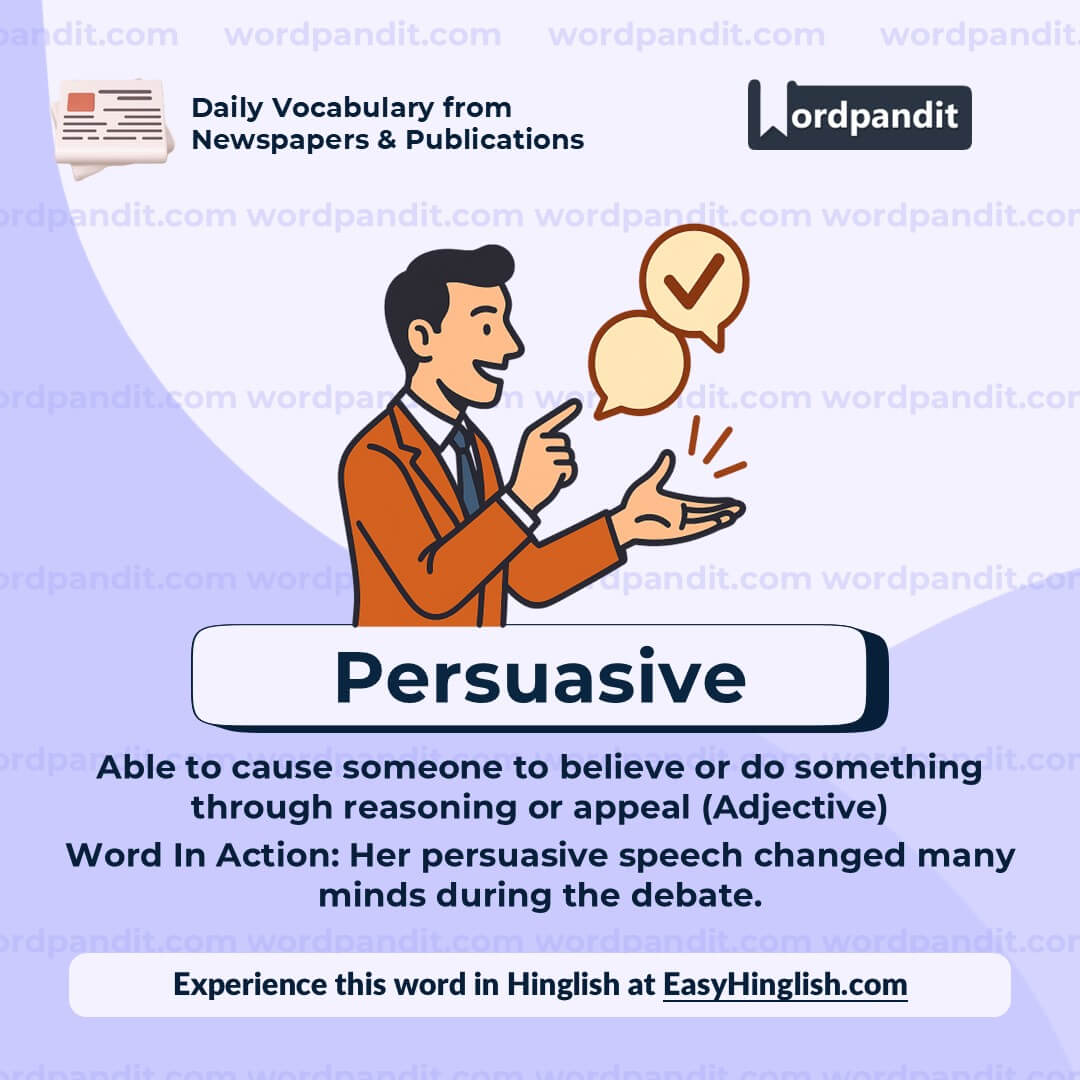
WORD-2: Persuasive
Context:
"She makes the persuasive case that even if he does not formally withdraw from the alliance, Trump can render it defunct simply by shaking confidence in its central commitment: that each member come to the defence of any other if attacked." - Guardian
Explanatory Paragraph:
The word persuasive describes something or someone that has the power to convince others. A persuasive argument, speech, or person is effective at influencing beliefs, attitudes, or actions. Being persuasive usually involves strong reasoning, emotional appeal, and clarity in communication.
Meaning: Able to cause someone to believe or do something through reasoning or appeal (Adjective)
Pronunciation: per-SWAY-siv
Difficulty Level: ⭐⭐ (Basic-Intermediate)
Etymology: From Latin persuadere, meaning “to convince, to advise,” formed from per- (“thoroughly”) + suadere (“to urge, recommend”).
Prashant Sir's Notes:
Persuasive is not just about winning arguments; it’s about influencing effectively. Think of it as the quality of speech, writing, or action that makes others adopt your viewpoint. It's a skill often seen in leaders, lawyers, marketers, and teachers.
Synonyms & Antonyms:
Synonyms: convincing, compelling, influential, effective, forceful
Antonyms: unconvincing, ineffective, weak, unpersuasive
Usage Examples:
- The lawyer delivered a persuasive closing statement that swayed the jury.
- Her persuasive smile and friendly tone won the audience over.
- He wrote a persuasive essay arguing for environmental protection.
- Advertisements often rely on persuasive language to influence buyers.
Cultural Reference:
"The most persuasive speeches are not those that rely on force, but those that stir the heart and mind together." – Adapted from classical rhetoric principles
Think About It:
Is being persuasive always a positive quality, or can it sometimes be manipulative?
Quick Activity:
Pick a simple topic (e.g., "Why people should exercise regularly") and write two sentences using persuasive reasoning to convince a friend.
Memory Tip:
Think of "persuasive" as “per-SWAY-sive”—something that sways or moves others to agree with you.
Real-World Application:
Persuasive communication is vital in politics, business, law, and everyday life. From convincing a client to buy a product to negotiating with a team, being persuasive often determines success.
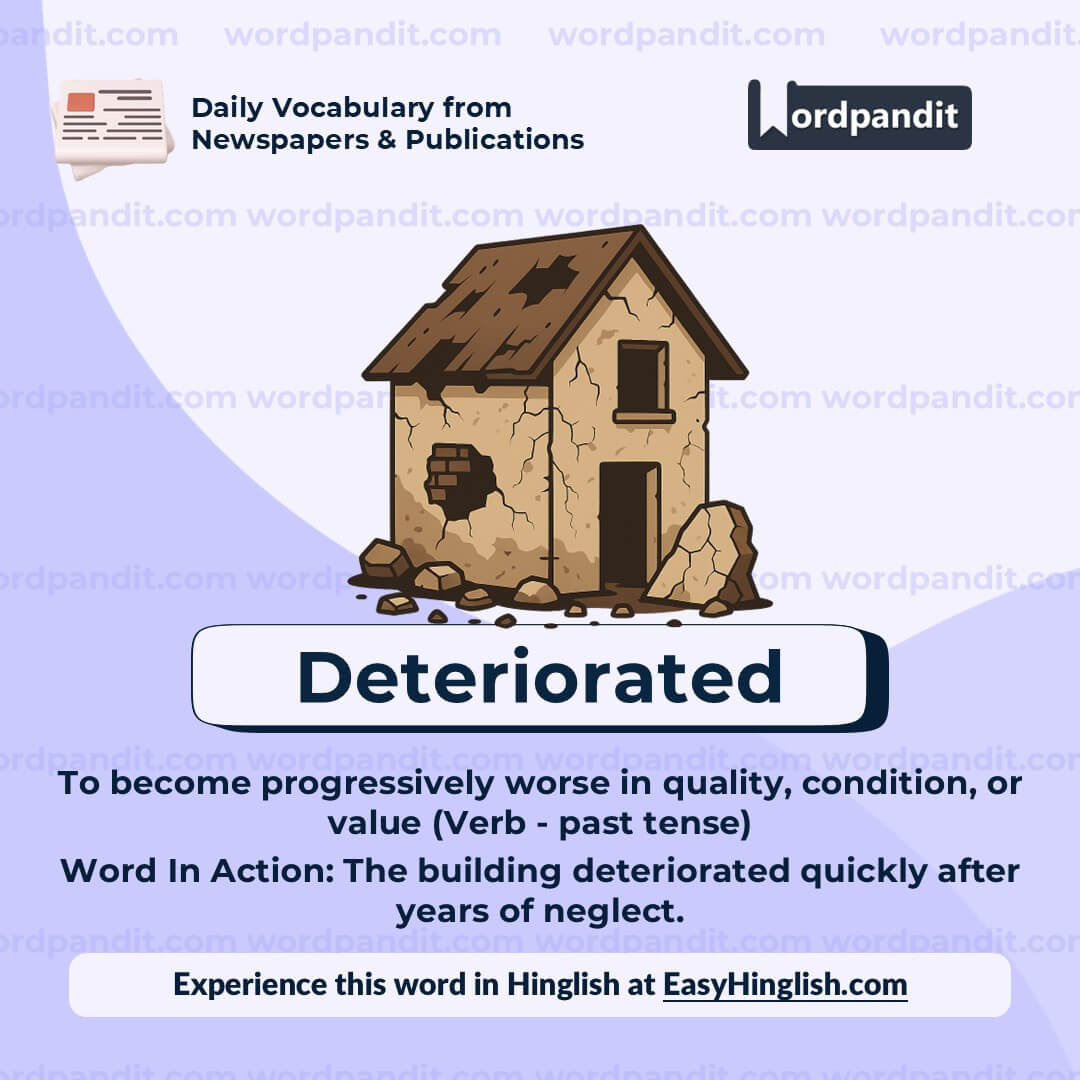
WORD-3: Deteriorated
Context:
"He was also one of the architects of the rapprochement between Hamas on the one hand, and Iran, Hezbollah and Syria on the other, after ties had deteriorated in the wake of the Syrian war." - Guardian
Explanatory Paragraph:
The word deteriorated means that something has become worse in condition, quality, or value over time. It describes a process of decline, whether in health, relationships, structures, or situations. When something deteriorates, it gradually breaks down or loses its original strength or goodness.
Meaning: To become progressively worse in quality, condition, or value (Verb - past tense)
Pronunciation: dih-TEER-ee-uh-ray-tid
Difficulty Level: ⭐⭐ (Basic-Intermediate)
Etymology: From Latin deterior meaning “worse,” combined with the suffix -ate to form the verb “to make worse.”
Prashant Sir's Notes:
Think of "deteriorated" as the opposite of "improved." It signals decline, decay, or weakening. This word is common in news and formal writing—political ties, relationships, health, or even buildings can all deteriorate over time.
Synonyms & Antonyms:
Synonyms: declined, worsened, decayed, degenerated, weakened
Antonyms: improved, strengthened, enhanced, recovered, restored
Usage Examples:
- Her health deteriorated rapidly after the illness spread.
- The relationship deteriorated due to constant misunderstandings.
- The old building deteriorated after years of neglect.
- Diplomatic ties deteriorated following the controversial decision.
Cultural Reference:
"Civilizations are not murdered—they often deteriorate from within." – A common theme in historical analysis of empires.
Think About It:
Why do you think some relationships or systems naturally deteriorate over time, while others improve and grow stronger?
Quick Activity:
Write two sentences: one showing how something can deteriorate physically (like a building) and one showing how it can deteriorate emotionally (like trust).
Memory Tip:
Break it down: “de-” (down) + “terior” (related to worse) → to go down into a worse state.
Real-World Application:
The word "deteriorated" is often used in health reports, political commentary, and environmental discussions. For example, news reports might say a patient’s condition has deteriorated or that peace talks have deteriorated due to conflict.
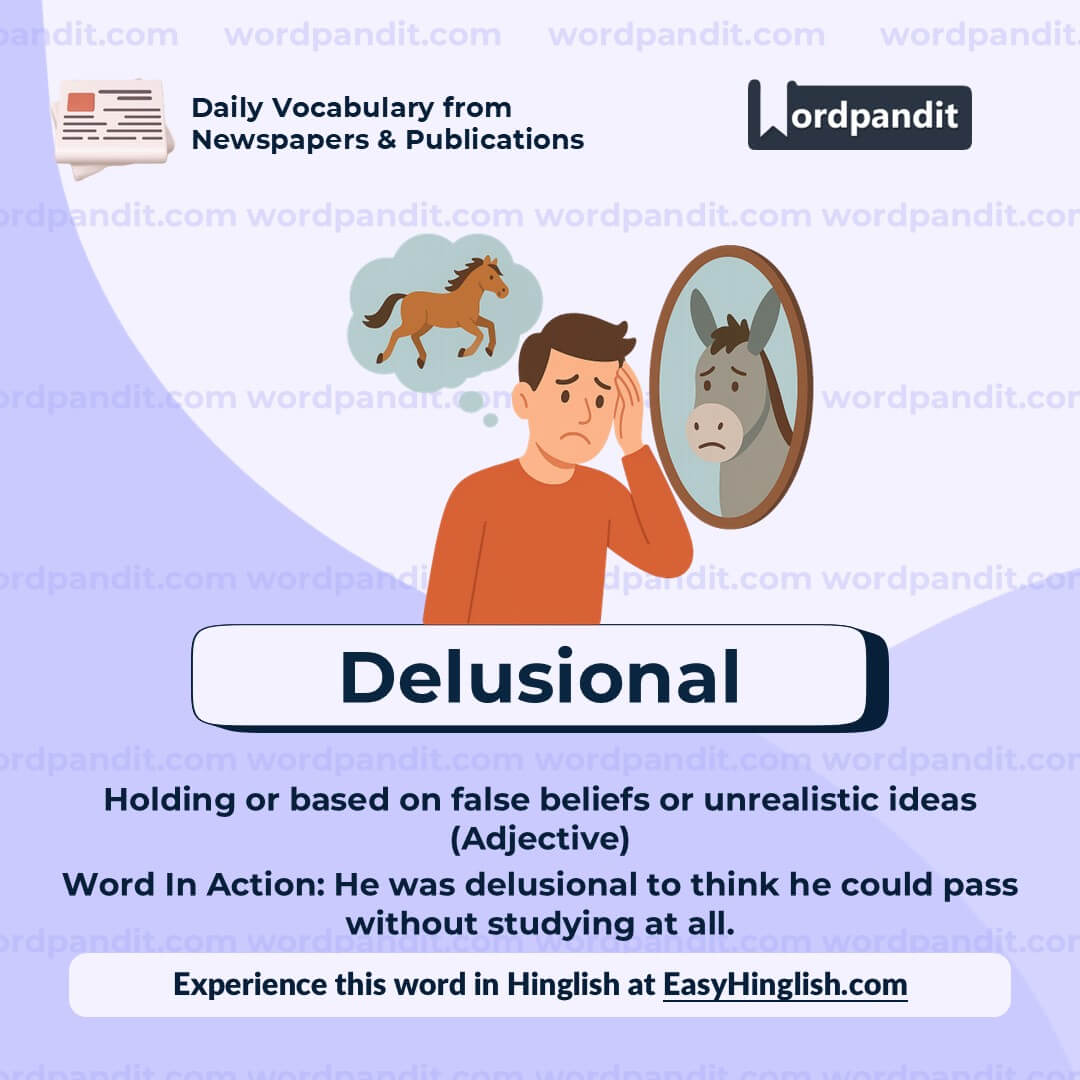
WORD-4: Delusional
Context:
"The go-it-alone fantasies of the Brexit era were always delusional." - Guardian
Explanatory Paragraph:
The word delusional describes a state of believing things that are not true or realistic. It can refer to extreme cases in psychology, where someone holds firm false beliefs despite evidence, but it is also often used more casually to describe ideas, plans, or expectations that are overly unrealistic or disconnected from reality.
Meaning: Holding or based on false beliefs or unrealistic ideas (Adjective)
Pronunciation: dih-LOO-zhuh-nul
Difficulty Level: ⭐⭐ (Basic-Intermediate)
Etymology: From Latin deludere meaning “to deceive,” which gave rise to “delusion” in English, with the suffix -al forming the adjective.
Prashant Sir's Notes:
Use “delusional” carefully—it is powerful. It suggests someone is not simply mistaken but is disconnected from reality. In politics, economics, or personal ambition, labeling something as “delusional” highlights its dangerous impracticality.
Synonyms & Antonyms:
Synonyms: unrealistic, fanciful, irrational, misguided, false
Antonyms: realistic, rational, sensible, practical, logical
Usage Examples:
- He was delusional in thinking he could finish the marathon without any training.
- The business plan seemed delusional, relying on impossible growth rates.
- Calling himself a genius without evidence was simply delusional.
- Her delusional optimism blinded her to the real dangers ahead.
Cultural Reference:
In literature and film, characters who are delusional often drive tragedy—like Don Quixote, who famously mistook windmills for giants in his quest for glory.
Think About It:
Where is the line between being ambitious and being delusional? At what point does optimism become unrealistic?
Quick Activity:
Write down one dream or plan you have. Then, list one reason it is realistic and one reason it might be considered delusional.
Memory Tip:
Link “delusional” with “illusion”—both involve false beliefs or things that aren’t real.
Real-World Application:
People often call political promises, business schemes, or overconfident personal goals delusional when they are detached from practical reality. The word is used to highlight the danger of acting on false beliefs.
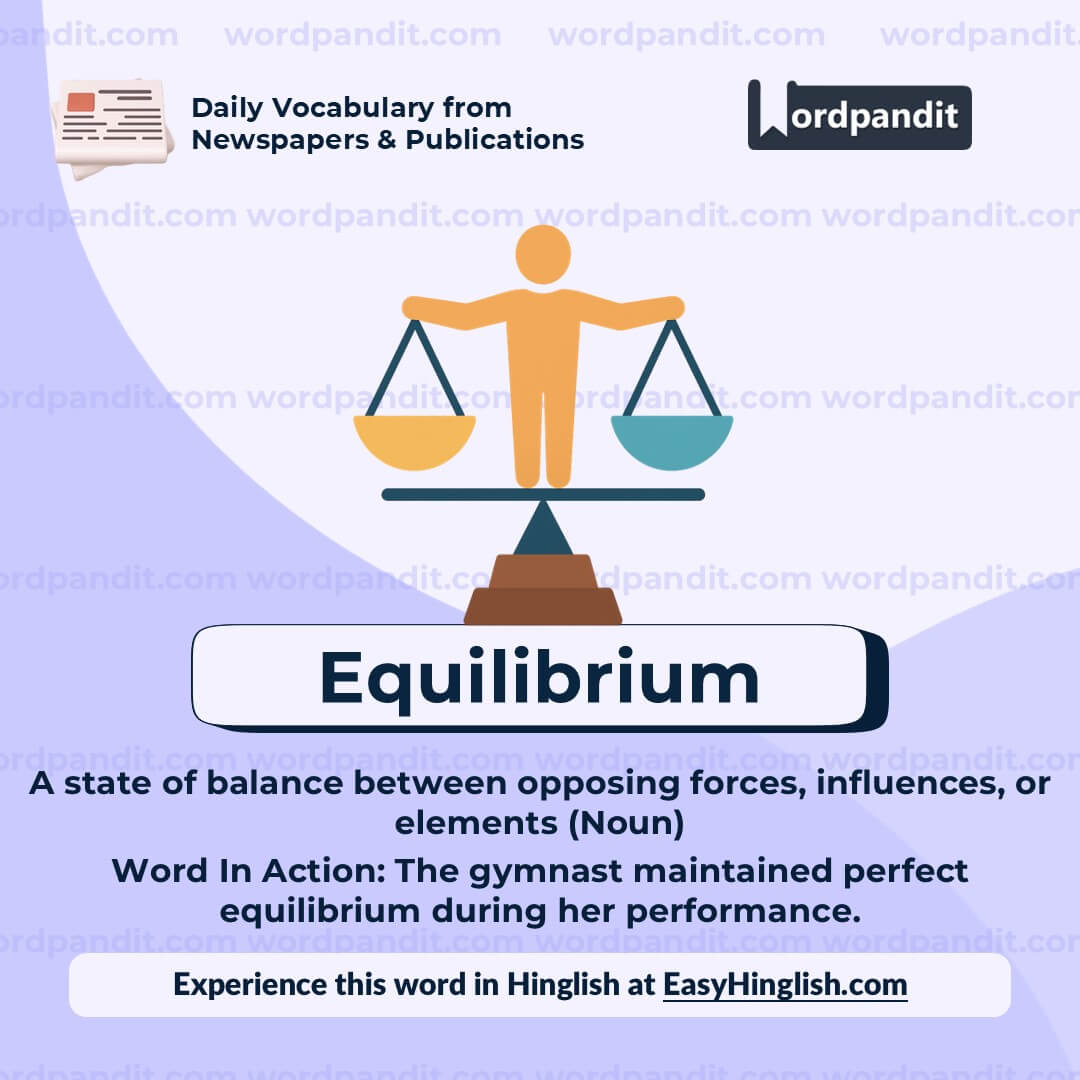
WORD-5: Equilibrium
Context:
"In its eyes, a clear response will be the only way to restore equilibrium." - Guardian
Explanatory Paragraph:
The word equilibrium refers to a state of balance or stability, where opposing forces or influences are equal. It can describe physical balance, like a tightrope walker’s stability, or metaphorical balance, such as peace in society, mental calmness, or economic stability. When equilibrium is disturbed, systems become unstable until balance is restored.
Meaning: A state of balance between opposing forces, influences, or elements (Noun)
Pronunciation: ee-kwuh-LIB-ree-um or ek-wuh-LIB-ree-um
Difficulty Level: ⭐⭐⭐ (Intermediate)
Etymology: From Latin aequus (“equal”) + libra (“balance, scale”), literally meaning “equal balance.”
Prashant Sir's Notes:
Think of “equilibrium” as the point of calm or balance after conflict, change, or disturbance. It’s a scientific term used in physics and chemistry but equally powerful in social, emotional, and political contexts.
Synonyms & Antonyms:
Synonyms: balance, stability, harmony, steadiness, poise
Antonyms: imbalance, instability, disorder, chaos, disequilibrium
Usage Examples:
- The new trade agreement restored economic equilibrium between the two nations.
- Yoga helps maintain both physical and mental equilibrium.
- The seesaw reached equilibrium when both children were of equal weight.
- After the argument, the family worked to regain emotional equilibrium.
Cultural Reference:
In ancient Greek philosophy, the idea of living a balanced life was central—Aristotle’s “Golden Mean” is essentially about achieving equilibrium between extremes.
Think About It:
Do you think true equilibrium—in society, emotions, or the world—can ever be permanent, or is balance always temporary?
Quick Activity:
Think of a recent conflict in your life. Write one sentence describing how equilibrium was restored—or how it could be restored.
Memory Tip:
Break it down: “Equi-” means equal, and “-librium” relates to balance (like a libra scale). Together, they mean “equal balance.”
Real-World Application:
“Equilibrium” is a key concept in science (chemical equilibrium, physical balance), economics (market equilibrium), and personal growth (emotional balance). It is widely used to describe situations where stability is achieved after forces compete or conflict.


